

UFC DFS Captain Mode: A Complete Strategy Guide for UFC Freedom 250
The UFC is gearing up for its Freedom 250 event on Sunday, June 14, which is set to take place on the White House front lawn. With an event of that magnitude taking place in front of a sitting U.S. President, there are bound to be security and logistics nightmares, so the company has reduced the card to just seven fights, down from the typical 10-14 range.
What does this mean for DFS on DraftKings? Well, with fewer fights to pick from, if we stuck to the traditional format, there would be too many duplicate entries. That top prize of $100,000 would be split between hundreds, likely thousands of lineups -- even more if the outcomes are chalky. So, DraftKings had to alter its game and instead switch to Captain Mode (often called Showdown) to add that extra layer of differentiation.
Skip the strategy breakdown and get straight to making lineups with our DraftKings UFC Lineup Optimizer. It's free to make one lineup, but subscribers unlock added customizations and the ability to mass-generate lineups. Use promo code ROTO15 at checkout for 15% off your DFS subscription purchase.
What is Captain Mode in UFC DFS?
For those familiar, Captain Mode is similar to Showdown slates in other sports. In a Showdown, there's only one game to pick from (popular during the Super Bowl), so DFS sites must employ an added layer of differentiation to lineups. Hence, the "Captain" (aka "MVP") spot is born. It's the most pivotal decision you'll have to make when constructing any DFS lineups in these contests.
Your captain scores you 1.5x the number of points, but also costs you 1.5x the salary. If you want the biggest favorite, or highest-projected player, you'll have to pay up considerably, which can often cripple the rest of your lineup. In the case of MMA, you'll be forced into some uncomfortable underdogs.
Understanding DraftKings UFC Showdown Scoring
How categories are scored in UFC DFS is actually the same as regular MMA contests. The difference, however, comes down to the 1.5 point captain multiplier, which applies to all of the categories in the Fantasy Points column.
| Moves | Fantasy Points |
|---|---|
| Strikes | +0.2 Pts |
| Significant Strikes | +0.2 Pts |
| Control Time | +0.03 Pts/Second |
| Takedown | +5 Pts |
| Reversal/Sweep | +5 Pts |
| Knockdown | +10 Pts |
| Fight Conclusion Bonuses | Fantasy Points |
|---|---|
| 1st Round Win | +90 Pts |
| 2nd Round Win | +70 Pts |
| 3rd Round Win | +45 Pts |
| 4th Round Win | +40 Pts |
| 5th Round Win | +40 Pts |
| Decision Win | +30 Pts |
Quick Win Bonus (First round win in 60 seconds or less) | +25 Pts |
Finish Bonuses and Why They Decide Slates
Make note of the quick-win bonus above. If a fighter gets a fast stoppage, they're looking at 115 points (172.5 for captain) at a minimum (90 +25), as there will usually be at least a few more points for strikes, a takedown or a knockdown. GPP winners likely will have selected an underdog who gets a win in the first minute -- this doesn't always happen, but it's your ticket to the front of the field. More on this below.
How to Pick Your Captain in UFC DFS
When picking a captain for your lineup, one must consider the following factors:
- What are the odds of a quick finish?
- Is the fighter known as a high-volume striker or grappler?
- Is the fight scheduled for three or five rounds?
For the first, head to the RotoWire UFC betting odds page, where you'll get fully up to date UFC props from seven noteworthy, legal sportsbooks.
Below, I'll highlight a key part of that odds table that helps identify the finishers. This table is sorted by FDGTD (fight doesn't go the distance) odds, and also shows you a fighter's chances of a Round 1 victory, giving you a better chance of that elusive quick-win bonus. Odds are up to date as of Tuesday evening.
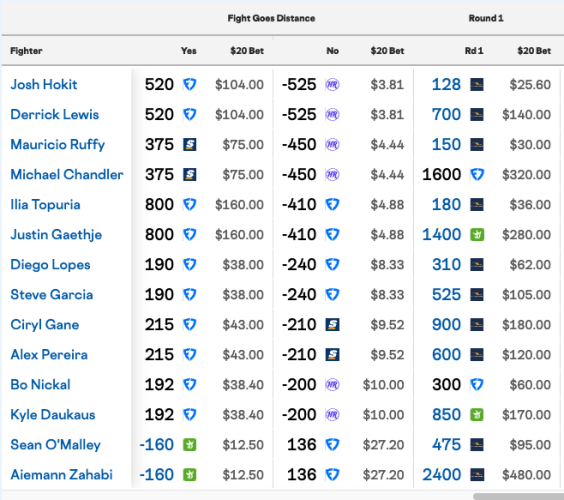
As you can see, fighters like Hokit, Topuria and Ruffy have both a) fights likely to end in a finish and b) good chances individually of a first-round stoppage. That explains why they are priced at such a premium.
Reading Fighter Styles for Fantasy Upside
Some fighters are more aggressive than others, and fortunately, we can measure aggressiveness numerically using stats from previous UFC bouts, looking specifically for those with higher-volume numbers.
Striking and grappling stats can be found on the official UFC website. Just search a fighter + UFC stats (i.e. Ilia Topuria UFC stats) and select the top result. We usually want to look for strikers averaging over five significant strikes landed per minute or greater. For this card, Josh Hokit (9.25) leads the way, but it's a small sample size of fights. Fighters like Justin Gaethje (6.48) and Steve Garcia (5.39) have done so over a more significant sample against stronger UFC fighters.
For grappling, you want to look for a high takedown volume. That's a bit tougher on this card, as volume king Merab Dvalishvili (5.97 takedowns per 15 minutes) won't be making the walk Sunday. Instead, the closest thing we have is Bo Nickal (3.10), who scores primarily from takedowns and control time. Mix that with being a heavy favorite, and it explains why he's the fifth most expensive fighter on the card.
Of course, having extra rounds to extrapolate higher volume helps. Only title fights (and main events) are scheduled for five rounds, so in this case, just the main and co-main events have the potential of bonus time (or "championship rounds"). Effectively, Ilia Topuria, Ciryl Gane, Alex Pereira (and to a lesser extent, Justin Gaethje) all get a slight projections boost due to the potential to go five rounds.
UFC Freedom 250 Captain Picks
With the above strategy in mind, here are some of my preferred captain candidates for Sunday.
Chalk Pick: Ilia Topuria ($14,400)
Topuria is the second-highest priced fighter on the card and second most expensive, as the undefeated two-division champion has torn through UFC competition with ease -- including legends like Charles Oliveira, Max Holloway and Alexander Volkanovski. He can win with both volume striking (4.81 significant strikes per minute) and volume grappling (1.96 takedowns per 15), giving him plenty of ways to score.
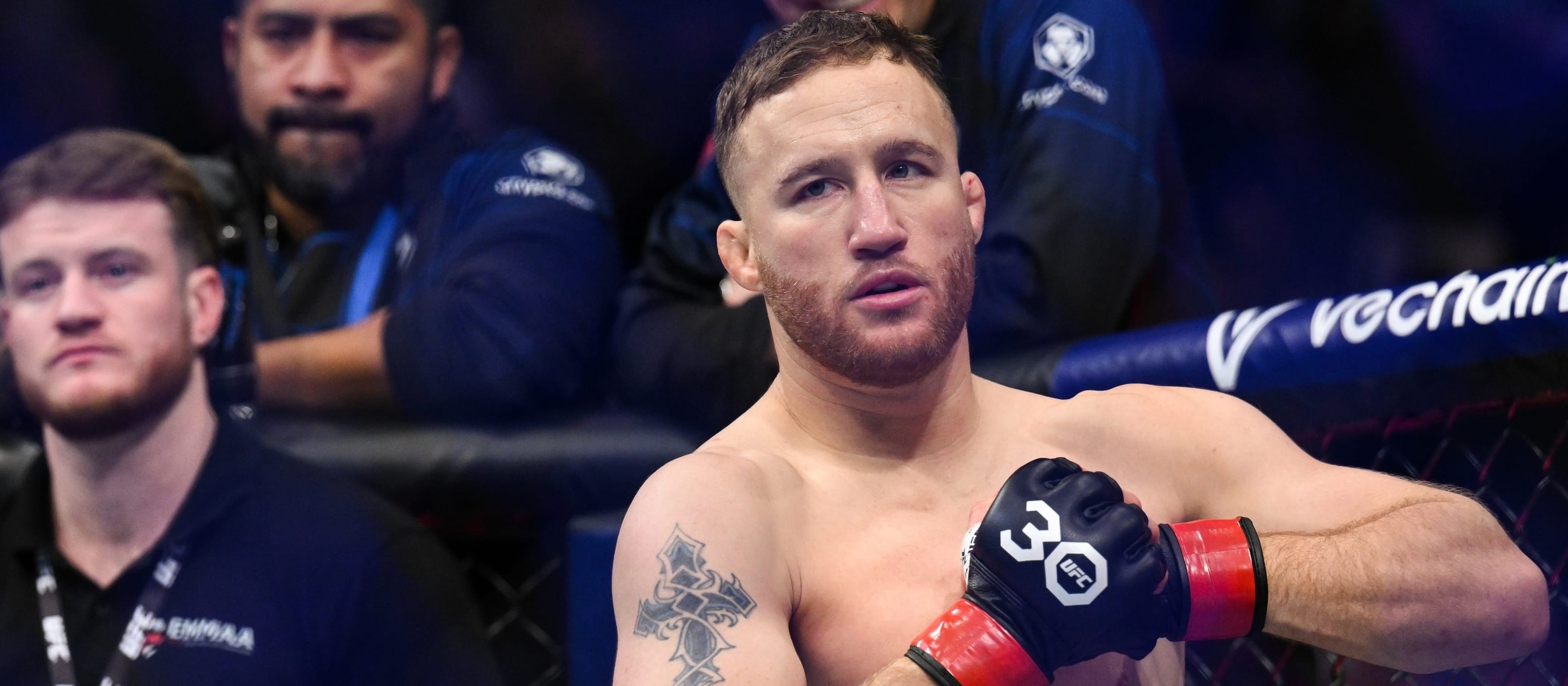
He now faces Gaethje in his first title defense at lightweight and has a (-175) KO/TKO prop -- a number rarely seen. This is because Gaethje throws caution to the wind, and is willing to get hit in order to find his own offense. While fan-friendly, that strategy simply doesn't play against the highest caliber of UFC fighters. Look for Gaethje to expose himself early, and for Topuria to take full advantage.
Gaethje's history of exciting fights has made him a fan favorite, so plenty of DFS players will see the low price tag and try to work him into lineups. In this fight, eating the chalk might be the actual leverage play.
Underdog: Derrick Lewis ($9,000)
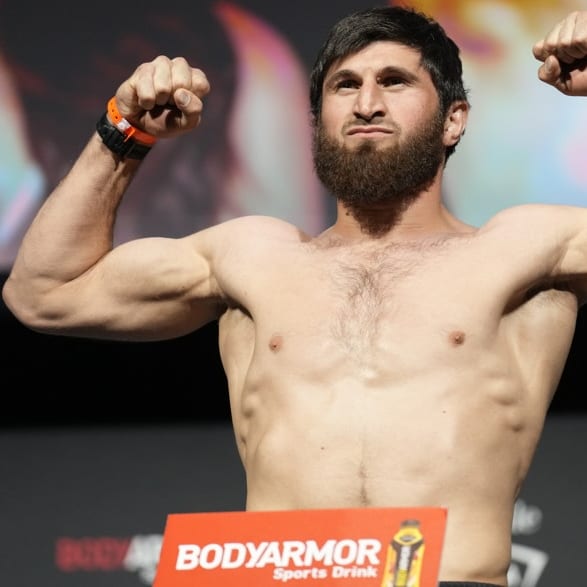
Lewis is a fan-favorite and happens to be the favorite fighter of President Donald Trump. That counts for something, right? Unfortunately, Lewis is 41 years old, didn't look great his last time out. He now faces an undefeated, 28-year-old up-and-comer in Josh Hokit. Hokit carries the fourth-highest salary and fourth-best odds to win, with good reason.
However, Hokit took a potentially life-altering beating against Curtis Blaydes just over two months ago, absorbing 174 significant strikes in the process. His chin held up there, but this is an awfully quick turnaround against a fighter with more knockout power, albeit an aging one. Lewis can catch anyone on the right night, and he carries more power than Blaydes. He can be prone to folding when the going gets tough, but I bet he'll want to put on an epic show on this stage.
The only downside with Lewis is that his name-recognition will lead to less leverage on the field than an underdog of this caliber would otherwise get. That means more duplicates if he does pull the massive upset. But I believe he has as good of a chance as any of the other big underdogs.
My Pick: Alex Pereira ($11,100)
Pereira is moving up to heavyweight for the first time and is set to face a stand-up specialist in Ciryl Gane. Because of the unknown, as well as the fact Gane looked so good last time out against Tom Aspinall, the odds here are relatively even. I believe we can exploit this.
If we went by walking-around weight, Pereira would already be a heavyweight. He has always cut a tremendous amount of weight to make middleweight and light heavyweight. While he bulked up a bit for heavyweight, this will be the first time he's not depleting himself to make weight. It should have notable effects on both his chin and cardio.
Pereira also measures up nearly equally in height and reach despite moving up. Gane might be a tad more technical, but I have Pereira with the speed advantage. Gane could try to grapple, but Pereira's takedown defense has typically held up when it had to.
Gane has also had trouble winning the "big" fight. He lost to all-time greats Jon Jones and Francis Ngannou, and Alexander Volkov took him to a decision twice, the most recent of which Gane was incredibly fortunate to win. Some might call it a robbery.
All of that considered, I'll take Pereira to get the win, and the finish, especially given the price break.
How to Build a UFC DFS Showdown Lineup
Now that you have a captain, what's next?
We have plenty of resources on RotoWire, starting with our UFC DFS Lineup Optimizer. If you've already picked your captain, you can lock them in the captain spot via the Customizations tab (or increase their exposure by liking/editing their projection). Our default projections aren't typically taking big swings at underdogs, so you'll get a few relatively chalky ways to fill out your lineups post-captain selection.
We'll also have a full lineup of content throughout the week to help you study fighters and make additional picks. Our long-tenured MMA writers watch the film so you don't have to and are always exceptional resources.
Of course, chalk plays like Mauricio Ruffy and Sean O'Malley both offer excellent chances to win and score high via stoppage (the former) and volume (the latter). If you're not taking either as your captain, you probably want one of the two in your lineup.
Heavyweights have the highest finishing rates, so you definitely want a piece of Gane vs. Pereira, whether you agree with me on the pick or not. Hokit vs. Lewis is another solid place to make a stand.
Other underdogs I'm probably higher than the field on are Kyle Daukaus and Steve Garcia. Daukaus faces a strong wrestler in Bo Nickal, but Nickal offers zero KO/TKO finishing upside due to his wrestling-heavy attack, and is far from a finished UFC product. Daukaus is a vet with good takedown defense (82%) and finishing potential. Garcia is a high-volume striker with momentum, and there's a real question about Lopes' ability to recover from foot injuries sustained in his title fight loss last January.
Collectively, there are a lot of ways to make lineups work, even on a card with so many big favorites.
UFC Freedom 250 Fighters to Fade
With only seven fights, mass-entry player probably can't afford to leave anyone out of their builds entirely. The closest and most obvious candidate is Michael Chandler as the biggest underdog. It almost seems that the UFC is doing the 40-year-old a favor with one last payday after a Conor McGregor fight never materialized. I don't see a way he wins, but if he lasts a few rounds, he may score just enough to justify the salary relief he provides.
The same could be said of Justin Gaethje, a (+400) underdog. But Gaethje has a tremendous chin, a size advantage and the fact that the fight is scheduled for five rounds all in his favor. Both Gaethje and Chandler could make the optimal in a loss, if nothing else due to the fact they open the door for DFS players to squeeze in another heavy favorite.
Should You Roster Both Fighters in the Same Matchup?
Rostering two fighters facing each other, often called "stacking," is a strategy sometimes used for differentiation in large-field GPPs for traditional UFC DFS contests. This works best on nights that are chalk-heavy, as a lack of upsets means a higher-scoring loser needs to be used for lineups to fit. I personally don't think this is a wise strategy for showdowns, as the captain spot should lead to enough differentiation, and there are a few upsets that seem plausible.
If one were to stack, they'll likely look to the five-round main and co-main events. With reasonably high-volume strikers in both, it's possible the loser of either fight still lands enough to see 40-50 points. There are other rare instances that can pay off big, and we don't have to look too far back.
At UFC 328, Khamzat Chimaev lost his belt but put up a higher DFS score than now-champion Sean Strickland. Chimaev scored via 98 significant strikes, nine takedowns and 7:16 of control time, but the more damaging shots came from Strickland's 123 significant strikes. That was enough to get Strickland the victory in the eyes of the judges (and the DFS win bonus), but still not the better DFS score.
Even in that scenario, however, a stack didn't really work out, as other winners than Strickland were higher scoring.
Weigh-Ins, Late Swap, and Last-Minute News
Very rarely does a UFC card come together as originally planned, so UFC DFS players know they must confirm their DFS lineups after weigh-ins the day before the fight. You simply can't enter 150 lineups on Tuesday and never look back. Sometimes a fight is cancelled due to weigh-in or visa troubles, while other times a fighter simply looks bad on the scales. Suspicious line movement can also raise flags, but the last two instances that happened, the fight went on anyway.
The same could certainly apply at UFC Freedom 250, but I would say it's far less likely than normal. With only seven fights, and the venue demanding extra security, the UFC likely was extra careful with its matchmaking. We have 14 fighters with a history of successfully making weight, and two of the seven fights are at heavyweight, where there are rarely misses. I could maybe see some line movement if Lopes injury news comes out, but that's purely speculation.
In summary, you can feel good about locking entries early, but it's still worth double-checking to avoid dead lineups. There is no late-swap feature in MMA, so once the first fight starts, your lineup is locked in.
UFC DFS Captain Mode: Key Takeaways
- Selecting your captain is the most important part of Captain Mode/Showdown. The safest plays are high-volume fighters with strong finishing upside, with a bonus for fights scheduled for five rounds.
- Make sure to utilize betting odds to find fighters with high finishing potential.
- You'll need some underdogs to make your lineups work. Key in on fights that have a high potential to end early, or high-volume fighters booked for extra rounds.
- As always, double check your lineups before lock, as there is no late swap.
UFC Freedom 250 Weigh-In Notes
From the RotoWire MMA editors...
- All fighters have made weight for the historic event -- including both Ilia Topuria and Justin Gaethje making championship weight of 155 lbs.
- Diego Lopes weighs in twice, once at 146.0 for his featherweight fight with Steve Garcia, and again at 154.0 to serve as an alternate for the main event.
- Making his heavyweight debut, Alex Pereira weighs in heavier (251) than his opponent Ciryl Gane (248).
- Derrick Lewis pushes the heavyweight limit, weighing in at 265, compared to 231 for opponent Josh Hokit.