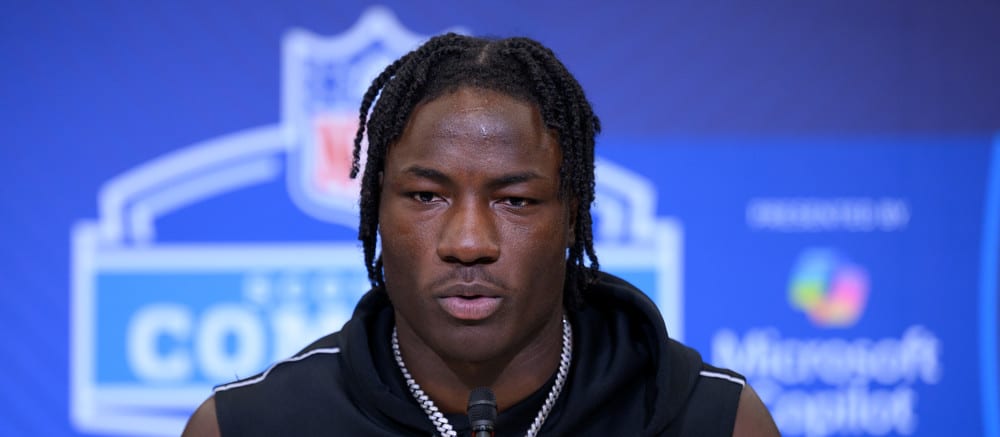



This article series will look at the top fantasy football rookies of 2026 and break down their fantasy football upside.
By examining the full scope of their talent level and their projected opportunity, the player's merit is weighed against their draft ADP to determine their cost-adjusted value to fantasy drafters.
This entry will look at Emmett Johnson, who was drafted by the Kansas City Chiefs in the fifth round (161st overall) out of Nebraska in the 2026 NFL Draft. As of May 24 the fantasy football ADP for Johnson is 182.2 on Underdog best ball drafts.
To read the entry on Raiders fourth-round pick running back Mike Washington, click here. To read about 49ers third-round pick Kaelon Black, click here.
SKILL SET
Johnson has a perfectly clear three-down skill set from scrimmage, and for one season at least he showed the ability to withstand major volume (297 touches in 12 games). Johnson is likely a top-five receiver among 2026 rookie running backs, catching 85 receptions for 656 yards and five touchdowns on 103 targets over the last two years (82.5 percent catch rate, 6.4 YPT).
Johnson's instinctive feel as a running back appears to be one of his other strengths. He doesn't have much raw speed or power, so Johnson's effectiveness would more so attribute to his quick processing and trigger. Johnson's ability to see and anticipate the field adds to his elusiveness, and then the combination of the live motor and the quick reflexes allows him to hit top speed quickly. When watching Johnson's tape it often feels like he's the one dictating the tempo of the play, with the defense forced to react, as opposed to the other way around.
Although he doesn't have much anchor, Johnson does seem to have plenty of balance and some amount of acrobatic ability. There are often times where Johnson maneuvers his way out of close calls by pulling some improvised stunt or another.


At around 200 pounds and with more grit than natural anchor, Johnson does not project as the type of running back you should subject to prolonged punishment on the interior. He has the demeanor to handle it and likely can for short periods, but it might be best if Johnson were spared some of the harshest carries over a longer period of higher volume. As a 20-carry back he might burn a little fast, but he should hold up fine as a 15-carry, four-catch back.
Johnson's game should fit any NFL offense be it in a small or extensive role. He is prolific enough as a pass catcher to make a quick dent as a hurryup or pass-catching specialist, and explosive enough as a runner to justify a role off the bench in a run-heavy offense. In the event that he has a starting opportunity like he did at Nebraska, Johnson is likely capable of producing notably both as a rusher and receiver.
ATHLETICISM
Raw athleticism is by far the main concern with Johnson, and if he burns out as an NFL prospect it would likely be due to athletic limitations. He is what you'd describe as an all-skill, no-tools sort of prospect.
Johnson's emphatically positive production gives reason to believe his skill profile can offset and overrule the limitations in his athletic profile, but we're definitely operating close to the red line where, no matter how much skill a player might have, the objective athleticism ranks low enough that it puts the translation of their game at risk when jumping to the next level.
Johnson (5-10, 202) lacks anchor and only compounds the issue with his athletic testing, almost all of which is below average even by the standards of a player 10 pounds heavier. His 4.56-second Combine 40 registers as 46th percentile, according to Mockdraftable, and this is on a 202-pound frame that ranks only in the 20th percentile. It's ideal for a running back to be as dense and athletic as possible, yet Johnson is plainly deficient in both areas. The question is how much it actually matters in his case.
COMPARISON AND 2026 PROJECTION
As alluded to in the Athleticism section, there is good news for Johnson in the fact that plenty of running backs, especially in recent years, have proven productive in the NFL despite objectively below-average athletic testing. By far the leading examples of this are Kyren Williams and Bucky Irving, both of whose raw athleticism grades rank at the very bottom for their position. Running back prospects have a shot as long as they are clearly productive and avoid a 40 time in the 4.7-second range. Johnson clears those red lines safely enough.
When sifting through the lesser running back athletes for NFL-viable outliers, the more productive the better. Particularly in 2025, Johnson's production was great rather than good. If we look specifically to the Williams and Irving examples, it also helps to have strong pass-catching production, a category where Johnson grades similarly well. There is sound basis to suspect Johnson will be among the next running back prospects to thrive from scrimmage in the NFL despite basement-grade athletic metrics.
As objective and substantive as athletic metrics might be, in the case of running backs it makes perfectly coherent sense that a player might reach Point B faster than another player even if the second player is more athletic than the first, because spatial processing is a big part of how fast a running back gets to Point B. Irving is a particularly good example of this – his 4.55-second 40 won't outrun many defenders from the second level onward, but because of his instant processing and trigger Irving can eat up space faster than a lot of running backs who would dust him in the 40.
COMPARISON: Tyjae Spears, with the ability to take many more hits. Johnson has nowhere near the level of injury concerns that Spears did out of Tulane, and thus has a higher volume ceiling projection than Spears ever warranted. This is meant to be a positive comparison – Spears is a player who is clearly capable from scrimmage in the NFL, including if not especially as a receiver, and his volume limitations are the only reason why Spears hasn't made a bigger impact.
2026 Projection and ADP:
As of May 24 the ADP for Johnson on Underdog is at 182.2 (RB55), which would be in the early 16th round.
Some of the running backs going just ahead of him include Dylan Sampson (169.1), Nicholas Singleton (174.8) and Tank Bigsby (175.4). The ones going right after include Alvin Kamara (187.6), Mike Washington (189.2), Kaytron Allen (191.5), Emanuel Wilson (192.8), Sean Tucker (196.1) and Ray Davis (202.0).
By this range of the ADP there are no sure things at the position, and very little playing time assured without injuries to players ahead of them on the depth chart. Johnson is assured very little other than that he won't push Kenneth Walker for playing time. Whether Johnson is worth his current ADP depends on the question of whether he can push aside free-agent pickup Emari Demercado for usage, because if Johnson is the from-scrimmage RB2 in Kansas City then the standard handcuff logic would make Johnson a good pick at his current price.
Demercado is a bit of a wildcard. His prospect profile from scrimmage is rather bad but he's faster than Johnson at about 10 pounds heavier, and even if it's unsustainable it's still impressive that Demercado has five carries of 40 or more yards on just 126 NFL attempts. Those big plays propelled Demercado's 6.5 YPC figure in the NFL after averaging just 4.8 YPC over 338 attempts at TCU.
Demercado will likely hold an edge over Johnson in blitz pickup, so Johnson will need to apply pressure by outplaying Demercado from scrimmage. It's possible that Johnson will initially function as the RB3 in Kansas City in terms of snaps, because the Chiefs might try to give Walker as much of the usage as possible while leaving Demercado with the blitz pickup. The key for Johnson's handcuff utility is that, if Walker were to miss time, then Johnson would need to outplay Demercado from scrimmage conclusively enough to more or less take the usage previously held by Walker.
There exists the potential nightmare scenario of Andy Reid proving stingy over the blitz pickup point, giving Demercado both the passing-down snaps and the from-scrimmage reps at the expense of Johnson even in the event of a Walker absence. That would likely come at a yardage cost for the Chiefs, who don't seem so rich at the moment as to easily justify leaving yardage on the field, particularly while Patrick Mahomes recovers from the ACL and LCL tear suffered Dec. 14. Still, Reid is free to make whatever choice, reasoned or not.
It seems reasonable to suspect that Johnson would prove productive from scrimmage if given the opportunity, and if he makes some plays then it will be harder to keep Johnson on the bench going forward. He might actually be Kansas City's best pass catcher out of the backfield right now, even ahead of presumed RB4 Brashard Smith, so it's easy enough to imagine how Johnson could increase his role as the season progresses.
To begin the year, though, Johnson might not have much to do if the Chiefs give Demercado the passing-down snaps left over from whatever Walker takes as the RB1. Johnson can probably overtake Demercado from scrimmage in the event of a Walker absence, and in such a scenario Johnson might push for something like RB2 utility in most fantasy formats, but Johnson is unlikely to provide even flex utility whenever Walker is on the field.
For 2026 considerations Johnson should probably be understood as a long-term handcuff to Walker. If you need a running back who chips in reliable weekly points then you'd probably rather be the person drafting Sampson (169.1), because he'll definitely have some pass-catching role even when Quinshon Judkins is healthy. Kamara (187.6) might also be a better bet to offer some semblance of a weekly floor.
Everyone other than Sampson and Kamara at this point in the ADP are in the same boat as Johnson otherwise – they're all either an RB2 behind a workhorse or the RB3 on their depth chart. They're all risky, and luck will play some major role in whatever the 'correct' answers are in this range.
While Johnson is a justifiable pick at ADP and a viable low-floor, high-ceiling RB5 at his current price, volume drafters will want to keep their exposure contained, probably not much higher than a 20 percent exposure rate. As previously mentioned, the 'Right' answers in this range of the ADP often come down to considerations of luck, or in this case the macabre 'luck' of the guy ahead getting hurt.
If Walker misses time, then there's reason to believe Johnson will produce well with the increased opportunity. Similar things can be said for most running backs in this range of the ADP, however. If Saquon Barkley were to miss time then Tank Bigsby would likely become valuable. If Travis Etienne got hurt in New Orleans then Alvin Kamara would become a likely fantasy starter. Ray Davis can rake if James Cook were to miss time, etc., etc. The 'correct' answer in this case could have little or nothing to do with foresight.