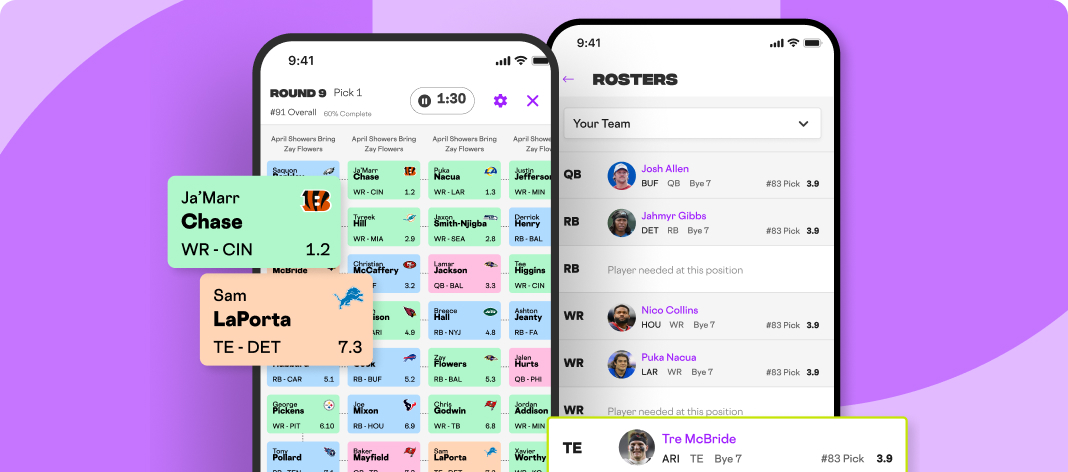
All fantasy football rankings have some similarities, as superstar players will always be at the top of these charts, but these go-to draft day elements change notably when moving across re-draft, auction, dynasty and Best Ball league types. Those similarities often dissipate in the later rounds, so fantasy managers would be well advised not to rely on a static set of rankings when playing in various types of leagues.
These alterations go even further when one considers factors such as scoring format, roster construction or impact performance rankings. For example, a running back who catches only a few passes can have a high RB fantasy football ADP valuation in a non-PPR format, but it's much more difficult to retain that value in a PPR format.
We've put together this primer to help you steer through these differences and adjust your fantasy football draft strategy accordingly. It will cover how re-draft rankings prioritize immediate production, detail why dynasty rankings emphasize age and long-term value, show you how Best Ball rankings boost ceiling and stacking value, highlight how positional value shifts across league formats and give you some insights on adjusting rankings based on risk tolerance and roster construction.
How Re-draft Rankings Prioritize Immediate Production
Re-draft rankings focus on one-season output because these leagues are only used for a single NFL campaign. The emphasis here is on projected volume, role security and weekly consistency. The greater a player rates in these areas, the higher he will be rated on a re-draft fantasy football cheat sheet.
Another thing to be aware of is that the RotoWire fantasy football projections will lean heavily on a player's short-term opportunity. This is a win-now format. Players who might have potential long-term upside over the course of a single season will receive higher grades than those without that upside, but will still rate far behind those players with more defined paths to immediate success.
Why Dynasty Rankings Emphasize Age and Long-Term Value
The dynasty rankings in the RotoWire fantasy football draft kit account for dynamics such as career trajectory, contract outlook and multi-year upside. The mindset here will be much like what an NFL general manager thinks when looking at a 53-man roster. There is a place for aging veterans, but the emphasis should be on finding younger players that a team can build around over the long term.
The dynasty format also takes a much different approach to the NFL injury report and NFL depth charts than other league formats. A player who is out for the year will lose all value in a re-draft league, but that same player will have injured reserve stash value in a dynasty league.


"One of the biggest mistakes you can make when drafting a dynasty league is using a generic cheat sheet," said Rotowire fantasy football expert Jake Letarski. "You may be set up for success in Year 1, provided none of the older players break down, but you'll be rebuilding before you know it, and could be stuck for the next 5-plus years."
How Best Ball Rankings Boost Ceiling and Stacking Value
Best Ball rankings prioritize spike-week potential and touchdown upside over steady weekly floors. Solid scores don't cut it in this league, so the RotoWire fantasy football draft assistant will boost ceiling value when grading a player's potential performance in this scoring format.
The Best Ball environment also rewards stacking quarterbacks with pass catchers. This type of move will maximize the impact of players in scoreboard shootouts, thus increasing a team's overall winning potential. In certain offenses (the truly great ones capable of posting 500 or more points in a single season), this can mean stacking a quarterback with a wide receiver and a tight end. You want as much stock as possible in these offenses.
Positional Value Shifts Across League Formats
Quarterbacks are the highest scoring players in fantasy football, but their position value rises even higher for fantasy teams in Superflex, 2QB and dynasty formats. Running backs will get that value increase in re-draft leagues since they are more central to victory in that type of scoring format.
These format rules also directly influence tier breaks and draft boards. These differences are significant and need to be accounted for when you are prepping for your fantasy drafts. You will find these differences reflected in the RotoWire fantasy football mock draft tool.
"I like to double-dip on QBs if at all possible in the first two rounds of a dynasty superflex startup," Letarski said. "Not only do they score the most, but they have the longest shelf life and are the toughest to replace on the waiver wire. Picking safe QBs in stable organizations allows you to 'set it and forget it' with respect to the position, as opposed to having to scour the wire each week for subpar backups."
Adjusting Rankings for Risk Tolerance and Roster Construction
Each scoring and league format requires a different balance of floor vs upside. For instance, the roster construction in an 8-team PPR league with a short bench will be much different than a roster in a 12-team, non-PPR league with a large bench. You also want a roster that reflects your risk tolerance level.
This is why fantasy football managers should aim to tailor rankings based on roster build strategy, league size and scoring settings for maximum draft-day efficiency. You can do this with the wide-ranging set of tools available to you once you subscribe to RotoWire. Then you can tailor your draft builds with the huge array of customizable options, and you'll never want to do another draft without them.
"One of my favorite features of the new RotoWire Draft Assistant is the ability to set risk tolerance by round," Letarski said. "Before you even draft, you can tell your 'Assistant GM' to take high-floor players in the early rounds and gear to the high-risk/high-reward players later. Then, the recommended selections will factor our ceiling/floor projections model into our draft recommendations based on the risk tolerance you set."