Every offseason move matters for fantasy football. Coaching changes, free agent departures, depth chart shifts and injury recoveries reshape how we should value players heading into draft season.
In this edition of the NFL Barometer, we'll look at running backs whose value has taken a hit this offseason. Whether it's lost offensive line talent, coaching departures, new competition or declining roles, these backs are being drafted higher than their current situations warrant. If you're building your draft board, pair this with RotoWire's running back rankings to see where these players are landing.
If you've missed any previous installments of this series, you can find them here.
Running Back Downgrades
De'Von Achane, Dolphins
Achane would have been better off wearing a Superman suit than his Dolphins' uniform last year. With a below-average offensive line, Tyreek Hill out most of the season and Tua Tagovailoa's weak arm giving defenses every reason to focus on the running game, Achane posted a ridiculous 1,838 scrimmage yards and 12 touchdowns.
He also rushed for 5.7 yards per carry with an insane 99th-percentile yards-after-contact rate. As great as Achane was, the challenges might be even greater this year.
First, coach Mike McDaniel and the rushing scheme he implemented to help Achane are gone. Next, not only is Hill not coming back, but Jaylen Waddle was traded to Denver. Use RotoWire's ADP tracker to see how the market is reacting.
Finally, Malik Willis, who only attempted 18 passes per game in three starts the last two years, takes over the quarterback spot from Tagovailoa. Although the Dolphins had a pair of first-round picks, they waited until the third round to address their terrible receiver room.


As good as Achane is, there might be limit to what he can overcome. I won't discourage anyone from taking him at his RB8 price, but the deck is heavily stacked against him. I am not aggressively targeting him in drafts.
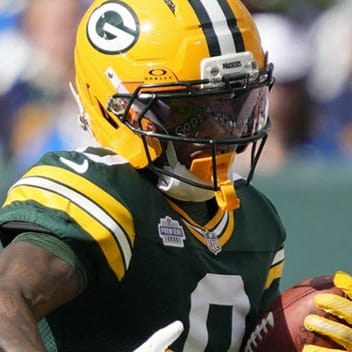
Josh Jacobs, Packers
Jacobs has been a strong fantasy producer his first two years in Green Bay. Before spraining his knee in Week 11 last year, Jacobs averaged 19.8 PPR, but it was heavily influenced by 11 touchdowns, as he only had 3.8 yards per carry.
After the injury, Jacobs missed just one game, but his production fell to 10.4 PPR points per game. The main reason for the uneven production (aside from the knee sprain) was that the offensive line fell off drastically from its 2024 levels.
The problem for this year is that the line might even be worse. The interior line has three players who need to improve, but that is far from a guarantee. Third-year tackle Jordan Morgan is also a below-average run blocker.
It also should be noted that Jacobs had some recent off-field issues, the impact of which is uncertain. It's another variable for a player who already has factors working against him.
Jacobs' RB14 cost accounts for volume and is a fair price, but there is more downside than in past years, as the line issues may worsen.
RJ Harvey, Broncos
With J.K. Dobbins suffering a season-ending injury in Week 10, Harvey averaged 3.3 yards per carry the rest of the way. However, his receiving and red-zone work led him to 14.5 PPR per game in those nine games.
With Dobbins back and Jonah Coleman added in the draft, if Dobbins misses significant time again, Harvey is unlikely to fall back into the lead role. In that scenario, we'd likely be looking at a Coleman and Harvey committee.
In any case, Harvey profiles as a passing-game-only option, and don't forget that Denver added wide receiver Jaylen Waddle this offseason. The expectation is that Waddle will see heavy volume in the short area of the field, so running back targets could scale back for Harvey.
As a result, his RB28 price does not account for likely volatility. I'm fading at cost.
Tyler Allgeier, Cardinals
There was significant hype during free agency when Allgeier signed a two-year, $12.25 million contract with the Cardinals. It was thought that he could be the lead back over an aging James Conner.
During the last three years behind a good Atlanta offensive line, Allgeier averaged a pedestrian 4.0 yards per carry. His biggest fantasy value was stealing goal-line work from Bijan Robinson.
Any thoughts of Allgeier being a big deal for fantasy were dashed when the Cardinals selected Jeremiyah Love with the third overall pick in the draft. I'm not even sold that Allgeier will be the goal-line back, as James Conner could be a more reliable option. Allgeier is a hard fade for me at RB44 cost.
The Final Word
The common thread with these four running backs is that the situations got worse, but the market hasn't fully adjusted. Achane is the most fascinating case. The talent is undeniable, but losing his coach, his quarterback and nearly every receiver is an enormous amount of change to absorb.
Jacobs is a quieter fade. The offensive line decline is real, and the production was already slipping before the knee injury. Harvey went from emerging lead back to committee option in one offseason, and Allgeier's path to meaningful touches all but disappeared on draft night.
If there's one takeaway from this installment, it's that last year's production doesn't guarantee this year's value. Achane at RB8 carries the most risk relative to cost.
Stay on top of these values as draft season heats up with updated fantasy news and RotoWire's NFL depth charts.