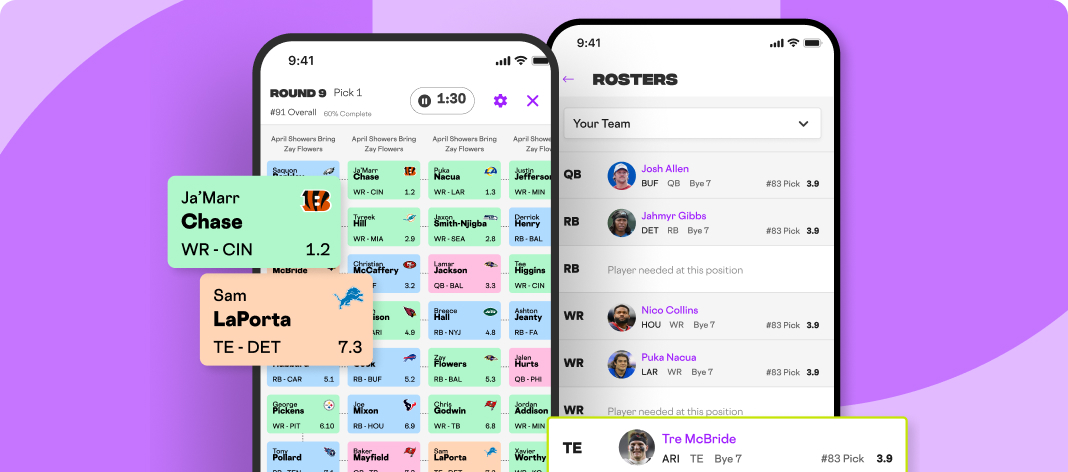
Think you know fantasy football ADP cold? The game above gives you two players from a single season and asks one question: who was drafted earlier? Keep the streak alive, climb the global leaderboard, and find out whether your sense of draft value actually holds up. Pick a year from 2020 through 2026, trust your gut and see how deep your fantasy memory really runs.
Below the game, here is everything you need to know about ADP, how it works and how to turn it into a draft-day edge.
Also, see if you can build a perfect 17-0 fantasy football team with this other free RotoWire game.
What Is ADP in Fantasy Football?
ADP stands for Average Draft Position -- the average spot at which a player is selected across a large sample of fantasy drafts. If a running back is taken anywhere from pick 8 to pick 14 in different leagues, his ADP might settle around 11. It is the single cleanest snapshot of how the fantasy community values a player heading into the season.
ADP is expressed as a number: the lower the number, the earlier the player comes off the board. A player with an ADP of 3.0 is, on average, a top-three pick. A player with an ADP of 95.0 is typically a late-round flier. That is the entire premise of the game above -- lower ADP means drafted earlier.
What Does ADP Stand For?
ADP stands for Average Draft Position. You will see it everywhere in draft prep -- rankings pages, draft kits, mock draft tools -- because it distills thousands of individual draft decisions into one digestible figure. Where a ranking reflects one analyst's opinion, ADP reflects the collective behavior of real drafters.
How Is ADP Calculated?
ADP is calculated by averaging the pick number a player is selected at across many drafts on a given platform or across multiple platforms. Pull in thousands of drafts, record where each player went in each one and average those slots. The bigger and more recent the sample, the more reliable the number.


Because each platform draws from its own pool of drafts, ADP differs from site to site. Yahoo, ESPN, Sleeper, Underdog, and the high-stakes NFBC and FFPC formats all produce slightly different boards. That is why you will see the same player carry a different ADP depending on where you look -- the scoring settings and the drafter pool both shift the math.
If you want to increase your odds of going undefeated when the real season begins, be sure to check out RotoWire's 2026 fantasy football rankings.
PPR vs. Standard ADP
Scoring format changes ADP, sometimes dramatically. In PPR (point-per-reception) leagues, pass-catching backs and high-volume receivers get a boost because every catch is worth a point. A reception-heavy running back can carry a noticeably earlier ADP in PPR than in standard scoring, where only yards and touchdowns count.
The game above uses PPR ADP, the most popular format in modern fantasy football. When you are comparing two players, keep scoring in mind -- a player's draft value is inseparable from how his production is counted.
How to Read ADP in Your Draft
Reading ADP well is about spotting the gap between where a player is going and where you value him. Three habits help:
1. Anchor your tiers. Group players into tiers and note the ADP range of each tier so you know when a run is about to start.
2. Watch for value. When a player you rank highly is sliding past his ADP, that is your cue -- you are getting a discount the room is handing you.
3. Avoid the reach. Taking a player a full round or more ahead of ADP means you could have waited and still gotten him. Use that capital elsewhere.
Why ADP Changes Year to Year
ADP is a living number. A breakout season, a coaching change, an offseason trade, a rookie's arrival, or a training-camp injury can swing a player's draft slot by dozens of picks from one summer to the next. A player who was a third-round staple in 2022 might be a sixth-rounder by 2024 -- or a first-rounder.
That volatility is exactly what the game above tests. Spanning 2020 through 2026, it asks you to remember not just who was good, but when the market believed in them. Recency bias is the enemy: the player you think of as a stud today may have been an afterthought three drafts ago.
How to Use ADP to Win Your Draft
ADP is a map of the room, not a ranking of talent. The drafters who win their leagues use it to anticipate behavior rather than to follow it. Know which positions tend to run early, identify the rounds where value pools at your favorite positions, and let other drafters reach while you pocket the players sliding past their ADP.
Build your own rankings first, then overlay ADP. Where your number and the market's number disagree, you have either found a value or flagged a player to fade. That disagreement -- not the ADP itself -- is where edges live.
Mapping out your wagers for the week? Check out the latest Sportsbook Promo Codes to get special offers and make the most of your bets.
Frequently Asked Questions
What is a good ADP in fantasy football?
There is no universally "good" ADP -- it depends on the player's expected production relative to his draft cost. A good value is any player whose realistic ceiling outstrips his ADP. The goal is return on investment, not simply drafting players with low ADP numbers.
What is ECR vs. ADP?
ECR (Expert Consensus Ranking) is where analysts rank a player; ADP is where the public actually drafts him. When ECR is much higher than ADP, the experts like a player more than the room does -- a potential value. When ADP is higher than ECR, the public is reaching relative to expert opinion.
Is ADP the same as player rankings?
No. Rankings are opinions about how players should be valued. ADP is data about how players are actually being drafted. Smart drafters use both -- rankings to form a view, ADP to find where that view diverges from the crowd.
Why is a player's ADP different on each site?
Each platform calculates ADP from its own pool of drafts and scoring settings. A PPR-default site will value pass-catchers more than a standard-scoring site, and a high-stakes platform's sharper drafter pool can push certain players earlier or later than a casual one.
Ready to put your draft knowledge to the test? Scroll back up, pick a season, and see how long you can keep the streak alive.