


Best Ball ADP Comparison Tool
One of my favorite elements of best ball and, really, fantasy football at large is seeing how the fantasy football ADP takes shape over time. Being able to visualize of the changes in market behavior is really instructive for our purposes. There's a lot of movement still to come as players emerge in camp and injuries crop up, of course. But even in this "quiet" period of the offseason, the market has moved players up and down.
The idea with this tool is to get a look at the last snapshot of the ADP before the draft, and then see how things have changed and progressed in the month and a half since then.
You can track any player's ADP when you type their name in the first search bar. If you want to compare their ADP to another player, just enter that next player into the Player 2 search bar.
Knowing what we do now, this is a good way of spotlighting the market movement and putting it under a microscope to see if it really makes sense. Below are a few of the ADP side-by-sides that really caught my attention.
You can always check the recent ADP trends against my best ball rankings to see how much stock I'm putting into the various shifts and trends.
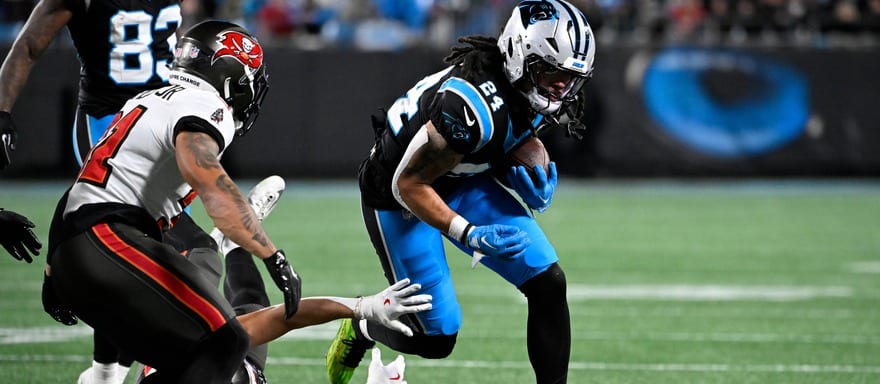
Panthers Running Backs: Chuba Hubbard and Jonathon Brooks

Brooks has been one of the biggest risers in all of fantasy football since contests opened. It makes sense; Rico Dowdle left, the Panthers didn't add anyone of note in free agency or the draft, and Brooks himself was a high-pedigree prospect who now looks to be fully healthy after an injury-riddled start to his NFL career. Drafters are excited to see what he can do in this backfield.
What's interesting is that Brooks' rapid ascent up draft boards has not correlated with any market cooling on Chuba Hubbard, whose ADP has remained flat. If Brooks is rising this much, how is Hubbard not slipping at all?


There's still a 40-pick gap between these two, so it's not like the market has fully overcorrected. There are plenty of backfields with tighter gaps between their top two running backs -- Commanders, Vikings, Steelers, Broncos -- but the Panthers are trending in that direction now if this holds.
I wrote in last week's Zero RB article that last year, a lot of the jumbled backfields produced Very Right and Very Wrong answers. I added that it seemed this year's jumbled backfields could realistically produce good picks at cost. I wonder if the Panthers will be one of those backfields this year where you sink or swim based on which side you take.
If nothing else, the window has closed on Brooks being someone you can wait until the 11th or 12th round to get. I've been doing more and more drafts lately, and it feels like each room is competing to set the new min-pick on him. Stacking Brooks up next to J.K. Dobbins, Blake Corum, Kenneth Gainwell, etc is a different discussion than it was when Brooks was going new Zach Charbonnet, Tyrone Tracy and Keaton Mitchell back in April.
Handcuffs: Robinson vs Pacheco

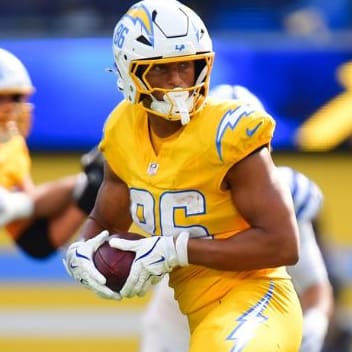
Robinson and Pacheco profile as the same type of fantasy asset this year. Both are the new backups for the elite of the elite running backs in the league (Bijan Robinson and Jahmyr Gibbs).
(Side note: Mario Puig and I dove deep into the Bijan vs Gibbs debate on the latest RotoWire Fantasy Football podcast.)
This chart is really breaking my brain. The market correctly valued these guys back in April as late-round, "eh, I need a running back here, I guess" type of picks. For whatever reason, Robinson has stayed put while Pacheco has gone up almost two full rounds.
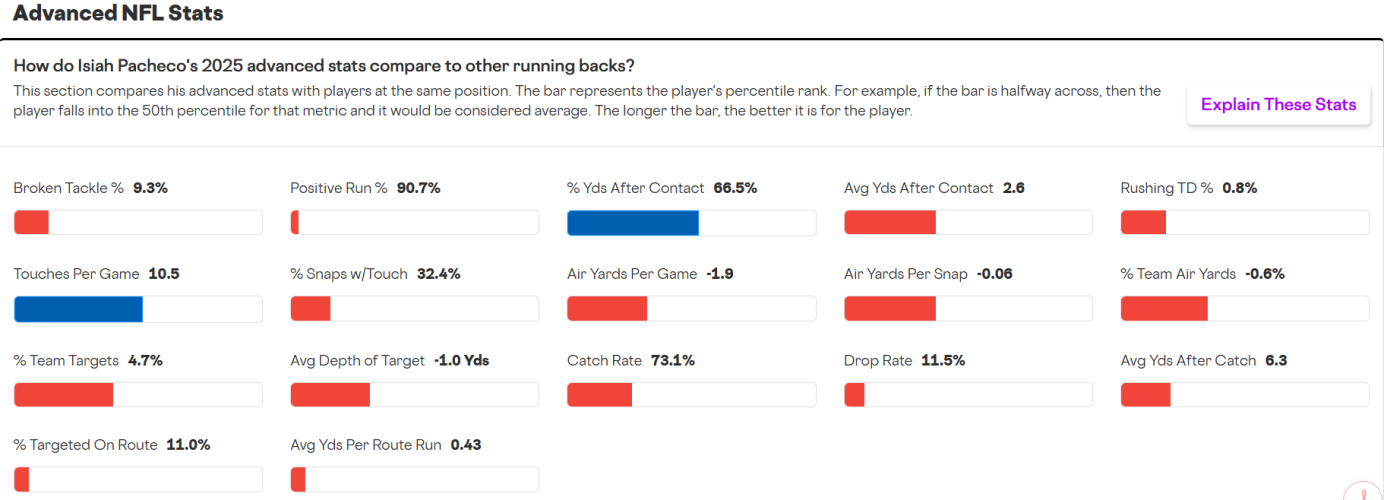
They fit the same exact bill. Neither will have much standalone value as long as the starter is healthy. Pacheco was not good last year, by really any metric. And if you want to use the recovery from the 2024 broken fibula as the primary reason, it's worth noting that Pacheco was even worse than 2025 in that season before the injury.
Maybe the market thinks that Gibbs can't take on the same workload as Robinson, and therefore there are more opportunities up for grabs in Detroit. That's something I can understand. There's an additional sentiment baked in here that Pacheco will simply take David Montgomery's workload. That's where I can't abide.
Montgomery took 158 carries on 407 snaps last season and had a 44.7% snaps-per-touch rate (63 percentile). I have a hard time seeing Pacheco just sliding into that kind of usage 1:1.
Ultimately, Pacheco is now in a part of the draft where he needs to have standalone value to be a good pick. Right now, you're paying up for an expensive handcuff who is unlikely to crack your lineup at all without a Gibbs injury. Maybe that's the point, but if it is, why not go with the same type of player two rounds later?
My pal and fellow RotoWire writer Jerry Donabedian chimed in on this discussion as well.
"Not a fan of either player really, but Robinson has even less competition than Pacheco and a bigger contract. Think part of it is people expect Detroit would still score plenty without Gibbs; the Falcons might not... even when Bijan is healthy."
The offensive environment detail is worth mentioning here. If we look at the Lions and Falcons implied totals across the whole season, we see two very different outlooks. The Lions carry a 26.1 PPG average implied total, ranking 2nd in the NFL, while the Falcons check in at 25th at 21.3.
Targeting the better offense is a good tiebreaker between players, for sure. And, Vegas is rarely way off on this type of thing. That's where we need to put our thinking cap on. Is the market making a blanket assumption that the Lions offense will be among the league's best again? They brought in a new offensive coordinator in Drew Petzing, who wasn't exactly amazing during his run in Arizona. I'm not saying Detroit's offense is a trap -- far from it -- but it's at least worth wondering if it'll live up to the same level we've seen in the Dan Campbell era.
Atlanta, meanwhile, might be a little underrated. I, for one, liked the Kevin Stefanski hire. I like the pieces of that offense and think that there's a chance the Falcons outperform their offensive projection by a good bit. It helps that they have one of the easiest schedules in the NFL this year (so do the Lions).
Not to say the Falcons will have a better offense between the two. But I think it's hasty to just write them off and put them in the "bad offense" bucket.
One last thing on this. A strategy I've seen tossed around on best-ball Twitter is that if you have either Bijan or Gibbs on your team, taking the other handcuff is an interesting idea. IE, if you have Gibbs and Brian Robinson, and Bijan misses time, all of a sudden you have an elite running back (Gibbs) plus a value pick with a starter's workload. This is a good and very best-ball-brained idea I can support.
Raiders Receivers: Tucker vs Nailor

Both Nailor and Tucker have been on the rise since the draft thanks to the Raiders only adding sixth-rounder Malik Benson to that group. This essentially locks both Nailor and Tucker into starting roles with good volume projection.
Both have gone up significantly since the NFL Draft, especially Tucker, who has jumped 35 spots to qualify as the second biggest post-draft riser. This is a real mystery box of a receiving corps, and though there's a little less pressure on both of them with Brock Bowers keying the passing game, there's still a need for at least one of Tucker or Nailor to pop.
The market is growing more confident that the Raiders offense won't be a total wasteland this year after a busy offseason that improved the roster and brought in a promising new head coach in Klint Kubiak. But how do we determine which is the right pick between these two?
Nailor has one more season of experience than Tucker, but Tucker has been more involved over the last two years with 173 combined targets to Nailor's 95.

Nailor has the edge in efficiency, but neither has been standout in that regard at least on the surface. YPRR figures below 1.2 grade out as mediocre, and neither have been drawing targets at a strong rate.
Nailor's numbers drag a bit because he was playing in a loaded receiving corps that already had Justin Jefferson and Jordan Addison, and then last year the passing environment just wasn't good for anybody. Tucker, of course, knows all about bad offensive environments from the last few years in Vegas.
If I had to call it right now, I'd lean Nailor in this toss-up if I'm going for a steady floor. Tucker has the spike-week appeal -- he can coast on that game against the Commanders for a while before people fully give up on him. I would imagine Nailor's role will be more so in the slot, which should funnel more targets in his direction. He had a higher aDOT than Tucker over the last two years but that signals a misuse of Tucker's speed (4.4) more than anything. Tucker needs to be the deep threat that keeps defenses honest. That could put him in the (trendy new term alert) Sacrificial X bucket and make him more of a high-variance type of play.