Over the past three decades, the bottom of WNBA rosters have gotten substantially more skilled. WNBA statistics show that bench players and rookies shoot more efficiently, take more 3-pointers and protect the ball better that a generation ago.
Between the 3-point revolution among rookies and sharper play from bench players, skill levels entering the WNBA 2026 season have never been better. For WNBA betting insight, RotoWire.com dug into the data to find out much each camp has evolved since the first true "rookie class" in 1998.
WNBA Bench Players Are More Skilled With Better Efficiency and Ballhandling
Between 1997 and 2025, bench players in the WNBA saw slight upticks in true shooting percentage (51%, from 49%) and 3-point accuracy (31%, vs. 30%), And the number of attempts from deep by players in this tier rose dramatically over that span.
In total, WNBA bench players attempt 33% of their collective shots from behind the arc as of 2025, up from 20% in 1997. Coaches demand that players at all positions find comfort in shooting 3s, regardless of how well they hit those shots.
Overall, the biggest shift for WNBA bench players in today's game is the improvement in ball-handling from those coming off the bench. The average assist-to-turnover ratio now is 1.21, which represents an improvement of more than 50% over the 0.80 mark from the league's early days.
That clear improvement in ballhandling is an argument that players have a higher basketball IQ than in the league's early days.
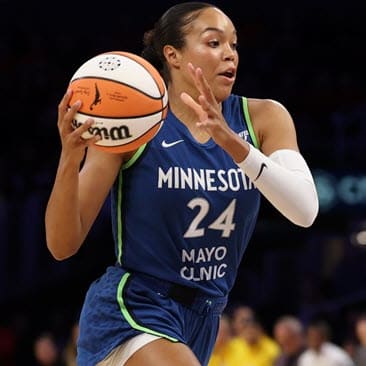
What do all of these trends mean for WNBA player props betting? Let's use Monique Akoa Makani of the Phoenix Mercury as an example. As a rookie in 2025, she had a similar stat line to a starter two decades ago, with 49 3s (on 123 attempts) and an Effective Field Goal percentage (or eFG%) of .523. Those numbers would have put her sixth leaguewide in eFG% and tied for 10th (with Sue Bird) among all league members in 2003.
How WNBA Rookies Improved 3 Point Shooting Scoring and Decision Making
In a similar fashion to the WNBA's bench players, the league's rookie classes have gotten much more comfortable shooting 3s of late, versus those that entered the "W" in its early days.
For instance, the 37% 3-point attempt rate among the 2025 rookie class was nearly double that of the cadre of first-year players in 1998 (21%). Ballhandling followed a similar curve to bench players.
Overall, the 1.37 assist-to-turnover ratio for all 2025 rookies combined was 38% better than the number in 1998 (0.99). Overall scoring from the 2025 first-year class was another delineator, improving from 11.7 points per game in 1998 to 13.5 points on average.
Interestingly, the 3-point attempt rate for rookies was pretty much stationary from 1998 through 2014, before climbing steeply from there. The implication is that the NCAA's behind-the-arc explosion finally translated to the WNBA Draft pipeline.
Now, college players take a lot more 3s than a decade earlier, so WNBA rookies arrive with more shooting experience behind the arc. Better decision-making has accompanied that change too.
Caitlin Clark, Paige Bueckers, A'ja Wilson Show the Modern WNBA Skill Surge
Caitlin Clark of the Indiana Fever is an example of a player who has undoubtedly helped push the curve upwards across these statistics.
The former All-American at Iowa hit 122 3s on 355 attempts, leading the league in both categories, and had an eFG% of .522 as a rookie in 2024. Clark's 3-point total was nearly double the WNBA's leader in 2002 (Allison Feaster, with 79). In 2002, Clark's eFG% would have ranked 10th; in 2024, she barely missed the top 20.
Another example is Clark's successor as WNBA Rookie of the Year, Paige Bueckers of the Dallas Wings. Bueckers, a 6-foot guard, nailed 39 3s on 118 attempts in 2025 and posted an eFG% of .513, missing the top 20 in both categories. In 1998 with those numbers, Bueckers would have been second in made 3s (behind Cynthia Cooper's 64) and sixth leaguewide in effective FG%.
Finally, in her 2018 Rookie of the Year campaign, A'ja Wilson of the Las Vegas Aces posted an eFG% of .462 and averaged 20.7 points and 8.0 rebounds per game. Looking back at the WNBA's league leaders from 2000, though Wilson's eFG% would have ranked just outside of the top 20, she would have tied Sheryl Swoopes for the scoring title and tied Tari Phillips of the New York Liberty for the fourth-most rebounds per game.
In current WNBA championship odds, with the 2026 season barely underway, the defending champion Aces are among the favorites to take the title again. As of May 11, their odds range from +320 to +450, depending on the operator.
What WNBA Bench Depth and Rookie Growth Mean for Fantasy Basketball and Betting
Given the increased output offensively by rookies and bench players in the 15-team league, it's no wonder that WNBA daily fantasy players are chomping at the bit to get their hands on younger players. Late-round fantasy draft picks have more functional ceiling than they did even as recently as 2010.
All told, today's bench-tier player in the WNBA (who is likely to be drafted at the back of your league) is more likely to produce a usable Per-36 line than the equivalent pick a decade ago, because their underlying skill floor is higher.
The increased production from rookies, particularly in 3-point shooting, means that WNBA fantasy players should bank on solid shooting from many first-year players they draft. Yet it seems that the prudent move as a fantasy basketball player is to focus on a rookie's assist-to-turnover stats from college. That is the metric that has quietly moved the most in recent first-year player classes.
On that note, the old adage that rookies are turnover-prone is increasingly wrong. Rookies have improved their collective assist-to-turnover ratio by 38% in the past decade, particularly post-2018.
There are plenty of reasons to keep an eye out for the next fantasy steal as the WNBA 30th season gets rolling. Bench players and rookies are delivering unprecedented value for team owners in 2026, compared with the league's early days.
WNBA Statistical Methodology
RotoWire.com used the Stathead Player Season Finder at Basketball-Reference.com, 1997-2025, all player-seasons with zero starts (pure bench all year) and 200+ minutes played. n = 472 across 29 seasons (median 16 per season; 1997 has just 5, so the early curve is directional. These are volume-weighted aggregates rather than per-player medians, so a season's number reflects the actual league-wide bench output. TS%, 3PAr, and AST/TO are all pace-neutral, so none of this is an artifact of the league playing faster. Bench tier = pure-bench seasons (zero starts) with 200+ minutes (n = 472 player-seasons). Rookies = first-year experience with 200+ minutes (n = 577 across 28 cohorts, excluding the WNBA inaugural season of 1997). All trend lines are 3-year centered moving averages of season-level volume-weighted aggregates. TS%, 3PAr, and AST/TO are pace-neutral by construction.
Frequently Asked Questions
Are WNBA players really more skilled today than in the 1990s and 2000s?
Yes, but the gain shows up in specific places, not uniformly across every stat. The clearest improvements are in decision-making (assist-to-turnover ratios have nearly doubled at the bench tier) and shot diversity (3-point attempt rates have climbed 47% relative to 1997). Pure shooting accuracy has barely moved; bench-tier 3-point percentage is essentially flat at around 30%. So today's WNBA player is making smarter decisions and taking more modern shots but isn't necessarily a better pure shooter than her 2003 counterpart.
Has WNBA bench depth specifically gotten better, or is it just the stars?
The bench has improved on its own so this isn't a trickle-down effect from the All-Star tier. The data tracks pure-bench seasons (zero starts with 200 or more minutes). Within that depth tier, every meaningful skill metric has trended upward over 28 seasons. The replacement-level WNBA player in 2025 produces a more efficient, more disciplined stat line than her 2003 equivalent. This provocative framing argues that today's bench player would have started a generation ago.
Couldn't this just be the league playing faster?
No, and this is the most important methodological point. The headline metrics (true shooting percentage, 3-point attempt rate, assist-to-turnover ratio) are all pace-neutral by construction. TS% is points per scoring opportunity. 3PAr is the share of all shots that are 3-pointers. AST/TO is a ratio of two counting stats from the same player's minutes. None of them inflate when the league plays faster. The improvements documented here aren't an artifact of pace, but rather real changes in shooting profile and decision quality.
Are today's WNBA rookies more polished than past rookies?
Yes. The clearest signal: Rookies score about 15% more points per 36 minutes than rookies of the early 2000s (13.5 vs. 11.7). They also take 71% more 3-pointers and have substantially better assist-to-turnover ratios than rookies a generation ago. Notably, these gains are concentrated post-2014, the same window in which NCAA basketball's 3-point revolution started feeding into the WNBA. Today's average rookie arrives ready to contribute scoring volume in a way that her 2005 counterpart did not.
Why aren't WNBA bench players making more 3s if they're taking more?
This might be the most interesting tension for WNBA betting trends in the data. Bench-tier 3-point attempt rates nearly doubled over 28 years while bench-tier 3-point accuracy stayed essentially flat at around 30%. The most likely explanation is that bench players today are deployed as catch-and-shoot specialists rather than self-creating shooters. This indicates that coaches are willing to live with the same accuracy at higher volume because floor spacing and 3s per possession matter more than ever in modern offenses. The depth tier hasn't gotten better at making 3s, but these players attempt 3s better within an offensive scheme.
What does this mean for WNBA fantasy basketball?
There are three practical implications for WNBA daily fantasy managers. First, late-round picks have a higher functional ceiling than they did a decade ago. Former waiver-wire fillers are now more often plug-and-play contributors and fantasy WNBA sleepers. Second, rookie evaluation should weigh assist-to-turnover ratio more heavily than conventional wisdom suggests. The "rookies are turnover-prone" stereotype is increasingly wrong, particularly since 2018. Third, a high-volume college 3-point shooter is now a median rookie profile rather than an outlier. The modern "value rookie" in fantasy is one with elite decision-making, not just elite shooting volume.