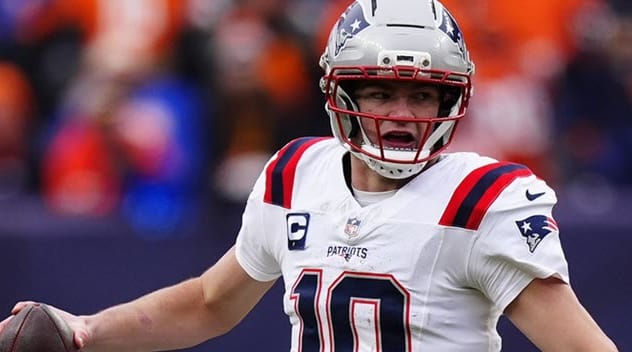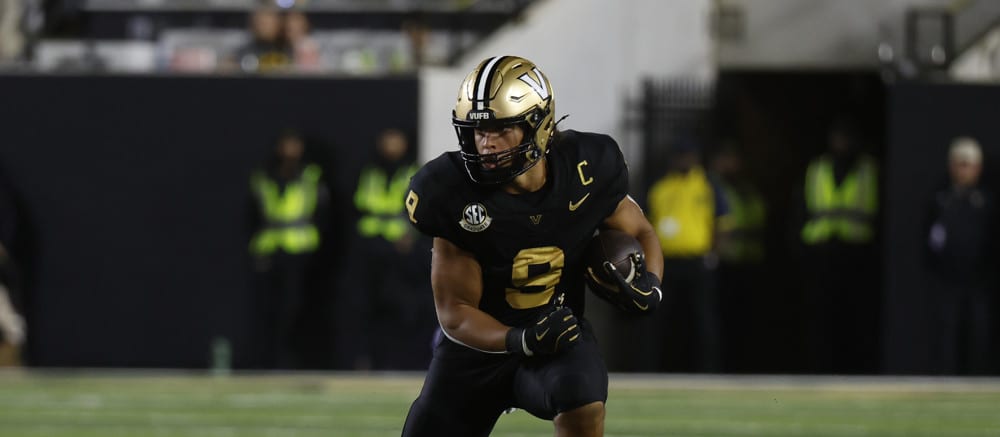


This article breaks down the top 30 players in the rookie ADP for Underdog best ball fantasy football drafts.
Each blurb will address the general projection of the player and weigh their current draft value at price compared to alternatives.
The players are listed in descending ADP. Each blurb contains a general advisory with a quick mention of similarly-priced alternatives.
This breakdown will be updated as necessary once NFL Combine athletic testing is concluded around March 2.
Jeremiyah Love, RB, Notre Dame (18.4 Underdog ADP)
Love is explosive with the football, be it as a runner or a pass catcher. In terms of skill set Love has a complete game – speed and power, start/stop and change of direction – so in terms of per-play best-case scenario Love warrants a high projection.
The only real question with Love is his volume projection. If the answer to the volume question is favorable then Love's fantasy upside would be massive, as in safely in the top 12 among running backs and potentially something more like the top five. High yards per carry, high touchdown rate per carry, and high per-target efficiency at a notable target volume are all obviously on the table for Love.
The main case for present caution on Love is that his current price doesn't feature much room for error. Love's present ADP generally outpaces Derrick Henry, Chase Brown, Josh Jacobs and Bucky Irving. It would generally be ideal to get Love at a draft slot later than those four, if only because their short-term workload is more assured. There's absolutely a chance Love splits work as a rookie.


Verdict: Cautious exposure at ADP (Up to ~10 percent)
Cheaper alternatives: Derrick Henry (21.1), Chase Brown (21.9), Josh Jacobs (27.5), Bucky Irving (27.9), Breece Hall (29.3)
Carnell Tate, WR, Ohio State (53.4)
Tate has a strong chance to go in the first 10 picks of the 2026 NFL Draft, and with that kind of draft capital the question of where he plays is largely immaterial. No matter what the answer is, the team that picks Tate will very likely make him at least their WR2 in terms of target rotation. As a prospect Tate is notable for projecting as the top boundary receiver between himself, Makai Lemon and Jordyn Tyson.
Alternatives like Christian Watson (55.7), Makai Lemon (57.2), Rome Odunze (57.4) and Jordyn Tyson (58.7) are next in line, and though each has their own case for selection there's nothing that gives them an obvious edge on Tate at the moment.
Verdict: Worthwhile exposure at ADP (Up to ~15 percent)
Cheaper alternatives: Christian Watson (55.7), Makai Lemon (57.2)
Makai Lemon, WR, USC (57.2)
There's an increasing drumbeat for Lemon to be the first wide receiver selected among the 2026 rookie class, and now we wait to see if he'll push for the fourth rounds of fantasy drafts after crashing the late fifth.
Lemon has a high-floor as a prospect, especially from the slot, and he should play a lot somewhere in 2026, presumably doing a good job doing it. He might need target volume to carry his projection at ADP, though, because Lemon projects more as a high-efficiency target than a high-explosiveness one.
As much as Lemon might project for the highest reception total among himself and the big three rookie wideouts, it would hurt in Underdog's 0.5PPR scoring if Lemon lagged behind Tate and Tyson for yardage and touchdowns.
Verdict: Worthwhile exposure at ADP (Up to ~15.0 percent)
Cheaper alternatives: Rome Odunze (57.4), Jordyn Tyson (58.7)
Jordyn Tyson, WR, Arizona State (58.5)
In terms of college productivity there's no doubt that Tyson carries the best grade between himself, Tate and Lemon, and a lot of the cases against Tyson rest on concerns over his durability after suffering a three-ligament season-ending injury as a true freshman in 2022. Tyson torched for Colorado before the injury and for Arizona State following his recovery.
The reality for the rookie trio of Tate, Lemon and Tyson could be as simple as the 'winner' in 2026 could be the one who gets drafted by the best offense. Each rookie wideout appears to have a lot to offer, including an immediate WR2 role or more for whichever team drafts them. We really want them to land with teams like the Commanders (7), Chiefs (9), Bengals (10), or Rams (13) as opposed to a nightmare like Pittsburgh (21).
Verdict: Worthwhile exposure at ADP (Up to ~15.0 percent)
Cheaper alternatives: Brian Thomas (60.2), Courtland Sutton (62.7), Marvin Harrison (64.1), Mike Evans (66.2)
Jadarian Price, RB, Notre Dame (97.4)
Perhaps it's only because the rookie class is thin, but if he tests well at the NFL Combine then Price could really push for the first round of the 2026 NFL Draft. He needs to test well, though, because Price's pitch is largely as a big-play threat.
Price did not catch passes at Notre Dame – Love handled most of that – and Price was not as productive as a pure runner. But Price's own production was some version of good, and we can forgive Price for getting outplayed by someone as good as Love.
Still, that benefit of the doubt would lessen if Price doesn't prove he's fast. If Price proves to be a big-play specialist without big-play speed, then his prospect profile would quickly turn for the worse.
For now, though, Price is unlikely to fall out of Day 2 and that will likely remain the case even if Price runs something as disappointing as a 4.52-second 40 or whatever. I'd consider buying Price right now if only because his price might not get any lower but could get quite a lot higher if he torches the Combine.
Verdict: Worthwhile exposure at ADP (Up to ~15.0 percent)
Cheaper alternatives: Tyler Allgeier (100.3), Rico Dowdle (102.0), David Montgomery (108.5), Jonah Coleman (116.3)
Denzel Boston, WR, Washington (106.3)
Boston is consistently projected as a potential if not likely first-round pick in the 2026 draft. It doesn't make much sense to me, but with draft capital like that Boston objectively has a lot working in his favor right now.
With that said, Boston's target rate at Washington only vaguely implied an NFL starter and his catch rate was a red flag. My concern is he'll need development time even if he turns out a good NFL starter. I won't be drafting Boston over the likes of Wan'Dale Robinson, Jauan Jennings or Khalil Shakir. There are probably others later yet in the ADP that I would also prefer over Boston.
Verdict: Skeptical exposure at ADP (Up to ~5.0 percent)
Cheaper alternatives: Wan'Dale Robinson (109.9), Jauan Jennings (111.7), Jayden Reed (112.8), Chris Godwin (114.3), Khalil Shakir (115.7)
Jonah Coleman, RB, Washington (116.3)
Coleman is a likable player with some clearly standout qualities as a starting NFL prospect, so he has a shot. Unfortunately, each year there is some number of guys who 'have a shot' but ultimately don't quite work out.
Where we hold our breath with Coleman is likely on the speed question. At 5-foot-9, 220 pounds we know Coleman is a shifty, tough runner who will pop a defender under his pads to drive him back a bit, and Coleman showed good pass-catching ability to project for usage through all game scripts. It's mostly just clear positives in his profile.
But the description of Coleman to this point is almost identical to that of Zack Moss out of Utah. It's a thin line between a Zack Moss and a Javonte Williams, and sometimes the distinction is based on arbitrary luck. Coleman is a guy who could be a hit with a little luck but could fade into the backup scene if luck isn't in his favor.
Verdict: Worthwhile exposure at ADP (Up to ~12.5 percent)
Cheaper alternatives: Woody Marks (121.5), Jacory Croskey-Merritt (122.4), Kenneth Gainwell (126.7)
KC Concepcion, WR, Texas A&M (125.7)
Concepcion seems to have some clear limitations as a receiver and I'm skeptical he'll ever emerge as more than a WR3 on a given offense. If Concepcion is a WR2 or higher in a rotation I'd worry that the passing game in question was at best hit-or-miss and dependent on big-play ability.
Concepcion is a constant big-play threat with his truly rare burst and change of direction, but dubious hands and route running make it difficult to project the volume of viable targets necessary for Concepcion to stick as a starter.
There is some price point where we definitely want to buy Concepcion – he has clear uncommon strengths despite his whatever other weaknesses – and that point in the ADP is probably anywhere in the ADP where the wideouts are no longer clear NFL starters. For instance, Concepcion's limitations are no more profound than those of Tre Tucker or whoever.
The problem is Tucker's ADP is at 184.4, and pretty much every wide receiver in the order before him projects more plausibly as a starter than Concepcion. I'm not taking Concepcion over the likes of Romeo Doubs (138.4), Rashid Shaheed (140.4), Brandon Aiyuk (141.6) or Josh Downs (152.3).
Verdict: Skeptical exposure at ADP (Up to ~5.0 percent)
Cheaper alternatives: Romeo Doubs (138.4), Rashid Shaheed (140.4), Brandon Aiyuk (141.6), Josh Downs (152.3)
Emmett Johnson, RB, Nebraska (127.8)
He still needs to test well athletically, but Johnson's tape and production are really encouraging. He's not a blue-chip prospect but in this wide-open running back class I absolutely believe people are underestimating Johnson.
As much as I project Jadarian Price to be the second rookie running back selected at the moment, it's Johnson I would personally rank second behind Love going into the Combine.
Johnson is light (~200 pounds) and therefore will probably work in a rotation at least to start his career, but the fact that Johnson withstood major volume at Nebraska gives reason to project some volume upside, and he should otherwise work just fine as a rotational back.
If you're looking for someone who can scale up to a starting workload and has the talent to plausibly compel said workload then Johnson needs to be on that short list. As much as cheaper veterans like Tyrone Tracy, J.K. Dobbins and Trey Benson are all also arguably on that list, Johnson does probably offer more talent than Tracy and more durability than Dobbins or Benson.
Verdict: Extensive exposure at ADP (Up to ~18 percent)
Cheaper alternatives: Tyrone Tracy (130.5), J.K. Dobbins (134.6), Trey Benson (137.3)
Fernando Mendoza, QB, Indiana (133.6)
Mendoza looks like the real deal and the Raiders offense will be a lot better in 2026. You never want to go too heavy on the exposure with any one quarterback – that's probably the position where you'd like your exposure to prove flattest – but at price I don't think Mendoza can hurt you if he stays healthy.
Verdict: Worthwhile exposure at ADP (Up to ~15 percent)
Cheaper alternatives: C.J. Stroud (136.4), Kyler Murray (140.6), Malik Willis (141.6), Cam Ward (144.0)
Kenyon Sadiq, TE, Oregon (145.8)
Sadiq is likely headed toward the first round of the 2026 NFL Draft, and it's easy to imagine Sadiq's ADP rising at that point. He's in the category where it makes sense to buy now if only because the price almost definitely will get higher.
As much as Sadiq's price will likely get higher, that's not to say it isn't more appropriate at 145.8, the 13th round, than something in the 10th round. Sadiq never really broke out at Oregon the way you'd expect of someone so apparently athletic and otherwise productive. He's also young – he only turns 21 in March – so Sadiq could look great as a rookie and still not play a starting role.
That Sadiq could prove more of a long-term prospect could make it tricky to utilize him in 2026 best ball. At price you need Sadiq to prove sufficient as TE2 for your roster, but his rookie-year snap count might make it tough to safely rank in the top 24 among fantasy tight ends.
That leads to the main case against Sadiq at price: there are other affordable alternatives with clearly higher floors. Mark Andrews (151.8), Hunter Henry (154.6), Isaiah Likely (174.3) and T.J. Hockenson (187.5) are all very likely starters who could inherit snap counts upwards of twice what Sadiq might play in 2026.
Verdict: Cautious exposure at ADP (Up to ~10 percent)
Cheaper alternatives: Mark Andrews (151.8), Hunter Henry (154.6), Isaiah Likely (174.3), T.J. Hockenson (187.5)
Kaytron Allen, RB, Penn State (173.8)
Allen should prove a steady NFL runner, to the point that some team might find him an acceptable starter at some point. Allen does not stand out as a pure runner, however, and as a pass catcher there's reason to suspect he's not very good. Rushing-specialist rookie running backs have to be one of the very riskiest genres of fantasy pick.
Then again, Allen is rather cheap at this point. It's not as if the alternatives are compelling in this range. I do prefer his college teammate Singleton, though.
Verdict: Cautious exposure at ADP (Up to ~10 percent)
Cheaper alternatives: Kimani Vidal (177.0), Dylan Sampson (183.4), Nicholas Singleton (191.7)
Elijah Sarratt, WR, Indiana (177.3)
I will probably draft a good amount of Surratt at this price. I expect him to fall as far as the third round of the 2026 draft but like he did at St. Francis, James Madison and Indiana I think Sarratt will immediately impress and earn playing time.
There is a concerted Draft Media push to hype fellow Indiana wideout Omar Cooper over Sarratt, but Sarratt is the better player.
Verdict: Worthwhile exposure at ADP (Up to ~15 percent)
Cheaper alternatives: Adonai Mitchell (178.9), Tre' Harris (180.8), Tre Tucker (184.4)
Omar Cooper, WR, Indiana (185.0)
Cooper shouldn't fall any farther than the fourth round of the 2026 draft, but don't believe the people who say he's better than Sarratt. He isn't. I would want at least two Sarratt shares for each Cooper share I draft.
Verdict: Cautious exposure at ADP (Up to ~10 percent)
Cheaper alternatives: Tory Horton (193.9), Zachariah Branch (197.4), Keon Coleman (201.8)
Nicholas Singleton, RB, Penn State (191.7)
I'd want to draft Sarratt two times for every once I draft Cooper, but I'd probably want to draft three Singleton shares to every Kaytron Allen share. Singleton is risky but he'll probably be a primary target for me in this range.
Singleton projects as a rotational big-play back who offers standout pass-catching potential. He has the frame and power to project as a starter at around 220 pounds, but Singleton's rushing production wasn't as steady as Allen's at Penn State.
I'm still banking on the fact that Singleton's traits are rarer in the NFL than Allen's – big fast guys with standout pass-catching ability simply aren't common. I see people all the time ranking Singleton behind guys who won't be on NFL teams -- perspective has been completely lost on this one.
Verdict: Extensive exposure at ADP (Up to ~18 percent)
Cheaper alternatives: Tank Bigsby (192.5), Ray Davis (205.7), Kaleb Johnson (209.2)
Zachariah Branch, WR, Georgia (197.4)
To me Branch is largely the same player as Concepcion, just a lot cheaper. Branch is easily my preferred target of the two at price.
Branch is probably a YAC merchant who can't run a full host of routes, but he's way faster than Concepcion and might be a better player in the NFL even though Concepcion was better in college.
Verdict: Worthwhile exposure at ADP (Up to ~15 percent)
Cheaper alternatives: Keon Coleman (201.8), Marvin Mims (205.4), Ryan Flournoy (206.7), Darnell Mooney (216.3), Kyle Williams (218.6)
Ja'Kobi Lane, WR, USC (213.9)
Lane has clearly positive production at USC that implies an NFL starter – perhaps an above-average starter – but he also has a low floor. Lane is slowish and needs to win as a precise technician who rakes above the rim, because he won't be outrunning anyone downfield and he isn't built to withstand slants over the middle.
It's generally not good to be a slow boundary specialist, but that's what Lane is. And he had durability troubles in college, which can keep him buried on the depth chart if the issue carries over to the NFL. He's cheap enough at price that these aren't huge concerns, but Lane's investors need to be prepared for a quiet rookie season.
Verdict: Cautious exposure at ADP (Up to ~10 percent)
Cheaper alternatives: Darnell Mooney (216.3), Chris Brazzell (216.8), Kyle Williams (218.6), Devaughn Vele (222.9), Jack Bech (235.9)
Chris Brazzell, WR, Tennessee (217.2)
Brazzell is not as refined as a route runner with worse hands than Lane, but unlike Lane, Brazzell is a boundary specialist with plenty of downfield speed.
That speed could get Brazzell onto the field as a rookie, even if only as a decoy. Brazzell's routes should trend far downfield, making him a classic Better In Best Ball prospect. Brazzell is likely headed toward Day 2 of the draft.
Verdict: Cautious exposure (Up to ~10 percent)
Cheaper alternatives: Kyle Williams (218.6), Devaughn Vele (222.9), Jack Bech (235.9)
Mike Washington, RB, Arkansas (218.2)
Washington was a rotational back for almost all of his college career. He runs extremely upright and presents a huge target for it, making it difficult for him to run between the tackles.
Washington looks fast but he's too unwieldy as a runner to easily access space, and because he can't generate leverage he can't generate power, even as a back pushing 225 pounds. If this all wasn't bad enough, Washington has ghastly pass-catching numbers and is one of the most prolific fumblers of recent history.
I've seen fantasy industry people ranking Washington as RB2 in this class. That is hilarious.
Verdict: Minimal or no exposure (Up to ~2.5 percent)
Cheaper alternatives: Anyone other than Demond Claiborne (224.9)
Eli Stowers, TE, Vanderbilt (222.0)
I don't see why Kenyon Sadiq would obviously be better than Stowers, especially in 2026.
Stowers is older than Sadiq and might have worse long-term upside for it, but in the meantime Stowers has already developed the skills and shown the abilities that we merely hope to see at some point from Sadiq.
The TE2 application problem with Sadiq applies to Stowers as well – they have the ceiling but not the floor assurance you'd like to see from your TE2 – but as a TE3 Stowers is a golden pick and there's a plenty decent chance he proves a good best ball TE2 as a rookie. This is clearly one of the best values on the board.
Verdict: Aggressive exposure (Up to ~20 percent)
Cheaper alternatives: Chig Okonkwo (231.2), Ben Sinnott (237.5), Elijah Arroyo (238.2), Ja'Tavion Sanders (238.8), Michael Mayer (239.1), Darnell Washington (239.4)
Demond Claiborne, RB, Wake Forest (222.9)
It would surprise me if Claiborne made a roster. A 195-pound back who offers no explosiveness and fumbles constantly will not be on the NFL field. This is the kind of player you can only trick yourself into drafting by watching YouTube highlight reels.
Verdict: Minimal or no exposure (Up to ~2.5 percent)
Cheaper alternatives: Anything else
Malachi Fields, WR, Notre Dame (223.6)
Fields looks like a fairly safe pick this late, as there's a drumbeat for him to go as high as the first round of the draft. To me he's more like a Round 3-4 prospect, but as an 18th-round pick you could almost certainly do worse.
Verdict: Worthwhile exposure (Up to ~15 percent)
Cheaper alternatives: Jack Bech (235.9), Darius Slayton (238.1), Dontayvion Wicks (238.4)
Ty Simpson, QB, Alabama (232.8)
Simpson makes sense for two build types: (1) extremely high-risk 2QB builds and (2) three-QB builds where Simpson is the QB3. There is no third situation where he should be on your board for now.
Simpson could very well end up a first-round pick – at the least it appears he will be the second quarterback drafted behind Mendoza – so Simpson will therefore likely start at least 10 or so games in 2026.
Simpson probably isn't a good starting quarterback in the NFL, but any quarterback starting games can be useful in best ball, especially at a price this cheap.
Verdict: Extremely specific exposure (High-risk 2QB builds as QB2 or 3QB builds as QB3)
Cheaper alternatives: N/A
Germie Bernard, WR, Alabama (232.4)
To me, Bernard is in the same category as Malachi Fields – there's no reason to target them excessively, but as a projected Day 2 pick there's only so much downside in taking on a player like Bernard for diversification purposes if nothing else.
Verdict: Worthwhile exposure (Up to ~15 percent)
Cheaper alternatives: Jack Bech (235.9), Darius Slayton (238.1), Dontayvion Wicks (238.4)
Chris Bell, WR, Louisville (233.9)
Look, Bell is probably a good prospect but he tore his ACL Nov. 22. Bell was not a blue-chip prospect before his injury – this is probably the range of the ADP he should go without the ACL tear, so that he's getting drafted at all with the injury is frankly confusing.
Verdict: Minimal or no exposure (Up to ~2.5 percent)
Cheaper alternatives: Jack Bech (235.9), Darius Slayton (238.1), Dontayvion Wicks (238.4)
Adam Randall, RB, Clemson (236.5)
Randall played admirably in his first year at running back in 2025 but is not presently a serious candidate for NFL playing time at the position. Randall is simply too tall and upright to make it as a runner – they need to move him to tight end.
Verdict: Zero exposure
Cheaper alternatives: N/A
Ted Hurst, WR, Georgia State (237.3)
You can't just go nuts with it – Hurst has a very low floor – but man, his upside is tempting in the last round. Hurst operated disproportionately as a downfield boundary wideout at Georgia State yet drew targets at a blistering pace and did a lot of damage with them.
If Hurst shows he has the raw speed to keep striking downfield at the NFL level then there's serious basis to project his game to translate to the next level. A Nico Collins-type outcome could be possible if Hurst can run faster than a 4.50 40.
Verdict: Worthwhile exposure (Up to ~15 percent)
Cheaper alternatives: Darius Slayton (238.1), Dontayvion Wicks (238.4)
Roman Hemby, RB, Indiana (238.6)
I don't especially like Hemby's chances in the NFL, especially as a rookie, but I'd definitely rather have him on my NFL team than Washington or Claiborne.
Hemby is a classic case of a player with clear skill as a football player who might lack the athleticism for those skills to materialize at the NFL level. At the very least Hemby looks like an easy candidate for passing-down work – a calling card that could reserve him an RB3 spot somewhere despite otherwise lacking athleticism.
With that said, there are numerous running backs later than Hemby in the ADP who are clearly more talented.
Verdict: Minimal exposure (Up to ~2.5 percent)
Cheaper alternatives: Jaylen Wright (238.9), Kendre Miller (239.6), Tahj Brooks (239.7)
Michael Trigg, TE, Baylor (238.6)
Highlight watchers find Trigg entertaining but that's probably all he is. Trigg's standout athleticism never showed up in the box score until his fifth season, and before then he had more suspensions than he did productive seasons.
Drafting Trigg as more than a TE3 is almost out of the question, but it's so easy to do better even among the TE3 market. If I must dig this far for a rookie tight end then I'd rather go with Max Klare.
Verdict: Minimal exposure (Up to ~2.5 percent)
Cheaper alternatives: Ja'Tavion Sanders (238.8), Max Klare (238.9), Michael Mayer (239.1), Darnell Washington (239.4)
Max Klare, TE, Ohio State (238.9)
Klare doesn't have as many highlight reel plays or stunt clips as Trigg but he's almost certainly the better player. Klare produced at Purdue early in his career before splitting playing time with blocking specialist Will Kacmarek at Ohio State.
Klare's blocking in the meantime is probably a bit of a question, but Klare has a good shot to start at some point in the next few years.
Verdict: Cautious exposure (Up to ~10 percent)
Cheaper alternatives: Michael Mayer (239.1), Darnell Washington (239.4)