Best ball season is in full swing here in June, and we're starting to see some trends emerge as the best ball ADP solidifies with more and more drafts taking place. Something that's catching my eye both in drafts and on best ball Twitter is the major pivot away from Zero RB as a common draft strategy.
The Zero RB strategy in fantasy started over a decade ago and was a novel pivot away from the conventional way of drafting a fantasy team. Shawn Siegele over at RotoViz brought it to the mainstream at a time when most fantasy drafters were starting their teams with three or four running backs before even considering another position.
Zero RB went from trendy to popular to the standard in a matter of years. It has somewhat mutated from its origins as it has gained in popularity, and applying it in a best ball context requires additional layers of planning. In redraft, a roster that's light on RB can still thrive by hitting the right running back pickups on waivers. Of course, there is no roster management in best ball. This is somewhat offset by deeper drafts like the 20-round format on DraftKings.
Looking at the bigger picture, when the masses coopt a certain strategy, there's an opportunity to zig where the masses are zagging. The last couple of years saw Zero RB get so mainstream until the bubble finally burst. You'd see drafts where your fellow drafters seemed to be playing a game of chicken for who could go the longest without taking their first running back. Now, that's far less common as the pendulum has swung back towards RB-heavy starts.
How do we adjust for these trends in our Best Ball drafts on DraftKings? Well, it's always a good idea to battle-test your theories, and our friends at DraftKings are making it easier than ever. Claim your BOGO entry to DraftKings' Biggest Best Ball contest ever!
Try DraftKings Best Ball Today
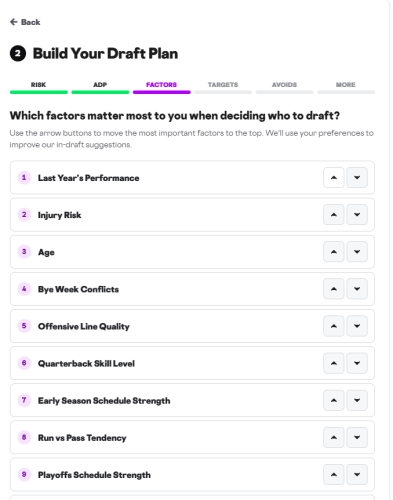
If you need to workshop some things before you play on DraftKings, we've got your back. We just launched a best ball mock draft simulator that is fully customizable. Choose your draft slot, craft your draft plans to your exact preferences and test out your strategies for free.


Of course, you can also check out our DraftKings Best Ball rankings to get an edge on the competition. I've also got a best ball bye week and fantasy playoffs cheat sheet to keep handy while drafting.
What is Zero RB draft strategy?
Simply put, Zero RB is a draft strategy where you eschew drafting running backs in the early rounds to gain an edge at receiver or tight end, and then backfill at running back by targeting lower-cost players with strong upside or contingent upside.
When has Zero RB worked?
Here's a great table from @BBDataMuse on Twitter that shows ZRB's viability over the years.
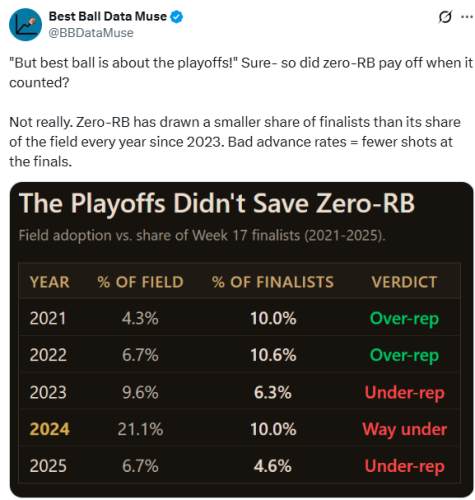
He follows it up with a truism that often gets overlooked: ZeroRB really only works if you get those late-round running backs right. That doesn't mean drafting RB36 and getting RB24 value. That doesn't move the needle enough. You need one or two of those late-round darts to absolutely smash. Raheem Mostert and Kyren Williams made people a lot of money in 2023, for example.
This year, the ADP tells a different story. More running backs are going early. It might not seem significant, but we now have 16 running backs going in the first three rounds (up from 15 in 2025). There are also more running backs going in rounds 3 through 10.
| Position | 2025 (picks 25–120) | 2026 (picks 25–120) | Change |
|---|---|---|---|
| RB | 19 | 22 | +3 |
| WR | 32 | 41 | +9 |
| QB | 15 | 18 | +3 |
| TE | ~8 | ~7 | -1 |
If you're waiting until the fifth round to take your first running back, your options are Quinshon Judkins (promising but coming off of significant injury in December), David Montgomery (all floor, no ceiling), D'Andre Swift (concern he doesn't build off of 2025) or Bucky Irving.
How Zero RB worked in 2025
| Finish | Player | Team | ADP Pos Rank | DK Pick | PPR Pts | Spots Gained |
|---|---|---|---|---|---|---|
| RB19 | Kenneth Gainwell | PIT | Undrafted | — | 229.5 | A Lot |
| RB22 | Rico Dowdle | CAR | RB54 | 174 | 220.8 | +32 |
| RB10 | Travis Etienne | JAX | RB34 | 99 | 276.5 | +24 |
| RB17 | Rhamondre Stevenson | NE | RB39 | 139 | 233.1 | +22 |
| RB16 | Javonte Williams | DAL | RB35 | 106 | 246.8 | +19 |
| RB21 | Jaylen Warren | PIT | RB30 | 91 | 222.8 | +9 |

If we jump into the time machine and go back to last summer, we can see how some of these big winners were in jumbled backfields that the market couldn't make up its mind on.
Travis Etienne was going in the same ADP neighborhood as Tank Bigsby and Bhayshul Tuten. Same for Javonte Williams with Jayden Blue, or Jaylen Warren with Kaleb Johnson (whoops). I wrote a little bit more on this earlier in the offseason in my best ball running back 2025 stats review.
Targeting those muddy backfields seemed to be the best way to extract extreme value at RB last season. Kenneth Gainwell was an outlier the likes of which we can't realistically project for this season. That is, unless you can tell me which RB3 is going to go mostly undrafted and finish top five in receptions among running backs. In which case, please tell me.
The other interesting detail from 2025 is that, outside of Gainwell and Dowdle (to a lesser extent), it was really hard to find a late running back who posted elite production. There was no 2023 Mostert or Kyren. It doesn't mean cases like those can't happen again, but it's important to acknowledge how unlikely those instances are.
How Zero RB can work in 2026
So, the winds are blowing in a direction that says Zero RB is dead. Maybe it is. The market continues to get sharper; the average drafter has more information at their disposal than even the top players had five or ten years ago. In the aforementioned RB article, I had some data that pointed to how difficult it has become to extract value at running back in the late rounds. Going back a few years, running backs taken in the last five rounds of drafts rarely combine to produce even one usable week on average.
There's added tension in that more running backs are taken in the first five rounds this year. Put another way, the market isn't going to let a top 15 running back just fall into your lap after you start with a robust group of receivers.
All the signs point to making sure you're building a good base at running back this year. Whether it's Hero RB or Robust RB, the conventional wisdom is to not play with fire and wait to start drafting your running backs.
But... wasn't that the same environment that opened the door for Zero RB to be viable in the first place? When everyone is adopting the same general strategy, there's going to be a lot of overlap in these massive best ball contests once we get to playoff time. Unique builds tend to be the ones that win in the end. You need something to differentiate yourself from the pack. I'm not saying for certain that Zero RB is the move this year. But definitively closing the door on that strategy seems misguided too. We just need to mold the principles of ZRB to this year's draft environment.
I'm going to toss out some running backs going late in drafts on DraftKings that I'm trying to get on my teams this summer.
- Sean Tucker (ADP 192): Bucky Irving (54.5) and Kenneth Gainwell (101.4) lead the Tampa Bay backfield and are solid picks at cost. There's something about that tandem that leaves open the possibility for a third contributor, though. Irving and Gainwell have overlapping skill sets. Last year showed that Irving might not be cut out for 17 carries a game, and scaling him back to 12-15 per game may keep him in better shape for the long haul. Gainwell had surprisingly good rushing results last year that may be a bit of a mirage, but he'll still be a solid pass game contributor. There is a need for some thump, though, and Tucker has that. Tucker was a workhorse at Syracuse who has looked solid when given the opportunity. He also has the best short-yardage profile of this group, which could mean some touchdown upside on the cheap. He may not unseat Irving or Gainwell on passing downs, but he's not a total zero there either; Tucker had 56 combined grabs in his final two seasons in college. The ADP is late enough to where it won't tank your team if he doesn't pan out. But it feels like there's under-acknowledged opportunity for Tucker to be a useful endgame target.
- Ollie Gordon (226.9): Not to compare Irving to De'Von Achane, but it's fair to say that Achane should probably max out at no more than 250 carries in a season. There will still be rushing work needed from the rest of this backfield. The market seems to disagree, though, or at least just assume that Malik Willis is picking up all the extra slack. Why throw your quarterback into the teeth of the defense when you have a 6-2, 225-pounder like Gordon who can do the dirty work? I'm not stumping for Gordon quite the same way I am for Tucker, and the team context is significantly worse. Even so, if I need a running back with one of my last two picks, I can at least squint hard enough to see Gordon as someone who can take on some volume and potentially some red zone work (we might not get a ton of red zone trips in Miami this year but alas).
- Tyler Allgeier (157.1): Allgeier's ADP understandably cratered when the Cardinals drafted Jeremiyah Love. Arizona will use Love as much as possible, but Love is another back who might have some volume limitations. Allgeier is the perfect complement to eat up carries effectively and keep Arizona's prized draft pick fresh. Dropping to the 14th round is an overcorrection. There will still be room for Allgeier to give 10-12 carries per game in the desert.
Circling back to the clustered backfields angle, the market has produced a few coinflips at ADP.
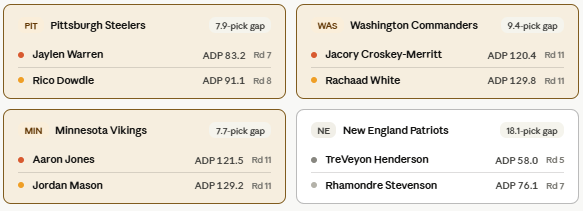
- Steelers: This is a rare instance where, even with the small ADP gap, there's a good chance that both Warren and Dowdle are good picks at cost. Warren understandably has the edge in DraftKings scoring with his plus-pass-catching ability. Aaron Rodgers being back confirms that there will be dumpoffs aplenty in this offense. Dowdle is more suited to taking on high rushing volume and might be in line for a lite version of what Najee Harris' role was a couple of years ago.
- Commanders: JCM and White seem to have the type of complementary skill sets to where they'll be able to coexist in this backfield. Croskey-Merritt needs to get it done as a rusher because he offers little in the passing game and White was signed for that exact function. Our RotoWire NFL projections are a little bearish on Croskey-Merritt's rushing volume, clocking him at 141 carries. If that's the case, Croskey-Merritt is the fade for me in this backfield and I'll be much more likely to side with White's pass-catching floor. Right now, White seems like, at worst, the No.3 passing game target on this roster. Maybe there's a case for taking a shot on Kaytron Allen (196) after all.
- Vikings: I don't like the looks of this backfield at all. The offense should be better this year with Kyler Murray at the helm, and more pass-happy at that. Prior to last year when Minnesota had to run the ball out of necessity, Minnesota ranked as one of the most aggressive passing teams in terms of PROE under Kevin O'Connell. Mason should be good for roughly the same rushing volume as last year but it's difficult to maintain the same efficiency (4.8 YPC). Jones, I fear, may be over the hill. The cliff certainly looked like it was here last year in his age-30 season when his rushing yardage and volume were basically cut in half due to injury, and his pass-catching numbers suffered, including a 4.9 YPR figure that was his worst since his rookie season. I'll side with taking Mason even in DraftKings' full PPR scoring, and I don't plan on having much Aaron Jones. I'm a little interested in the big-play ability that speedy rookie Demond Claiborne brings to the table in the 19th round...