

Some NFL players are known by their regular-season highlights: The 4,500-yard passer, the 1,800-yard rusher, the receiver who leads the league in touchdowns. But the more interesting question, and the one that wins NFL fantasy leagues and Super Bowls, is which players consistently raise their game when the schedule shrinks to one win-or-go-home contest at a time.
Our interactive graphic below shows you the players who are at their best in the postseason, with a description and methodology below:
This piece looks at every quarterback, running back, wide receiver and tight end with a meaningful playoff sample over the past 16 years. Then we ranked them by how much better their per-game efficiency was in the postseason compared to the regular season. The methodology is the same for every position: Take four stats that capture a player's per-game impact, calculate the difference between regular-season and postseason production, normalize each into a z-score and combine into a single composite.
The result isn't a list of the best players in NFL history. It's a list of the biggest playoff risers of the modern era: The guys whose tape gets better, not just bigger, in January and February.
Playoff Risers Methodology
For every player, we compared career regular-season per-game stats to their postseason stats. The composite uses four metrics per position, each standardized to its candidate pool's distribution:
· QB: Passer rating, TD%, INT% (inverted), passing yards per game
· RB: Yards per carry, rush YPG, scrimmage YPG, total TDs per game


· WR/TE: Receiving YPG, yards per reception, receptions per game, TDs per game
Filters: Postseason data tracked from 2010 onward, minimum 5 playoff games and minimum sample sizes by position to avoid one-game flukes. All player data is current through the 2025 NFL regular season and 2026 playoff games.
These insights should come in handy for playoff prop wagering at NFL betting sites.
Quarterbacks: Mayfield, Foles and the Modern Risers
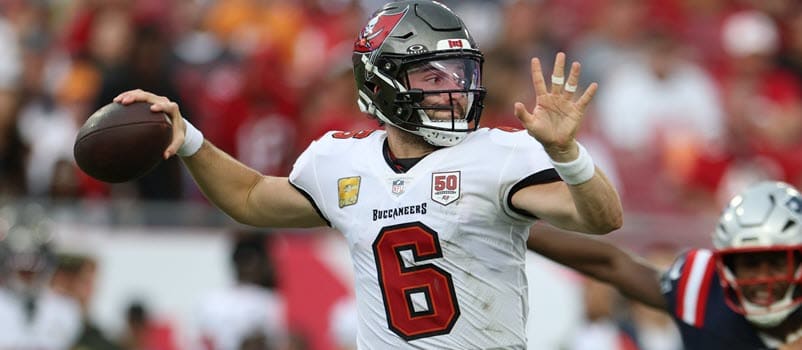
1. Baker Mayfield (CLE/CAR/LAR/TB, 2018-25): His 5 PO games include the 2020 wild-card win over PIT (Browns' first playoff win in 26 years) and the 2024 Buccaneers wild-card run. PO YPG of 267.6 sits 35.7 yards above his RS career mark for the kind of volume bump that defines a riser. His passer rating climbed from 91.2 in the regular season to 105.9 in 5 playoff games (+14.7), and his passing volume grew from 231.9 to 267.6 YPG (+35.7). Composite: +1.46.
2. Nick Foles (PHI/STL/KC/JAX/CHI/IND, 2012-22): The Philly Special. Took over for an injured Carson Wentz in 2017, won SB LII MVP, then won a 2018 wild-card game on the road. Career PO YPG of 272.2 vs 200.4 regular season, a +71.8 yard jump per game. His passer rating climbed from 86.2 in the regular season to 98.8 in 6 playoff games (+12.6). Composite: +1.21.
3. Josh Allen (BUF, 2018-25): 15 PO games (and counting). His PO rating of 92.4 sits above his career RS rating, and his rushing TD volume in playoffs (8 in 15 games) is historic. His passer rating climbs from 94.4 in the regular season to 101.4 in 15 postseason games (+7.0), and his passing volume grew from 235.2 to 261.0 YPG (+25.8). Composite: +0.89.
4. Patrick Mahomes (KC, 2017-25): 21 PO games, three SB rings. His PO TD% is barely below his elite RS mark and PO rating climbs in January despite a slight dip in passing volume. His passer rating climbed from 100.8 in the regular season to 105.4 in 21 playoff games (+4.6), and his passing volume barely dipped, from 285.2 to 276.9 YPG (-8.4), against elite defenses. Composite: +0.56.
5. Cam Newton (CAR/NE, 2011-21): His 2015 NFC Championship run took the Panthers to SB 50. PO TD% of 4.5 is above his 4.3 RS career rate, with a +41.3 YPG bump across 7 PO games. His passer rating climbed from 85.2 in the regular season to 87.7 in 7 playoff games (+2.5), and his passing volume grew from 218.8 to 260.1 YPG (+41.3). Composite: +0.48.
Baker Mayfield topping this list is one of the most surprising findings, but it's earned. The Browns' first playoff appearance in 18 years (in 2020) led to a wild-card win in Pittsburgh. After he joined Tampa Bay, the Bucs' 2024 wild-card run cemented the pattern. His PO passer rating is +14.7 above his regular-season mark.
Nick Foles cementing himself at No. 2 needs no introduction. His "Philly Special" Super Bowl run with the Eagles is one of the great backup-QB stories in NFL history. And Foles led Philadelphia to a 2018 wild-card win over the Bears (also while subbing for a hobbled Carson Wentz) means the playoff bump wasn't a one-game fluke. His +71.8 YPG postseason jump is the steepest volume swing in the entire QB pool.
John Allen (No. 3) and Patrick Mahomes (No. 4) top the volume leaders. But note, even at sample sizes of 15 and 21 PO games respectively, both maintain or improve on their elite regular-season baselines. That's the inverse of small-sample variance, proving that these are sustained big-game producers.
Running Backs: Playoff Damien and the Volume Bumps
1. Damien Williams (MIA/KC/CHI/ATL/ARI, 2014-23): "Playoff Damien" had 11 TDs in 6 PO games (6 rushing, 5 receiving) and 558 scrimmage yards, capped by SB LIV's clinching 38-yard TD. His PO scrimmage YPG of 93.0 vs his 26.3 RS baseline is the steepest jump of any modern RB. His TD/G climbed from 0.25 to 1.83. Composite: +2.92.
2. Saquon Barkley (NYG/PHI, 2018-25): His 2024 Eagles SB run was historic: 499 rush yds, 5.5 YPC, 5 TDs in 4 games. He has 7 career PO games at 102.7 rushing ypg, well above his 78.8 RS career mark. His scrimmage YPG jumped from 103.8 to 128.0 (+24.2) and his TD/G climbed from 0.67 to 1.0. Composite: +1.17.
3. Le'Veon Bell (PIT/NYJ/KC/BAL/TB, 2013-21): In Bell's 5 PO games (4 with the Steelers), he averaged 86 rush ypg (well above his 68.3 RS mark) at 5.2 YPC. His 167-yard, 2-TD effort vs MIA in 2016 wild card is one of the finer single-game RB lines of the era and he followed it with 170 rush yards the next game against Kansas City. His scrimmage YPG jumped from 102.5 to 104.2 (+1.7) and his TD/G climbed from 0.53 to 0.8. Composite: +0.85.
4. Derrick Henry (TEN/BAL, 2016-25): Four career 150+ rush PO games. Only he, John Riggins, Terrell Davis and Edgerrin James have multiple. Henry's 111 PO ypg ranks 4th all-time. His PO run in the 2019 season featured back-to-back games of 30+ carries vs NE and BAL. His scrimmage YPG jumped from 96.9 to 121.1 (+24.3) and his TD/G fell from 0.83 to 0.78. Composite: +0.75.
5. Leonard Fournette (JAX/TB/BUF, 2017-23): "Playoff Lenny" had 242 rush yds in two games during the 2017 Jags AFC Championship Game run. Then in the 2020 Bucs SB LV run, Fournette had 3 rushing TDs in 4 PO games. His scrimmage YPG jumped from 83.2 to 95.3 (+12.2) and his TD/G climbed from 0.51 to 1.11. Composite: +0.75.
The "Playoff Damien" nickname Williams earned with the Chiefs is the perfect representative of this list. He was a journeyman role player whose career averages look pedestrian. But not when you isolate the 2018-19 Andy Reid playoff runs and his Super Bowl LIV MVP-caliber game (104 rush yards, 1 rushing TD, 1 receiving TD, including the clinching 38-yard score). Across six career postseason games, he scored 11 touchdowns.
Saquon Barkley's No. 2 ranking captures the historic 2024 Eagles SB run, where he averaged 5.5 YPC across four games and rushed for 442 yards. Bernard Pierce slotting at No. 7 is one of the most obscure entries here. As a rookie he was Ray Rice's backup during Baltimore's 2012 SB XLVII run, averaging 6.3 YPC across the first three playoff games before Rice took over the workload in the title game. Cam Akers at No. 6 is another deep cut. He has two Super Bowl rings on three different rosters. Akers returned from a torn Achilles after five months in 2021 to lead the NFL in postseason carries.
Wide Receivers: Metcalf, Hogan, and the Postseason Specialists
1. DK Metcalf (SEA/PIT, 2019-25): He has had 5 PO games, four with Seattle. Averaged almost 100 receiving yards and outproduced his RS YPR substantially. His 160-yard game vs PHI in the 2019 wild card, his playoff debut, announced him on the postseason stage. His receiving YPG climbed from 64.1 to 98.6 (+34.5) and his YPR jumped +3.2. Composite: +1.97.
2. Chris Hogan (BUF/NE/CAR/NYJ/NO, 2013-21): He was the Patriots' postseason specialist. Set franchise PO record with 9 catches, 180 yds and 2 TDs vs PIT in the 2016 AFC Championship Game. The following season he had a 6-128-1 line in SB LII. His PO YPG of 60.2 more than doubled his 27.0 RS baseline across 9 postseason games. His YPR jumped +3.0. Composite: +1.76.
3. Gabe Davis (BUF/JAX, 2020-25): His 4-TD game vs KC in the 2021 divisional round is the single-game playoff record for receiving TDs by any player. His receiving YPG climbed from 38.7 to 61.0 (+22.3) and his YPR jumped +4.4. Composite: +1.53.
4. Christian Kirk (ARI/JAX/HOU, 2018-25): Big-game role player. The 2022 Jags run included a key TD vs LAC; the 2025 Texans run featured 8 catches for 144 yds vs PIT in the wild-card game. His receiving YPG climbed from 51.1 RS to 69.0 (+17.9), though his YPR dipped by 1.4. Composite: +1.43.
5. Jermaine Kearse (SEA/NYJ, 2012-18): Russell Wilson's go-to in big spots for Seattle. His "tipped catch" in SB XLIX was a highlight. Kearse had four PO TDs across two back-to-back Seahawks SB runs in 2014 and '15 seasons. His receiving YPG climbed from 33.2 in RS to 41.1 (+7.9) and his YPR jumped +3.0. Composite: +1.32.
DK Metcalf topping the WR list reflects his Seattle tenure, featuring multiple 100-yard performances and a YPR jump that outpaced his already-elite RS baseline. The 2019 wild-card 7-160 line vs PHI announced him as a postseason force. He's now with the Steelers.
Chris Hogan jumping into the WR top 3 is one of the most interesting findings. His career postseason YPG of 60.2 more than doubled his 27.0 RS figure, a remarkable signal-to-noise ratio for a player whose RS profile was that of a No. 4 receiver.
Gabe Davis at No. 3 deserves special mention. His 4-TD game at Kansas City in the 2021 division round is the single-game playoff record for receiving touchdowns by any player. Among the more recent additions, Khalil Shakir (No. 7) is operating as Allen's PO security blanket with 9 PO games already on his ledger.
Tight Ends: Kelce, Hurst, and the Modern Specialists
1. Travis Kelce (KC, 2013-25): All-time PO leader in receptions (178) after 25 postseason games. His per-game playoff stats rise above his elite RS baseline. Three Super Bowl rings. His 2023 PO run featured a 2-TD game vs BUF in the divisional round. His receiving YPG climbs from 67.7 to 83.1 (+15.4) and his YPR is almost level (0.3 lower in PO). Composite: +1.24.
2. Hayden Hurst (BAL/ATL/CIN/CAR/LAC, 2018-24): Bengals' 2022 PO surprise. He had 13 catches for 141 yds and 2 TDs in 3 PO games during Cincinnati's AFC Championship run. In 5 PO games (two for the Ravens, three for the Bengals) he averaged 38.8 ypg vs 22.4 RS (+16.4) and his YPR was +1.7 higher. Composite: +1.24.
3. Colby Parkinson (SEA/LAR, 2020-25): Quietly solid postseason role player for SEA (2022) and LAR (2024-25) in 6 PO games. Postseason YPR jumps from 10.2 RS to 12.5 (+2.3), including a 14.5 average in the Rams' 2024-25 PO runs. His receiving YPG climbed from 15.3 to 31.3 (+16.0). Composite: +1.21.
4. Jesse James (PIT/DET/CHI/CLE, 2015-22): Steelers' No. 2 TE during the Big Ben late-era PO runs. He had 6 PO games at 28.5 ypg vs 14.9 RS (13.6), with PO YPR of 13.2 well above his 9.7 RS career mark. Composite: +0.79.
5. Dalton Schultz (DAL/HOU, 2018-25): Cowboys and Texans red-zone target. He has had 11 PO games with TDs/G ratio of 0.36 vs 0.22 RS. Schultz has had a resurgence with CJ Stroud in HOU. His receiving YPG climbed from 32.8 RS to 41.5 PO (+8.7) and his YPR is +2.3 higher. Composite: +0.69.
Travis Kelce at No. 1 is impressive for a different reason than the others on this list. His sample size is enormous with 25 career postseason games, the most in this study across all positions. But his per-game stats still climbed from his elite regular-season baseline. He's the all-time NFL leader in playoff receptions (178) by a wide margin. The fact that his composite z-score is positive at that volume is a testament to consistency.
Hayden Hurst's emergence at No. 2 reflects the Bengals' 2022 PO run more than anything else. He had 13 catches, 141 yards, 2 TDs across 3 games as Joe Burrow's go-to seam-stretcher in the middle of the field. Combined with his earlier Ravens divisional round appearance, that's 5 PO games at 38.8 ypg vs. his 22.4 RS baseline.
Colby Parkinson at No. 3 is the deepest cut on the TE list as he has put together solid numbers for SEA (2022) and LAR (2024-25).
What the Composite Doesn't Tell You
A few notes on the limits of this exercise:
· Sample size matters. A 5-game playoff sample (Metcalf, Hurst, Pierce, Kirk) is more volatile than a 21-game sample (Mahomes) or 25-game sample (Kelce). Players ranked highly with smaller samples should be viewed with a touch more skepticism.
· Volume vs. efficiency. Some players (Cam Akers, Aaron Jones) climb the list because they get more touches in the playoffs as the offensive workhorse, even if their per-touch efficiency holds steady or dips slightly. The composite credits per-game volume bumps as a real form of "rising."
· Quality of opposition. Playoff defenses are, on average, better than regular-season defenses. A player whose composite is just a hair positive might be a stronger relative performer than the raw number suggests.
· Era-adjusted scoring. This study compares each player to their own regular-season baseline, which controls for era to some extent. But the 2010s and 2020s both feature passing-friendly rule sets, so cross-era comparisons within this pool are reasonable.
Players Who Underperform in Playoffs
It's worth noting for context that some players in this same dataset notably regressed in their postseason production. That list includes George Kittle (-29 receiving YPG diff), Mark Andrews (0 PO TDs in 8 games), and Mike Evans across 8 PO games. Those numbers do not diminish their star power, it just means the postseason wasn't always kind to them. Among QBs, Ryan Tannehill (-74.2 YPG) and Jimmy Garoppolo (-25.9 YPG) saw the biggest passing volume drops in the postseason.
The players at all four positions, with regular-season vs. postseason splits across all four metrics, are available in the interactive widget above. Click any player row to expand their narrative and see their full stat differential.