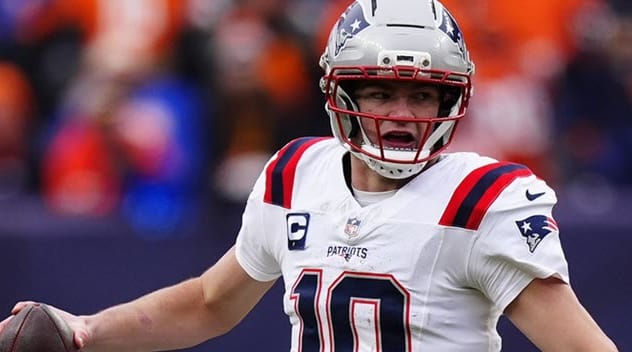
This article series will look at the top fantasy football rookies of 2026 and break down their fantasy football upside.
By examining the full scope of their talent level and their projected opportunity, the player's merit is weighed against their draft ADP to determine their cost-adjusted value to fantasy drafters.
This entry will look at Nicholas Singleton, who was drafted by Tennessee in the fifth round of the 2026 NFL Draft (165th overall) out of Penn State.
You can read prior entries on Mike Washington (here), Kaelon Black (here), Emmett Johnson (here) and Jadarian Price (here).
SKILL SET
Singleton (6-0, 219) is a bigger running back yet sometimes doesn't really look like one at a glance, running with a fairly upright gait and displaying gracefulness that is more so associated with the receiver position. Particularly when playing next to the tank-like Kaytron Allen, Singleton looks almost light even though he is not.
Another reason Singleton sometimes looks like a wide receiver is because he can run advanced routes for a running back, threatening defenses with real routes downfield instead of just spamming the flats. Given that he can gracefully run multi-part routes out of the backfield Singleton can probably run routes when split out wide, too, upping his matchup appeal especially when playing linebackers who can't cover.
The pass-catching detail with Singleton is important because his relatively upright build and modest anchor (for his weight) might make it difficult for him to accumulate and withstand league-leading rushing volume, especially power concepts at volume, while remaining sufficiently rested for a high-volume receiving role. Singleton's most unique trait might be his pass-catching ability, and it might therefore be his best route to earning a role in a game plan as a rookie.


Though it's possible Singleton would have held up as a true workhorse at Penn State, he and Allen split the Penn State backfield each of their four collegiate seasons, with Singleton generally trending toward passing and goal-line situations while Allen handled most power concepts between the 20s. If Singleton ever reaches something like a full-time role from scrimmage then he might need his receiving production to pick up some of that slack that he otherwise leaves to a power-specialist teammate. The good news is Singleton pretty obviously has that ability, to the point that he might be as dangerous of a pass catcher as any running back in the class.
If Singleton has a true limitation it might have to do with his processing between the tackles, where he sometimes seems to guess more than truly read the developments ahead of him. Singleton plays with plenty of motor and that raw power shows up especially when it's time to drive the pile, but when reading zone concepts Singleton might make decisions that irritate his coaches.
Singleton's rushing production at Penn State was clearly good, however, and when you factor in his athleticism it seems likely that Singleton will translate to the NFL level as a pure runner, even if there are certain play designs that suit him worse than others. Plenty of running backs see their usage accommodated to their traits, and someone with as much big-play ability as Singleton warrants such accommodations.
Despite the complaints about Singleton's rushing tape and the somewhat trendy narrative that Allen was the better player at Penn State (false), Singleton's production on the ground was unambiguously better than Allen's. Allen was productive in his own right for the Nittany Lions, averaging 5.4 yards per carry with a touchdown rate of 5.07 percent over 769 attempts, but Singleton's average of 5.6 yards per carry with a 7.24-percent touchdown rate over 622 attempts was still plainly superior.
Keep in mind, touchdown rate is a downward pressure on yards per carry. There is less potential yardage gained on a carry the closer it occurs to the end zone, and in Singleton's case it indicates an unusual number of instances where the end zone made the 'tackle.' In other words, if Singleton hadn't seen so many red-zone carries for Penn State his rushing average would be even higher.
Underrated runner he might be, but Singleton's most unique strength is potentially his pass catching. Over the last three years Singleton turned 118 targets into 91 receptions for 902 yards and eight touchdowns (77.2 percent catch rate, 7.6 YPT).
ATHLETICISM
Despite his above-average weight, Singleton boasts clearly uncommon athleticism. He couldn't do pre-draft testing due to a broken foot, but the belief is Singleton runs something in the mid-4.4s or better. Singleton had plenty of big plays in college, and the one that maybe best clocked his speed was his 59-yard carry against Indiana in 2025, when he was just barely ran down by D'Angelo Ponds (No. 5), who ran a 4.37-second pro day 40. It would therefore be fairly surprising if Singleton's 40 were worse than a Combine 4.47. That time would be a 78th-percentile figure according to Mockdraftable, and at a 68th-percentile weight. The assumption is Singleton's speed is more like an 85th- or 90th-percentile figure, though.
Singleton is also physically strong – he has all the raw strength you'd expect of a 220-pound back, even if doesn't have quite as much natural anchor as you'd hope. When he gets his feet set and his pads low Singleton can pack a wallop in his own right, though if he's at a full sprint he's less likely to stay anchored.
As noted previously in the Skill Set section, Singleton appears to have a wealth of natural pass-catching ability, with regard to both route-running and hand coordination. Needless to say, speed like Singleton's makes him loud after the catch.
COMPARISON AND 2026 PROJECTION
Singleton is an unusual prospect, and one who probably lacks a direct comparison. The players who do compare tend to be quite good, however.
The size/speed distinction with Singleton quickly narrows down the list of viable comparisons, and then the pass-catching variable thins it further yet. What's left is mostly names of NFL players who weren't just good, but were among the best fantasy running backs of their eras.
The absolute worst-case comp you can make for Singleton would probably be Mario Fannin or Damien Williams, two toolsy plus pass catchers in the 220-pound range. This would be an uncharitable comparison because Singleton's production very clearly dwarfs that of Fannin or Williams. Similarly, the Isaac Guerendo comparison on Singleton's NFL.com prospect page doesn't make any sense for production reasons.
When you apply the athleticism and production queries the names that most closely match Singleton are probably DeMarco Murray and especially Matt Forte. Murray (4.37 40 at 6-1, 213) and Forte (4.44 40 at 6-2, 217) were both tall running backs with excellent 40 times, and they both were plus pass catchers in college. Murray played his NFL peak at something closer to 230 pounds, though, so unless Singleton bulks up similarly then Singleton would more so trend toward the Forte track.
The Forte comparison also works because Forte's NFL production never featured sustained high-volume rushing – Forte surpassed 1,093 rushing yards in only two of his 10 NFL seasons, with injuries getting in the way more than a few times.
Comparison: If Matt Forte is too spicy of a comp for Singleton then you could also identify other running backs whose production profiles were defined by medium rushing volume but high pass-catching volume. Something like a smaller David Johnson or a faster Edgar Bennett might be another viable framing.
2026 Projection and ADP:
As of June 8 Singleton's best ball ADP is 182.0 (RB55) on Underdog and 216.25 (RB55) in NFFC Best Ball Championship drafts.
This places Singleton around fellow runners like Tank Bigsby, Sean Tucker, Emanuel Wilson, Emmett Johnson, Alvin Kamara, Mike Washington, Ray Davis and even Penn State teammate Kaytron Allen.
Of course, all the running backs available this late in the ADP have shaky projections. None of them is assured playing time, and in at least a couple of the cases we have reason to doubt the talent of the players in question.
There are big-platform pundits who would argue that Singleton is one of those whose talent is in doubt. I don't agree. I think Singleton's talent, even if not perfectly well-rounded, is fairly obvious. I think we'll all have a big laugh not long from now about how so many touts rallied around Mike Washington as the RB2 while otherwise castigating Singleton for being a Speed Merchant or whatever else. It's objectively applying a double standard to say Washington is good but Singleton is not. You can believe both are bad or argue like I do that Singleton is good and Washington is not, but anyone who says Washington is good and Singleton is not just isn't serious.
With that said, even if Singleton has the talent he still is all but guaranteed to enter the year as the RB3 on the Titans depth chart behind starter Tony Pollard and RB2 Tyjae Spears. Pollard is clearly an adequate starter and Spears, though durability challenged, is particularly skilled as a pass catcher.
Singleton's best route to getting his foot in the door might be as a pass catcher, where I'd argue he's already the best option on the team. Just the same, Spears is a good receiver for his own part, and it's unlikely that Spears would struggle so much that the Titans would turn to Singleton as an alternative.
The macabre reality is that for Singleton to accumulate so many as 300 snaps in 2026 it will likely require an injury to one of Pollard or Spears. Neither Pollard nor Spears is a workhorse, so there should be room for two Tennessee running backs to feature extensively, but if Pollard and Spears are both healthy Singleton will probably struggle to crack 20 snaps in any given game.
The "good" news here is that Spears probably carries as much or more injury concern than any running back in the league – it's why he's not a starting candidate in his own right – and as a sub-210 pound 29-year-old back Pollard doesn't project for big volume capacity, either.
In the event that Pollard or Spears misses time, Singleton could quickly become a useful fantasy back. The volume and pass-catching upside with Singleton objectively stands out in this range. If you're considering an assortment of players who all have low playing time projections then you might as well bet on talent and upside, which Singleton clearly offers at his current price.
For the long-term Singleton projects as a viable starter, including potentially in Tennessee. That transition could begin as soon as the next time either of Pollard or Spears get hurt. Although he would ideally trend closer to 250 carries annually than 300, instead prioritizing his pass-catching volume, Singleton projects for more volume capacity than a lot of current NFL starters, including Pollard.
Warped perspective has caused much of NFL media to overlook the fact that Singleton is one of the most athletic running backs in the NFL with one of the best pass-catching tools at the position. If the public plainly understood Singleton that way then I think his ADP would be higher than it is right now. The people who hype Washington and bash Singleton have a fair amount of influence, and as long as their false teachings spread the Singleton skepticism will continue to permeate the ADP.
For 2026 Singleton stands out in his range of the ADP as a no-floor, high-ceiling option. If you need bankable floor then Singleton cannot give you that as long as Pollard and Spears are healthy, and in best ball you won't want to go crazy with exposure given that Pollard and Spears could stay healthy all year. Singleton is the biggest, fastest, strongest Titans running back and potentially their most skilled pass-catching back, on the other hand, and you can't say the same about any of the other running backs in his range of the ADP. The Titans probably got away with a steal.