

Winning a dynasty championship is fun. Rebuilding can be too. But there's nothing fun about getting stuck in the middle of the standings, especially if it keeps happening year after year.
Dynasty league strategy starts with an honest assessment of our team and the competition in our league. If the reality is something like "borderline playoff team" or "I can make a run if a bunch of stuff breaks right"... The hard-to-swallow truth is that it's probably time to rebuild.
If the assessment is more optimistic — like third- or fourth-best team in a fairly balanced league — we still need to set out on a course of action. The reality of dynasty fantasy football strategy is that teams naturally tend to go through competing/rebuilding cycles anyway; our advantage lies in accepting this and leaning into it, not trying to fight it. When done properly, the 'compete' phases can last a half-decade while the 'rebuild' phases will only be 2-3 years apiece.
The goal for most teams in the middle of the standings? Find a path to the top, or else a path to the bottom. And since I've already written up my strategy for tanking and rebuilding, this article will focus on the win-now side of things.
1. Re-consider the Rebuild
Ok, I lied. We aren't getting to win-now strategy just yet. Hopefully I don't sound like a broken record in making one last case for the tank-and-rebuild path in borderline situations.
A mediocre dynasty team typically has 1-2 prime assets and a handful of other players with some degree of value (equivalent to a rookie second-round pick or more). If we decide to tear this team apart and tank during the 2026 offseason, we can get a massive haul of draft picks while also setting up our own 2027 pick as the favorite to be first overall (Jeremiah Smith scenes?).


Our team will be terrible in 2026, and probably also in 2027, with the realistic goals* being playoff contention in 2028 and championship contention in 2029. We sacrifice the shot at a playoff appearance in 2026, but we also avoid an ugly worst-case scenario in which our team misses the 2026 playoffs and some of our key players lose value, thrusting us into a forced rebuild during the 2027 offseason.
We're now starting our rebuild a season later, likely without the 2027 1.01, and with fewer valuable veterans to net top picks in trades. Now we can expect our non-competitive cycle to last 3-4 years rather than 1-3 years, which means no playoffs until the 2030s. I'd also argue that starting a tank-and-rebuild from a lower point (in terms of cumulative roster value) usually equates to a lower ceiling for the team down the road.
*I once pulled off a full tank/rebuild with just one gap year (0-14 record) between playoff appearances, but that involved some ridiculous luck whereby a tanking strategy — De'Von Achane, Raheem Mostert and Chuba Hubbard as my only warm bodies at RB — ended up being the ideal late-round RB strategy for 2023. It's otherwise best to assume two years of non-competitiveness during a full tank/rebuild.
2. Not Rebuilding? Figure Out Who Is.
If we're not rebuilding, we should be aggressively trying to win. The obvious way to do this is trading draft picks for veterans, but that usually means flat-out overpaying, or at least operating at a steep discount rate — strategies that are rarely optimal unless we have a championship-caliber team with a specific need or weakness to be addressed.
Every league is different, but I've generally found progress hard to come by when discussing blockbuster trades between two competing teams. If we're going to find value that can help us right now, it'll likely be by trading with the league mates who know they can't win this year.
Once we've identified that team, or those teams, there's nothing wrong with discussing their top assets. Ideally, we'll catch someone who is over-anxious to rebuild and willing to sell off good players for less than they are worth in draft picks.
More likely, we won't be able to work out the mega-deal but can pivot to a smaller trade, ideally targeting players who have some of the characteristics discussed below...
3. Target Risky Players
Risk is often a bad thing for someone sitting in the catbird seat as a league favorite. Risk is our best friend when we're the plucky upstart trying to turn the fourth-best roster in our league into a title contender.
For us, Brian Thomas is a 2024 first-round pick who had 1,282 yards as a rookie; he's not the guy who looked scared to play football (at times) in 2025.
Rashee Rice is the guy who averaged 17.7 PPR points per game over the past two seasons, not the guy who only played 12 games over the past two seasons because he pleaded guilty to two felony charges, served an NFL suspension, underwent multiple knee surgeries, and then got caught violating probation — ok, not my favorite example, but you get the idea.
We want to pursue players with high ceilings who won't cost an arm and a leg, perhaps trading away similarly valued assets who are viewed as 'reliable' rather than 'high upside'. It's often the case that the high-ceiling, low-floor profiles are also your breakout candidates, bounce-back candidates, etc... the guys who inspire endless arguments about ADPs and have league-mates threatening to smash virtual dynasty trade calculators.
Examples that come to mind include WR Brian Thomas, WR Rome Odunze, WR Ricky Pearsall, RB TreVeyon Henderson, RB Cam Skattebo (ankle), RB Bucky Irving and RB Jonathon Brooks.
I also like TE Isaiah Likely, WR Matthew Golden, WR Jayden Higgins and WR Jalen Coker as affordable breakout candidates, all sporting redraft ADPs outside of the Top 100 and dynasty ADPs well shy of the Top 50.
4. Stack Teammates
The idea here, if you haven't figured it out, is that we need to embrace variance if we're gunning for a championship despite starting from a lower point talent-wise than the other contending teams. Safe and boring might not get us a playoff spot, and even if it does, we'll be an underdog in most matchups.
The idea is to take a real crack at joining the league's heavyweights, making big bets with the potential for big rewards (and accepting that we'll probably need to tank the following season if it doesn't work out well).
As with DFS or best ball, the easiest way to increase lineup variance is by stacking QBs with their pass catchers. This is especially true in two-QB and superflex formats, where we can theoretically stack two different offenses (including QB) to account for half or more of our lineup spots.
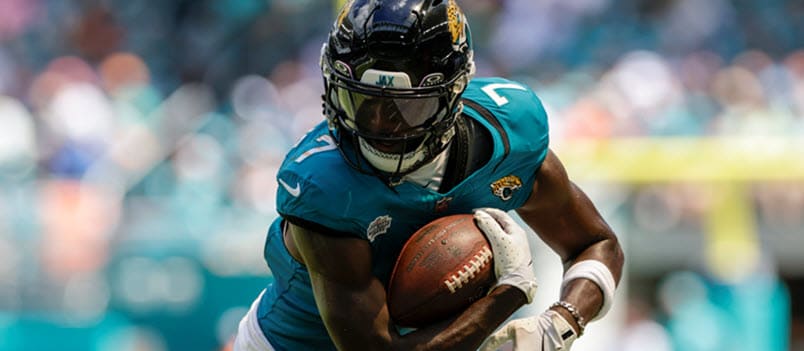
I'm a big believer in Liam Coen and already have Trevor Lawrence on three of my five dynasty teams, so I might try to trade for players like BTJ, Parker Washington and Bhayshul Tuten as a double/triple-down on Jacksonville's offense (BTJ and Tuten also happen to have high-risk, high-reward profiles independently).
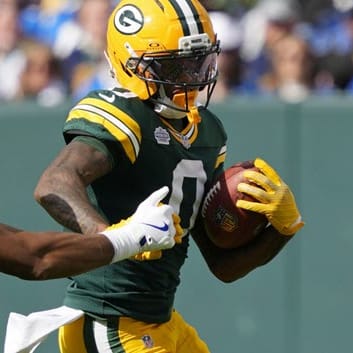
If you're interested in digging a little deeper... a Jordan Love manager might start to dream on upside scenarios for Green Bay's passing game. What if Josh Jacobs is suspended or injured and the run-first offense becomes a pass-first attack? Who benefits besides Love?
None of the answers is prohibitively expensive, including two RBs (Chris Brooks and MarShawn Lloyd) who can be found on the waiver wire in many dynasty leagues. The guys I'd target in this situation are Brooks and WR Matthew Golden, but I'll also listen to upside arguments for most of the others.
5. Know Your League
I don't just mean the people in it; we also should be very aware of everything from the playoff format to scoring settings.
Leagues with byes in the first round of the playoffs create added incentive to lean towards the extremes of tanking or win-now, because sneaking into the playoffs means less while earning the top spot(s) means more.
On the other hand, in leagues with four playoff teams and no byes, it's easier to justify a slow-and-steady approach, trying to make the playoffs each year even if it's just as the No. 4 seed. Simply put, there's less incentive to go all-in for the top spot when there's no actual advantage to that spot come playoff time (apart from the likelihood that you have the better team). A truly dominant squad might be a 65/35 or 60-40 favorite in its first-round matchup, but that still doesn't compare to getting a free pass through the round.
We should also consider how the number of lineup spots can impact variance, and thus strategy. In a dynasty league where each team only starts eight players, we're looking at higher variance for the lineups as a whole, i.e., the lesser fantasy team will tend to have decent odds of upsetting the superior team.
Now take a league that has 13 starting spots or best-ball scoring, where variance tends to carry less weight each week and the better teams tend to win more often. In this type of league, we're better off with the all-or-nothing approach, trying to build a juggernaut even if it takes years to do so. Sneaking into the playoffs year after year will just lead to a lot of anger and frustration anyway.