

This article identifies rookies and second-year players who are fantasy football sleepers for the 2026 season. These players have the talent to post big numbers out of nowhere in the 2026 NFL season if the pieces fall the right way.
The breakout candidates are listed from most expensive to least expensive ADP.
For up-to-the-minute updates on injuries, news and everything going on around the NFL, head to RotoWire's NFL Fantasy Football News Today or follow @RotoWireNFL on X.
Bhayshul Tuten, RB, JAX
The Jaguars eased Bhayshul Tuten onto the field as a rookie fourth-round pick, giving him short-yardage and kick-returning duties while Travis Etienne handled the starting role and fellow rookie LeQuint Allen handled blitz pickup. With Etienne off to New Orleans, there's a much bigger opportunity for Tuten in his second season.
As much as free-agent pickup Chris Rodriguez offers the Jaguars a unique power element, Rodriguez is not a candidate to claim any of Etienne's targets. Even if Rodriguez picks up a good chunk of the rushing workload that previously went to Etienne, Tuten should pick up the majority of the passing-down reps vacated by Etienne's departure.
If Rodriguez were to miss any time then at that point Tuten would probably be a 1:1 replacement for Etienne. Tuten's main challenge is to prove ball security after fumbling too often in college. He has the speed and the power otherwise.
Stay informed with fantasy football news and track usage roles with the NFL depth charts.


Jayden Higgins, WR, HOU
Although the Texans are headed more toward a tight end-heavy offense, it shouldn't be an issue for Jayden Higgins, who appears locked into a three-down role in the boundary rep opposite Nico Collins.
Increased tight end reps mostly occur at the expense of the slot wide receiver, because the tight end usually takes the inline or slot rep. That makes Marlin Klein and Foster Moreau a problem for the likes of Jaylin Noel and Tank Dell rather than Higgins.
Higgins (6-4, 218) is a prototypical boundary receiver and has almost identical athletic testing to Collins, who has an extensive injury history at the NFL level. Higgins is a potential WR1 in the future and should take the next step as Houston's WR2 in the meantime.
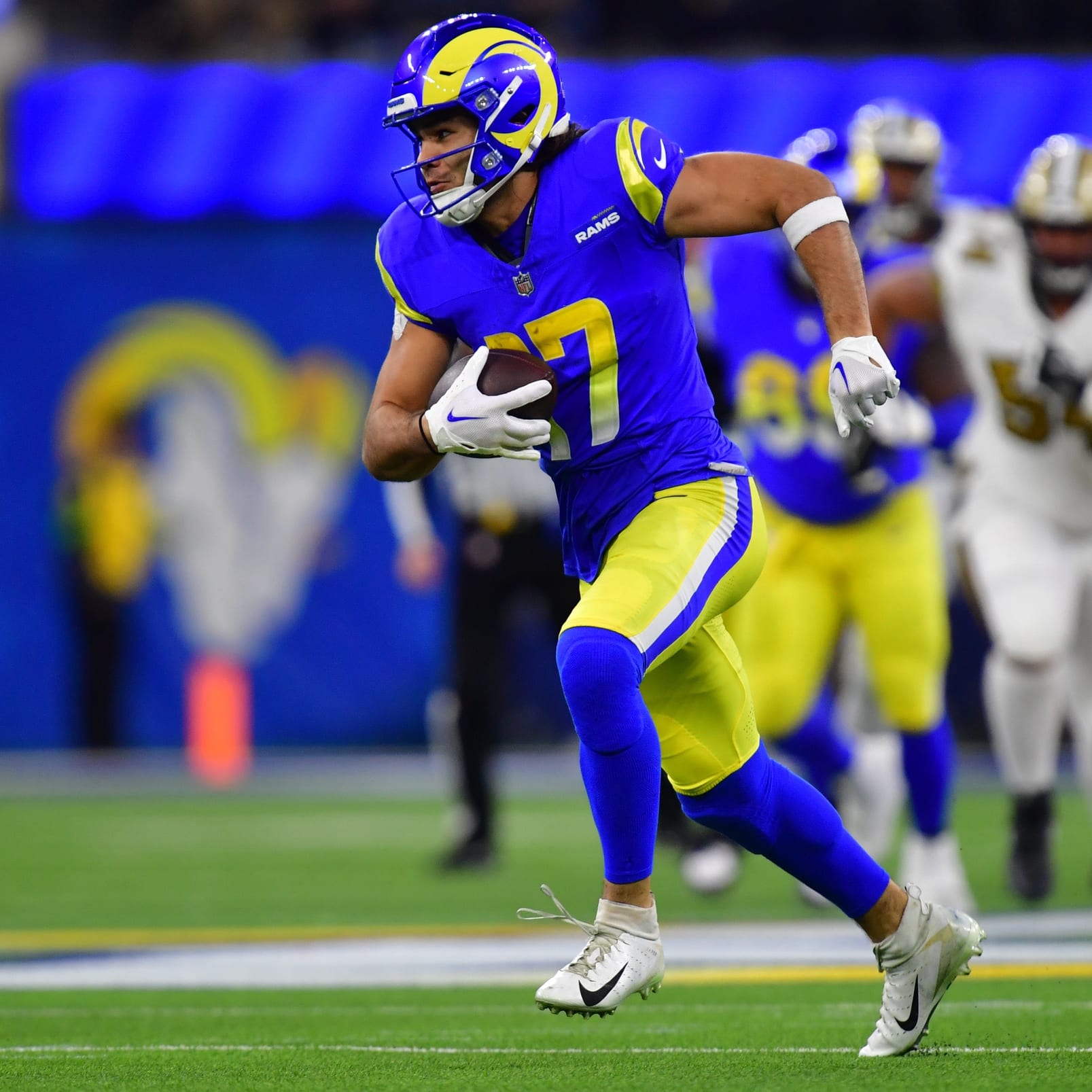
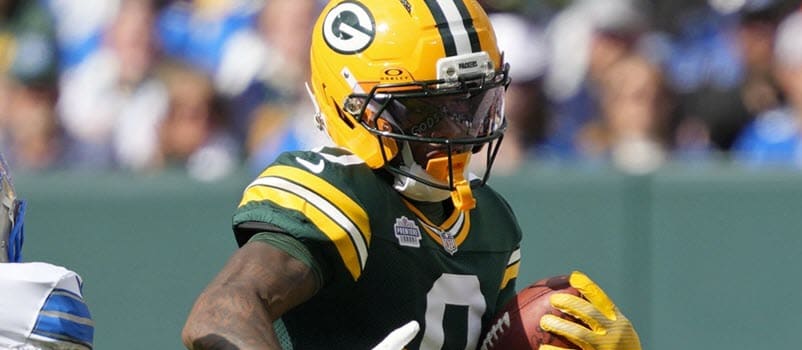
Matthew Golden, WR, GB
Matthew Golden's rookie year was a bummer and he heads into his second season with a lot to prove. The good news is he'll get every opportunity to prove himself in 2026.
With Romeo Doubs, Dontayvion Wicks and Malik Heath subtracted from the Green Bay wideout rotation there's much more slack for Golden to exploit as he heads into his second season. Those three receivers combined for 138 targets and 1,394 snaps in 2025.
Golden and his 4.29 speed should settle in fine at the flanker rep for Green Bay this year, in a season where the Packers might need to throw more due to defensive regression.
Jonah Coleman, RB, DEN
Jonah Coleman (5-foot-8, 220) is a human fire hydrant whose easy anchor and developed all-around skill set make him easy to plug into a lineup. For the Broncos that will likely be as the RB3 behind J.K. Dobbins and R.J. Harvey, but neither player has shown the ability to withstand volume at the NFL level.
Before Denver spent a fourth-round pick on Coleman they had no semblance of raw power in their backfield after Dobbins, who isn't even a pure power guy himself. Given Dobbins' uniquely bad injury history, Coleman is closer to the field than most RB3s, and if Dobbins were to miss time Coleman would likely become Denver's primary goal-line runner.
Harvey is Denver's best receiver at running back, but Coleman is capable as a receiver in his own right and probably offers better blitz pickup ability than Harvey, who's about 15 pounds lighter than Coleman at the same height.
Tre' Harris, WR, LAC
Tre' Harris will begin the year as the Chargers' WR3 behind Ladd McConkey and Quentin Johnston, which might in function be more like the WR4 when you account for TE/WR tweener Oronde Gadsden. There's still reason to consider Harris as a depth pick or at least keep him on your FAAB speed dial going into 2026.
Johnston's hands sometimes fail him, while McConkey to this point has often been failed by his durability. Of the three Harris is by far the most rugged – better hands than Johnston, and a better blocker than both.
You'll sometimes see talk about how new offensive coordinator Mike McDaniel will unleash YAC potential for Johnston, but that premise could just as easily apply to Harris. If anything, Harris has questions to answer about his downfield route-running ability. Harris' hands and ability after the catch are a clear cumulative strength that exceeds Johnston and matches McConkey.
Emmett Johnson, RB, KC
Emari Demercado will likely begin the year as the RB2 behind Kenneth Walker, so any Emmett Johnson investors need to be patient while the Chiefs ease Johnson in as a rookie fifth-round pick.
With that said, if Demercado initially plays ahead of Johnson it will likely be due to Demercado being better in blitz pickup. The Chiefs intend to give steady or even heavy work from scrimmage to Walker, and to do that they'll probably try to offload blitz pickup work to Demercado.
This is just to say that while Demercado might be the RB2 on the depth chart and the first one off the bench, that would not remain the case if the Chiefs' priority on those snaps shifted to producing from scrimmage. Demercado is more trusted than Johnson in blitz pickup, but if you need someone to advance the football from scrimmage it's Johnson who will likely prove superior.
In other words, if Walker were to miss time you might not see much difference in Demercado's workload from scrimmage – much or most of the work might just transfer to Johnson, who's a better pure runner and especially a better receiver than Demercado. Actually, Johnson is probably a better receiver than Walker, too.
Isaac TeSlaa, WR, DET
Kalif Raymond is off to Chicago and with that there is room in Detroit's snap budget for Isaac TeSlaa to push for something like 700 snaps in 2026, even if Amon-Ra St. Brown and Jameson Williams stay perfectly healthy.
TeSlaa played 438 snaps in 16 games as a rookie third-round pick, a season in which Raymond drew 357 snaps. While it's true that TeSlaa needs to increase his per-snap target rate after drawing only 27 last year, he's in line for a clear snap promotion and brings big-play ability especially downfield (4.43-second 40) and in the red zone (6-4, 214).
Zachariah Branch, WR, ATL
Zachariah Branch was an electric YAC threat at Georgia, but at 5-foot-9, 177 pounds his lack of size and lack of downfield collegiate production raised the fear that he might be more like a gadget receiver than a potential starter at the NFL level.
As much as those concerns might persist, the fact is the Falcons might be thin enough at receiver that they have little choice but to make Branch their WR2 behind Drake London. Branch's main competition otherwise appears to be former first-round bust Jahan Dotson.
With 4.35 speed Branch can certainly reach downfield depths, even if he was more so a screen-pass merchant at the college level. The Falcons could really use that speed to clear out more room for London, Bijan Robinson and Kyle Pitts. That speed might be Branch's ticket to something like 750 snaps as a rookie, in which case he might get just enough playing time to make a dent in PPR scoring.
Nicholas Singleton, RB, TEN
Robert Saleh was perfectly clear that Tennessee's RB1 is Tony Pollard and their RB2 is Tyjae Spears. That makes sense – Pollard and Spears are both good players.
Solid as their skill sets might be, durability is not the strong suit of either Pollard or especially Spears. Spears might be the greatest injury concern at running back league-wide, in fact, due to his recent history of concussions and his long-term history of knee concerns.
Nicholas Singleton will need to catch up to the nuances of the pro game as a rookie fifth-round pick, but like Coleman in Denver you can reason that Singleton is closer to the field than most other RB3s, because both of the guys ahead of him have volume limitations. Pollard is a former receiver who weighs no more than 210 pounds, and Spears projects for much less volume yet.
Singleton is bigger and much faster than either of Pollard or Spears. Similarly crucial is the fact that Singleton is a plus pass catcher, to the point that he might be the best receiver between himself, Pollard and Spears.
If Pollard or Spears misses any time Singleton immediately becomes important. Neither Pollard nor Spears can withstand a full workload, so just one of them missing time is a sufficient condition for Singleton and his loud athleticism to kick the door in despite beginning the year as RB3.
Jordan James, Kaelon Black, RB, SF
Christian McCaffrey withstood 413 touches from scrimmage in 2025 and now heads into his age-30 season. The 49ers want to get as much as possible out of McCaffrey, but to do that they somewhat paradoxically need to decrease his workload.
Whatever McCaffrey leaves on the bone won't be much by the time any of his backups get on the field, but he needs more relief all the same. Jordan James and/or Kaelon Black need to make that happen, because the 49ers have all but announced their intention to move on from Isaac Guerendo.
James heads into his second season as a former fifth-round pick out of Oregon, while Black is a rookie third-round pick out of Indiana. Though Black has clearly better draft capital, he was not invited to the Combine and was thus a shocking selection in the third round of the 2026 draft. James was almost universally regarded as a better prospect the prior year, even if he went in the fifth round. James more or less matched the production of former teammate Bucky Irving at Oregon, whereas Black was backup to the undrafted Roman Hemby. James is also more than two years younger than Black.
Whether it's James or Black who ultimately prevails, these two are worth watching closely for handcuff purposes at the very least.
Ted Hurst, WR, TB
Ted Hurst was too big and too fast for the defenders to have a chance at the collegiate level, where he played for Valdosta State and then Georgia State later. Hurst is probably raw as a result of how easily he dominated in college, but as far as raw materials go you can't do much better than Hurst.
Hurst is big (6-4, 206) yet logged a 4.42-second 40-yard dash at the Combine, registering a height/weight/speed combination reminiscent of Nico Collins out of Michigan. It's a trait set the Buccaneers could really use with Mike Evans off to San Francisco.
Raw as he might be, it's no issue for the Buccaneers since they have Emeka Egbuka, Chris Godwin and Jalen McMillan lined up as a strong three-wide loadout. If any of them were to miss time, however, Hurst and his loud big-play ability would become interesting.
Elijah Sarratt, WR, BAL
Elijah Sarratt could have the opportunity to emerge as the WR2 in Baltimore. The Ravens insist they're committed to Rashod Bateman as their WR2 behind WR1 Zay Flowers, and they might very well mean it. It still must be noted that Bateman's 2025 was a disaster, and he missed OTAs for personal reasons while new offensive coordinator Declan Doyle was working on installing Baltimore's new offense.
If Bateman were to suddenly leave the picture then in terms of targets it would allow Baltimore's WR4 to jump straight to the WR2 spot. That's because presumed WR3 Devontez Walker is more of a field-stretching decoy than a candidate to draw many targets per snap.
Bateman has an intermediate and underneath game more than a downfield one, and intermediate/underneath targets accumulate more quickly than the more difficult targets farther downfield. On those sorts of targets Sarratt and fellow rookie Ja'Kobi Lane project better than Walker, who trends toward the sideline and far downfield.
As much as Sarratt and Lane might platoon in the scenario of a Bateman absence, there's little doubt that Sarratt is the one better suited to make catches in traffic. Whereas Sarratt can thrive in the slot and easily withstand hits, Lane is more delicate and probably trends more toward the boundary, where he'd likely be blocked by Walker.
.
Dominate your fantasy football league this season by exploring our draft kit. Packed with expert insights, rankings and strategy tips, the draft kit features our interactive mock draft simulator to prepare you for every scenario. Streamline your draft-day decisions using our printable cheat sheet and stay ahead of the competition with our up-to-date rankings for all formats.