

The 2026 NBA Draft lottery is set, and Washington has the No. 1 pick for the first time since selecting John Wall in 2010. The headline names are familiar — AJ Dybantsa, Darryn Peterson, Cameron Boozer — but this class earns its hype on the back half: lottery-caliber wings, two-way guards and breakout transfers extending real first-round value well into the teens. Below is a full 2026 NBA mock draft lottery projection, matching prospects to teams based on fit, need and consensus draft intel, with a fantasy outlook for every pick — category-league fits, redraft round targets and dynasty holds.
2026 NBA Mock Draft Lottery: Picks & Fantasy Outlook
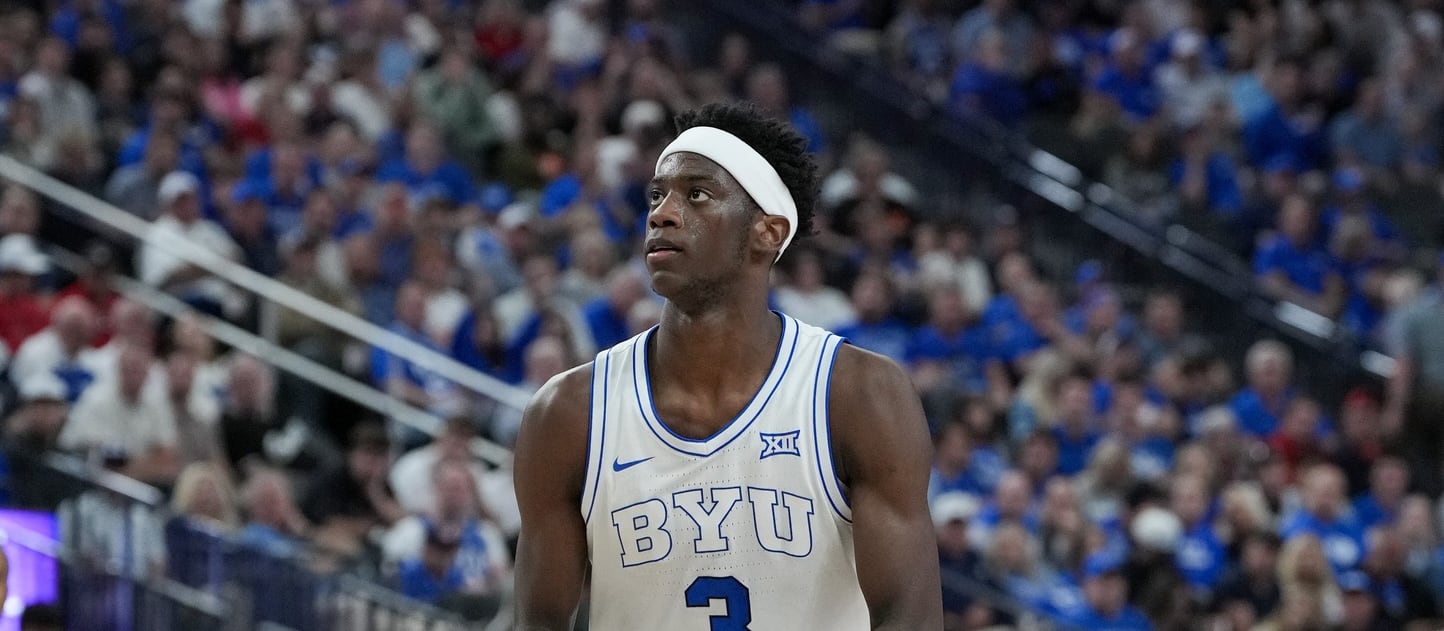
1. Washington Wizards — AJ Dybantsa, F, BYU (Freshman)
Washington pairs Dybantsa with Trae Young, Anthony Davis and Alex Sarr, giving the rookie a runway to be the primary wing scorer from Day 1, but he'll need to prove he's better than returning wings like Bilal Coulibaly and Kyshawn George from the jump. Dybantsa led the nation in scoring at 25.5 points per game on 51 percent shooting en route to the Julius Erving Award and consensus first-team All-American honors. His self-creation from the midrange is already NBA-caliber, and he gets to the line at an elite clip.
Fantasy outlook: Dybantsa should produce points and free-throw attempts immediately, with enough passing upside (3.7 APG in college) to flirt with secondary playmaking duties. Three-point shooting (33.1%) is the swing skill. If it climbs into the mid-to-high 30s, he's a fantasy All-Star within two seasons. The Washington fit could also be ideal, with Young drawing attention, Davis and Sarr cleaning up around the rim and Dybantsa operating in space created by Tre Johnson.
2. Utah Jazz — Darryn Peterson, G, Kansas (Freshman)
Utah slots Peterson alongside Keyonte George, giving the Jazz one of the NBA's most talented young backcourts. Peterson averaged 20.2 points per game on 44/38/83 splits in just 24 games at Kansas, with his availability limited by lower-body injuries and an illness. When healthy, he was the best shotmaker in college basketball.
Fantasy outlook: Peterson projects for scoring, threes and steals, but his field-goal percentage could be a negative in category leagues, at least to start his career. The health history and alleged lack of competitive motor were red flags, as he missed 11 games at Kansas, but the talent was always undeniable. If Utah hands him the keys early, the rookie could be an outstanding offensive producer from Day 1.
3. Memphis Grizzlies — Cameron Boozer, F/C, Duke (Freshman)
Memphis needs a foundational piece alongside (or eventually replacing) Ja Morant, and Boozer's passing from the post gives them a hub who can orchestrate offense from multiple spots. He averaged 22.5 points, 10.2 rebounds and 4.1 assists on 55.6/39.1/78.9 shooting splits as a freshman and swept every major national award, including AP Player of the Year.
Fantasy outlook: Boozer is the best all-around fantasy asset in this class. Points, rebounds, assists, percentages. When at his best, he will fill every positive category without hurting you. He's the closest thing to a Nikola Jokic archetype this class offers, though with an obviously lower usage rate. While Boozer is a relatively safe pick for a rookie, the biggest question will be how high his ceiling is.
4. Chicago Bulls — Caleb Wilson, F, North Carolina (Freshman)
Chicago pairs Wilson with Matas Buzelis, giving them two long, switchable forwards to build around. Wilson averaged 19.8 points and 9.4 rebounds on 57.8 percent shooting in 24 games before a fractured left hand and a subsequent broken right thumb ended his freshman year. His explosive athleticism and two-way impact made him just as productive as Boozer, Peterson and Dybantsa.
Fantasy outlook: Wilson is the league's best buy-low candidate if his injury concerns spook managers. When healthy, he projects for scoring, rebounds, blocks and steals, with the defensive stats being a huge differentiator. His 25.9 percent from three limits his floor in category leagues, but the athletic tools suggest his per-minute production will translate quickly. His fantasy value is tied to health and playing time, making him a slight risk. However, with the Bulls trending in the wrong direction, they should have no choice but to prioritize Wilson's development.
5. LA Clippers — Keaton Wagler, G, Illinois (Freshman)
With Darius Garland already in place at point guard, the Clippers pair him with Wagler, a 6-6 guard who shoots 40 percent from three and reads the floor with veteran poise. Wagler won the Jerry West Award and led Illinois to the Final Four, averaging 17.9 points, 5.1 rebounds and 4.2 assists per game. Wagler's size lets him play on- or off-ball, which is exactly what a Garland-led backcourt needs.
Fantasy outlook: Wagler is a three-point specialist with enough playmaking to avoid being one-dimensional, but his thin frame and lack of burst mean the counting stats may take a year or two to climb. With Kawhi Leonard and Garland leading the way, Wagler won't be thrust into a role he can't handle, but if his elite offensive traits translate right away, he could quickly become a go-to option for a Clippers team that's still trying to compete.
6. Brooklyn Nets — Darius Acuff Jr., G, Arkansas (Freshman)
Brooklyn needs a franchise guard, and Acuff is the most polished point guard in the class. He swept SEC Player of the Year and Rookie of the Year honors while averaging 23.5 points and 6.4 assists on 48/44/81 splits, joining Pete Maravich as the only players in SEC history to lead the conference in total points and assists in the same season. He won the Bob Cousy Award and the SEC Tournament MVP.
Fantasy outlook: Acuff could be a fantasy stud if he lands in the right situation. His 44 percent from three on meaningful volume is the headline from his college stats, as that kind of efficiency from a lead guard is rare. His lack of size may limit his defensive production at the next level, but the offensive profile is superb, and Brooklyn would be the perfect destination from a usage/fantasy standpoint.
7. Sacramento Kings — Kingston Flemings, G, Houston (Freshman)
Sacramento's guard depth has been a mess since they moved on from Tyrese Haliburton and De'Aaron Fox, and they desperately need to find a backcourt gem. Flemings, who won Texas Mr. Basketball and earned Jordan Brand Classic honors before averaging 16.1 points, 5.2 rebounds and 4.1 assists with 48/39/85 splits at Houston, fits the bill. His three-to-one assist-to-turnover ratio and renowned on-ball defense, honed under Kelvin Sampson, make Flemings the best two-way guard in the lottery.
Fantasy outlook: Flemings' defensive production could translate immediately, and the 39 percent from three with clean shooting mechanics suggests the offense will come. His combine measurements raised some eyebrows, but it's difficult to argue with his college production and what he put on tape. Flemings is certainly a wild card in this draft, but Sacramento would be an intriguing landing spot from a fantasy perspective.
8. Atlanta Hawks — Mikel Brown Jr., G, Louisville (Freshman)
Atlanta moved Trae Young and needs a lead guard with star upside. Brown was the top-ranked point guard in the 2025 class, a McDonald's All-American who averaged 18.2 points, 4.7 rebounds and 3.3 assists with 41/34/84 splits in 21 games before a back injury ended his season. When healthy, he looked like the most talented guard in this class, as his 45-point eruption against NC State set Louisville and ACC freshman records.
Fantasy outlook: Brown is the classic high-ceiling, high-risk dynasty pick. The back injury that cost him 14 games is the elephant in the room, and his 34 percent from three needs to improve. But his pull-up scoring, pick-and-roll playmaking and active hands on defense all point toward a potential All-Star if he stays healthy. Fantasy managers drafting Brown are betting on talent over polish.
9. Dallas Mavericks — Karim Lopez, F, New Zealand Breakers/NBL (Mexico)
Dallas pairs López with Cooper Flagg, adding a 6-9, 222-pound wing with a 7-1 wingspan who spent two professional seasons in Australia's NBL as a NextStars prospect. The 19-year-old from Hermosillo, Mexico, averaged 11.9 points, 6.1 rebounds, 1.9 assists, 1.2 steals and 1.0 blocks on 49/32/74 shooting in 25.6 minutes per game. He is projected to become the first Mexican-born first-round pick in NBA history. López is physical, coordinated and plays with an advanced feel for his age.
Fantasy outlook: López is a tough fantasy evaluation due to the talent gap from the Australian NBL to the NBA. His per-36 numbers flash legitimate multi-category upside, but he'll need to earn minutes in a Dallas rotation that already has Flagg commanding most of the touches. López's three-point shot is the clear developmental swing, but it may take him a few years to make a meaningful impact in the NBA, especially if Dallas tries to contend next season.
10. Milwaukee Bucks — Labaron Philon, G, Alabama (Sophomore)
Milwaukee's championship window is closing quickly, but a plug-and-play guard who can score off the bench could be just what they need. Philon, who averaged 22.0 points per game on 50/40/80 splits, is about as ready-made as it gets. His herky-jerky handle and three-level scoring made him the most improved player in the SEC this season, and his tournament run showed he elevates in big moments.
Fantasy outlook: Philon would be a sneaky fantasy asset in Milwaukee. If paired next to Giannis Antetokounmpo, Philon could see tons of open lanes and 1-on-1 coverage. If Antetokounmpo is traded this offseason, Philon would have a huge developmental runway, though he'd still have to compete for touches with Ryan Rollins and Kevin Porter.
11. Golden State Warriors — Nate Ament, F, Tennessee (Freshman)
Golden State has always coveted big wings who can shoot, pass and switch, and Ament's 6-10 frame with ball-handling ability fits their DNA. He averaged 16.8 points on 40/33/79 splits as a freshman and helped Tennessee reach the Elite Eight. The shooting percentages don't jump off the page, but the free-throw rate and mechanics suggest the three-point stroke will come.
Fantasy outlook: Ament is a long-term dynasty hold rather than an instant-impact redraft target. His rookie year in Golden State's system could look modest because the Warriors spread minutes and touches. But the positional size, foul-drawing ability and playmaking upside signal a breakout could be coming.
12. Oklahoma City Thunder — Yaxel Lendeborg, F, Michigan (Senior)
OKC adds another NBA-ready contributor to the league's deepest roster. Lendeborg was Big Ten Player of the Year and a consensus first-team All-American, averaging 15.1 points, 6.8 rebounds and 3.2 assists with 52/37/82 splits while anchoring Michigan's national championship run. At 23, he's older than a typical lottery pick, but his 7-4 wingspan, defensive versatility and connective offense fit exactly what contenders want.
Fantasy outlook: Lendeborg will likely produce more real-life value than fantasy value as a rookie. He's the quintessential "good player, bad fantasy situation" pick. In category leagues, his percentages, low turnovers and defensive stats offer some niche value.
13. Miami Heat — Aday Mara, C, Michigan (Junior)
Miami loves defensive identity, and Mara's 7-3 frame with quick feet and 2.6 blocks per game slots perfectly into a Heat culture that develops bigs (Bam Adebayo, Kel'el Ware). Mara anchored Michigan's title-winning defense and averaged 12.1 points, 6.8 rebounds and 2.6 blocks on 67 percent from the floor while fouling out only once all season. His touch around the rim, particularly his floater, gives him some offensive runway.
Fantasy outlook: Mara is a blocks-and-percentages specialist in fantasy. The 56 percent free-throw shooting is a real drag in standard formats, though his 76.2 percent in tournament play suggests improvement is possible.
14. Charlotte Hornets — Brayden Burries, G, Arizona (Freshman)
Charlotte gets a polished, two-way combo guard who started all 39 games for a Final Four team. Burries averaged 16.1 points, 4.9 rebounds, 2.4 assists and 1.5 steals on 49/39/81 splits, earning First-Team All-Big 12 and Honorable Mention All-American honors. He elevated in the tournament, posting 16.8 points on 51.7 percent from three during Arizona's run. At 6-5 and 215 pounds with an NBA-ready frame, Burries is a physical guard who scores efficiently at all three levels, handles the ball capably and defends with strength and active hands. He's older for a freshman (turns 21 before his rookie year), which limits his perceived ceiling but raises his floor.
Fantasy outlook: This would be a great fit for Charlotte, who adds another impact scorer to a group that featured LaMelo Ball, Brandon Miller, Kon Knueppel and Coby White last season. However, it would be a less-than-ideal landing spot for Burries, who'd likely be brought along slowly like Dylan Harper was for the Spurs this season.