It's impossible to draft the perfect team, even if you use Rotowire's fantasy baseball draft assistant on the big day. Even if your team starts hot, there will be one or more players who struggle out of the gates. It's not uncommon, and it may mean needing to make a decision on whether to hang onto a player or cutting bait on a lost cause.
Don't Weigh April Performance Too Heavily
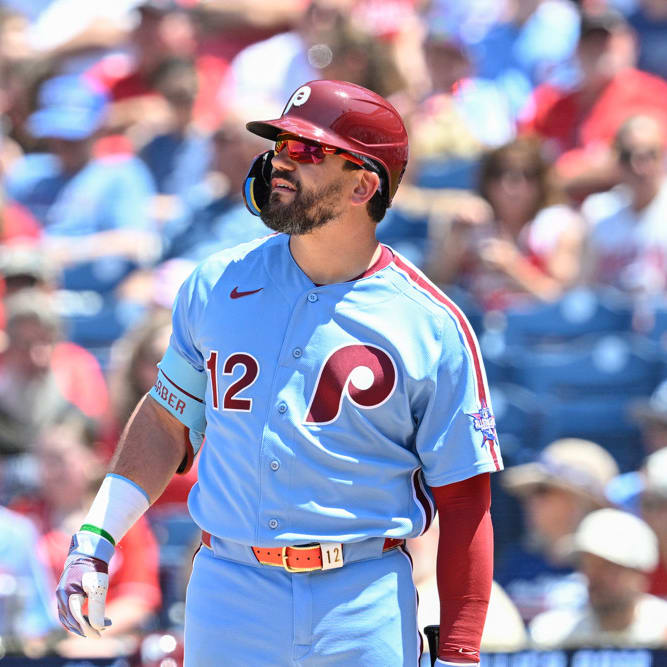
The MLB regular season spans 162 games and covers seven different months. Players are bound to slump at some point, and for some, that comes in April. We'll use veteran first baseman Josh Bell as an example: He has a career WRC+ (Weighted Run Created Plus) of 90 in March/April, where 100 is league average. One would think, based on that, he'd be non-existent in fantasy baseball rankings. But his career WRC+ jumps to 122 in May, 116 in June, and 117 in July. His career WRC+ is 112.
Examples like this are everywhere. Some players are notoriously slow starters–whether it's shaking off cobwebs they didn't get to in spring training, the cold weather (Bell played the first seven years of his career in Pittsburgh and Washington) or just taking time to get in a flow.
As long as a player hasn't lost playing time or been pulled from a rotation, give them until May to see if they can turn it around. This is also true for young players who you may pluck from the MLB prospect rankings. Life is tough in the MLB, and it's a massive adjustment for even the top prospects.
Look Beyond the Box Score: Advanced Sabermetrics
Fantasy baseball managers should know that MLB player stats only tell half the story with struggling players. While it's true that those are the only numbers that actually count toward fantasy baseball wins and losses, there are a handful of advanced statistics "under the hood" that can reveal how much of a player's poor performance is skill-based, and how much is simply being unlucky.
BABIP (batting average on balls in play) is a solid indicator. In 2025, the league average was .291. If your struggling player's BABIP is well below that number (or their own historical trends), you can chalk up some of their struggles to bad luck that eventually should balance out in a positive direction. If a player's hard-hit rate is staying steady, you can expect power to come back sooner than later.
Similarly, xwOBA (expected weighted on-base average) looks at contact quality. The better a player's xwOBA, the more you can expect that they'll turn things around. RotoWire's MLB projections take these into account when generating predictions for the rest of the season, making it a great tool to decide what to do with a struggling player.
Draft Capital vs. Waiver Wire Realities
The team you finish the season with will look much different from the one you draft. Your fantasy baseball mock draft is great to get a feel for where players might be taken, but players not included will rise up waiver wire rankings throughout the season. Don't be afraid to cut a player you used draft assets on if you've researched another players with a better outlook, no matter where you took the struggling player.
It's why it's important that managers pay attention to players in RotoWire's fantasy baseball draft kit who go unselected. There's always going to talent hanging around, players who get off to fast starts and those who carve out roles for certain teams.
The Emotional Trap of "Sunk Cost"
It makes sense that players drafted higher are more likely to turn things around. Cutting a second-round pick doesn't make as much sense as cutting a player you took a flier on in the later rounds. But fantasy baseball rankings can only go so far.
There are some exceptions to that rule, of course. Last year Zac Gallen had a 5.53 ERA in 12 starts through May. His fastball velocity was down and his declining strikeout rate was worrisome. Though he was an All-Star in 2023, had a 3.65 ERA in 2024 and a solid fantasy baseball ADP, it was clear he wasn't roster material. He was better, but not good, in the second half and most managers in mixed leagues could have found stronger options.
Don't be too proud to drop a player if he's struggling and the metrics under the hood aren't great. The potential reward of them turning around isn't worth the risk that they continue to hurt your team in important categories. There will always be waiver wire targets available, and you may be able to trade the player on name recognition, if they were near the top in fantasy baseball auction values.
You just need to subscribe to RotoWire to be prepared for whatever roster decisions you face.