The goal with Lineup Lowdown is simple: we're looking for trends which could help identify players that might be undervalued or overvalued. Who is playing more/less? Who is moving up/down? This week, we will be focusing on players from the American League that are trending up.
Trending Up
Chandler Simpson, OF,  Tampa Bay Rays
The left-handed-hitting Simpson was not in the Rays' lineup on Opening Day against lefty Matthew Liberatore. That felt a bit telling of how the team views him, especially since lefties have fared better against Liberatore since the beginning of last season. Out of Simpson's first seven starts of the season (six versus righties), he batted higher than sixth just once (and he hit fifth that day). Since then, however, Simpson has not batted lower than fifth against a righty, and in his last two starts versus right-handed pitching he's been up in the leadoff spot. With a robust .407/.435/.475 batting line and seven stolen bases, it's fair to say Simpson has forced the Rays' hand.
Simpson is unlike any other hitter in baseball. He has just a 16.9 percent hard-hit rate in his career and is still looking to connect on his first home run and his first barrel. He drew walks at a healthy 9.4 percent rate in the minors, but that rate has been just 4.6 percent so far at the big-league level. And yet, he's sitting on a career .309 batting average that's backed by a .297 xBA. His on-base percentage
The goal with Lineup Lowdown is simple: we're looking for trends which could help identify players that might be undervalued or overvalued. Who is playing more/less? Who is moving up/down? This week, we will be focusing on players from the American League that are trending up.
Trending Up
Chandler Simpson, OF, Tampa Bay Rays
The left-handed-hitting Simpson was not in the Rays' lineup on Opening Day against lefty Matthew Liberatore. That felt a bit telling of how the team views him, especially since lefties have fared better against Liberatore since the beginning of last season. Out of Simpson's first seven starts of the season (six versus righties), he batted higher than sixth just once (and he hit fifth that day). Since then, however, Simpson has not batted lower than fifth against a righty, and in his last two starts versus right-handed pitching he's been up in the leadoff spot. With a robust .407/.435/.475 batting line and seven stolen bases, it's fair to say Simpson has forced the Rays' hand.
Simpson is unlike any other hitter in baseball. He has just a 16.9 percent hard-hit rate in his career and is still looking to connect on his first home run and his first barrel. He drew walks at a healthy 9.4 percent rate in the minors, but that rate has been just 4.6 percent so far at the big-league level. And yet, he's sitting on a career .309 batting average that's backed by a .297 xBA. His on-base percentage will be almost entirely average-based, but Simpson should still get on at a healthy clip and score a bunch of runs while he's in the leadoff spot. The speedster's defensive metrics are also much-improved in 2026, which should help keep him in the lineup.
Lawrence Butler, OF,  Sacramento Athletics
The Athletics have been forced to alter their lineup since Brent Rooker (oblique) went down. One major beneficiary has been Butler, who has gone from hitting sixth to batting leadoff in each of the team's last four contests versus righties.
I was counting on a bounceback to some degree from Butler in 2026 after he played through issues with both knees in 2025. Unfortunately, the production hasn't been there. He did swat his second home run of the season Monday, but the 25-year-old is slashing only .176/.250/.314 in his first 16 contests. Butler's zone contact rate fell off dramatically in 2025 to 76.3 percent, and it's dipped further to 75.9 percent in 2026. That rate was 80.4 percent in 2024, which was already below the league average, so hopefully Butler can get closer to that mark. He'll need to if he wants to avoid being dropped back down in the batting order when Rooker returns (and maybe even before that). Butler has been out of the lineup for all five games against lefties this season, so his uptick in role has come only against right-handers.
It's been Carlos Cortes taking over in the designated hitter slot for each of the four contests Rooker has missed against righties (Shea Langeliers was at DH versus a lefty Tuesday). Cortes' best skill in the minors was his plate discipline, as he collected a 12.6 percent walk rate and 18.3 percent strikeout rate at the Triple-A level. In an exceedingly small sample in 2026, Cortes has four walks and one strikeout, and he's paired that with a 43.5 percent hard-hit rate and 13 percent barrel rate. There might be a little something there with Cortes, but he might have just a short window of regular playing time. In the first 12 games with Rooker healthy, Cortes totaled only 13 plate appearances.
Angel Martinez, OF/2B,  Cleveland Guardians
The Guardians have been looking for an outfielder to go with Steven Kwan and Chase DeLauter, and lately that guy has been Martinez. He started only one of the first four games of the season, but since then Martinez has been in the lineup for seven of the last eight tilts and 12 of the past 15 contests. He's also batted either second (six times) or first (once) in seven of his past nine starts.
Cleveland has faced a slew of left-handers lately, which seemingly has aided in Martinez's ascension. It's been the lefty-swinging DeLauter in the two hole each of the last six times the Guardians have faced a righty, with the switch-hitting Martinez either batting lower in the order or being out of the lineup those days. However, while Martinez has traditionally been a better hitter versus lefties, he has a 1.027 OPS in his first 35 plate appearances against righties in 2026 and an OPS near .900 overall. Additionally, his quality of contact has improved, as he's gone from a well below-average hard-hit rate in 2025 (29.3 percent) to an above-average rate in 2026 (41.3 percent). Martinez has also cut his strikeout rate from 22.7 percent to 10.5 percent and his pull-air rate sits at a healthy 26.1 percent.
Also moving to the forefront for the Guardians lately has been Juan Brito. Brito grabbed the roster spot of the injured Gabriel Arias (hamstring) last week and has since started seven of eight games at second base (with Brayan Rocchio shifting over to shortstop). The switch hitter probably would have spent a large chunk of 2025 in the majors if not for a plethora of injuries, but he's getting his chance now and it wouldn't be a surprise if he sticks around a while with Arias slated for an extended absence. Brito slashed .256/.365/.443 with 21 home runs and 13 stolen bases at Triple-A Columbus in 2024 in his last full season.
Christian Walker, 1B,  Houston Astros
The Astros are in the midst of a rough stretch, but the downturn is almost entirely related to pitching and injuries and not their lineup. One of the biggest drivers of the offense has been Walker, who is hitting like Houston thought he would when the team signed him last offseason.
Walker began the campaign down in the No. 7 spot in the Astros' lineup for three of the first four games. He moved up to fifth after that and more recently has batted cleanup for two of the team's last three contests. Walker's disappointing 2025 season was brought about in large part by a spike in his strikeout rate to a career-high 27.7 percent, but he's got that mark down to 15.3 percent in 2026, pairing it with an 11.1 percent walk rate. In truth, Walker's turnaround began in the second half of last season and he's carried that over with a great start to 2026. It's still early, but those worried that the 35-year-old Walker might be reaching the cliff can breathe easy for now.
Daulton Varsho, OF,  Toronto Blue Jays
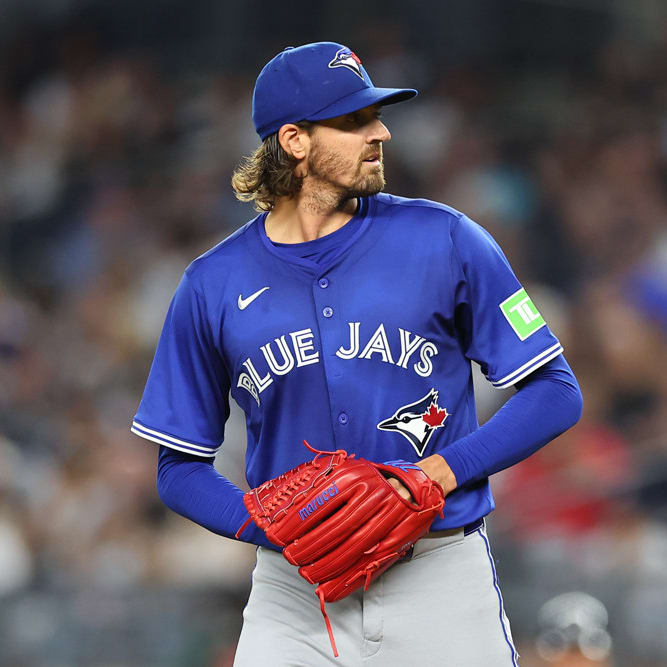
Varsho's move up in the Blue Jays' batting order is partly by necessity as the club navigates the losses of George Springer (toe), Addison Barger (ankles) and Alejandro Kirk (thumb). The 29-year-old Varsho was probably due to be elevated anyway, however, as he's in a five-game stretch that's seen him go 9-for-22 with three home runs, two doubles, six RBI, a stolen base and a 1:2 BB:K.
In his first nine starts to the season, Varsho batted sixth seven times, fifth once and seventh once. Across the last six contests, he's been locked in as the team's No. 2 hitter, and the first four of those came while leadoff man Springer was healthy. The left-handed-hitting Varsho has also been in the lineup two times in three games this season versus southpaws. Interestingly, Varsho's quality of contact is actually down significantly from last year, as his hard-hit rate, barrel rate and average exit velocity are all well below the league average. However, he's also striking out way less (28.4 percent to 12.7 percent year-over-year) and is trading flyballs (37.5 percent to 24.5 percent) for line drives (20.5 percent to 34.7 percent). Additionally, after his bat speed spiked at 75.6 percent in 2025, Varsho's bat speed of 73.4 mph in 2026 has been back in line with his career norm.
I'm not sure whether this is a conscious change Varsho has made in his walk year or a small-sample fluke. If it's the former, it alters his profile pretty drastically, as he's gone from a batting average drain to an asset. Varsho's highest xBA prior to 2026 was .245. This season it currently sits at .292, which is 29 points higher than his actual average of .263.
Ernie Clement has also been bumped up in Toronto's batting order, having hit leadoff in two straight contests after he batted between fifth and eighth in his first 14 starts. Varsho should have a much better shot than Clement of maintaining his current lineup spot, though, as the Blue Jays have been filtering through multiple guys in the two-hole. The leadoff spot will belong to Springer once he returns, which could be next week.
Trevor Larnach, OF,  Minnesota Twins
It was a bit of a surprise when the Twins chose to tender Larnach a contract over the offseason rather than let him walk. With Larnach off to a great start and the Twins playing surprisingly well, the club is surely glad the 29-year-old is still around.
Larnach batted seventh three times and sixth once in his first four starts of the season. Since then, the only time he's batted that low was in his lone start against a left-hander. All four of the left-handed-hitting Larnach's starts against righties during that span have come from the No. 2 spot in the Minnesota batting order. Across his first 13 contests this season, Larnach is sporting a healthy .267/.421/.433 batting line with one home run and an 8:6 BB:K. He's always been good at drawing walks, but Larnach has taken it to another level in the early going this year with a 21.1 percent walk rate, a mark that ranks in the 98th percentile. Also, while Larnach's strikeout rate has trended down over the years, his 15.8 percent strikeout rate in 2026 is markedly lower than last year's career-best 21.5 percent mark. Larnach's higher contact rate hasn't come at the expense of quality of contact, either. His average exit velocity is down a bit, but the outfielder's 45.8 percent hard-hit rate and 12.5 percent barrel rate would both be three-year highs.
Larnach's spray chart is also way different thus far. His pull rate has gone from 40.1 percent to 29.2 percent year-over-year, and his pulled groundball rate has gone from an above-average 23.5 percent to a miniscule 8.3 percent. We've also seen his line-drive rate climb from 25.8 percent to 37.5 percent. And finally, like the aforementioned Daulton Varsho, Larnach's bat speed is way down from last year (72.2 mph to 70.5 mph) and so are his strikeouts. It's too soon to know whether it's a sustainable change or early-season noise, but I'm interested to track Larnach's progress. Unfortunately, he rarely plays against lefties and the Twins have faced a whopping 10 of them already, holding down his counting stats.