NFL Draft: Running Back NFL Combine Testing Analysis
Free agency took center stage recently, but I wanted to circle back to NFL combine metrics and how predictive they are when it comes to future success for running backs.
I did this earlier this offseason with a look at NFL Combine results vs production for wide receivers, and the big takeaway was that the workout warriors were usually just that: workout warriors. The best composite athletes among receivers going back to 2019 rarely amounted to much as legitimate NFL producers.
That goes to show that there's a level of skill and positional chops that are required to be a successful NFL wide receiver, regardless of how fast a player is or how high he can jump.
Let's see what we can learn from running back workout data from the combine.
Methodology
While good receivers come in all shapes and sizes, there's more of an ideal we're chasing when it comes to running back prospects and their ability to become NFL workhorses, which are the most valuable things in fantasy football.
The best running backs tend to be dense and compact, checking in between 5-9 and 5-11 with 205-220 pounds on their frame. They should also be fast for their size, and that's a sliding scale.
Looking at this year, for instance, Demond Claiborne's 4.37 speed is great and all, but when it's on a 188-pound frame, there's an inherent limit to how many carries we can realistically project for him. Someone like De'Von Achane (who was faster than Claiborne) is an outlier and not an archetype.


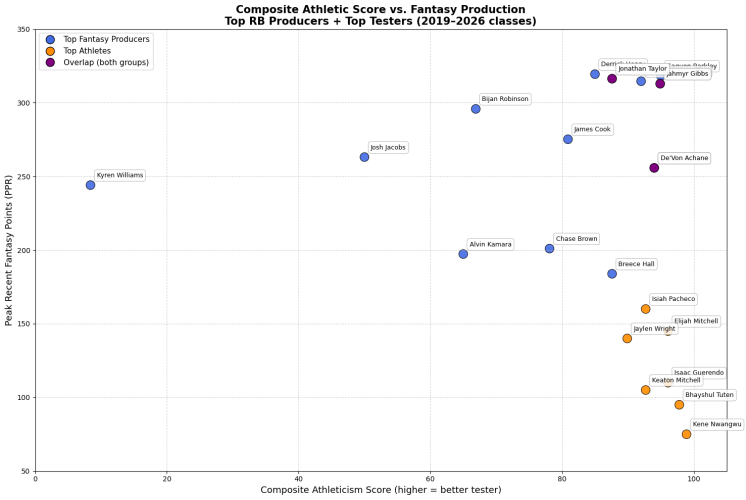
It's interesting to look at the contrast between combine performance for wide receivers vs their on-field production. The top wide receiver producers last year were not exactly burning up the track or jumping out of the gym at their combines and pro days. Puka Nacua, Jaxon Smith-Njigba and Amon-Ra St. Brown all graded as average athletes at best.
Running back is a little bit of a different story. It seems like the combine is at least a little more predictive for running backs. There are several standout fantasy running backs who graded out as great all-around athletes. Jonathan Taylor, Breece Hall, Chase Brown and Quinshon Judkins all ranked in the top 20 in this sample.
Guys like Kyren Williams are outliers on the other end of the spectrum who found a way into a big role and capitalized.
2026 Rookie Running Backs
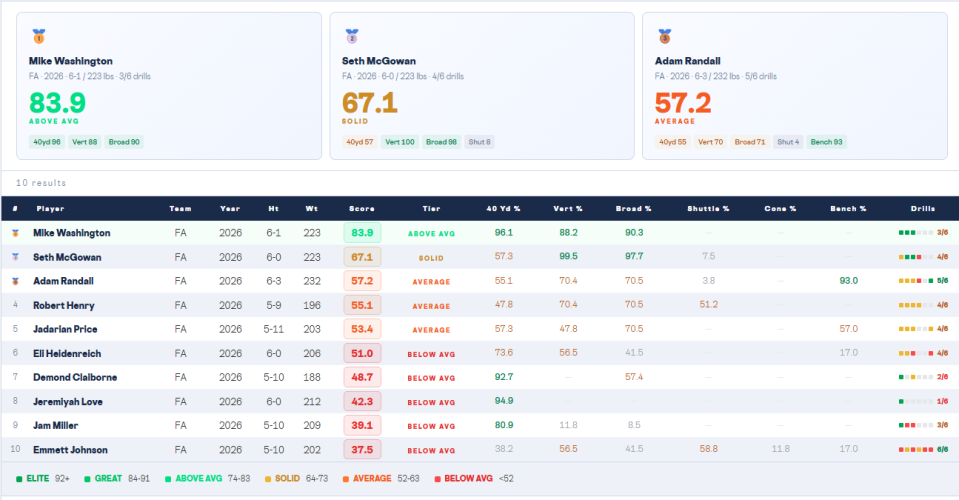
It really wasn't a standout group of running backs at the combine. We had a weakened crop with so many opt-outs, and even the guys who did participate often chose to skip some drills.
Mike Washington is the big test case for metrics vs production in this class. His production profile would have landed him in the discard pile. A fifth-year senior who topped out at 625 yards at Buffalo and took until his fifth season to crack 1,000 yards or 20 receptions?
| Year | School | G | Rush | Yds | Avg. | TD | Rec | Yds | Tgt | TD | YPT |
|---|---|---|---|---|---|---|---|---|---|---|---|
| 2021* | Buffalo | 3 | 15 | 78 | 5.2 | 0 | 0 | 0 | 0 | 0 | 0 |
| 2022 | Buffalo | 12 | 140 | 625 | 4.5 | 7 | 23 | 135 | 34 | 1 | 4.0 |
| 2023 | Buffalo | 12 | 108 | 416 | 3.9 | 3 | 13 | 35 | 23 | 0 | 1.5 |
| 2024 | New Mexico State | 12 | 157 | 725 | 4.6 | 8 | 9 | 74 | 18 | 1 | 4.1 |
| 2025 | Arkansas | 12 | 167 | 1070 | 6.4 | 8 | 28 | 226 | 42 | 1 | 5.4 |
| Career | 3 Schools | 51 | 588 | 2902 | 4.9 | 26 | 73 | 470 | 117 | 3 | 4 |
If his standout athleticism didn't translate at the college level, how can we expect it to magically click on Sundays? The market seems to be buying in, and it's fair in the sense that his combine performance will get him drafted as high as the third round and likely no later than the fifth.
Draft capital often leads to opportunity, so that's a mark in Washington's favor. But there's not much to suggest that he will capitalize on said opportunity. And there's even a chance he ends up like Isaac Guerendo, who got himself drafted thanks to his outstanding combine but has still yet to do much on Sundays.
At this point, I wonder a little more about Washington's dynasty stock being overinflated more than his best ball stock. The best ball market has had a fairly measured response to Washington's crazy combine workout; I expected that to catapult him close to the 9th or 10th round. Instead, it has pushed him from fringe draftable to ~12th round status. That's a big jump, but not an egregious spot to settle, all things considered. There are guys I'd prefer to draft (Emmett Johnson, Chris Rodriguez, Keaton Mitchell) who all go behind Washington, but again, it's not a completely ludicrous ADP for Washington.
Rookie Running Back ADP Changes
This year's combine didn't rock the boat too much in terms of ADP movement among rookie RBs. Jeremiyah Love's ADP is still hovering in the early second round and that won't change until the NFL Draft. His Notre Dame teammate, Jadarian Price, did not have a great combine but the market still dubs him as the second best back in this class.
There are a few rookie running backs who have slid a bit since the combine. Jonah Coleman will head to the draft with no verified workout metrics due to an ankle issue, but he did do positional drills at the Washington Pro Day. Same goes for Kaytron Allen and Nicholas Singleton from Penn State, who are also skidding close to an ADP of 200.
Quick Hitters
- Jeremiyah Love: Don't get too fixated on Love's grade in this model. He was penalized for only participating in one out of five drills. In 100% of his completed drills (well, one drill), Love excelled. His 4.36 40 is the best among players in our records who are at least 6'0" and between 210 and 215 pounds. That long speed on that frame is rare, and it backs up Love's label as a home run hitter. He will be an early first-round pick in the NFL Draft and a second-round pick in best ball drafts.
- Emmett Johnson: I'm not jumping ship on Johnson even with the lackluster testing results. I respect that he still competed, whereas so many of his peers opted out. Johnson didn't have a good combine, obviously, but it wasn't a disaster, either. His frame (5-10, 202) and production still suggest he can make it. Johnson was one of three players to take at least 200 carries and catch 40 passes in college this past season. That ability to take on volume and get an efficient output (5.78 yards per carry, 76% catch rate on 60 targets) is compelling. Maybe Johnson isn't a standout athlete but Tony Pollard and Chuba Hubbard graded out similarly before becoming fantasy standouts.
Overall, this isn't a great incoming class of running backs. Outside of Jeremiyah Love, there isn't a guaranteed top 50 type of prospect. It seems like NFL teams were convinced of that as well, considering the robust RB market in free agency. I still believe in Emmett Johnson and Jadarian Price despite less-than-ideal combine results.
Jeremiyah Love's second round ADP is pricey but understandable. If there's an endgame steal to be had from this class, I'd side with Nicholas Singleton out of Penn State or Seth McGowan out of Kentucky. Otherwise, I won't be heavily investing in this rookie class in best ball.