As advanced MLB player stats become more commonly used in baseball circles, OBP fantasy leagues are taking hold. It's a more indicative stat of a player's prowess at the plate compared to batting average, which is why more leagues are making the shift.
Moving from batting average to on-base percentage can also significantly change fantasy baseball rankings and how you target certain players. It's important to have a good understanding of your league's rules and then to find players who are elite at getting on base thus giving you the best chance of success in these types of formats.
What is an OBP Fantasy Baseball League?
An OBP fantasy baseball league uses on-base percentage instead of batting average as the ratio category for hitters. This means that walks and hit-by-pitches are included in a player's ratio rather than just the number of times they reached via a hit.
It's a much fairer statistic to use given the state of baseball, where getting on base is seen as a much more important metric than simply the number of times you put the ball in play and reached base.
Types of Hitters Who Gain Value in OBP Formats
Having a good eye and drawing walks is key for players who gain value in on-base percentage formats. There are plenty of players who draw a ton of walks each year despite hitting for a lower percentage (likely because they're power hitters who may also strike out a good amount).
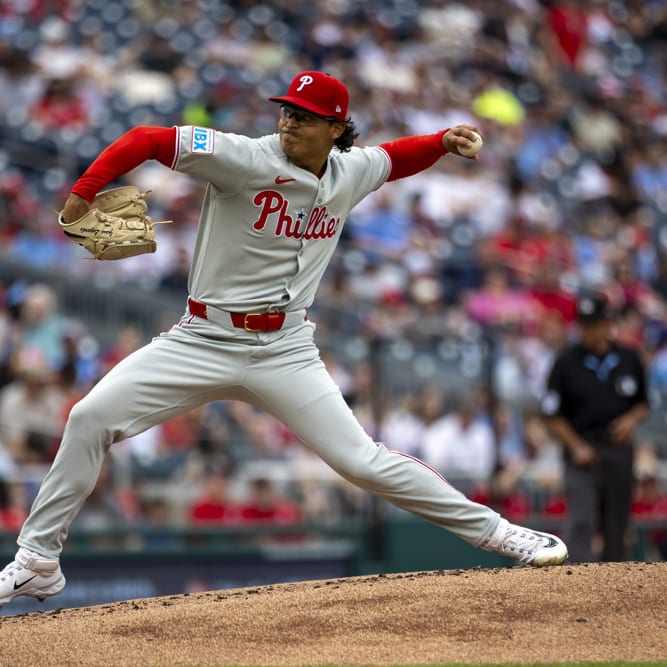
Two of the best examples are Cubs slugger Ian Happ, who has a career batting average of .247 and hasn't hit over .250 since 2022. That would stand out as a negative attribute in batting average leagues, but he has a career .343 on-base percentage and has drawn 80+ walks in each of the last three seasons. Phillies slugger Kyle Schwarber is also a star in on-base percentage leagues, thanks to his 100+ walks each of the last three seasons despite batting a combined .228 in that stretch.
Types of Hitters Who Lose Value in OBP Formats
Typically the best on-base percentage players also hit plenty of home runs, so the players who lose are aggressive batters who slap singles around the field. The best example will always be Luis Arraez, who has won three batting titles and has a career .317 batting average. But he's never walked more than 50 times in a season and doesn't have an OBP above .343 the last three seasons.
Other aggressive hitters like Pete Crow-Armstrong, Ernie Clement and Andy Pages lose some value, but as we'll discuss later, players who are hurt by on-base percentage vs. batting average still hold plenty of value and shouldn't necessarily be written off based on certain MLB projections.
How OBP Leagues Affect Draft Strategy
The most important thing to remember when diving into RotoWire's fantasy baseball draft kit for OBP leagues is that batting average is irrelevant. Don't even look at it. It's an outdated statistic as is and becomes a non-factor for your league.
But just like you wouldn't let one stat like stolen bases impact your overall thinking on a player, the same is true for on-base percentage. Crow-Armstrong is a negative in on-base percentage but dominated with 31 homers, 95 RBI and 35 stolen bases. OBP can be a tiebreaker, but don't write off a player just because he is going to struggle overall getting on base.
Building an OBP-Optimized Roster
Like all ratio categories in fantasy baseball, volume context is important. A player with a .340 on-base percentage on 350 plate appearances is more valuable than someone with a .345 on-base percentage on 150 plate appearances. This is important to consider on draft day and something that RotoWire's fantasy baseball draft assistant can help with as you build your team.
Also, on-base percentage can be a fluctuating statistic. Batters tend to get more patient as they age, so don't just rely on past performance, especially with younger players. That same sentiment is true for some players as the year goes on. If you can locate notoriously slow starters who heat up as the weather gets warmer, you can find great value in trades.
Make sure you subscribe to RotoWire and stay on top of fantasy baseball news to figure out who to target in on-base percentage leagues while building a competitive roster in all categories.