Stashing and speculating on prospects is a favorite pastime of fantasy managers, but it also brings increased risks to rosters. This season has been a particularly good year for such speculation, as the flow of players making their big-league debut has been significant and steady. Now that many have a decent sample in the majors, it feels like a natural time to take stock of some of those players.
The goal is also to provide some actionable advice, meaning there's no need to do a deep dive on Konnor Griffin, JJ Wetherholt or Kevin McGonigle. Everyone knows they are good, and there won't be any buy-low opportunities in trades or availability on the waiver wire. It is worth noting that each member of that trio has endured slow stretches, as can be expected, with Wetherholt currently being in the midst of a significant slump.
One larger trend worth noting in the introduction is that many of the pitchers that have made their debuts this season have struggled to meet expectations. This is likely more fluke than signal, as Cam Schlittler and Parker Messick were among the most impactful debuts in 2025.
With that, let's get to the analysis.
Risers
Murakami was a riser in the first edition of this article this season, and nothing has occurred since to change my mind. Simply, when Murakami swings, he does so with conviction. He has a moderate 65.2 percent zone-swing rate, but he ranks in the 87th percentile in
Stashing and speculating on prospects is a favorite pastime of fantasy managers, but it also brings increased risks to rosters. This season has been a particularly good year for such speculation, as the flow of players making their big-league debut has been significant and steady. Now that many have a decent sample in the majors, it feels like a natural time to take stock of some of those players.
The goal is also to provide some actionable advice, meaning there's no need to do a deep dive on Konnor Griffin, JJ Wetherholt or Kevin McGonigle. Everyone knows they are good, and there won't be any buy-low opportunities in trades or availability on the waiver wire. It is worth noting that each member of that trio has endured slow stretches, as can be expected, with Wetherholt currently being in the midst of a significant slump.
One larger trend worth noting in the introduction is that many of the pitchers that have made their debuts this season have struggled to meet expectations. This is likely more fluke than signal, as Cam Schlittler and Parker Messick were among the most impactful debuts in 2025.
With that, let's get to the analysis.
Risers
Murakami was a riser in the first edition of this article this season, and nothing has occurred since to change my mind. Simply, when Murakami swings, he does so with conviction. He has a moderate 65.2 percent zone-swing rate, but he ranks in the 87th percentile in average bat speed and has a 54.4 percent fast swing rate — good for 27th among the 294 batters with at least 100 plate appearances this season. That conviction has led to incredible impact on the ball as measured by any metric imaginable. Concerns about Murakami's bat speed and the ability to catch up to big-league fastballs look to have been overblown.
That doesn't mean Murakami has a flawless profile. He strikes out at a 32.8 percent clip, has a 45.7 percent flyball rate, and he also pulls groundballs at a well above-average 24.1 percent clip. That's likely to amount to a lot of easy outs and a lot of inconsistency. One key note in that regard is Murakami's walk rate of 17.4 percent, which obviously gives him a significant edge in on-base percentage leagues.
Sam Antonacci  / Travis Bazzana
Antonnaci and Bazzanna are interesting to compare because they have a very similar sample size in the majors and their skills mirror each other pretty well.
Antonacci has carried over his strong contact rate from the minors and has made enough solid contact to earn a .315 xBA, compared to his current actual batting average of .271. There are two areas in which he can take another step forward. The first is his stolen base efficiency. While Antonacci has been aggressive on the basepaths, with 11 stolen base attempts across 38 games, he's been successful on only seven of those attempts. Antonacci has 80th percentile sprint speed, so he's plenty fast enough. He's also shifted to the top spot in the White Sox's order, but his walk rate has fallen from double-digit percentage marks in the minors to around 6.5 percent in the majors. If Antonacci starts to work more walks, he should develop into at least a solid three-category contributor.
On the surface, Bazzana has shown more power than expected with three homers and a .156 ISO in his 113 plate appearances. However, he has those three home runs on as many barrels, and he has only a 14.9 percent pulled air rate. Put another way, he has a .435 slugging percentage with an xSLG of .397. Bazzana has recently taken over the leadoff role in Cleveland and should have a lot of run-scoring upside due to his on-base ability. Lastly, he has also been aggressive on the basepaths and has also been efficient with seven steals on nine attempts.
Overall, I'd value this duo similarly.

Waldschmidt's surface stats also look like they belong to a leadoff hitter, as he's managed a .302 average with 10 runs scored and five stolen bases across his first 70 plate appearances with the Diamondbacks. However, he has struck out a 30 percent clip, with his batting average being propped up by a .462 BABIP (.270 xBA). Waldschmidt also has a solid 39 percent flyball rate with a 9.5 percent barrel rate, all pulled together by an elite pulled air rate. There's more power coming, but the batting average is going to drop. Waldschmidt should eventually settle into the middle of Arizona's lineup and has shown the skills to do so successfully early on.

Okamoto was often compared to Murakami this offseason as the two jockeyed for a big-league contract. Murakami has been superior in pretty much every way, but Okamoto has also proven he belongs in the major leagues. His skills profile hasn't quite come together fully two months into his rookie season, but there are several reasons for optimism.
The first is his quality of contact. Okamoto measures out at the 85th percentile in average exit velocity, barrel rate and hard hit percentage. While he's struck out at an elevated 30.3 percent clip, Okamoto has a good sense of the strike zone while chasing out of the zone at only a 25.4 percent clip, 48th among 167 qualified hitters.
Perhaps most importantly, the Blue Jays have shown faith in Okamoto. He hit fifth to begin the season and was even demoted to seventh for a 17-day stretch in April. Since April 25, Okamoto has hit lower than fourth in the order only once and has delivered 19 RBI, 15 runs scored and six home runs across 29 games.
Fallers

Painter is a complicated evaluation, and I wouldn't advocate giving up on him simply because he appears on the "Fallers" list. Unlike some of the players we'll discuss later in this section, there's no glaring shortcoming in Painter's profile. The biggest issue is that he's having trouble generating swings and misses, with that additional contact coming back to harm him.
Drilling down a bit further is where things get interesting. His Fangraphs profile page suggests his secondary stuff was the reason for his lackluster return in 2025, yet that same stuff has been what has played up this season as compared to his fastball. The latter pitch is what has caused Painter trouble, a fact acknowledged by the young pitcher himself as well as interim manager Don Mattingly.
Painter is tough to trust for the time being, but I'd be monitoring his starts closely to look for any adjustments he makes to his fastball in the hopes it helps his overall production.
There are varying degrees of disappointing performers on this list, and Schultz and Imai are near the top of it. Prior to landing on the injured list Tuesday, a move that very well may have saved from a demotion back to Triple-A, Schultz had finished only 5.0 innings only one time in his last four starts. In that span, he had a 13:10 K:BB across 17.1 total frames. As those numbers suggest, control has been his primary problem.
There is some reason for hope that things will turn around. Schultz first experienced control problems when he reached the upper minors last season, posting a 14.4 and 11.7 percent walk rate in Double-A and Triple-A, respectively. He began this season at the latter level and decreased that mark to only 4.3 percent, albeit in a very small sample.
Imai is a bit more difficult to evaluate given the unknowns of his game translating from overseas to MLB. His walk rate is similarly out of control (17.5 percent), and he's also been plagued by the long ball since his return from the injured list, giving up two home runs in two of his three starts. Projections aren't everything, but Imai's have shifted significantly in a negative direction. His projected ERA ranges from 4.18 to 5.19 with an accompanying projected WHIP of 1.30 to 1.58. Both his sample to date and those projections suggest he's unusable for fantasy purposes after being selected as a key piece of fantasy rotations this spring.
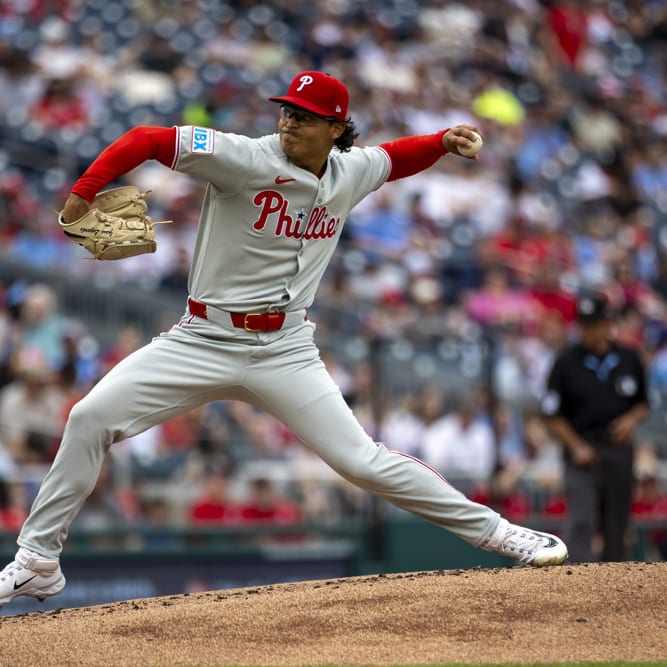
It's not a surprise that Crawford hasn't hit for power, but his path to doing so has been disappointing. He didn't hit for any notable power with Triple-A Lehigh Valley, but his primary downfall was his inability or unwillingness to lift the ball. That's carried over to the majors, but Crawford has also seen a significant downturn in quality of contact.
Context is perhaps even more important. Crawford has hit above eighth in the Phillies' order only once this season. That's limited his ability to produce in the two stats he was expected to excel in entering the season, as Crawford has just seven stolen bases and 12 runs scored across 50 games. Given the Phillies' recent stretch of playing winning ball and the veteran talent they have on the roster, Crawford can't project to move up the lineup any time soon.

Prielipp would have been in the "Risers" section without question just two weeks ago. However, in his last two starts, he's allowed a combined 11 earned runs with a 6:4 K:BB across 8.1 innings. He's generally run into bad luck this season (55.6 percent left on base rate), but he's also put himself in harm's way with a 4.05 BB/9. Similar to Painter, Prielipp has a fastball problem, with opposing hitters generating a .480 xSLG and .372 xwOBA against the pitch. Expect the same inconsistency he's shown to continue throughout the season, but he and Painter both have the makings of finding more consistency.