In roto leagues, a pitcher's WHIP is rarely mentioned when evaluating an arm, with ERA and strikeouts taking center stage in any analysis. While a fantasy team's WHIP counts just as much as its ERA, many managers just ignore WHIP. Today, I'm going to point out when WHIP can be an issue and when to move on from high-WHIP starters.
It's hard to know how much damage WHIP is causing without a reference. I decided to put WHIP on an ERA scale. I ranked all the contestants in the NFBC RotoWire Online Championship by WHIP and ERA and plotted the following line to get a comparison formula.

Formula: ERA Equivalent = 6.017 x WHIP - 3.3691
Here are the ERA equivalents in a table at different WHIP values:
WHIP | ERA Equivalent |
|---|---|
0.90 | 1.98 |
0.95 | 2.28 |
1.00 | 2.57 |
1.05 | 2.86 |
1.10 | 3.16 |
1.15 | 3.45 |
1.20 | 3.75 |
1.25 | 4.04 |
1.30 | 4.34 |
1.35 | 4.63 |
1.40 | 4.93 |
1.45 | 5.22 |
1.50 | 5.52 |
1.55 | 5.81 |
1.60 | 6.11 |
1.65 | 6.40 |
1.70 | 6.70 |
1.75 | 6.99 |
In roto leagues, I try to start pitchers with a sub-1.35 WHIP. Above that level, they are simply hurting the category too much. From previous work, I found that a walk rate over 3.5 BB/9 usually results in an unrosterable WHIP.
Some pitchers could see their WHIP improve. They have a high BABIP, but a decent walk rate. Since BABIP takes longer to stabilize, it usually regresses to the league average value (.289 BABIP). Looking at the table below, Cade Cavalli and
In roto leagues, a pitcher's WHIP is rarely mentioned when evaluating an arm, with ERA and strikeouts taking center stage in any analysis. While a fantasy team's WHIP counts just as much as its ERA, many managers just ignore WHIP. Today, I'm going to point out when WHIP can be an issue and when to move on from high-WHIP starters.
It's hard to know how much damage WHIP is causing without a reference. I decided to put WHIP on an ERA scale. I ranked all the contestants in the NFBC RotoWire Online Championship by WHIP and ERA and plotted the following line to get a comparison formula.
Formula: ERA Equivalent = 6.017 x WHIP - 3.3691
Here are the ERA equivalents in a table at different WHIP values:
WHIP | ERA Equivalent |
|---|---|
0.90 | 1.98 |
0.95 | 2.28 |
1.00 | 2.57 |
1.05 | 2.86 |
1.10 | 3.16 |
1.15 | 3.45 |
1.20 | 3.75 |
1.25 | 4.04 |
1.30 | 4.34 |
1.35 | 4.63 |
1.40 | 4.93 |
1.45 | 5.22 |
1.50 | 5.52 |
1.55 | 5.81 |
1.60 | 6.11 |
1.65 | 6.40 |
1.70 | 6.70 |
1.75 | 6.99 |
In roto leagues, I try to start pitchers with a sub-1.35 WHIP. Above that level, they are simply hurting the category too much. From previous work, I found that a walk rate over 3.5 BB/9 usually results in an unrosterable WHIP.
Some pitchers could see their WHIP improve. They have a high BABIP, but a decent walk rate. Since BABIP takes longer to stabilize, it usually regresses to the league average value (.289 BABIP). Looking at the table below, Cade Cavalli and Will Warren fit this player profile.
One pitcher type that will be common on these lists is the high-walk, high-groundball guys. On average, more groundballs than flyballs will go for hits, even though they don't do as much damage. The hits counted in WHIP don't differentiate between singles and home runs. Andrew Alvarez and Framber Valdez are the poster kids for this player type.
These pitchers are some of the toughest to manage. The guys featured average out to 4.00 ERA, which is respectable. If a team in a roto league has one of these players, it might not be a big deal, but having several of them could be a huge drag. At some point, you might need to drop those pitchers or only use them sparingly. Last season, I needed to drop Yusei Kikuchi and his 1.42 WHIP (1.58 WHIP this year), even though he was pitching like a 4.00 ERA talent.
If I were in a trading league, I'd try to move them in challenge trades for other pitchers or to boost my offense. It's time to start improving in the category while causing other teams to have their WHIP inflated by these arms.
Here are the starters this year with a WHIP over 1.35, an ERA under 4.50, and at least 20 innings pitched as a starter:
| Name | IP | K/9 | BB/9 | BABIP | GB% | ERA | WHIP | ERA Equivalent |
|---|---|---|---|---|---|---|---|---|
| Chad Patrick | 28 | 7.0 | 4.8 | .293 | 32% | 2.86 | 1.41 | 5.00 |
| Hunter Brown | 29 | 10.7 | 5.2 | .271 | 49% | 3.38 | 1.36 | 4.71 |
| Brandon Young | 77 | 7.2 | 3.5 | .288 | 42% | 3.38 | 1.36 | 4.68 |
| Joey Cantillo | 96 | 9.0 | 4.4 | .295 | 43% | 3.66 | 1.39 | 4.84 |
| Shane Drohan | 39 | 8.1 | 3.7 | .319 | 43% | 3.69 | 1.44 | 5.14 |
| Kyle Bradish | 100 | 9.0 | 4.3 | .303 | 48% | 3.75 | 1.40 | 4.93 |
| Kyle Leahy | 86 | 7.6 | 3.4 | .322 | 43% | 3.86 | 1.45 | 5.21 |
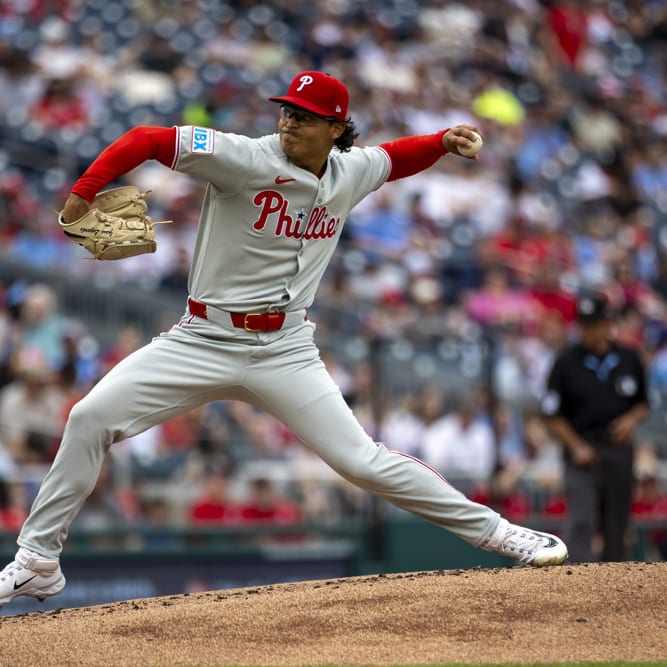
| Cade Cavalli | 92 | 10.2 | 3.0 | .348 | 48% | 3.88 | 1.38 | 4.82 |
| Andrew Abbott | 101 | 7.2 | 4.0 | .274 | 41% | 3.92 | 1.41 | 4.96 |
| Grant Holmes | 78 | 7.7 | 4.4 | .258 | 42% | 4.02 | 1.40 | 4.95 |
| Andrew Alvarez | 26 | 9.5 | 5.1 | .360 | 59% | 4.05 | 1.61 | 6.18 |
| Will Warren | 93 | 9.1 | 3.0 | .311 | 42% | 4.15 | 1.37 | 4.76 |
| Luis Severino | 62 | 9.3 | 4.5 | .317 | 44% | 4.16 | 1.47 | 5.33 |
| Shane Baz | 107 | 7.6 | 3.5 | .304 | 37% | 4.21 | 1.37 | 4.77 |
| Framber Valdez | 100 | 7.0 | 3.2 | .297 | 52% | 4.29 | 1.38 | 4.81 |
| Carmen Mlodzinski | 44 | 8.0 | 3.1 | .358 | 43% | 4.30 | 1.52 | 5.65 |
| Anthony Kay | 77 | 7.7 | 3.5 | .294 | 44% | 4.32 | 1.39 | 4.87 |
| Lucas Giolito | 20 | 6.1 | 7.8 | .254 | 27% | 4.35 | 1.74 | 6.94 |
| Kumar Rocker | 71 | 7.3 | 3.6 | .295 | 44% | 4.40 | 1.42 | 5.06 |
| Slade Cecconi | 95 | 6.9 | 2.8 | .307 | 46% | 4.44 | 1.40 | 4.90 |
| Randy Vasquez | 80 | 6.6 | 2.9 | .316 | 35% | 4.46 | 1.45 | 5.22 |
| Mike Paredes | 22 | 4.5 | 2.9 | .254 | 40% | 4.50 | 1.36 | 4.71 |
| Average | 7.9 | 3.9 | .302 | 43% | 4.00 | 1.43 | 5.11 |
Hunter Brown: Since coming off the IL, Brown has been abysmal, with a 4.82 ERA (4.91 xFIP), 1.55 WHIP (5.3 BB/9) and 8.7 K/9. His performance has worsened each game, as seen by his K%-BB% dropping from 19 percent to 12 to 8 to -5.
The lack of command is inflating his WHIP, with his zone rate down from 48.6 percent last year to 46.1 percent this year. Sadly, he might be someone to bench until he strings together a few low-walk starts.
Brandon Young: Young seems to be walking a tightrope act with his 3.38 ERA, with all other indications point to a mid-4.00 ERA talent. He's showing no signs of improving his walk rate.
The regression may already be coming with a 5.40 ERA over his last two starts.
Joey Cantillo: Walks have always been an issue for Cantillo (4.1 BB/9 for his career), but they are up at 4.4 BB/9 this year. And that 1.39 WHIP is just a killer.
He has shown some signs of life after adding a cutter in early June. Since adding it, he has a 3.18 ERA (3.52 xFIP), 1.26 WHIP (3.4 BB/9) and 10.6 K/9. The WHIP is still an issue, but not as much.
Shane Drohan: Drohan's stats as a reliever are covering up some flaws as a starter. As a reliever, he had a 1.5 BB/9, but his walk rate has jumped to 3.7 BB/9 while starting.
Now, if an early four-walk start is removed, his walk rate drops to 3.0 and his WHIP to 1.35, which still makes our cutoff. No way anyone would be starting him if he had an 4.75 ERA, so they might need to consider sitting him because of his WHIP.
Kyle Bradish: A 48 percent groundball rate and 4.3 BB/9 will lead to the 1.40 WHIP. He's shown no signs of getting his walk rate under control, with a free pass in every game and five two starts ago (a start in which he allowed three earned runs on one hit). No signs of improvement.
Cade Cavalli: Cavalli is one of the pitchers whose WHIP I expect to drop. While a 3.0 BB/9 could improve, his .348 BABIP is doing most of the WHIP inflation.
Andrew Alvarez: In a roto league, there is no way to start Alvarez at this time. The 59 percent groundball rate (which contributes to a .360 BABIP) and 5.1 BB/9 are leading to a 1.61 WHIP. He's a huge red flag.