Last week's ADP shapes article shed some light on how the best ball market views each individual team across all draftable positions. But it also gave us another interesting insight into how the market is overrating depth pieces on good offenses over key pieces of bad offenses.
Put another way, is it really the best idea to draft a team's WR3 when another team's WR1 is still available? The ADP says yes in some cases, and I can't quite get behind that. Even if getting exposure to some of the league's less inspiring offenses isn't all that exciting, those teams still have to play 17 games like everyone else. There will be production in those systems, and the low draft cost to get the key pieces of those offenses helps offset some of the risk.
I'm guilty of dreaming on sleepers, too. But in our unending pursuit of upside in best ball, especially in the late rounds, we often overlook the boring, bankable options that can give our rosters some much-needed floor.
This article aims to highlight some of the players you may have quickly scrolled past during your best ball drafts. Let's get in the mud.
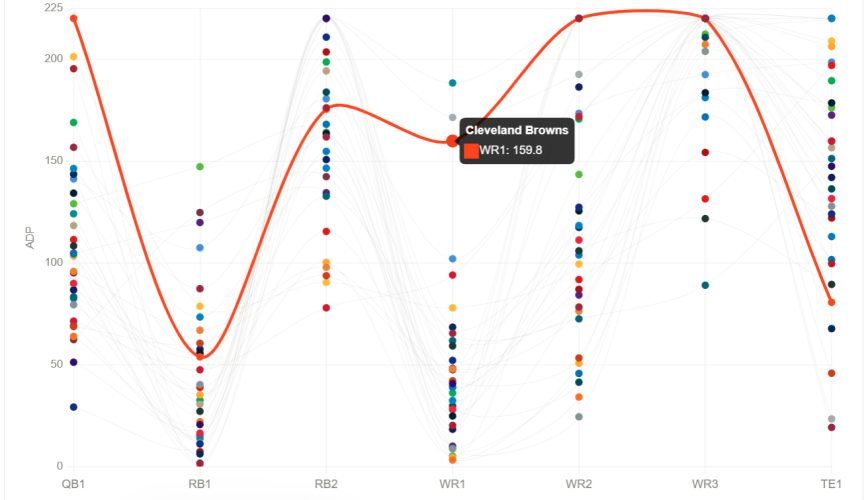
A graphic so nice we had to use it twice
Cheap WR1s
No one is going to brag about drafting any of the following players. However, the visual above helps us see that the market is willingly taking the No.3 or No.4 options in a good offense instead of one of the top options in a bad offense.
Targeting good offenses is understandable, of course, but even the worst offense in the league is going to generate ~180 passing yards and about one passing touchdown per game on average. Teams like this generally don't have a wealth of options, so there are usually 1-2 players who soak up most of the opportunities. It might not be the most fun way to draft, but getting a guy with a strong built-in role on a bad team is likely a more sound strategy than speculating on an "upside" play who is the third receiver on a good depth chart.


Jerry Jeudy, Cleveland Browns (ADP 159.8)
Jeudy's a really interesting test case for this. He'll only be 27 years old this season and has several quality seasons to his credit already. The problem? He's coming off not only his worst season to date, but one of the worst seasons for a receiver with a high target volume that we've seen in some time.
Looking at the advanced stats, Jeudy ranked last in TPRR% (17.9) and YPRR (1.02) among receivers with at least 100 targets. He had a 47% catch rate. I mean, the bar was really low in Cleveland with a 57% completion rate and a 5.6 YPA and Jeudy still limbo'd under it.
To put it in context, that's the fourth-lowest TPRR% since 2023 among wideouts with at least 100 targets in a season, and the second-worst YPRR in that span as well.
So, will the real Jerry Jeudy please stand up? He's never been a great catch rate guy, but he'd been averaging 60 grabs for 856 yards and three touchdowns per season through his first five years before last year's disaster. And it doesn't look like his role is at much risk. It should be the Harold Fannin and Jeudy show again in 2026.
I'm not deluding myself into thinking Cleveland's offense will even be league-average this year. But isn't some progress a reasonable expectation, whether it's Shedeur Sanders in Year 2 or Deshaun Watson somehow recapturing a level of competency?
Regardless, Jeudy's role is eminently more appealing than some of the other pass-catchers going in this range. For example, Brandon Aiyuk is going ahead of Jeudy, and nobody knows for sure where or how he will play this year. Isaac TeSlaa and Jaylin Noel both go a round later as WR3 on their respective teams. Adonai Mitchell and Kayshon Boutte are drafted as WR2 on their respective teams and also go in this range. I also would not draft Travis Hunter (WR???, ADP 151.4) ahead of Jeudy.
Jalen Nailor, Las Vegas Raiders (ADP 171.4)
Nailor is moving up just a little bit in light of the Kirk Cousins signing (~4 picks ), but is still remarkably cheap for a WR1 in an offense. Like Jeudy, the tight end (Brock Bowers) is actually the straw that stirs the drink in this offense. There's also some risk that the Raiders add to the receiving corps during the draft.
That rookie receiver would be coming in the second round or later, though, and I doubt that there's a Day 2 receiver in this class that is better than Nailor right now. The team is also going to be motivated to get the most out of its investment in Nailor, which was made to the tune of $23 million in guaranteed money over the next three years.

As it stands, Nailor is the second-cheapest WR1 in best ball drafts with an ADP of 171, which puts him in the 15th round. That's simply too late for someone in line for a healthy chunk of targets in what should be an improved offense.
The one gripe I'd listen to is Nailor's relative inexperience carrying a big role. In Minnesota, he was never more than the WR3 in the offense. His best season came in 2024 when he caught 28 of 42 targets for 414 yards and six touchdowns. Last year was a little more challenging with Minnesota's QB struggles, but he still managed 8.4 YPT and nine of his 29 receptions went for over 20 yards. That's promising big-play ability.
The quarterback play will be better in Vegas this year. The offensive line will be better, too. Defenses will be preoccupied with slowing Bowers and Jeanty. That's enough for me to get in on Nailor as my 15th round pick.
Your other receiver options in that range are low-end WR2s like Adonai Mitchell or Kayshon Boutte (both fine picks but volume questions abound, especially with Boutte) or even a WR3 like Isaac TeSlaa or Tre' Harris.
If I'm taking 10 swings at receiver in this range, I'm going after Nailor in at least half of them.
WR2 Values
Not all WR2s are created equal. Some, like George Pickens or Tee Higgins, go well before the WR1 on other teams. Others go later than another team's WR3. Here are some of my favorite WR2 values, broken down into categories.
Cheap PPR Upside
- Michael Pittman, Steelers (99.4): New offense and an uncertain quarterback situation, but assuming that it's Aaron Rodgers back behind center, Pittman's skill set is going to work perfectly. He's a low-ADOT, high catch rate option who can take on heavy target volume.
- Josh Downs, Colts (117.4): Pittman's departure leaves 20% of the team's targets up for grabs. Downs' role is clearly defined as the primary slot option. Tyler Warren should see his target share increase but Alec Pierce is more of a downfield, lower target volume option. Downs is in a great spot to have a big year.
- Khalil Shakir, Bills (127.3): The market isn't over its skis with the DJ Moore addition as he's going early in the fifth round in most drafts. And yet, Shakir is still sitting there in the 11th round. That's a good 47 picks from where he was going a year ago despite being just 12 points off the pace of his 2024 season. Even if the Bills draft a receiver, Shakir's slot role should remain stable. Projecting for roughly 100 targets from Josh Allen is something I'm interested in after the 10th round.
Breakout Candidates
- Jalen Coker, Panthers (118.3): It's interesting how Coker goes about 50 picks earlier than he did in 2025 despite having almost identical production to his rookie season.

It seems that Coker's big playoff game against the Rams (9/134/1) gave him some helium. Going off recency and selection bias isn't the best way of going about things, but there's reason to buy into Coker's overall profile with his big frame and catch radius, along with reliable hands. If Bryce Young can provide average quarterback play, that'll be enough for Coker to be a strong second option in this offense opposite Tetairoa McMillan.
- Jayden Higgins, Texans (125.5): Everyone loves a Year 2 breakout receiver, and there is encouraging evidence that Higgins is the next one. The big-bodied boundary receiver is coming off a promising rookie year by both conventional and advanced metrics. From the bye week through Week 18, Higgins had 32 catches on 58 targets (20.5 TPRR%, 1.43 YRR), eight red zone targets and five touchdowns. Believe me, I'm worried about quarterback C.J. Stroud, but Higgins in the 11th is still a good bet to make in best ball this year.

WR2 Soft Spots
Below is a list to keep handy during the upcoming NFL Draft.
- Atlanta - Jahan Dotson
- Baltimore - Rashod Bateman
- Cleveland - Isaiah Bond/Cedric Tillman
- Miami - Jalen Tolbert
- New Orleans - Devaughn Vele
- Washington - Jaylin Lane
You can look at this list in a couple of ways. Either this is the time to draft these WR2s, or this list will be a cheat sheet of rookies with real redraft value if they land with these teams. Put another way, almost regardless of what we think of a given receiver prospect, we have to pay attention if they get drafted by any of these teams.
Shaky RB1s
We talked a little about the Commanders and Vikings backfields being committees in the ADP shapes article. Let's take a look at some other nominal RB1s who might be in trouble
Tony Pollard, Tennessee Titans (ADP 107.4)
I'm not convinced that Tennessee's RB1 is on the roster right now. They seem primed to add some juice to the backfield after splashing the pot at seemingly every other position group during free agency.
I don't think spending the No.4 overall pick in the draft makes a ton of sense for this team, either, but we can't rule it out. There's a reason why teams like the Titans are picking down here for a second year in a row. That would mean Jeremiyah Love is a Titan, which frankly doesn't sound all that exciting seeing as Tennessee is more than just an RB away from relevancy.
If Tennessee passes on Love, then Pollard likely remains a value at his ADP regardless of which running back it takes later in the draft. Jadarian Price or Jonah Coleman would make more sense for this team in the second round, but both would have uphill battles completely dethroning Pollard.
I've not been a huge Pollard guy over the years, and it has cost me. Not saying I'm diving all the way in, but the guy has churned out four consecutive 1,000-yard seasons with good rushing efficiencies along the way. This is the last year of his deal; Tennessee could easily say "hey, let's run Pollard as much as possible."
Zach Charbonnet (148.0) and Emanuel Wilson (163.6)
There's little enough separation between these two that I'm lumping them together. I'm worried that this backfield is going to be a headache for drafters. Charbonnet is has proven to be some level of good but is coming off an ACL tear suffered in the playoffs, so it's hard to project when he'll be ready to go and how close to full speed he will be. Wilson was an interesting free-agent addition as well but he's also in Seattle on a one-year, $2.1m deal. Even if Seattle is bullish on George Holani, this backfield needs more.
With that, I can see a Day 2 running back (Mario mocked Nicholas Singleton) entering the mix here. Unlike Tony Pollard, whose ADP should spike a decent bit if Tennessee doesn't draft Jeremiyah Love, I don't think either Charb or Wilson will see much of a bump post draft if Seattle opts to ignore the running back class until after Day 2. With that, I probably won't be aggressively adding either until we have a clearer picture of what this backfield holds.