


Best Ball Rankings: Toughest Best Ball Ranking Decisions
It feels good to be back, y'all. I took a couple of weeks off after the birth of my daughter, but the best ball world is relentless, and the landscape has changed wildly since we last talked. The NFL Draft has taken place, and the main #BestBallSzn drafts have launched. Flagship contests like Underdog's Best Ball Mania and DraftKings' Best Ball Millionaire are now up and running, and the new ADP is taking shape.
With that, I've taken the new market into account and updated my best ball rankings. Thus far, I have tailored my rankings to Underdog scoring, but fear not, DraftKings rankings will be available soon. We also have a best ball cheat sheet that's powered by our NFL projections.
We also have a best ball playoff cheat sheet with each team's fantasy playoff schedule and bye week in one place.
My colleague Jerry Donabedian did a great write-up on the latest Best Ball ADP trends since the NFL Draft, where he dug into the notable market movement. It's a must-read if you're just getting back into best ball for the 2026 season because extreme market reactions provide useful information for your drafts.
This article will be a peek behind the curtain at how I generated my rankings. I'm going to highlight my toughest ranking decisions and biggest differences in my ranks from the ADP.
The Price is...Wrong?
Jadarian Price
ADP: 58.0
My Rank: 93.0


I never envisioned myself being the low man on Jadarian Price. I was a huge fan of his in college and felt like his film showed standout athleticism. Then the combine happened, and he checked in at 5-11, 203 with average athleticism, so I cooled off a bit.
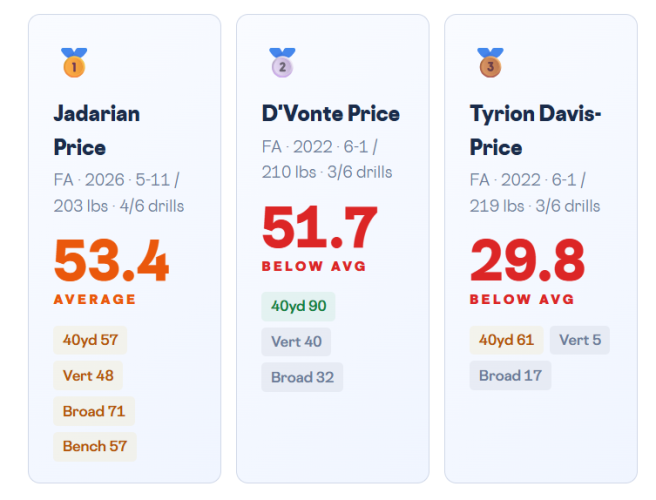
There was still the possibility that he would be the second running back off the board because the class was so weak both at the position and overall, but his profile still did not scream First Round Grade. Price was never the lead back at Notre Dame, though that's not really his fault when he was up against Jeremiyah Love.
Still, we're talking about a guy who never had more than 120 carries or six catches in any of his three collegiate seasons. He was, of course, explosive with his opportunities by rushing for over 6.0 YPC in his last two seasons and piling up 18 rushing touchdowns on 233 combined carries.
There's a lot to like here, but it's also hard to draw definitive conclusions. We don't know if he can be a factor in the passing game -- something that was also an unknown with Kenneth Walker coming out of college -- and we don't know if he can handle a workhorse role.
Even with all of those questions or concerns, Price's first-round capital and landing spot have sent his ADP skyrocketing. He was going in the 9th round before the draft, now he's going at the end of the fifth. That's a near 50-pick surge. To put it in context, your Price decision used to be between him and J.K. Dobbins, Blake Corum or Tony Pollard (another big post-draft riser). Now? It's Price vs Bhayshul Tuten, D'Andre Swift or Quinshon Judkins.
A rise like that tells us a few things. The market is basically copy-pasting Price into where it was taking Kenneth Walker a year ago. Walker, if you remember, had a kind of frustrating regular season. He averaged 9.5 fantasy points per game over 17 games, while Zach Charbonnet averaged 10.0. So chasing the Kenneth Walker role isn't all that exciting. We don't even know if it exists in the same way with Klint Kubiak now coaching the Raiders.
That being said, it's a different setup in Seattle now. Obviously, Walker is gone, but the Charbonnet threat to the lead back's workload is lessened. He's coming off a serious knee injury suffered in the playoffs. I'd be surprised if he's ready for Week 1, let alone recapturing his pre-injury form. Emanuel Wilson was brought in this offseason, but it's a one-year, $2.1m pact. There's obviously a higher level of investment from the team on Price.
TL;DR I understand the market's enthusiasm for Price, to an extent. He's a first-round pick, Walker's 221 carries are up for grabs, Charbonnet may take a while to be back to himself, and his only big competition for carries is a veteran on a cheap (possibly cuttable?) deal. However, there's nothing in his profile that screams that he's a slam dunk prospect. Taking him in the fifth round is a significant commitment that requires a different level of production than we were previously expecting.
I'm establishing myself as way below market on Price for now. Even if I end up folding and moving him up in my rankings, Price in the 5th is not something I'm going to heavily mix into my best ball portfolio.
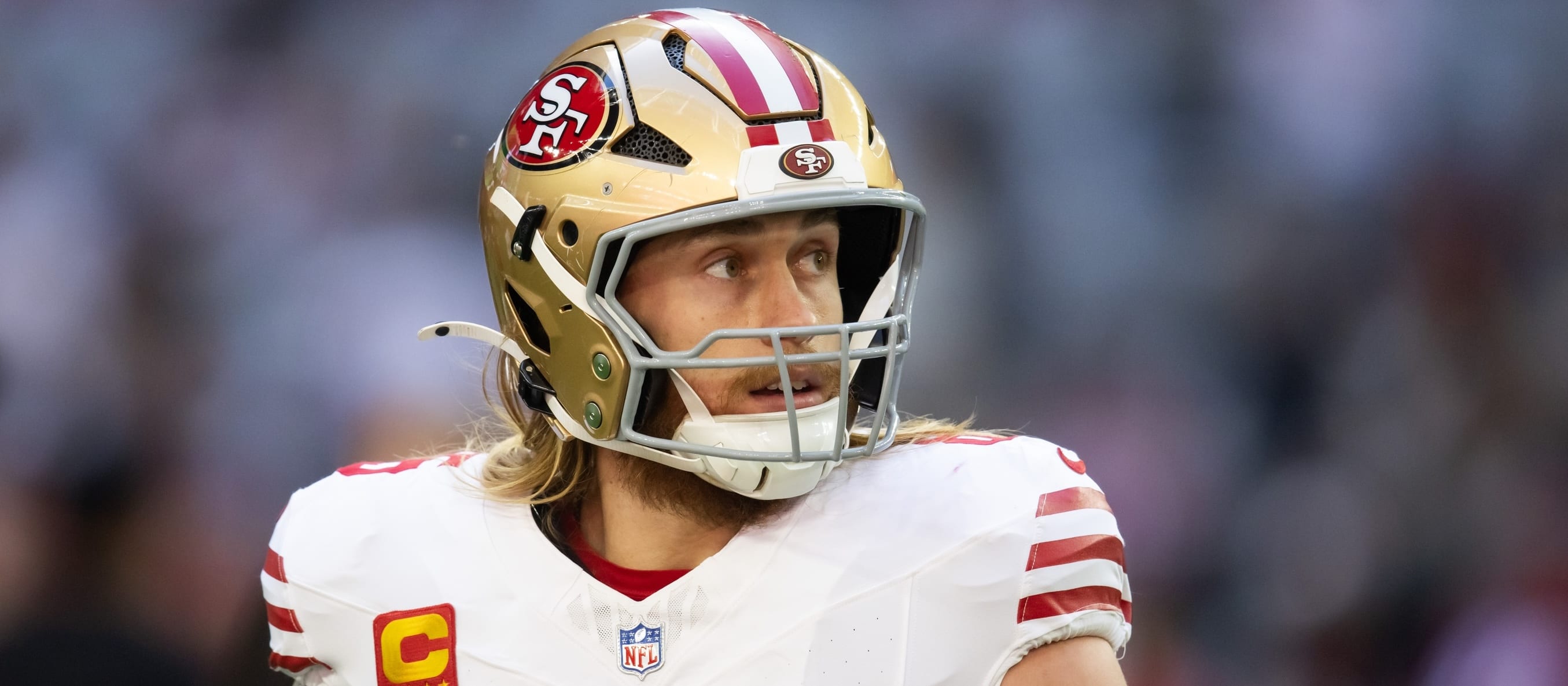
George Kittle
ADP: 116.5 (TE9)
My Rank: 138 (TE15)
I am surprised there's not a steeper discount on George Kittle. We can't deny how good Kittle has been for the better part of a decade. But this is about 2026. And I have some concerns.
Kittle turns 33 in October. He missed six games last season (hamstring) and then suffered a torn Achilles in mid-January. A torn Achilles casts doubt on any player the following season. It happening in January makes it even more concerning. Tack on the age tax, and I just don't understand how he's going as the ninth tight end off the board.
The bullish case for Kittle is that, regardless of when he's back, he'll be just as effective as he was pre-injury. Missing the first month doesn't matter if Kittle is smashing during the fantasy playoffs. That's best ball in a nutshell.
My issue is that I'm not buying that Kittle will be the same this year. I'm going to have to fight back against a deluge of positive reports this summer, suggesting that he's way ahead of schedule and targeting Week 1 and all that. Even if he's ready by then -- which I still think is a stretch -- I fear that his elite traits will look more pedestrian. Kittle rated in the 90th percentile in TPRR% (24.2) and 96th in YPRR (2.20) among tight ends last year. It's going to be hard to match that with the factors working against him.
If I'm wrong and Kittle looks no worse for wear, you'll be happy to have gotten him at his current ADP. I will say he's a much more justifiable pick as a TE2, but then you're spending a lot of capital on tight end before the 10th round is over.
I feel like the tight end pool is as deep as it's been in years. Options like Oronde Gadsden, Dalton Kincaid, Travis Kelce, Mark Andrews and Jake Ferguson all go later than Kittle without having the combined age & injury red flags.
Respectful Disagreements
In this section, we'll look at my strongest disagreements with the market. We'll start with a look at the players I'm higher on than the ADP. In best ball, we usually have to assume that the market is mostly efficient. We don't want to make a habit of being way out of tune with ADP. That's not to say that it's perfect. ADP can be off on certain players.
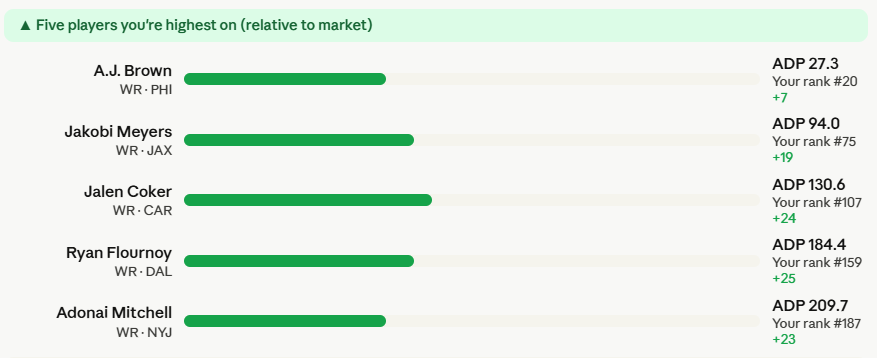
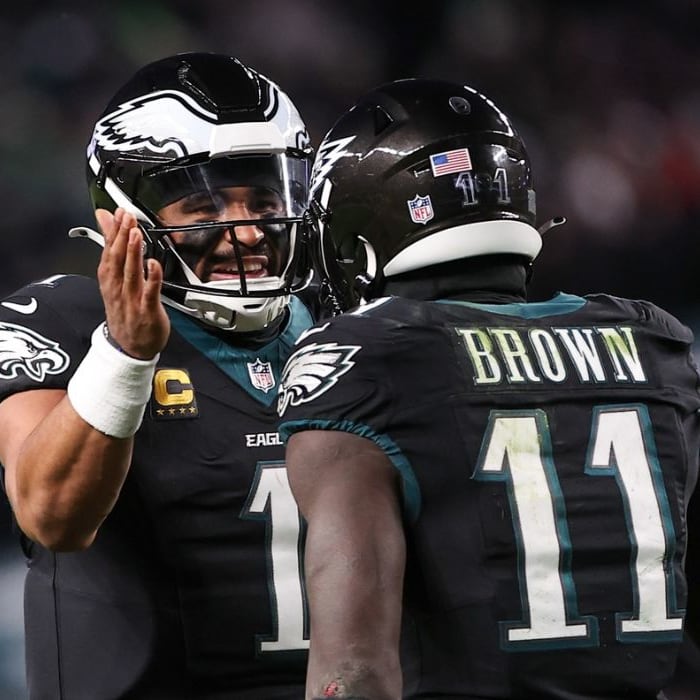
- A.J. Brown: I'm expecting Brown to be playing elsewhere in 2026. He's still very much in his prime. I don't understand the market hesitancy of making him WR11 when he might have a top 5 season in his bag.
- Jakobi Meyers: Maybe I'm overselling Meyers a bit in this scoring environment. We need touchdowns in Underdog, and that has not been Meyers' strong suit in recent years. I'm also expecting some handwringing about his role getting pinched this summer as people fixate on the two-tight-end trend, which deletes a third receiver from the formation. I might scale Meyers back a bit in the rankings but still feel like he's a strong floor target to help bolster your receiver room. You can't swing for the fences with every single pick.
- Jalen Coker: I don't understand why Coker's ADP has slid nearly a full round since the draft. Chris Brazell is an Xavier Legette, problem, not a Coker problem. Coker should be the primary slot option in this offense and is ready to take a leap. It takes a little projection since his first two years were essentially identical and somewhat forgettable, but there's reason to believe another level exists for Coker. The target share should double and he has the athletic traits to maximize the added opportunities
- Ryan Flournoy: Flournoy has some barriers in front of him for sure with CeeDee Lamb and George Pickens in the fold, but with a 16th-round ADP, he's also got an upside case that's worth a gamble. It's easier to find gems at receiver in the end game than it is running backs so when you're rounding out your draft with a WR, give him a look. Flo had strong TPRR% and YPRR figures last season and also caught 71% of his targets. We're not asking for 100 targets, but if he ticks up into the 70s or low 80s, he will far outperform this ADP.
- Adonai Mitchell: Mitchell's ADP has cratered since the draft. I get it to an extent; the Jets drafted two pass-catchers in the first round in Kenyon Sadiq and Omar Cooper. I fail to see how that deletes Mitchell from the offense, though. Mitchell should still have a claim to one of the boundary reps while Cooper and Sadiq eat up a lot of slot work. Garrett Wilson is still the runaway No.1 option, but I think the rumors of Mitchell's demise have been greatly exaggerated. People were all in on this guy just two years ago and he showed some promise down the stretch last year.
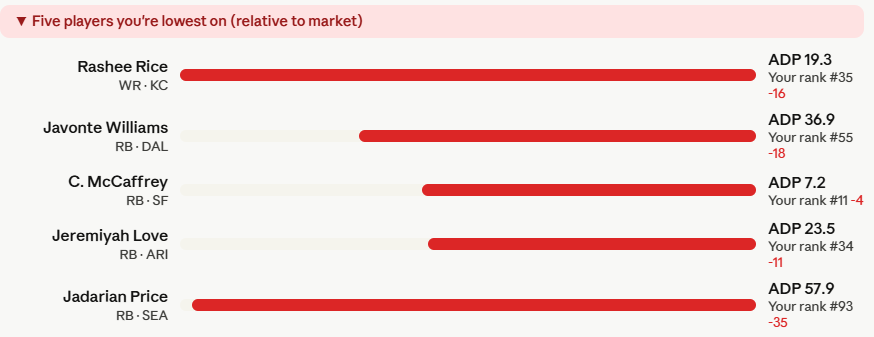
- Rashee Rice: More on him in the next section but I think Rice's low-aDOT, target spammer type of role just isn't all that exciting in .5 PPR scoring. He's being drafted as if he's the runaway No.1 receiver in the best passing attack in the league. I think the Chiefs' reputation overshadows the reality of the last couple of seasons.
- Javonte Williams: Williams feels like this year's Chuba Hubbard where if you drafted him last year, you made out like a bandit. Taking him at the end of the third is a whole different discussion. Dallas didn't add to the backfield this offseason, which helps his role projection, but I'm not sure he'll have the same monopoly that he did last year. Right or wrong, I'm wondering if post-hype Jaydon Blue can get himself into the mix.
- Christian McCaffrey: A lot of old fantasy football adages apply here. CMC will be 30 this season and is coming off of 413 touches last season. We've seen him wear down before and durability has been an issue multiple times. A fully healthy season from CMC will crush my ranking and likely result in a top 3 finish overall. I'm just pretty dubious we'll get that two years in a row from him. And who knows, maybe the Niners will start using some of the other million runnning backs they've spent draft picks on.
- Jeremiyah Love: The market has pushed Love back a bit since the draft because of the landing spot. I don't think it's gone far enough, though. This is a bad Cardinals team. They will run more, and taking Love third overall is a signal of that. But this feels like a bad Jeanty rookie year sequel to me, but with less of a stranglehold on a workhorse role due to Tyler Allgeier's presence.
- Jadarian Price: I said what I said.
Tough Tiers
Coming up with rankings is a tricky exercise. There are so many inputs to consider and it can be tough to cut through all the noise. I wanted to highlight some of those pain points and walk you through how I sorted out a couple of difficult ranking decisions.
Premier WR2s
The glut of running backs that take up most of Round 2 pushes some intriguing receiver options into the third round and even the early 4th. This is an important group to get right this year
Rashee Rice (ADP 18.9, Rank 35) is drafted well ahead of the rest of these receivers. That's not where I have him ranked, though. I have him right in this cluster. He's got standout TPRR% and YPRR figures, though on an incomplete sample last year (and the year before). The market is drafting him as if Rice is the runaway top target in an elite offense. I'm not sure that can be said of the Chiefs anymore. The offense has stagnated in recent years, and Mahomes is coming off an ACL. I don't care that he's golfing again already.
Rice should be ticketed for a lot of usage, but his aDOT (4.6) is minuscule, and his catch rate lags well behind where it should be when he's being targeted at those depths. It feels like there's some misplaced optimism that spammy usage will result in top 10 WR production. Rice is more palatable in full-point PPR scoring. In Underdog's half-point format, I'm looking elsewhere.
I have the following three receivers ranked ahead of Rice.
Chris Olave (ADP 32.7, Rank 25) has seen his ADP dip since the draft, and that feels like a misstep by the market. If anything, it's good that there's another viable target out there that defenses have to account for in Jordyn Tyson. I don't think Tyson takes from Olave's plate, and Olave's life should be easier generally. As long as Olave stays healthy -- a fair concern -- he's going to return top 25 value.
DeVonta Smith (ADP 32.2, Rank 31) has seen his ADP creep up to the middle of the third round, presumably because everyone is expecting AJ Brown to be playing elsewhere next year. I wonder if there's some hesitancy from the market that's stopping him from going inside the top 30. Regardless, I'll keep trying to aggressively add him when he's available at ADP or slips past it.
Tetairoa McMillan (ADP 36.1, Rank 32) is the best Year 2 breakout candidate according to the market. He's routinely going inside the third round, ahead of guys like Emeka Egbuka and Garrett Wilson. McMillan has a different profile than some of these guys, but it works well on Underdog. Instead of being a target hog, McMillan is a downfield target who packs a lot of punch on a per-catch basis. Drafting McMillan at cost means we're putting some serious eggs in the Bryce Young basket, and that can be scary, but there are worse situations out there, and T-Mac has a convincing profile that we can buy in on.
Garrett Wilson (ADP 38.8, Rank 33) shouldn't be penalized this much for the tough 2025. I don't know if any receiver was going to eat in that offense last year, even over a full season. When he was active, Wilson dominated the target share and air yardage. The Jets obviously added a lot of talent via the draft that will be involved in the offense, but this is still the Wilson show. I'm dubious that Omar Cooper and Kenyon Sadiq meaningfully hurt Wilson's bottom line.
I drew the line for Rice at Emeka Egbuka, who is still interesting at his current draft slot.
Emeka Egbuka (ADP 39.8, Rank 36) is an interesting case in that the hype couldn't have been crazier after the first month of the season, but he went out with a whimper down the stretch. I was surprised to see his catch rate (48.5%) sit as low as it did. Still, with Mike Evans gone and Chris Godwin seemingly in the twilight of his career, Egbuka should see his target share improve, and a slight decrease in aDOT will help with his efficiency.
Tight End Logjam
We've got a big cluster of tight ends going in the 10th and 11th rounds. According to the ADP, this run starts with George Kittle (117.0, TE9), Travis Kelce (124.3), Jake Ferguson (124.6), Mark Andrews (127.3), Dalton Kincaid (131.1), Isaiah Likely (133.5), Dallas Goedert (134.8) and Oronde Gadsden (137.5).
This is good and bad. It's good because you can structure your first nine rounds knowing you'll have good options to get a good starting tight end and possibly double-dip and grab two players from this range. It's bad because there are going to be extremely right and extremely wrong answers, ultimately.
I've gone ahead and given my two cents on each of these guys in order of how I have them ranked.
Dalton Kincaid (TE9): This is where you have to be careful with sample sizes. I've never been a huge Kincaid guy, but there was some wildly encouraging stuff from his shortened 2025. In 12 games, he had elite under-the-hood stats, including 3.01 YPRR with a 25.8 TPRR. Those will come down a bit over a full season but maybe not by a ton. The offensive system won't change much with Joe Brady now the head coach and Kincaid thrived in a higher aDOT role (9.3) last year with a near-80% catch rate and standout 6.7 YAC average. He also led tight ends in 20-yard receptions in just 12 games. It's fair to be concerned about the PCL injury that has hampered him since his second season, and also not to give full credit to last year's numbers. Basically, I think this could be Kincaid's peak season. Josh Allen is at the top of his game, and DJ Moore only helps the overall health of this offense. Kincaid clearly has Allen's trust, and even as a skeptic early on, this might be the year to buy in.
Oronde Gadsden (TE10): I'm pretty surprised at how much the market has downgraded Gadsden in light of the David Njoku signing. He's down 16 spots in ADP since Njoku signed, which is objectively a big drop and it gets crazier when you consider how many tight ends he is now ranked behind by the consensus. Gadsden had an extremely promising rookie year, especially relative to expectations. He drew targets at a solid rate (19.7) despite having a downfield role by TE standards (8.7), and tied for third among tight ends with 11 grabs of 20+ yards. With the new offense and added competition for snaps, it's fair to be concerned that Gadsden lags behind this group in targets. Still, rookie years like Gadsden's signal major per-target upside. If you're buying the Mike McDaniel Chargers offense, you have to be in on Gadsden by extension. I'll be very interested in getting more Gadsden shares while his ADP is this low.
Travis Kelce (TE11): This one is tough because my eyes told me one thing and his numbers told me another. He's starting to move around like the Tin Man, kind of like late-stage Gronk. But he's still such a staple of this Chiefs offense (and getting paid like it). He's still crafty after the catch, ranking third among tight ends in YAC last year and fifth in YAC average. I won't begrudge anyone who wants to get out a year early than a year too late on Kelce. His YPRR has fallen off but is still serviceable at just over 1.5. That adds up when he should be near the top of the league in routes run among tight ends. Basically, if you accept that a ceiling season is out of the question and draft Kelce for stability, he's fine where he goes. The offseason signals that it's still the Kelce/Rice show in KC.
Mark Andrews (TE12): Andrews is coming off the worst season of his career and turns 31 before Week 1. I get it if you're out on this profile. There's also an unknown that comes with a new offensive scheme. However, similar to Kelce, he still projects to be a major part of this offense. Outside of Andrews and Zay Flowers, there aren't a lot of sure things among the Baltimore pass-catchers. 18 or even 20% target share seems feasible, and his YPRR dropoff last year was so extreme (2.01 > 1.29) that it might be safe to assume a solid bounce back. He had never been below 1.98 YPRR going back to 2021. I'm not ready to write him off after one bad season, even if the market is.
Jake Ferguson (TE13): Ferguson is a great floor play from this tier. He's got a solid target share projection in a high-volume offense, and his 80.4 catch rate led all tight ends with at least 300 routes last year. That was a significant jump from his previous norms (~70%) but with a low aDOT role (4.6), he can come close to replicating that efficiency. He got a strong 24 red zone targets, the second time in three years he's crossed 20 such looks. They didn't all come when CeeDee Lamb was out, either. He had six games with multiple RZ targets when Lamb was active.
Play Caller historical pass rate over expected by distance away (yards) from the opposing endzone pic.twitter.com/2WTf8j0dOZ
— Football Insights 📊 (@fball_insights) May 14, 2026
Dallas has a neutral PROE down in the red zone, so the ball is still going in the air when the Cowboys get into scoring range. Ideally, Ferguson's red zone usage will be stable for our purposes on Underdog. Even if that RZ rate comes down a little, Ferguson's strong target share and catch rate combo make him a solid buy at ADP.
Isaiah Likely (TE14): I've been a Likely believer for a long time, and this might be the year he finally gets unleashed. This will sound like cherry picking, but hear me out. The last time Likely functioned as the unquestioned TE1 (Weeks 12-18 in 2023), he finished with 72.7 HPPR points in that span, which graded out as TE4 in the league. Two frustrating seasons followed before hitting free agency and getting a needed change of scenery. It will be interesting to see how Likely holds up in a bigger role, but again, we have reason to believe he's ready to take the next step. There's a chance he finishes second on the team in target share. Not bad for an 11th-round option.
George Kittle (TE15): I gave my screed on Kittle above. I simply do not like him at this ADP, especially if he's my first tight end. The floor is so low, and the ceiling is lower than the ADP implies. I can hear the argument, though, if he's your second tight end. If I'm wrong and he's back to normal, he'll smash this ADP. His per-game target share should still be strong even if the efficiency numbers wane a bit. Ideally, you'd be pairing him up with a more stable TE1 who's not coming off an injury like Tyler Warren or maybe even Kyle Pitts if you're buying that late-season surge.
Dallas Goedert (TE16): Last year's TE3 is not being treated like most players who post an elite season the year prior. I think a lot of that has to do with an expected regression in touchdown efficiency. 11 on 82 targets is going to be really hard to replicate. The Eagles will likely shed A.J. Brown from the offense, but the team also added Makai Lemon and Eli Stowers, along with some solid vets who can draw targets. If Goedert's targets get pinched, it puts more pressure on him to replicate the wild TD efficiency he had last year. The market has moved him down about half a round since drafts opened in February. I don't think that's enough of a discount for me at the current ADP.