

NFL Best Ball: ADP Shapes by Team
This best ball article is all about shapes. "Shapes?" you say. Yes. Shapes.
In this context, it's a look at how ADP for each individual piece (QB, RB1, RB2, WR1, WR2, WR3, TE1) of an offense comes together. Some shapes are flat, with most of their players going in a condensed range. Other shapes are jagged, with premium pieces at the top of the ADP and then a bunch of players who are barely getting drafted. There's insight into how each component is being drafted and how it fits into the broader picture of the team's offense and the best ball ADP as a whole.
Looking at teams through this lens can help us visualize where the soft spots in the market are, and even where some attainable best ball stacks may be.
Best Ball ADP Shapes By Team
NFL Best Ball: ADP Shapes by Team
This best ball article is all about shapes. "Shapes?" you say. Yes. Shapes.
In this context, it's a look at how ADP for each individual piece (QB, RB1, RB2, WR1, WR2, WR3, TE1) of an offense comes together. Some shapes are flat, with most of their players going in a condensed range. Other shapes are jagged, with premium pieces at the top of the ADP and then a bunch of players who are barely getting drafted. There's insight into how each component is being drafted and how it fits into the broader picture of the team's offense and the best ball ADP as a whole.
Looking at teams through this lens can help us visualize where the soft spots in the market are, and even where some attainable best ball stacks may be.
Best Ball ADP Shapes By Team
You can hover over each line to see every individual team's ADP shape. It can be an insightful look into how the market views a given offense. Basically, it's a way of seeing what type of story the market is telling about each team. For example, if there's a team with two receivers going in the first 40 picks but the quarterback is going outside the top 100 picks, the market might be underselling that quarterback or overrating one of those two wideouts.
Let's look at some of the funkier teams according to the ADP.
Las Vegas Raiders 
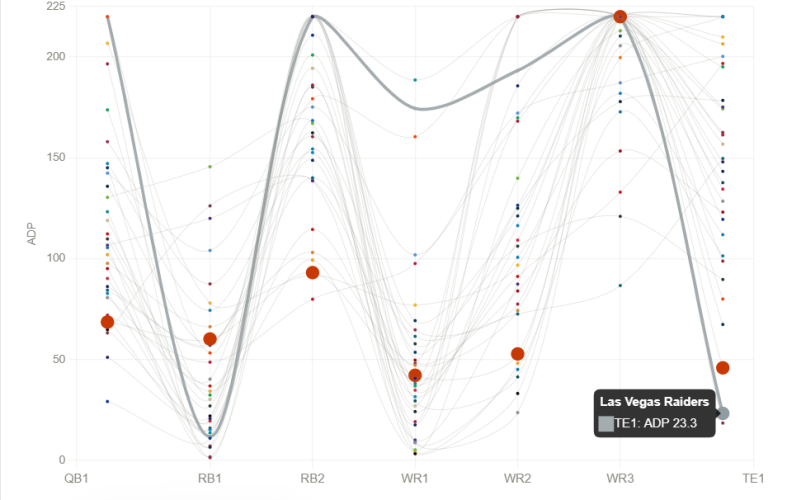
Ashton Jeanty (11.8) and Brock Bowers (23.3) both go inside the top 24, but no other Raider goes inside the top 150. If we pencil in Fernando Mendoza (QB27), that puts him right on that line. Otherwise, you're looking at receivers like Jalen Nailor and Tre Tucker who are available in the 14th round or later. The market is telling us that the Raiders' studs will rake while the rest of the offense struggles. Is that a realistic outcome? I'm not so sure. Vegas will have to collectively take a step forward this year for Jeanty and Bowers to return value. If they struggle as badly as they did last year, it'll be hard for either to end up as good picks. It's interesting that the Raiders are one of five teams (DET, DAL, ATL, CIN) with two players who go in the first two rounds.
There's also been a slight market shakeup in Vegas since I started this article with Kirk Cousins signing. This will likely knock Fernando Mendoza's ADP a round or two while Cousins likely creeps into the top 180. This might end up being a toss-up depending on the reporting. Right now, I'm not buying the redshirt idea for Mendoza and believe he will be starting when it counts for best ball purposes. As your QB3, I think it's fine to keep drafting Mendoza at a decreased ADP.
Cincinnati Bengals 
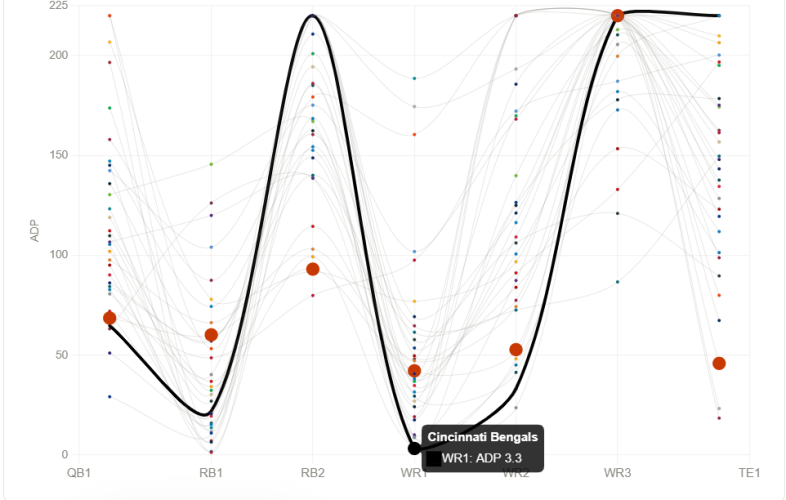
The Bengals are very top-heavy. Ja'Marr Chase, Chase Brown, Tee Higgins and Joe Burrow go in the first six rounds, and then it's a crapshoot as to whether another Bengal gets drafted. The market likely has this correct; we've seen that the Bengals can support elite production from the QB, RB1, WR1 and WR2 spots over the last few years. It leaves little room for anything else. I will say that I don't mind Mike Gesicki as a last-round TE target, and I'd be a little interested if the Bengals took a running back in the draft to compete with Tahj Brooks.
Jacksonville Jaguars 
Jacksonville is interesting because the entire starting loadout gets drafted inside the top 150, but no single Jaguar has an ADP inside the top 50. Bhayshul Tuten has risen up the ADP this offseason and isn't far away from cracking the top 50 if there's some attrition in front of him.
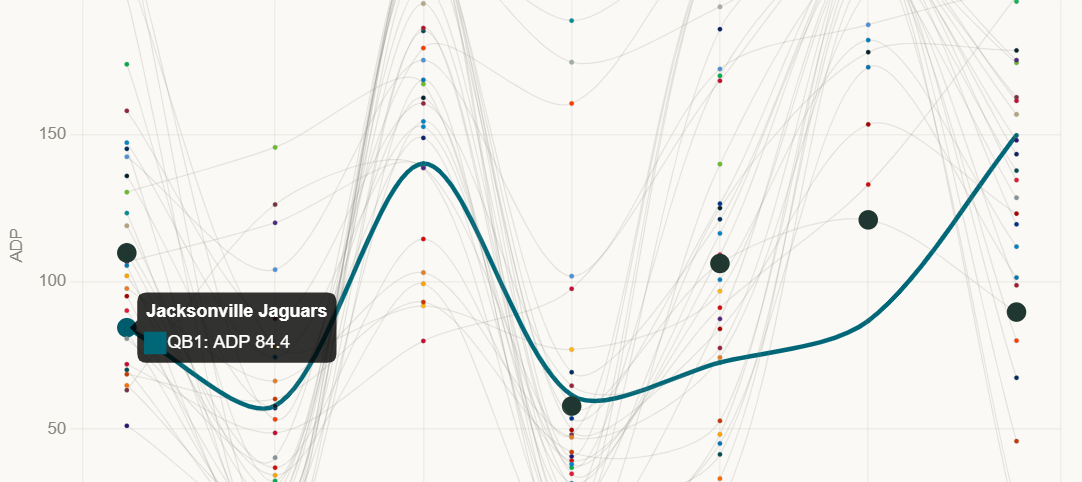
The Jaguars are, I believe, the only team with seven players going inside the top 150. Put another way, the market is very bullish on the Jaguars offense, but there isn't an elite piece here. I keep harping on it but the market was very wrong on Jacksonville in both directions last year. It was way too high on Brian Thomas and Travis Hunter, and too low on everyone else.
I would think that something's got to give with the way the Jaguars market is taking shape. It's going to be hard for each of these data points to be right. There has to be some give and take. I'm particularly skeptical that all three of the receivers are being drafted in the right order and in the right spots. Brian Thomas, Parker Washington and Jakobi Meyers go within a 26-pick band from the start of the sixth to the middle of the eighth round. I'll talk about this later in the RB section but usually when a team has a very jumbled position group, there ends up being a very right and very wrong answer.
The problem for us, right now, is that it's really tough to tell who that is in Jacksonville. It's hard to fully jump ship on Brian Thomas after the rookie year that he had, but it's also hard to be fully in after last year, along with the trade rumors this offseason. Parker Washington is very good, but do you really like him as your WR3 when you can get Meyers a round and a half later? It's also interesting that Meyers is the highest drafted WR3 in the ADP by a good 3.5 rounds.
I believe in the Jacksonville offense and my approach is going to be: take what the draft gives you. If I can get Trevor Lawrence, I'm absolutely going to try and get Meyers with my next pick. Or if I'm in the market for a Thomas or Washington, I will hopefully have a good path to snagging Lawrence at the end of the seventh.
For what it's worth, I've been drafting the latter pieces of the Jags offense -- Brenton Strange and Chris Rodriguez -- in bulk over the last month.
Biggest Gaps Between WR1 and WR2
There are eight teams with a gap of 100 picks between their WR1 and WR2. This signals a couple of things. For one, it strengthens the notion that the WR1 has a massive target share in his offense. You may look at this and say, "Well, what about the tight ends?" Only Harold Fannin in Cleveland and Kyle Pitts in Atlanta have ADPs of any significance from this cluster of teams.
The other thought I had in looking at this chart was, "Are we even sure the market is correctly identifying the WR2 in these offenses?" We are talking about guys like Jahan Dotson, Devaughn Vele, and Jaylin Lane, after all. I think there are cases to be made for any of these "WR2s" just because the level of investment is so minimal. But we'd want to be careful with overdoing our exposure to any of them, because I'm not sure they will end up as the actual WR2 by the time the season gets here.
There's another useful insight here, which is that this list could be instructive for which teams are likely to draft a receiver early. Sure, the Saints traded (kind of a lot) for Vele last season, but would you really blame them for getting a difference-maker opposite Chris Olave to give Tyler Shough a better supporting cast? Or Washington, where it really feels like Terry McLaurin and nothing else in that offense, while Jayden Daniels looks to get back on track.
Other teams on this list have promising younger receivers that they have invested in recently, like Jayden Higgins in Houston or Adonai Mitchell with the Jets.
Most of these teams are justified in emphasizing their WR1s to this degree. Who would argue with Drake London, Chris Olave, Zay Flowers, Terry McLaurin, Malik Nabers, Jaxon Smith-Njigba, Nico Collins or Tetairoa McMillan dominating the target share?
My main point for this section, as opposed to the following one, is that the distant WR2 could in reality be the WR3 or WR4 by the time the season gets here. Taking any of these players is going to require some additional skill evaluation. You have to ask yourself, is there upside here? What role can he feasibly play within the structure of this offense?
Among this group of WR2s, the ones I'm most confident in living up to their ADP are: Jalen Coker (116.4), Rashid Shaheed (135), Adonai Mitchell (170) and Jayden Higgins (125.0). Rashod Bateman, Devaughn Vele, Jahan Dotson, Darnell Mooney and Isaiah Bond are standing on shakier ground, in my opinion.
Biggest Gaps From RB1 to RB2
This graph aims to reflect the backfields the market views as very settled.
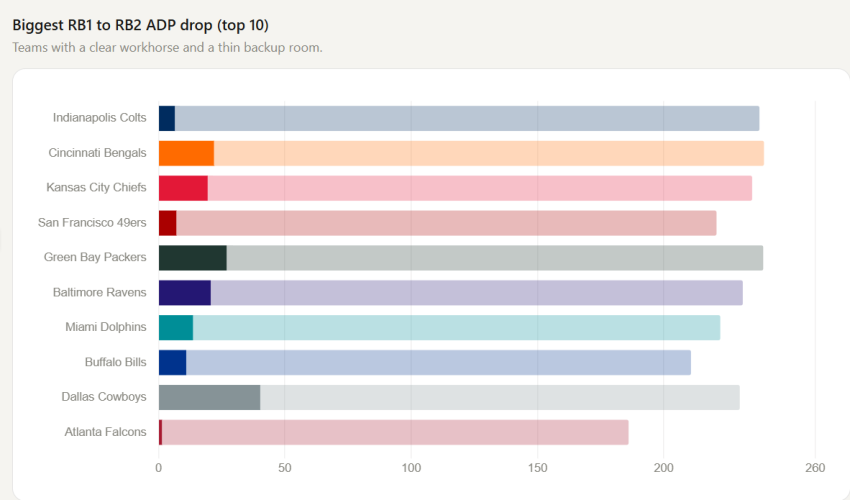
This chart paints a pretty intuitive picture that underscores how strong a hold the league's workhorses have on their collective backfields. Every RB1 on this chart is backed up by an RB2 with an ADP north of 200, save for Bijan Robinson and his backup, Brian Robinson.
The question, just like with the distant WR2s, centers on whether any of these RB2s are worth drafting. You simultaneously position yourself for massive contingent upside if the RB1 goes down, while also opening yourself up to getting a total goose egg from a pick. We want to avoid goose eggs. Here are the super late RB2s I'll consider mixing into my portfolio.
- Jordan James, San Francisco 49ers (ADP236.1): My guy Mario Puig gave a nod to James in his late-round targets article, and the more I think about it, the more it makes sense. I've already stated that I'm leery of Christian McCaffrey coming off such a massive workload at his age. With Brian Robinson gone, James seems like the next guy up behind CMC. James was a strong producer at Oregon who should at least be able to shoulder a decent amount of carries. There's a risk for him or Isaac Guerendo getting competition drafted into the RB room, but it's unlikely it would come before Day 3.
- Ollie Gordon, Miami Dolphins (ADP 222): Yes, Miami is going to have an awful offense this year. But the run game might not be half bad with Malik Willis at the helm and De'Von Achane. At his best, Achane is getting 14-15 carries a game along with a healthy dose of targets. That leaves available carries. Willis will get some of that, but Gordon has the contrasting frame to Achane that lends itself to handling the dirty work between the tackles and near the goal line. If you like my thesis -- that there's room for a fantasy viable role behind Achane -- but not my player eval, Jaylen Wright (238) is there as a last-round option.
- Jaydon Blue, Dallas Cowboys (230.5): The market got the Cowboys' backfield wrong last year. Javonte Williams went way too late, and guys like Blue and Miles Sanders went too early. Has the market overcorrected, though? Williams, who got paid this offseason, has a mid-4th-round ADP while the market lets nearly 200 picks go by before another Dallas RB comes off the board. Sometimes the market can over-punish the players that they whiffed on, and Blue fits that bill. He was a complete dud last year while going about 100 picks earlier. Now, with a year under his belt, can't we envision some semblance of utility from him and his blazing speed as a complementary piece behind Williams?
A little FWIW here on the Bengals and Chase Brown, while we're at it. Look at the chart above and think about some of the names on that list. Jonathan Taylor, Christian McCaffrey, James Cook, De'Von Achane and so on. Brown is good, don't get me wrong, but I don't think he's in the conversation with those guys. His best selling points are role and team context. But I'm not sure he should have the monopoly on the Bengal backfield the way he currently does. With that in mind, I'm trying to speculate on some late-round rookie running backs who may end up in Cincy to compete with Brown. Emmett Johnson and Nicholas Singleton come to mind as potential fits there who could cut into Brown's monopoly just a bit.
Crowded Running Back Rooms
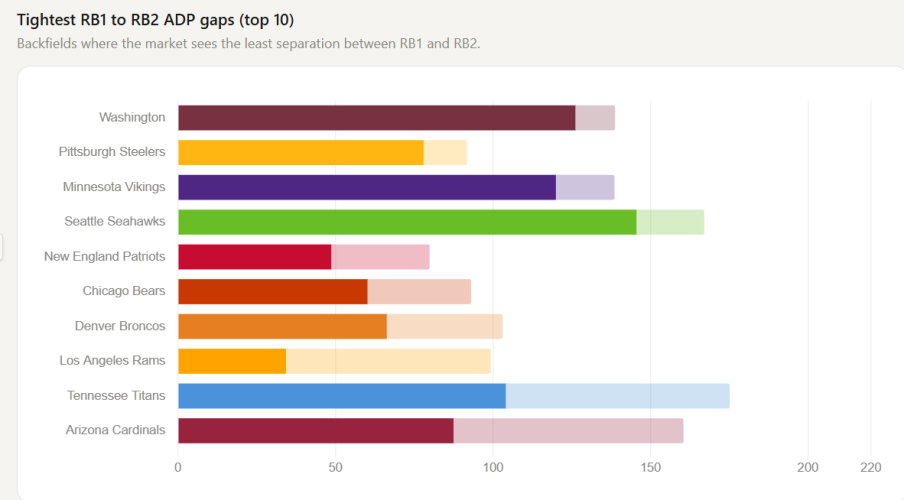
When the market can't make up its mind on a running back room, there's often a buying opportunity. Jumbled backfields usually lead to capped ADPs for the top two running backs on the depth chart. And there's usually a right answer.
Look at last year, where getting the Jacksonville or Dallas backfields right resulted in massive ROI. We can at once acknowledge that there's likely to be a clear winner from a backfield while also realizing that picking the right one isn't always so straightforward. I mean, there were reasons why people were looking for something other than Travis Etienne or Javonte Williams this time last year, as crazy as that may sound in hindsight.
Here's how I'm handicapping some of the trickier backfields as we get close to the next big turning point in Best Ball season, the NFL Draft.
Washington Commanders
Rachaad White (126.2) vs. Jacory Croskey-Merritt (138.8)
White is the newcomer to the backfield, while Croskey-Merritt returns for his second season. From the looks of it, this could work out as a nice committee with their complementary skill sets. JCM is a serviceable between-the-tackles running back who can move the pile and punch it in at the goal line. White, meanwhile, is a classic pass-catching back who ranks third among running backs in receptions dating back to 2022.
Both have their flaws, but they should work well in tandem. You don't have to pony up major draft capital for either, which is nice. My lean would be taking Croskey-Merritt for the slight discount and better rushing + touchdown upside. White's PPR-merchant skill set makes him more appealing on DraftKings.
Pittsburgh Steelers
Jaylen Warren (78.0) vs Rico Dowdle (91.8)
The backfield paid dividends in Pittsburgh last year, but not in the way the market expected. Drafters were keen on Kaleb Johnson, who was the flop of all flops, while Kenneth Gainwell became one of the best last-round picks you could have made. With Gainwell gone, the door seemed open for Johnson to be a late-round value this year. That was until the Stillers inked Dowdle after his impressive season in Carolina. It's probably also worth noting that Dowdle has ties to new coach Mike McCarthy from their days in Dallas.
Dowdle has more of a workhorse profile than Warren, but both can handle legitimate volume. This is another backfield where we could see it work out alright for both players. Warren going ahead of Dowdle is my only gripe at the moment, though.
Warren is not a bad pick in a vacuum, but Dowdle will likely lead this team in carries. Warren might see an uptick in passing game work to offset the lost rushing production. That's not ideal in this format, though. Touchdowns far outweigh dumpoff merchant production.
It's easy to say "take the cheaper one" when deciding between two running backs on the same team going in a similar range. But in this case, the market might be swinging and missing two years in a row when it comes to the Steelers backfield.
Minnesota Vikings
Jordan Mason (120) vs Aaron Jones (138.6)
This is just one man's opinion, but this feels like a jumbled backfield that could get even more convoluted by the time the draft is over. Jordan Mason goes at the 10/11 turn after racking up 758 yards and six touchdowns on 159 carries, while Jones checks in a round and a half later after a big contract restructure.
On the whole, Minnesota had a competent run game last year, picking up an above-average 4.5 YPC as a team. However, the Vikings had the sixth-fewest carries in the league (410).
Mason and Jones work well in tandem, with Mason handling most of the rushing work and Jones still effective on passing downs. That said, I'm skeptical of the upside cases playing out for either of them this season. Taking it a step further, Minnesota's running back depth is nonexistent behind them (sorry, Zavier Scott fan club).
The Vikings seem like a prime candidate to nab a running back either in the third round or the fifth round based on their current selections.
I'm fading both Mason and Jones for the most part, at least until after the draft. If the draft goes by and no significant capital is spent on a running back, I'll reconsider. But I think both current ADPs are about as high as I'd go, so any upward movement in the ADP after the draft would likely put me out of getting much exposure to either Mason or Jones.