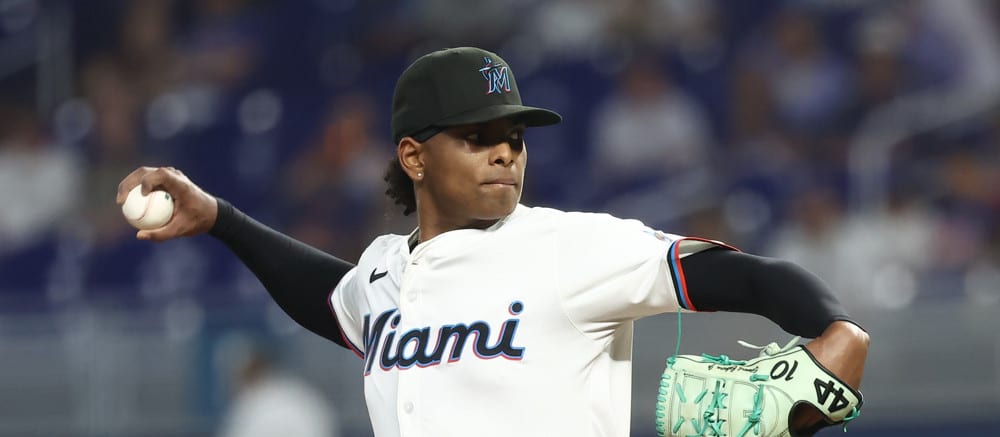


As I type this, Edward Cabrera is still a member of the Miami Marlins. By the time you read this article, he could be in a new organization. By Opening Day, he almost certainly will be.
Why has Cabrera become an appealing trade target for contenders? Let's dive in.
It doesn't take long to fall in love with Cabrera's potential when you watch him. He's a Pitching Ninja dream, particularly when it comes to a changeup that's thrown harder than most fastballs. That said, prior to the 2025 season, that potential had gone largely unfulfilled.
Injuries were a major reason why it took Cabrera so long to break through. Since debuting in the big leagues in 2021, Cabrera has made eight trips to the injured list. Three have been shoulder-related, two have been elbow-related and two have been blister-related, with one ankle issue also mixed in. Prior to the 2025 season, he had never reached 100 innings or made more than 20 starts in a major-league season.
Another huge stumbling block for Cabrera has been his control, or lack thereof. Among the 193 pitchers to accrue at least 250 innings from 2021 to 2024, Cabrera's 13.3 percent walk rate ranked dead last. It wasn't particularly close, either, with reliever Tanner Scott's 12.5 percent walk rate ranking next-to-last. The next-highest walk rate among starting pitchers was Blake Snell's 11.7 percent mark.
In 2025, Cabrera cut his walk rate down to 8.3 percent, which was right around the league average
As I type this, Edward Cabrera is still a member of the Miami Marlins. By the time you read this article, he could be in a new organization. By Opening Day, he almost certainly will be.
Why has Cabrera become an appealing trade target for contenders? Let's dive in.
It doesn't take long to fall in love with Cabrera's potential when you watch him. He's a Pitching Ninja dream, particularly when it comes to a changeup that's thrown harder than most fastballs. That said, prior to the 2025 season, that potential had gone largely unfulfilled.
Injuries were a major reason why it took Cabrera so long to break through. Since debuting in the big leagues in 2021, Cabrera has made eight trips to the injured list. Three have been shoulder-related, two have been elbow-related and two have been blister-related, with one ankle issue also mixed in. Prior to the 2025 season, he had never reached 100 innings or made more than 20 starts in a major-league season.
Another huge stumbling block for Cabrera has been his control, or lack thereof. Among the 193 pitchers to accrue at least 250 innings from 2021 to 2024, Cabrera's 13.3 percent walk rate ranked dead last. It wasn't particularly close, either, with reliever Tanner Scott's 12.5 percent walk rate ranking next-to-last. The next-highest walk rate among starting pitchers was Blake Snell's 11.7 percent mark.
In 2025, Cabrera cut his walk rate down to 8.3 percent, which was right around the league average and a massive improvement over what he had done previously. So what was the biggest driver of Cabrera's better control?
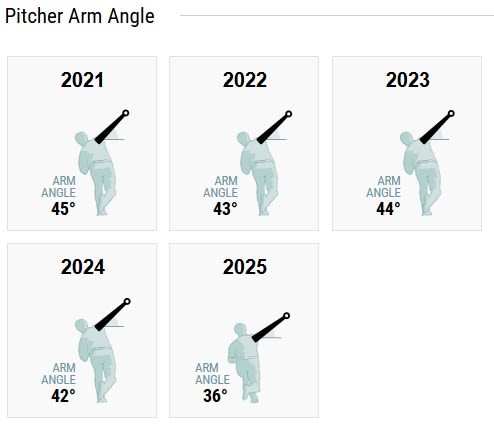
As you can see in the image above taken from Baseball Savant, Cabrera's arm slot dropped six degrees year-over-year and nine degrees from its highest point. He also switched from a four-seamer (27.2 percent usage in 2024, 12.7 percent in 2025) to a sinker (9.2 percent usage in 2024, 20.6 percent in 2025) as his primary fastball. While Cabrera's in-zone rate on his four non-sinker offerings was largely static from the previous season, his in-zone rate on the sinker spiked to 63.7 percent, up from 41.5 percent in 2024.
 Cabrera's sinker on its own is not a good pitch. Opposing batters hit .373 with a .609 slugging percentage off it in 2025, and a .452 wOBA was right in line with a .450 xwOBA. It garnered a minus-6 run value in 2025, per Baseball Savant, after it rated minus-3 in 2024. However, if that's the pitch the right-hander can find the zone with while using his new arm slot, then it's worth throwing with regularity. Cabrera's pure stuff is among the best in the game, but that doesn't matter much if he's constantly behind in the count.
As you might suspect with a guy that drastically altered his arm slot, the characteristics of Cabrera's repertoire also changed. Check out the images below from Baseball Savant, which highlight the improvement in horizontal movement and spin rate as a result of Cabrera's new arm angle.
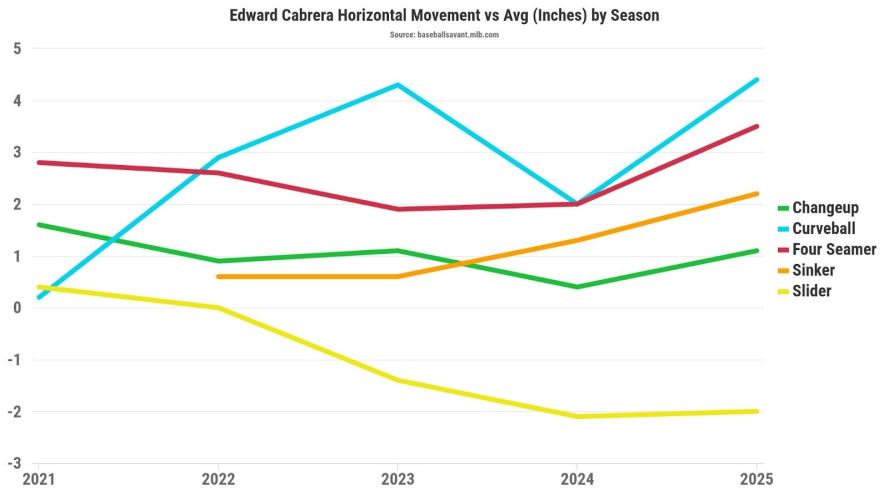
 Cabrera's curveball, in particular, really benefitted from the new arm slot. Its spin rate went up 122 rpm, its horizontal movement went from above average to elite and its vertical movement went from well below average to above average. All told, Cabrera's curveball came in at 119 in Stuff+, which ranked fifth in all of baseball among curveballs among the 105 pitchers with at least 120 innings. Cabrera's overall Stuff+ was a career-best 105, and his Location+ was a career-best 101. The right-hander's Stuff+ on his sinker was 110, which was a 10-point improvement from 2024 and the 15th-best mark in baseball on that aforementioned list of 105 hurlers.
Cabrera somehow threw his changeup even harder with his new arm slot, averaging an absurd 94.2 mph with the pitch. The offering induced whiffs at a 27.2 percent clip, which was easily his lowest mark since his rookie season, but the pitch produced a terrific .261 xwOBA and garnered a plus-5 run value, which was the second-highest in his repertoire behind the curveball. Cabrera's 25.8 percent changeup usage was easily his lowest in four seasons, but it was still the righty's most-used offering. It's always going to be Cabrera's bread-and-butter pitch.
Marlins Park hasn't played as pitcher-friendly over the last three seasons as its reputation suggests, ranking 12th in Baseball Savant's Park Factors (but 21st for home runs). Cabrera has loved pitching there, though. The righty holds a career 3.50 ERA and 1.23 WHIP at home versus a 4.68 ERA and 1.40 WHIP on the road. Those splits were even more pronounced during his breakout 2025 season, with Cabrera boasting a 2.72 ERA and 1.10 WHIP at home compared to a 4.63 ERA and 1.41 WHIP on the road. I'm not sure what, if anything, we can take away from this, but if Cabrera is indeed traded at some point this winter, he'll be looking to improve on the road, regardless of where he winds up.
It took Cabrera a month to settle into the changes he made, as he held a 7.23 ERA, 1.77 WHIP and 20:11 K:BB over 18.2 innings in four April starts. From that point forward, the 27-year-old collected a 2.95 ERA, 1.14 WHIP and 130:37 K:BB across 119 frames covering his last 22 starts. He had just one month with an ERA over 3.00 during that stretch, and that was in August when he had a 4.15 ERA but also a 29.7 percent strikeout rate and 6.1 percent walk rate. That Cabrera was able to sustain that level of consistency over an extended period of time provides hope that the new arm slot was his magic bullet.
While I do think there's a level of sustainability to Cabrera's performance, I also believe him to still be a massive injury risk. Cabrera missed nearly a month late in the season with what the Marlins labeled as a right elbow sprain. The injury was to the outside of the elbow (an injury to the inside of the elbow is when you worry about UCL surgery) and he was shut down for only one week before returning to make two starts, velocity intact. There does not seem to be any worry from the Marlins or teams interested in trading for Cabrera that the elbow injury could linger. That said, a guy with his injury history who throws as hard as he does warrants the brightest of red injury flags.
Cabrera's early NFBC ADP is 198.9, and he's the 57th starting pitcher to come off the board. That suggests to me that the risk with Cabrera is sufficiently baked into his cost, though his ADP is much likelier to go up than down, depending on where he lands in a trade (if he is indeed traded). I wouldn't go near him in a draft and hold, but in other formats, I might be able to talk myself into clicking his name if he falls into the 200s.