

Fantasy baseball has become a year-round hobby for many, with best ball and draft-and-hold leagues starting up almost the same day as the previous regular season concludes. That means that ADP is often fairly well set by the time traditional redraft leagues begin to appear in draft lobbies, particularly on sites such as Fantrax and NFBC.
However, there are still plenty of players who rocket up draft boards once pitchers and catchers report and spring training exhibition games begin. Those players often become some of the most hotly debated until the regular season begins, in turn making it interesting to track the outcomes of those players.
It's still too early to make any definitive judgments about whether those players were worth selecting at the peak of their hype, but this week's Barometer will focus on some of the players who saw their ADP rise the most from February 20 until the regular season began, relative to their ADP from January 1 to February 19. The ADP used was from the NFBC RotoWire Online Championship, which are 12-team redraft leagues. The table below features the biggest risers using the methodology described:
| Player | Team | Position(s) | Early ADP | Spring Training ADP | Difference |
|---|---|---|---|---|---|
| Bryan Abreu | HOU | P | 231.16 | 181.95 | 49.21 |
| Jac Caglianone | KC | OF | 212.39 | 165.89 | 46.5 |
| Griffin Jax | TB | P | 191.57 | 149.56 | 42.01 |
| Matt McLain | CIN | 2B | 184.88 | 145.69 | 39.19 |
| Daniel Palencia | CHC | P | 125.2 | 91.71 | 33.49 |
| Sal Stewart | CIN | 1B | 196 | 162.68 | 33.32 |
| Shane McClanahan | TB | P | 215.18 | 183.34 | 31.84 |
| Kazuma |
Fantasy baseball has become a year-round hobby for many, with best ball and draft-and-hold leagues starting up almost the same day as the previous regular season concludes. That means that ADP is often fairly well set by the time traditional redraft leagues begin to appear in draft lobbies, particularly on sites such as Fantrax and NFBC.
However, there are still plenty of players who rocket up draft boards once pitchers and catchers report and spring training exhibition games begin. Those players often become some of the most hotly debated until the regular season begins, in turn making it interesting to track the outcomes of those players.
It's still too early to make any definitive judgments about whether those players were worth selecting at the peak of their hype, but this week's Barometer will focus on some of the players who saw their ADP rise the most from February 20 until the regular season began, relative to their ADP from January 1 to February 19. The ADP used was from the NFBC RotoWire Online Championship, which are 12-team redraft leagues. The table below features the biggest risers using the methodology described:
| Player | Team | Position(s) | Early ADP | Spring Training ADP | Difference |
|---|---|---|---|---|---|
| Bryan Abreu | HOU | P | 231.16 | 181.95 | 49.21 |
| Jac Caglianone | KC | OF | 212.39 | 165.89 | 46.5 |
| Griffin Jax | TB | P | 191.57 | 149.56 | 42.01 |
| Matt McLain | CIN | 2B | 184.88 | 145.69 | 39.19 |
| Daniel Palencia | CHC | P | 125.2 | 91.71 | 33.49 |
| Sal Stewart | CIN | 1B | 196 | 162.68 | 33.32 |
| Shane McClanahan | TB | P | 215.18 | 183.34 | 31.84 |
| Kazuma Okamoto | TOR | 3B | 229.76 | 198.74 | 31.02 |
| Konnor Griffin | PIT | SS | 192.12 | 162.54 | 29.58 |
| Seranthony Dominguez | CWS | P | 218.86 | 193.92 | 24.94 |
| Ryan Walker | SF | P | 166.67 | 144.53 | 22.14 |
| Wilyer Abreu | BOS | OF | 220.49 | 199.89 | 20.6 |
| Drew Rasmussen | TB | P | 153.18 | 132.9 | 20.28 |
| Cade Horton | CHC | P | 195.84 | 176.59 | 19.25 |
| Carter Jensen | KC | C | 197.29 | 178.48 | 18.81 |
| Kris Bubic | KC | P | 209.63 | 190.92 | 18.71 |
| Luke Keaschall | MIN | 2B | 134.31 | 115.76 | 18.55 |
| Trevor Rogers | BAL | P | 164.47 | 146.03 | 18.44 |
| Daulton Varsho | TOR | OF | 207 | 191.64 | 15.36 |
| Nathan Eovaldi | TEX | P | 147.29 | 132.34 | 14.95 |
| Samuel Basallo | BAL | C | 174.24 | 159.97 | 14.27 |
| Jeff Hoffman | TOR | P | 114.24 | 100.13 | 14.11 |
| Ceddanne Rafaela | BOS | 2B, OF | 139.55 | 125.56 | 13.99 |
| Shota Imanaga | CHC | P | 171.57 | 157.6 | 13.97 |
| Emmet Sheehan | LAD | P | 125.8 | 111.86 | 13.94 |
| Cam Schlittler | NYY | P | 130.37 | 116.74 | 13.63 |
| Francisco Alvarez | NYM | C | 178 | 165.38 | 12.62 |
| Shane Baz | BAL | P | 199.51 | 186.93 | 12.58 |
| Addison Barger | TOR | 3B, OF | 206.37 | 194.39 | 11.98 |
| Framber Valdez | DET | P | 92.1 | 81.19 | 10.91 |
| Teoscar Hernandez | LAD | OF | 136.04 | 125.45 | 10.59 |
| Austin Riley | ATL | 3B | 69.67 | 59.37 | 10.3 |
| Eugenio Suarez | CIN | 3B | 107.92 | 97.85 | 10.07 |
Before we jump into the specific player analysis, there are a few caveats or conditions to lay out. I used this exercise to dive a bit deeper on players whose performance hasn't necessarily been clear or easily explained. For example, Bryan Abreu was the biggest ADP riser, but he isn't included because he's no longer receiving save chances and was a significant detriment to any fantasy manager that rostered him through the first few weeks of the season. Similarly, it's clear that Griffin Jax isn't getting saves in Tampa Bay. While clear "Fallers," there aren't many compelling insights to come from analyzing those players.
Feel free to comment on some of the players that interest you the most from this list in the comments below.
Risers

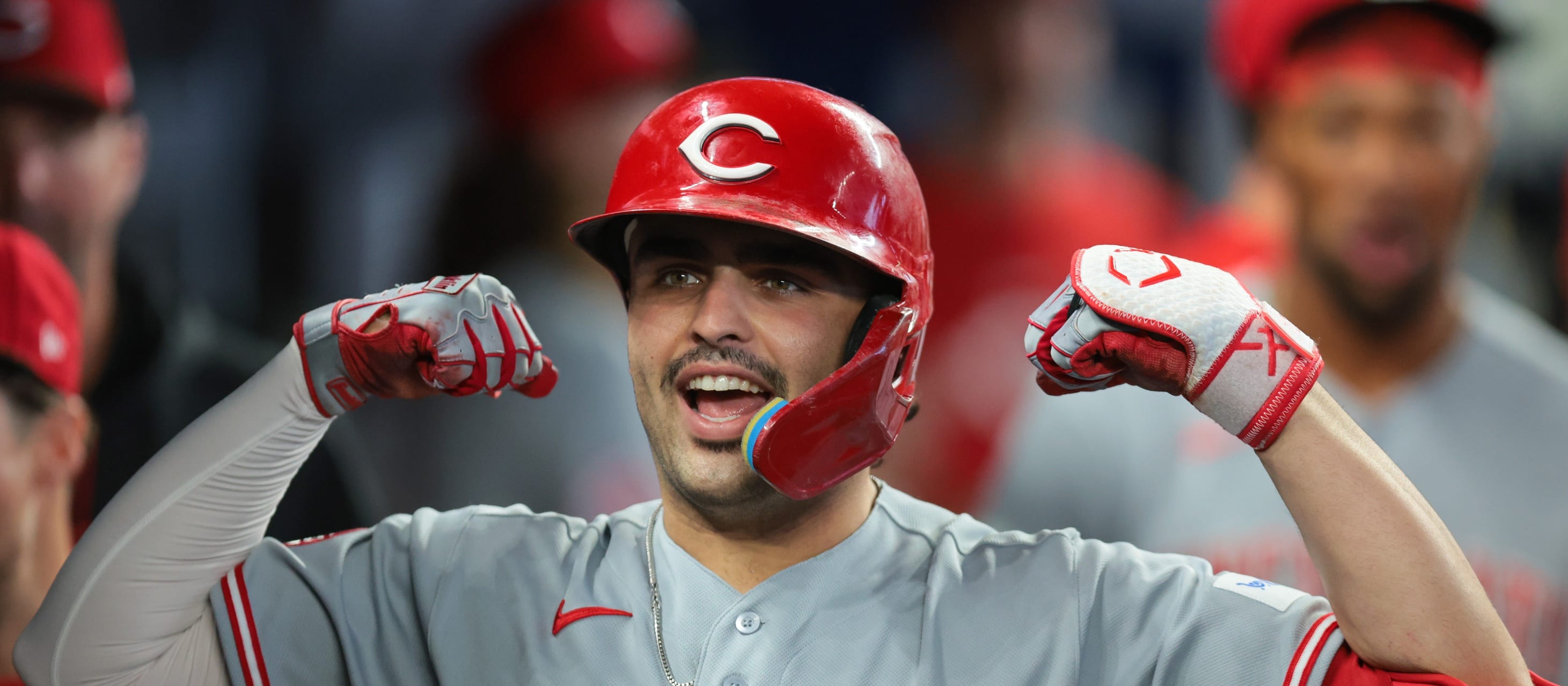
Stewart hit three home runs and maintained a .265 ISO across 20 plate appearances in Cactus League games, which solidified his hold on the first-base job in Cincinnati and also caused a considerable amount of hype as the regular season neared. Needless to say, he's carried that level of performance over into the games that count, as he has nine home runs and a .297 ISO through 130 plate appearances (through Wednesday's game), landing him inside the top 10 of qualified hitters in both statistics. In fact, he's been an excellent contributor across all five categories, also stealing seven bases while maintaining a .288 batting average.
There's no doubt that Stewart has been worth his elevated ADP, and the underlying batted ball metrics tell us his start has been no fluke. Stewart ranks in the 80th percentile or above in any metric of choice to measure quality of contact, and he's even walking at a 13.9 percent clip. Paired with his position in the lineup — Stewart has exclusively hit cleanup — and his favorable home park, and there aren't many holes left to poke in his profile.
To get extremely picky, Stewart arguably hasn't shown the raw power metrics to suggest that he can continue to produce at the pace of an elite power hitter. For example, his max exit velocity and air pulled rate are not elite, while his average bat speed and fast swing rate are both below average. Finally, his sprint speed (32nd percentile) suggests his stolen base pace won't continue, although he is 7-for-7 on his attempts.
While there will almost certainly be some give back over the course of the season, Stewart looks to be a true breakout and is likely to perform as a key ADP value throughout the summer despite his rise up draft boards throughout March.

McClanahan is the toughest case to make as a riser among the group chosen for this article. His 3.91 ERA is solid enough, particularly when taken in the context of a 61.6 percent left on base percentage. On the other hand, he has a 12.9 percent walk rate and just an 11.9 percent K-BB% across his full sample of 23.0 innings. It's dangerous to chop that small sample up, but given the context of McClanahan returning from multiple significant arm injuries, I'm willing to take signs of improvement in that span fairly heavily into account.
Across his first three starts, McClanahan had a 13:11 K:BB and allowed an average exit velocity of 91.0 mph or greater on two occasions. In his two subsequent starts, he's posted a 12:2 K:BB while also limiting his average exit velocity allowed to 89.5 mph or below. Unsurprisingly, it appears that his stuff and ability to locate his pitches are returning. He posted a 116 Stuff + in his last start Saturday and has two consecutive starts with a Location+ of 100 or better after failing to reach anything above 81 in his first three starts. McClanahan's Pitching+ has followed a very similar trend.
There is still plenty of room for McClanahan to improve. He has yet to complete more than five innings, and he's giving up multiple barrels in nearly every start, a combination that suggests there is room for his ERA to balloon and minimal opportunities for wins. On the other hand, he's shown improvement and at least hints of the upside that made him one of the most exciting young pitchers in the league as recently as 2023.

There were a few Red Sox players who were big spring risers, with both Abreu and Ceddanne Rafaela making the list. Since, they've trended in opposite directions. Abreu has cut his strikeout rate by nearly seven percentage points relative to 2025 and has seen a corresponding improvement in his batting average. He hasn't necessarily improved in the most desirable way, as nearly the entirety of his contact rate improvement has come on pitches outside the zone. For now, that hasn't led to a decrease in batted ball quality.
Fenway Park may mute Abreu's true power upside and the Red Sox's underperforming offense has similarly held back his counting stats. The latter should improve as the temperatures begin to warm in New England, setting Abreu up for a strong summer of production.
Fallers

Caglianone was similar to McClanahan in that it was a borderline call as to whether he'd appear as a "Riser" or "Faller". There are a lot of skills that hypothetically point to a very productive player, most of which have to do with clear indications of exceptional raw power. For now, the word "raw" is doing the majority of work in that sentence. Despite boasting 92nd percentile or better marks in average exit velocity, barrel rate, hard hit percentage and bat speed, Caglianone has only two home runs and four RBI across his first 26 games.
As those numbers suggest, Caglianone has struggled to translate his impressive Statcast profile into production. Lack of aggressiveness at the plate and lack of consistent contact are the primary culprits. For example, he has a 62.9 percent zone swing rate, which ranks 135th out of 179 total qualified hitters. Similarly, his 44.9 percent overall swing rate ranks 106th. Finally, Caglianone's overall contact rate is only 67.5 percent, placing him 163rd among those same qualified hitters. He was generally far more aggressive during his time in the minors and had at least a mediocre contact rate, so there should be room to improve as he continues to adjust to big-league pitching.
Overall, there's still plenty of promise in Caglianone's profile, but he has issues to address that will likely prevent him from fully breaking out in 2026. He's a buy-low candidate in dynasty leagues and not someone I'd want to fully dismiss in redraft leagues. However, he has yet to prove he was worth his rise in ADP a few months ago.

Baz hasn't had much success early in the season, but a quick glance at his underlying numbers suggests he's suffered from some bad luck. While his .352 BABIP should improve, Baz's problems extend beyond just unlucky bounces. Or, put more accurately, Baz no longer seems to possess the swing-and-miss stuff to survive some bad luck. His K% is at a career-low 19.3 percent and both his swinging strike rate and CSW have taken corresponding dips to 9.4 percent and 25.5 percent, respectively.
Aspects of Baz's profile have remained encouraging, as he's suppressed hard contact (6.5 percent barrel rate, 37 percent hard hit percentage) and has the best walk rate (7.3 percent) of his career. Given those positives, Baz will almost certainly have stretches of fantasy productivity, with his most recent start against the Astros being an excellent example. All of this leads to the conclusion that Baz is more than likely to be best used as a streamer in shallower formats and an unreliable starter in deeper leagues. That has its utility, but it's almost certainly not what fantasy managers who drafted him had in mind.
The case against Rafaela doesn't necessarily fall into the more traditional lines of analysis. Much of his batted ball profile is similar to that of 2025, and perhaps even slightly improved in some regards. Some more indirect factors raise reasons for concern. After stealing 20 bases on 25 attempts last year, Rafaela has attempted only three stolen bases one month into the season and has yet to be successful. His sprint speed remains strong, so perhaps he'll regain his aggressiveness and efficiency on the basepaths. For now, the lack of both is a significant dent in his fantasy utility.
Fielding doesn't affect fantasy leagues directly, but it can impact playing time. Rafaela's ability with the glove was one of the main reasons that he was presumed to remain a stalwart in Boston's lineup in 2026 and beyond. However, that has been another negative shift in his profile, as both his Outs Above Average and Defensive Runs Saved reflect that his work in center field has been replacement level. There isn't necessarily a direct threat to Rafaela's playing time for now, but it hasn't been a breakout-like start to his year.