

Fantasy baseball drafts come in two main formats: snake and auction. Both formats have fantasy baseball managers select players to fill out a roster, but the way those rosters are filled are entirely different. There are certain rankings to consult, strategies to consider and pivots to make with each. There isn't a better or worse way to draft your team, and it's important that fantasy baseball managers looking for leagues try out both to see which they prefer.
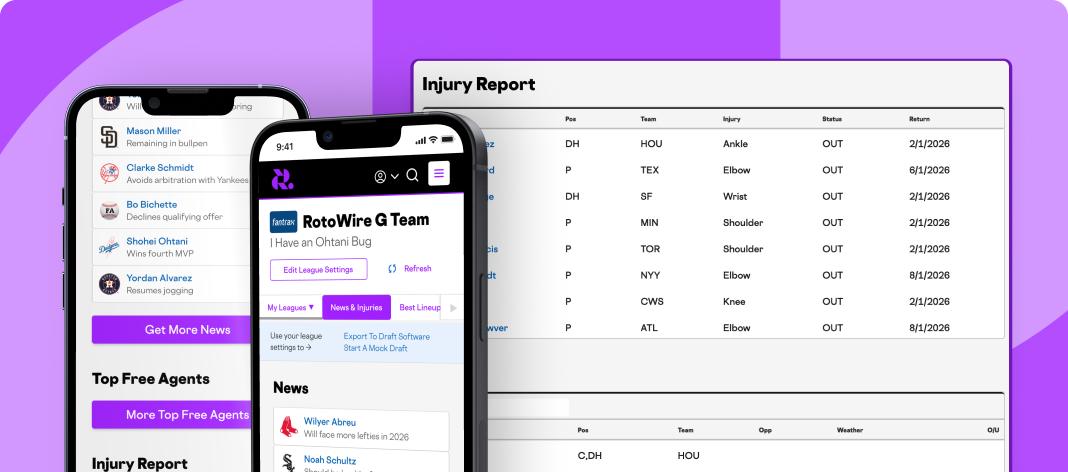
Using RotoWire's comprehensive fantasy baseball draft assistant can and will help, but it's also good to prepare and formulate a strategy based on the format you'll be drafting in.
Overview of Snake Drafts vs Auction Drafts in Fantasy Baseball
Snake drafts have an exact order, with the last pick in odd-numbered rounds selecting first in even-numbered rounds. The order of the draft board looks like a snake, hence the name. It has long been the most popular type of draft and is generally easier to do because you simply wait your turn and then make your picks (usually based on the top players on your fantasy baseball rankings list). It still involves preparing and strategy, but you'll always know when it's your turn to make a selection.
That's much different from auction drafts, which involve teams bidding on players to obtain their rights. Each team begins with the same dollar amount (typically $260) and then bids on a player until only one high bidder remains. That high bidder adds the player to their team and has that dollar amount subtracted from their overall total. This continues until all rosters have been set. It's a more difficult format because you're in constant action, but it helps when you have up-to-date fantasy baseball auction values in front of you.
How Player Value Is Established in Snake Drafts
Player value in snake drafts is determined by the top MLB projections combined with position scarcity. Players are ranked in the order of the value they bring to your specific fantasy baseball league, and using fantasy baseball ADP (average draft position) can give you an idea of which players will be available when it's your turn to pick.
For example, a team with the ninth overall pick in a snake draft can see that they won't have a chance to draft Shohei Ohtani (ADP of 1.21), Aaron Judge (2.04) or Juan Soto (3.68). But players like Ronald Acuna (8.61) and Elly De La Cruz (9.73) are solid picks in that slot. Values, of course, will change for each team throughout the draft based on their team's strengths and biggest needs, which is why it's important to always be adapting and using RotoWire's draft assistant to see where you stack up and who you should be targeting.
How Player Value Is Established in Auction Drafts
Based on league settings, all players in auction drafts are assigned a dollar amount based on their expected value. In standard leagues, this ranges from Aaron Judge's $65 value to Jacob Wilson's $1 value. Certain players also have negative values, which reflects them being negative contributors and not worth bidding on.
Each player is available to all teams at the start of an auction draft. It's considered a more fair way to draft, but strays from the traditional snake draft that so many fantasy baseball managers enjoy. You'll want to assign your own custom values to players, and RotoWire's fantasy experts recommend spending a little extra on players you really want. Just like ADP doesn't keep you from reaching on a player lower on your rankings, the dollar amounts assigned to players are not capped figures.
Strategic Advantages and Disadvantages of Each Draft Format
Auction drafts are more difficult to manage because every manager is in on just about every player. You could wind up with Ohtani at $63 and have an entirely different draft than if you waited for a star in the $40 range. With snake drafts, you'll need to pay attention to other teams' rosters as well as the strengths of your own, but once you're on the clock you have time to select a player.
Auction drafts are fast-paced, while snake drafts tend to go slower. You'll have more time to assess your roster in snake drafts, though RotoWire's draft assistant can do that heavy lifting for you in real time. But auction drafts are also considered fairer and let players prepare for multiple types of team builds. In any auction draft, you can get Ohtani or Judge. In any snake draft where you're picking fourth or later, Ohtani and Judge aren't even a consideration.
Choosing Between Snake and Auction Drafts
It really comes down to personal preference when determining which type of draft is right for you. Both are enjoyable, but each requires a much different strategy. Beginners may want to do snake drafts as they get the hang of fantasy baseball before graduating to auctions. Participating in fantasy baseball mock drafts is an important part of understanding how things go.
Whichever route you take, you just need to subscribe to RotoWire and their comprehensive fantasy baseball draft kit will have you covered. You'll be able to prepare for your draft, target sleepers and prospects, and analyze MLB player stats so you're ready to build a title contender whenever the draft of your choice begins.