We are just about at the halfway point of the regular season schedule. 2,314 games have been played out of a 4,860 game schedule, putting us 47.6 percent of the way through play. I say this every season, but be cautious of anything discussing the All-Star break as the first and second half, because the season is more than 60 percent complete by the break, and you will have wasted some time to make course adjustments for the stretch run.
Last week, I looked at a few high-profile hitters who were doing some improbable things, and this week will be a focus on pitching. This information may be even more pressing, because we're seeing a change in recent weeks with the drag coefficient on baseballs that has not been seen since the outlier year of 2019:
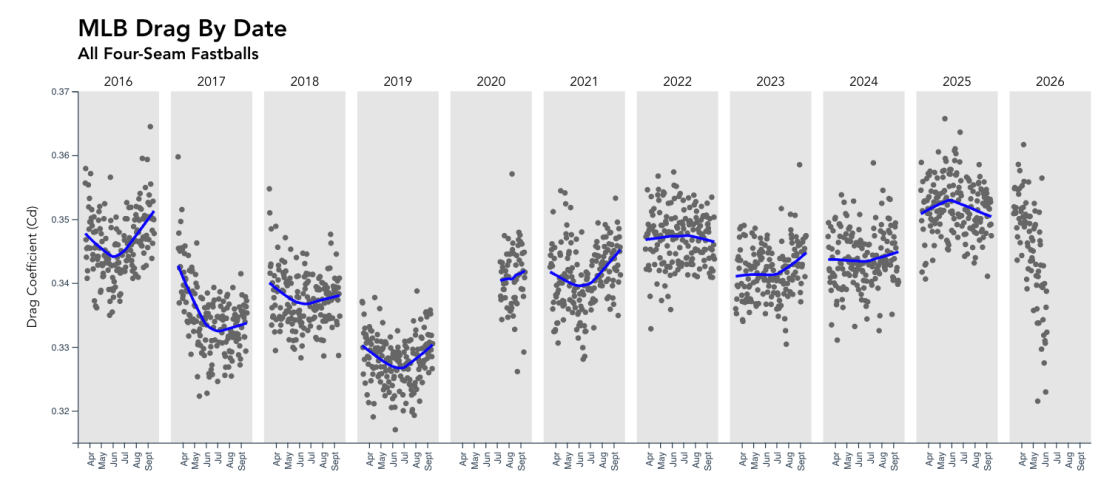
"Super happy fun ball," (h/t Jeff Zimmerman) may be back in play after being put on cobwebs for a while. We should see some stories about production issues or randomness in the coming days, but the ball don't lie, and it's carrying further in recent weeks due to reduced drag just as temperatures are pushing triple digits in some places. I believe this is a good place to start, because several pitchers currently have low home run to fly ball rates compared to career norms that could be in for some regression with a new batch of balls in circulation.
Max Fried: 2026 HR/FB%: 1.8% ; Career HR/FB%: 10.9%
Fried is still on
We are just about at the halfway point of the regular season schedule. 2,314 games have been played out of a 4,860 game schedule, putting us 47.6 percent of the way through play. I say this every season, but be cautious of anything discussing the All-Star break as the first and second half, because the season is more than 60 percent complete by the break, and you will have wasted some time to make course adjustments for the stretch run.
Last week, I looked at a few high-profile hitters who were doing some improbable things, and this week will be a focus on pitching. This information may be even more pressing, because we're seeing a change in recent weeks with the drag coefficient on baseballs that has not been seen since the outlier year of 2019:
"Super happy fun ball," (h/t Jeff Zimmerman) may be back in play after being put on cobwebs for a while. We should see some stories about production issues or randomness in the coming days, but the ball don't lie, and it's carrying further in recent weeks due to reduced drag just as temperatures are pushing triple digits in some places. I believe this is a good place to start, because several pitchers currently have low home run to fly ball rates compared to career norms that could be in for some regression with a new batch of balls in circulation.
Max Fried: 2026 HR/FB%: 1.8% ; Career HR/FB%: 10.9%
Fried is still on the injured list as he works his way back from an elbow issue and we will not see him until after the mid-summer classic. Fried worked 61.1 innings before going down with his injury and allowed a single homer in that time, to former teammate Oswald Peraza of all people. Fried did post a 8.7 HR/FB% last season and a full-season best 7.8 percent back in 2022. Fried's current rate is his lowest since 2021, and we have seen just three pitchers with a sub 2.0 HR/FB% from July-September in recent seasons, all of which came in 2022:
| PITCHER | APR-JUN HR/FB% | JULY-SEPT HR/FB% |
|---|---|---|
| Justin Verlander | 10.2% | 1.2% |
| George Kirby | 17.5% | 1.3% |
| Jose Quintana | 9.1% | 1.3% |
Cristopher Sanchez is the only other pitcher who recently had such a low HR/FB%. He had his in 2024 with a 2.0 HR/FB% before the break, allowing a single homer in his first 16 starts, but he went on to allow 10 homers over his final 15 starts to even things out.
Chase Burns: 2026 LOB%: 93%; Career LOB%: 82%
Zack Wheeler: 2026: LOB%: 91%; Career LOB% 76%
Burns has only worked 129 innings in his major-league career, but he has been on an absolute heater this season, going 9-1 over his first 15 starts. As luck would have it, his only loss is a game my daughter and I attended when the Angels beat up Burns on a Friday night outing in Cincinnati. Anytime I see a Cincinnati pitcher get off to a hot start, I am reminded of Jack Armstrong in 1990. That season, the young Reds hurler was 11-3 with a 2.28 ERA before the break and pitched to a 5.96 ERA in the second half as the magic fell apart.
The common team and uniform is the only thing those two pitchers have in common, as Burns' stuff is immensely better than Armstrong, but Burns's current left on base percentage is one of the best we have seen in recent seasons. He, Wheeler, and eight other pitchers have posted LOB% of 90 percent or higher in the first three months of the season; the table below shows how those pitchers did from July until the end of the season:
| PITCHER | SEASON | APR-JUN LOB% | JUL-SEP LOB% |
|---|---|---|---|
| John Means | 2021 | 100% | 69% |
| Eury Perez | 2023 | 94% | 73% |
| Chase Burns | 2026 | 93% | ?? |
| Paul Skenes | 2024 | 92% | 81% |
| Jeffrey Springs | 2022 | 91% | 76% |
| Zack Wheeler | 2026 | 91% | ?? |
| Tony Gonsolin | 2022 | 90% | 76% |
| Max Scherzer | 2021 | 90% | 79% |
| Robbie Ray | 2021 | 90% | 90% |
| Nathan Eovaldi | 2022 | 90% | 71% |
| Yusei Kikuchi | 2023 | 90% | 70% |
Ray is the only pitcher who was able to sustain his rate, and it led to him winning the Cy Young Award that season. Everyone else saw a noticeable regression in the back half of the season, so expect regression to come for both Burns and the surprising Wheeler, who has shown little rust following his major surgery last season.
Wheeler has also had the lowest BABIP of all qualified pitchers at .210, which is 76 points below his career .286 BABIP. We are long past the days of everything regressing to somewhere between .290 and .310, as Wheeler has come in well below that figure in each of the past two seasons, and Wheeler creates his own fortune by once again holding the league to a batting average below .200. Wheeler's next start will be his 100th since the beginning of the 2024 season, and in that time, he has a 77 percent LOB% and a .262 BABIP while holding the league to a .203 batting average. Wheeler has the longer track record of these two talented arms, so his summer regression may be a bit less painful than what Burns could go through.
Eduardo Rodriguez: 2.45 ERA with a 8.3% K-BB%
Rodriguez has been a pleasant surprise, with six wins, a 2.45 ERA and a 1.23 WHIP over his first 15 starts. He has done this despite a single-digit K-BB%, which is normally a warning flag of unsustainable success. Since 2021, the pitchers with a K-BB% of 8.3 percent or lower who have worked at least 120 innings have averaged a 4.88 ERA as a group. The lowest ERA by any such pitcher was Adrian Houser in 2021, who pitched to a 3.22 ERA for Milwaukee despite a 6.8 percent K-BB%. Michael Lorenzen, Zack Greinke, Chris Flexen, Randy Vasquez and Jose Quintana are the only other recent pitchers to post an ERA below 4.00 with such a low K-BB%.
All but Houser (3.22) and Lorenzen (3.31) had ERAs higher than 3.65, which shows just how much room for regression that Rodriguez has coming. A 4.93 xERA and 4.43 xFIP show just how fortunate he has been thus far and he is getting the first of two starts this week tomorrow as he takes on St. Louis. I mentioned on The Sleeper and The Bust podcast this past Friday I would be looking to use Rodriguez this week for the two-start and then bail on him ahead of the tough times ahead.
Walbert Urena: 12.0% BB% with a 2.41 ERA
Urena has been a surprising rookie for the Angels pitching to such a low ERA despite a 1.31 WHIP, which is mostly built on walks. Urena did just come off an outing with zero walks in Sacramento over five innings but has walked three or more batters in seven of his last 12 outings. Teammate Jose Soriano has the same walk rate, but his ERA is at 3.03, because Urena has allowed five fewer home runs. Blake Snell has twice had seasons with walk rates this high, and brought home a Cy Young in one of them. The other two names to pull it off over 120 innings include Luis Gil and Michael Kopech. Gil finished with a 3.50 ERA, while Kopech finished with a 5.43 ERA. Urena's last two starts have been encouraging and his stuff is impressive, but that ERA is going to climb in a hurry if he does not keep the walks under control.
Nick Martinez: 15.1% strikeout rate with a 2.73 ERA
Justin Wrobleski: 15.8% strikeout rate with a 2.72 ERA
These two pitchers have surprised in the ERA department despite a lack of strikeouts. They are currently two of the three qualified pitchers with a strikeout rate below 16 percent and an ERA below 4.45; Michael McGreevy is the only other one at 15.9 percent and 3.35 respectively.
We have seen four pitchers finish the season with a sub 4.00 ERA which such a low strikeout rate in recent seasons:
| PITCHER | SEASON | K% | ERA |
|---|---|---|---|
| Johnny Cueto | 2022 | 15.7% | 3.35 |
| Zack Greinke | 2022 | 12.5% | 3.68 |
| Randy Vasquez | 2025 | 13.7% | 3.84 |
| Jose Quintana | 2025 | 16.0% | 3.96 |
The odds are simply not in favor of Martinez nor Wrobleski continuing to avoid the fate of the other 25 pitchers not listed who finished with ERAs over 4.00 in seasons with strikeout rates no higher than 16 percent.
Aaron Ashby: 10 wins out of the bullpen
It has been fun to watch Ashby win 10 games in just 45.1 innings of work, but how in the world can he keep up a 20-win pace out of the pen? The most wins we have seen from any non-full time starter in the wildcard era was Ryan Yarbrough with 16 wins for the 2018 Rays, but he did that as a bulk pitcher working behind an opener while also working in 147.1 innings. Adrian Morejon just won 13 games out of the pen last season for the Padres, but no other pitcher has won more than 12, including former Brewer Brent Suter, who filled a similar role as Ashby for the 2021 Milwaukee club.
The most wins we have seen from a reliever in the first half of a season in the wildcard area, other than Ashby, came back in 2006 when Francisco Liriano had 10 wins at the break. He pitched in 22 games while starting 10 games in 88.1 innings of work. Danny Graves (2000) and Arthur Rhodes (1996) each had nine wins in the first half of those seasons with similar innings totals as Ashby, and that duo would combine to win just one more game in the second half of those seasons. The ride with Ashby has been fun, especially if you are also rostering some of the no-decision kings like Michael Wacha, but the odds are very much against Ashby even getting to 15 wins by season's end.
At the end of the day, it's best to make a move with overperformers a week early rather than a week late. Most of these guys have already given you much more than you expected from them, so either cash in now or plan on how you will counteract the possible regression by finding some other pitchers on the way up from rough first halves.