

This year's MLB First-Year Player Draft was an interesting one, with teams clearly trusting their models more and more up top, with hit-over-power players being prioritized over power-over-hit sluggers. Teams are telling us that they think they have a better chance of getting a good hitter to get to more power than they do at improving a slugger's contact woes, and this tracks based on the history of the draft. It had always been easy to fade the college hitters who struck out 20-plus percent of the time, but for the first time, big-league teams seem to all be properly devaluing those hitters in the draft. It was also the first year ever where only one pitcher was selected in the first 15 picks, but that had more to do with the drop off in college pitching after Jackson Flora (SF) than a change in team philosophy.
I'll be doing a First-Year Player Mock Draft on Wednesday's Prospect Podcast and I'll be updating the Top 400 Prospect Rankings on Friday, July 17!
In this article, I give my first blush top 25 FYPD rankings for dynasty baseball leagues featuring just 2026 draftees. I've included tiers and ETA, and I'll be adding another 25-plus draftees on the top 400 update, as well as roughly 80 new adds that aren't even from this year's draft.
| Prospect | Team (Pick) | Positions | School | ETA | |
| 1 | Grady Emerson | TB (2) | SS | Fort Worth Christian (TX) | 2028 |
| 2 | Roch Cholowsky | CHW (1) | SS | UCLA | 2027 |
| 3 |
This year's MLB First-Year Player Draft was an interesting one, with teams clearly trusting their models more and more up top, with hit-over-power players being prioritized over power-over-hit sluggers. Teams are telling us that they think they have a better chance of getting a good hitter to get to more power than they do at improving a slugger's contact woes, and this tracks based on the history of the draft. It had always been easy to fade the college hitters who struck out 20-plus percent of the time, but for the first time, big-league teams seem to all be properly devaluing those hitters in the draft. It was also the first year ever where only one pitcher was selected in the first 15 picks, but that had more to do with the drop off in college pitching after Jackson Flora (SF) than a change in team philosophy.
I'll be doing a First-Year Player Mock Draft on Wednesday's Prospect Podcast and I'll be updating the Top 400 Prospect Rankings on Friday, July 17!
In this article, I give my first blush top 25 FYPD rankings for dynasty baseball leagues featuring just 2026 draftees. I've included tiers and ETA, and I'll be adding another 25-plus draftees on the top 400 update, as well as roughly 80 new adds that aren't even from this year's draft.
| Prospect | Team (Pick) | Positions | School | ETA | |
| 1 | Grady Emerson | TB (2) | SS | Fort Worth Christian (TX) | 2028 |
| 2 | Roch Cholowsky | CHW (1) | SS | UCLA | 2027 |
| 3 | Vahn Lackey | MIN (3) | C | Georgia Tech | 2028 |
| 4 | Drew Burress | ATH (8) | CF/RF | Georgia Tech | 2027 |
| 5 | Tyler Bell | COL (10) | SS | Kentucky | 2028 |
| 6 | AJ Gracia | ATL (9) | LF/CF | Virginia | 2027 |
| 7 | Jacob Lombard | MIA (14) | SS | Gulliver Prep HS (FL) | 2029 |
| 8 | Eric Booth | BAL (7) | CF | Oak Grove HS (MS) | 2029 |
| 9 | Jackson Flora | SF (4) | RHP | UC Santa Barbara | 2027 |
| 10 | Derek Curiel | PIT (5) | CF | LSU | 2028 |
| 11 | Zion Rose | KC (6) | CF/LF | Louisville | 2028 |
| 12 | Trevor Condon | STL (13) | CF | Etowah HS (GA) | 2029 |
| 13 | Ace Reese | SEA (24) | 1B/3B | Mississippi State | 2028 |
| 14 | Jared Grindlinger | LAA (12) | RF | Huntington Beach HS (CA) | 2030 |
| 15 | Sawyer Strosnider | MIL (66) | RF/CF | TCU | 2028 |
| 16 | Liam Peterson | CLE (19) | RHP | Florida | 2028 |
| 17 | Gio Rojas | TEX (16) | LHP | Marjory Stoneman Douglas HS (FL) | 2030 |
| 18 | Daniel Jackson | COL (37) | C | Georgia | 2028 |
| 19 | Hunter Dietz | NYY (35) | LHP | Arkansas | 2028 |
| 20 | Tegan Kuhns | STL (32) | RHP | Tennessee | 2028 |
| 21 | Logan Hughes | HOU (17) | LF/DH | Texas Tech | 2028 |
| 22 | Chris Hacopian | WSH (11) | 2B | Texas A&M | 2028 |
| 23 | Bo Lowrance | LAD (40) | 3B/SS | Christ Church Episcopal HS (CA) | 2030 |
| 24 | Tyler Spangler | PHI (36) | 3B/SS | De La Salle HS (CA) | 2030 |
| 25 | Cole Prosek | CHW (41) | 2B | Magnolia Heights HS (MS) | 2029 |
TIER ONE
1. Grady Emerson, SS, TB, ETA: 2028
Close to a flawless prep shortstop prospect, Emerson showcases high-end skills on both sides of the ball, and the only real complaint might be that he doesn't have a 70-grade power or speed projection. We've seen Bobby Witt and Konnor Griffin generate similar pre-draft buzz, in part due to their extreme athleticism. That's not Emerson, although he should be at least an above-average runner with 25-homer power. The 6-foot-2 lefty hitter is a very safe bet to hit for average while getting on base at a high clip. He won't have to sell out for power to be a No. 2 or No. 3 hitter in time, and it's possible he'll make quick work of the lower levels of the minors.
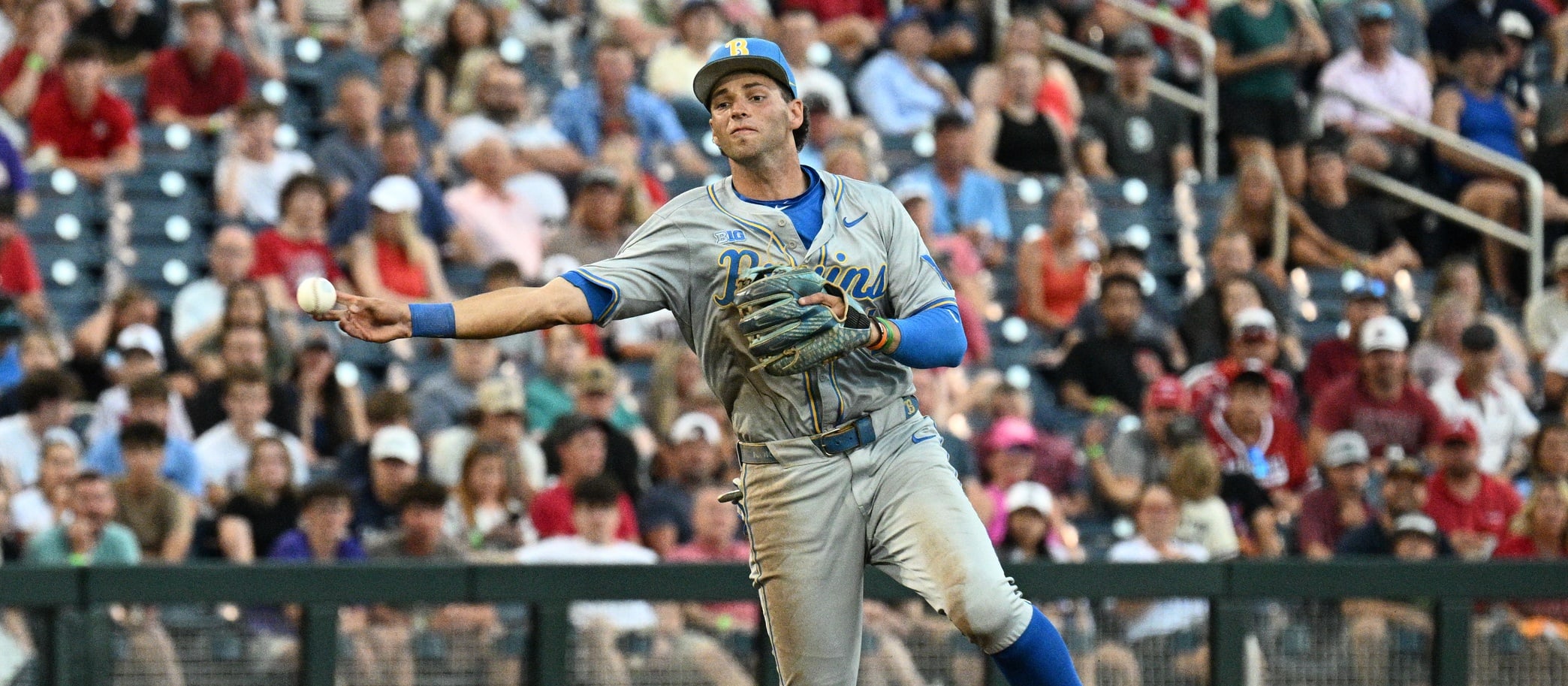
2. Roch Cholowsky, SS, CHW, ETA: 2027
A high-end prep prospect in 2023, Cholowsky made it clear that he would attend UCLA rather than go pro. The decision worked out for the sturdy 6-foot-2 shortstop, as he is one of the best college shortstop prospects in recent memory after putting up dominant sophomore and junior seasons. Cholowsky excels at getting the barrel on the ball and making contact in the zone, and he could be an above-average big-league hitter with above-average or plus power in short order (114 mph max EV). He slashed .320/.452/.636 with 21 home runs and as many walks as strikeouts as a junior and was even better as a sophomore. His perceived sky-high floor and lack of minor-league development time required are two of the big selling points in dynasty. The two knocks: he doesn't have a track record of hitting with a wood bat, as he logged a .666 OPS in the Cape Cod League in 2024, and Cholowsky's one substandard tool is his speed, particularly the act of stealing bases. He has the quickness to stick at shortstop for over a decade, but Cholowsky only attempted one steal as a junior and went 14-for-16 in 178 college games. The clearest path to Cholowsky being a top-five fantasy shortstop is for him to be among the positional leaders in runs and RBI while hitting high in a loaded White Sox lineup.
3. Vahn Lackey, C, MIN, ETA: 2028
Lackey's junior season for Georgia Tech is doing a lot of the lifting in his profile, as he was lightly recruited coming out of high school, struggled as a freshman (60 wRC+) and hit just six homers with a .153 ISO in his solid sophomore campaign that put him on the map. This spring, however, the 6-foot-2 backstop slashed .397/.519/.772 with 20 home runs, 15 steals, a 17.7 percent walk rate and a 13.4 percent strikeout rate. His numbers are propped up by a .406 BABIP and the fact this was his third tour of the ACC. While not a plus defender, Lackey has a plus arm and is an agile mover behind the dish, with few questions about whether he'll stick there. He had an OPS under .650 in the Northwoods League in 2024 and a .314 OPS in 26 plate appearances in the Cape Cod League in 2025, so his 2026 season for the Yellow Jackets certainly looks like the outlier. Still, he's always made consistent contact, even when the production has been middling. Lackey passes the eye test with flying colors, and the upside is obvious. It's notable that Lackey, the catcher, clearly projects to steal more bases than Cholowsky, the shortstop. The simplest way to put it with Lackey in dynasty: If you need a catcher, take him with your top three pick. If you don't need a catcher, take someone else.
4. Drew Burress, RF/CF, ATH, ETA: 2027
Burress is short (roughly 5-foot-8, 175 pounds) and bats right-handed, but he excels at everything within his control on a baseball field. A three-year standout at Georgia Tech, Burress was a notable prep prospect in 2023 but he made it clear that he would go to school if he didn't get selected in the first round. He walked more than he struck out all three years in college, although his power output peaked as a freshman (.440 ISO, .821 SLG, 25 HR in 58 games) before logging career-worsts (.299 ISO, .657 SLG, 16 HR in 61 games) in the power metrics as a junior. Even a down year for Burress qualifies as an excellent offensive season, and he doesn't have any notable weaknesses, which is a rarity for a college position player. Burress plays a fine center field and has the plus arm for right field. He also has above-average speed on the bases. The Athletics crushed it with this pick, and while it's a little crowded in the A's outfield, Burress should be big-league ready by this time next year.
TIER TWO
5. Tyler Bell, SS, COL, ETA: 2028
The Rays selected Bell as an Illinois prepster in the second round in 2024 but he chose to spend the next two years at Kentucky, where he was solid as a freshman (101 wRC+) before excelling as a draft-eligible sophomore. This spring, he slashed .343/.510/.608 with nine home runs, 10 steals, a 15.5 percent walk rate and an 18.6 percent strikeout rate in 41 games, all while nursing a torn labrum in his non-throwing shoulder that will require surgery and sideline him initially after signing. Despite being a draft-eligible sophomore, Bell turned 21 in June, so he's only slightly younger than many of the juniors who were selected in the first round. He may not have a plus tool, but his hitting, power and speed are all at least average and could get to above-average or better. He plays a sound shortstop and also has experience at second base and third base while with Team USA and in the Cape Cod League, where he logged an .883 OPS in five games with a wood bat last summer. Bell will thrive in Coors Field, as his hit tool could play to plus at altitude, and Ezequiel Tovar has been worth 0.2 fWAR since the start of last season.
6. AJ Gracia, LF/CF, ATL, ETA: 2027
Gracia has an uncommon combination of approach, contact and power for a college hitter who was available at this point in the first round. A big reason for that is that he might end up in left field, as he's got a physical 6-foot-3, 195-pound frame but his arm isn't prototypical for right field. He primarily played center field for Virginia as a junior, and if his average speed or arm tick up, that would put less pressure on his bat. Still, the lefty-hitting Gracia walked more than he struck out each of the past two years and logged an ISO over .250 all three years of college (he spent his first two years at Duke). He also posted an .888 OPS with a wood bat in the Cape Cod League in 2024. This spring, he slashed .354/.489/.632 with 14 home runs, 15 doubles, a 17.3 percent walk rate and a 14 percent strikeout rate in 56 games for the Cavaliers. He probably won't steal many bases in pro ball – he stole 17 in 176 college games – but there's a high four-category fantasy ceiling with Gracia, who could be big-league ready in roughly a year.
7. Jacob Lombard, SS, MIA, ETA: 2029
The younger brother of George Lombard Jr. and son of former big leaguer and current Tigers bench coach George Lombard, Jacob has a chance to be the best big leaguer in the family thanks to a tooled-up skill set and excellent shortstop defense. The 6-foot-3, 195-pound prep product from Miami has flashed plus raw power and plus-plus speed, so there's a lot to dream on in fantasy. He struck out more than expected on the 2025 showcase circuit and slid down boards as a result, but I love the fit staying home in Miami, as the Marlins are trending up in scouting and player development. If he reaches his ceiling, Lombard could be the best player in this class, and even if he falls short, he should still provide power and speed while playing shortstop every day, barring his hit tool being irredeemable.
8. Eric Booth, CF, BAL, ETA: 2029
Booth's father excelled as a kick returner at Southern Mississippi, so it's no surprise that Booth's top tool is his 70-grade speed. His swing and throwing motion are unconventional, and he worked to improve his throwing arm to average this year to allow him to profile in center field, which is a testament to his work ethic. He makes consistent contact with his choppy swing, yet doesn't get the most of his pure bat speed as he hasn't figured out how to consistently pull the ball in the air. By his mid-20s, Booth could be a 25-homer hitter, but there's work to do to get there. His speed is undeniable and isn't going anywhere, and Booth didn't turn 18 until a week before the draft, so he has plenty of time to refine his hitting mechanics. The floor is pretty low, given Booth's current hitting mechanics, but Booth's long-term fantasy upside is as high as anyone in the class.
9. Jackson Flora, RHP, SF, ETA: 2027
Flora stands out for his athletic, slender 6-foot-5 frame and his cockiness on the mound, but in fairness, he had a lot to be proud of the last two seasons for UC Santa Barbara. The 205-pound righty had a 22.3 K-BB% as a sophomore and a 25.3 K-BB% and 1.06 ERA in 102 innings as a junior after working as a reliever as a freshman. There's some effort in his delivery, but he sits in the mid-90s with his fastball and touches triple digits with excellent riding life up in the zone. He utilizes multiple sliders and recently added a kick-change and a curveball as he seeks to round out his arsenal, which was primarily fastball-slider coming into 2026. Flora has a very high ceiling if he stays reasonably healthy and is able to find a reliable third pitch. He should move quickly through the minors and could debut next summer. It's obviously a nice ballpark fit, but the Giants aren't in the upper echelon of developmental orgs on the pitching side.
TIER THREE
10. Derek Curiel, CF, PIT, ETA: 2028
A glove-first center fielder from LSU, Curiel is also firmly hit-over-power. Despite his quality center-field defense, Curiel is just an above-average runner, with his excellent instincts carrying that aspect of his profile. He also has a fringe-average arm to go with fringe-average power. Curiel hit .349 in college with 13 homers and 16 steals in 126 games. He cut his strikeout rate from 17.3 percent as a freshman to 15.7 percent as a draft-eligible sophomore. Curiel has good size at 6-foot-2, 192 pounds, and his exit velocities are better than his power output suggests, so it's possible he'll be able to unlock another level as a power hitter with pro instruction. As things stand, he's a better real-life prospect than a fantasy one, and I think the Pirates (and Royals) will regret passing on Drew Burress here.
11. Zion Rose, LF/CF, KC, ETA: 2028
Rose is a catcher turned outfielder who excelled in three years at Louisville. He walked more than he struck out as a freshman and junior and he had his best power season (13 homers, .242 ISO) as a sophomore. Rose has untapped potential if he can embrace an air-pull approach in pro ball, as he hits too many balls into the ground while making contact with too many pitches out of the zone. Despite measuring in at 6-foot-1, 205 pounds, he is a plus runner and stole 55 bases in 102 games the past two seasons.
12. Trevor Condon, CF, STL, ETA: 2029
There's a quickness to everything Condon does, whether it be his first step out of the box, or his bat speed, and he's also one of the best pure hitters from this year's prep class. A 5-foot-11, 175-pound center fielder, Condon has an unconventional swing that has worked for him thus far. He has a strong track record of making contact and using his speed on the bases, so if he can get a bit better at pulling the ball in the air, Condon could turn into a borderline five-tool player.
13. Ace Reese, 1B/3B, SEA, ETA: 2028
A power-over-hit left-handed slugger from Mississippi State, Reese most recently played third base but could slide to the bottom of the defensive spectrum. He measures in at a sturdy 6-foot-4, 220 pounds with a somewhat lumbering gait, but he has a chance to provide enough offensive impact to make up for his poor athleticism and defense. Reese hit 45 homers in 119 games over the past two seasons since transferring from Houston after his freshman season. He logged an .846 OPS with a wood bat last summer in the Cape Cod League and he had an OPS over 1.100 against righties and lefties this spring. There's a chance his aggressive approach gets exposed at the higher levels of the minors, but Reese could be an everyday first baseman/designated hitter in a couple years if his swing decisions are adequate.
14. Jared Grindlinger, RF, LAA, ETA: 2030
Grindlinger reclassified in February to join the 2026 class and won't turn 18 until April 2027. He is also a legitimate two-way talent with clear upside as a starting pitcher and/or as a lefty-hitting right fielder. The Huntington Beach phenom has barely started filling out his 6-foot-3 frame but makes a ton of contact and has a chance to grow into significant power. He already touches 95 mph and his slider and changeup project as at least above-average offerings, but after the Angels announced Grindlinger as an outfielder and not as a two-way player, it seems things will be pretty straightforward with projecting him in fantasy. His ETA is further away than the other top prep bats, but Grindlinger has a Cody Bellinger type of ceiling.
TIER FOUR
15. Sawyer Strosnider, RF/CF, MIL, ETA: 2028
Strosnider has been known for his left-handed power dating back to high school, but hit tool concerns led to him going to TCU for a couple seasons. The 6-foot-2, 200-pound outfielder quickly made good on his pedigree, slashing .350/.420/.650 with 11 home runs, 10 steals, an 8.0 percent walk rate and an 18.7 percent strikeout rate as a freshman. He maintained a similar strikeout rate (18.4 K%) this season while more than doubling his walk rate (18.4 BB%) in 50 games as a draft-eligible sophomore. Strosnider's BABIP cratered from .402 as a freshman to .282 as a sophomore, which helps explain the dip to a .273 batting average this spring. He's a good athlete with enough speed to steal double-digit bases and handle center field, although he profiles even better in right field, where he has a plus arm. Strosnider's problem isn't contact, it's selectivity, as he's prone to chase, but the Brewers have a history of helping guys improve that aspect of their game. I'm expecting Strosnider to sign for well over slot value after sliding to the 66th pick.
16. Liam Peterson, RHP, CLE, ETA: 2028
Peterson had no trouble missing bats as a three-year starter at Florida, but his surface stats are a bit ugly due to some bad luck on balls in play and elevated walk rates. His 9.8 percent walk rate as a junior was a career-best mark, and further improvement will be needed in pro ball. However, his mid-90s fastball (touches 99 mph) has excellent ride, and his slider and changeup will each flash plus. In addition to holding up as a starter for three straight years in the SEC, Peterson has a sturdy 6-foot-5, 225-pound frame and should be well suited for the rigors of pro ball, provided he can throw enough strikes. Big-league teams have coveted Peterson's pitch traits while being unconcerned about his college surface stats throughout the draft process. This landing spot with the Guardians is arguably the most beneficial of any of the landing spots for pitchers who went in the first couple rounds, as few teams develop arms as consistently as Cleveland.
17. Gio Rojas, LHP, TEX, ETA: 2029
Rojas, a 6-foot-4 lefty from Stoneman Douglas High School in Florida, has frontline upside thanks to easy mid-90s gas and a wipeout upper-80s slider. At 190 pounds, he has plenty of room to fill out his prototypical frame, and he already touches 98 mph with his heater. Rojas doesn't have much effort in his delivery and just needs to hone his third-pitch changeup while staying relatively healthy on his march to the majors. He could be a top five overall pitching prospect next summer.
18. Daniel Jackson, C, COL, ETA: 2028
Jackson transferred from Wofford to Georgia after his freshman season and really broke out this spring, hitting 32 homers with 26 steals in 67 games for the Bulldogs as a junior. He had a worrying 29.7 percent strikeout rate and .240 average as a sophomore, but cut the strikeout rate to 20.1 percent while hitting .379 this year. He is fairly new to catching but projects to stick behind the plate thanks to above-average athleticism and a strong arm. A hulking 6-foot-6, the righty-hitting Jackson has huge power to all fields and could easily be a 20-homer/10-steal catcher if he hits enough to play regularly. Even though Jackson cut the Ks this spring, there is still more swing and miss in his game than with most of the college hitters selected in this range of the draft. However, he's going to the perfect home park to prop up his batting average.
19. Hunter Dietz, LHP, NYY, ETA: 2028
Dietz had surgery for a stress fracture in his elbow in 2023 and had a setback early in 2024 that wiped out another season, so he entered his junior year at Arkansas with just 1.2 innings under his belt. The 6-foot-6 southpaw logged a 3.57 ERA, 1.19 WHIP and 131:31 K:BB in 85.2 innings this spring en route to rocketing up draft boards. He sits in the mid-90s with his fastball (touches 98 mph) and could throw even harder in a year or two. Dietz's slider, cutter and curveball all show significant promise while his changeup was seldom used. His 8.6 percent walk rate this spring was fine for a high-end pitching prospect knocking off significant rust, so there aren't many knocks in the profile beyond the arm injury history.
20. Tegan Kuhns, RHP, STL, ETA: 2028
Kuhns, a high-pedigree prep prospect in 2024 who had a strong commitment to Tennessee, broke out last summer with three excellent starts in the Cape Cod League (20:1 K:BB in 13.1 IP) and upped his stock this spring with an excellent finish to his sophomore-eligible season. An athletic 6-foot-3, 190-pound righty, Kuhns is a strike thrower (4.7 BB% in 81 innings this year) with power stuff. His 94-mph fastball has good life and has touched 99 mph. With pro instruction, that pitch should sit in the 95-96 mph range. He also has excellent feel for spin, with a plus upper-70s curveball and a quality gyro slider in the low-80s. There's some refining to do with his secondaries, but Kuhns could be ready for the big leagues after about a year of minor-league development, thanks to his advanced command and deep arsenal.
21. Logan Hughes, LF/DH, HOU, ETA: 2028
Hughes went in the first round because of his lefty bat, as he hit over .500 on fastballs over 93 mph this spring at Texas Tech. In 55 games, he slashed .375/.510/.735 with 18 home runs, a 19.5 percent walk rate and a 12.8 percent strikeout rate as a junior. Hughes could be a designated hitter or left fielder when it's all said and done, but he has a chance to hit enough to profile at the bottom of the defensive spectrum.
22. Chris Hacopian, 2B/LF/3B, WSH, ETA: 2028
There's no reason Hacopian can't have a long big-league career as a hit-first second baseman or left fielder, but he lacks loud physical tools or projection at 6-foot-1, 210 pounds. He attempted eight steals in 149 games in college – two seasons for Maryland before transferring to Texas A&M – and logged a .697 OPS with a wood bat on the Cape in 2025. Hacopian hit between 11 and 15 homers all three years in college, with his 15 as a freshman marking his career high. He was limited to 42 games for the Aggies this year due to a back issue and walked more (12.8 BB%) than he struck out (10.8 K%) for the third year in a row. Aside from his poor showing in the Cape Cod League last summer, there's nothing to nitpick with Hacopian's hit tool, but he needs to max out as a power hitter to be more than a boring hit-over-power bat-first player in the Brendan Donovan mold.
TIER FIVE
23. Bo Lowrance, 3B/1B, LAD, ETA: 2029
A late riser up draft boards thanks to a strong showing with the bat this spring, Lowrance is a bat-first prospect who could eventually end up at first base. The 6-foot-5 high schooler from South Carolina will need to lift the ball more consistently, but he has above-average power potential to go with above-average hitting potential. He runs well for his size now but should slow down as he fills out his frame and potentially moves off third base. Lowrance turns 19 in September, making him one of the older prep prospects to come off the board in the first couple rounds. The Dodgers may be betting on Lowrance's athleticism being a bit better than advertised.
24. Tyler Spangler, 3B/SS, PHI, ETA: 2029
A lean, 6-foot-3 lefty-hitting prep shortstop from California, Spangler missed most of his senior season with a back injury, so he got drafted based on his track record entering the year. He makes consistent contact and doesn't sell out for power, which should steadily tick up for him as he adds good weight. He moves well and could chip in 10-15 bases in the majors, rounding out a balanced profile.
25. Cole Prosek, 2B, CHW, ETA: 2029
Arguably the second-best pure hitter from the prep ranks behind Grady Emerson, Prosek projects as a plus hitter from the left side. He pitched in the low-90s in high school and has potential at third base and catcher in pro ball, but the White Sox announced him as a second baseman, which is a positive development for dynasty, as Chicago is fast-tracking Prosek's bat. He is already 19 and is a below-average runner, so he needs to live up to his billing at the plate. Prosek is hit-over-power, but if he reaches his potential, he should provide 20-plus homers.