Advanced MLB player stats can feel daunting, but many of them are simple to understand and can make a big difference at how you look at players and their performance. Taking that a step further, not every manager in your league will dive deep enough, meaning you can gain an advantage with even a moderate understanding at some of these statistics.
Many of these stats tell the true story about whether a player is underperforming or overperforming based on expectations. Nothing is an exact science, but diving into these stats give managers a clearer understanding beyond traditional MLB projections. Here's what you need to know to gain an upper hand.
Why Traditional MLB Stats Aren't Enough Anymore
While it's true that only traditional MLB stats count toward fantasy baseball wins and losses, these stats don't always tell the full story. Many fantasy baseball rankings only take into account traditional stats like home runs, stolen bases, pitcher strikeouts and saves. But advanced stats go under the hood to look at how a player is performing based on expectations and whether they've been unlucky (someone you should target) or lucky (someone you may want to sell high on).
"Technological advancements have brought numerous advanced metrics that do a better job telling the whole story to help identify breakout and regression candidates from one season to the next," said RotoWire baseball expert Ryan Pohle.
A pitcher may luck into some great defensive play, a batter may be hitting seeing-eye singles, that isn't sustainable, there any number of factors that produce numbers that don't tell the full story. That's why diving into advanced stats can help managers figure out how well a player is doing at the plate or on the mound to better project how they'll perform the rest of the season.
Hitting Metrics Every Fantasy Baseball Manager Should Know
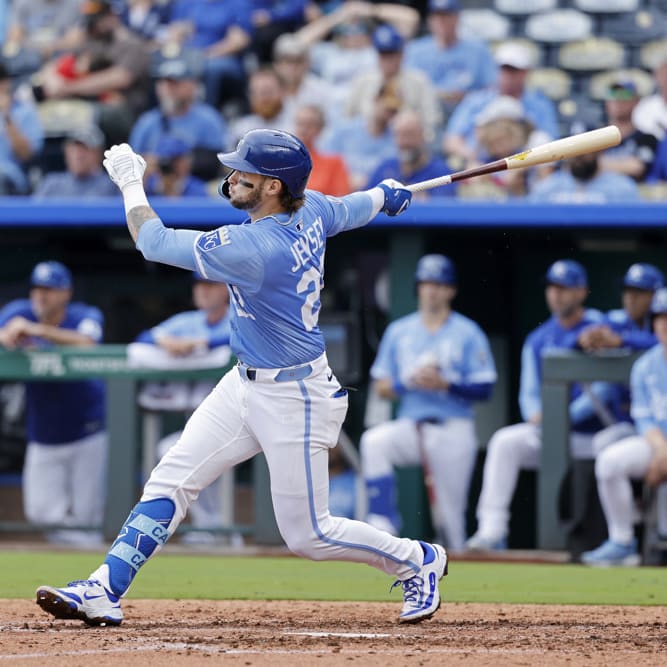
Our favorite hitting metric to analyze is xWOBA, which stands for expected weighted on-base average. It takes into account the quality of contact (exit velocity, launch angle, etc.) to give a more accurate picture of what a player's stats should look like. In 2025, Royals catcher Salvador Perez had a .236 batting average and .284 on-base percentage, both significant drops from his 2024 campaign. But Perez was incredibly unlucky; his xwOBA was .357, good for an 86th percentile mark. His expected slugging was a whopping .534, 12th in all of baseball. Despite his unlucky averages, he should still be a target heading into 2026 despite his lower fantasy baseball ADP.
BABIP, which stands for batting average of balls in play, is another one. This stat pulls strikeouts from the equation, with league average hovering between .285 and .291. If a player's BABIP is lower than those averages but still swinging hard with good exit velocity, you can expect better results moving forward. If a player has a BABIP in the .300s and isn't a star, expect some regression.
"BABIP (batting average on balls in play) doesn't factor in home runs or strikeouts, and a hitter with a BABIP much higher than their BA would be a regression candidate," Pohle said.
Pitching Metrics Every Fantasy Baseball Manager Should Know
Perhaps even more than hitting, pitching can be a lucky outcome based on defense, stadium and other factors. Our favorite advanced pitching metric to look at is xFIP, or expected field independent pitching. It measures a pitcher by their skills in factors they influence and adjusts for stadiums, luck and defense. It gives a more accurate picture of how a pitcher is actually performing based on what they can control.
A perfect example is Dylan Cease, who struggled to a 4.55 ERA in 2025, an anomaly from his 3.75 career ERA prior to the season. But his xFIP was 3.56, good for 15th in the MLB. He was incredibly unlucky in 2025 for a host of reasons, but there are many factors (like xFIP that indicate) he will perform better in 2026. He's a great sleeper based on his smaller fantasy baseball auction values because of a perceived bad 2025.
Part of that is because of Cease's 19.9% K/BB ratio, another great stat to look at when considering fantasy baseball pitching. Cease ranked 13th in the MLB, and players who rank high in this category are likely destined for success, because they strike out players at a higher clip compared to the free passes they hand out.
"K-BB% (strikeouts minus walks percentage) isn't a complicated metric, but it shows a pitcher's dominance and control and is one of the most predictive stats for pitchers," Pohle said.
How to Use Advanced MLB Stats to Make Start/Sit Decisions
Fantasy baseball managers should always know what their players' expected statistics look like. Of course those expected numbers don't count for anything, but it does give insight to what their future numbers may look like once they regress to the mean or tail off. It's important to remember that fantasy baseball is a 162-game marathon, so expected statistics are going to balance out more often than not.
This can help in the short term with lineup changes, but it's also important to use these advanced stats on targeting certain players who have been unlucky or selling your own players if they've been overly lucky and are going to fall off as their averages balance out.
"Advanced stats are something to consider for the players that are borderline starters/bench players in determining who has been lucky/unlucky and likely to regress to the norm," Pohle said.
Where to Find Advanced MLB Stats for Free
The best part of MLB advanced stats is that fantasy baseball managers don't need a costly subscription or a deep dive into websites to find them. They are readily available at websites like FanGraphs, Baseball Reference and Baseball Savant.
If you don't feel like crunching numbers all day to find trends on players, you're in luck. RotoWire's team of fantasy baseball experts take these advanced stats into account when writing blurbs, breakout lists and so much more that managers can use when poring over the fantasy baseball draft kit and throughout the season.
Make sure you subscribe to RotoWire to get a leg up on the competition using advanced stats. Just a little bit of knowledge can go a long way toward identifying players to target and those to stay away from over the course of 162 games.