2026 World Cup Group A Preview: Mexico, South Africa, South Korea and Czechia Lineups, Odds, Predictions and Tactics
Group A opens the 2026 World Cup on June 11 when Mexico host South Africa at Estadio Azteca in what will be the tournament's opening match, a direct callback to 2010, when these same two teams kicked off the competition in Johannesburg. The symmetry is striking and so is the pressure. Mexico play their first-ever World Cup at home as a co-host and carry the full weight of a nation that has not advanced past the round of 16 in seven consecutive tournaments. South Korea, potentially in Son Heung-Min's final World Cup, arrive after a troubled March window that raised real questions about their defensive setup. Czechia got here through two penalty shootouts in five days and return to the World Cup for the first time since 2006 under a 74-year-old coach who took the job days before the playoffs began. And South Africa come back to the biggest stage for the first time since hosting the tournament in 2010, carrying the goalscoring problems that have followed them all spring.
This is the full tactical guide to Group A, including playing style, attacking and defensive structure, key adjustments, projected starting lineups, set-piece takers and the latest odds for Mexico, South Africa, South Korea and Czechia.
This is part of RotoWire's full 2026 World Cup group preview series covering all 12 groups.
World Cup Group A Schedule
MEXICO | 2026 World Cup Tactical Analysis and Predicted Lineup
How Mexico Will Play at the 2026 World Cup
In his third stint with the national squad, coach Javier Aguirre has done what seemed improbable when he was handed the job in mid-2024 after the chaos of Qatar. He has made Mexico a team worth watching again. Back-to-back CONCACAF titles, the Nations League in March 2025 and the Gold Cup in July gave the squad belief and identity that had been missing for several years. The March 2026 window added another layer. Mexico drew 0-0 with Portugal at the reopened Azteca, holding their own without star striker Santiago Gimenez and a dozen other regulars, then drew 1-1 with Belgium in Chicago despite manager Aguirre being without much of his strongest group. Julian Quinones was arguably the best player on either side in the Belgium game, Jorge Eduardo Sanchez scored a composed finisher from a corner rebound, and the collective defensive shape held even when the level dropped in the second half. Coach Aguirre himself said the attitude was right and the camp was positive. Which, given the history of Mexican football press cycles, is not nothing.
The settled formation is a 4-3-3, a setup head coach Aguirre has increasingly favored since the Gold Cup triumph. Edson Alvarez plays the holding role but has been limited with injuries in recent months and is a doubt for the competition. Youngsters with the likes of Alvaro Fidalgo and Obed Vargas could start in the midfield. Raul Jimenez leads the line, and the March window confirmed that at 34 years old he remains their most reliable finisher available. The right-back position remains a problem with Rodrigo Huescas injured, and the center-back pairing of Cesar Montes and Johan Vasquez is settled and experienced. Goalkeeper is still genuinely uncertain between Jose Rangel and Luis Angel Malagon, but Rangel started the Portugal and Belgium games and responded well to the moment.
Mexico's Attacking Style at the 2026 World Cup
Mexico's attacking structure is built around a blend of proven experience, individual flair, and emerging dynamism, giving manager Javier Aguirre multiple tactical avenues to break down elite defenses.
Key attacking themes include:
Raul Jimenez as the physical, intelligent focal point of the attack, whose four goals in the 2025 Nations League final stages proved he still delivers in tournament football. At Fulham he has been decent and arrives in good form.
Julian Quinones and Roberto Alvarado as the most dangerous wide options, with the directness and close control to create chances from nothing against a retreating defensive block.
Hirving Lozano providing the pace and unpredictability that elite defenses struggle to account for, particularly on the right side where his ability to run in behind is a genuine weapon, although he could be a backup option heading into the competition.
Alvaro Fidalgo as the dynamic midfielder capable of changing the tempo and rhythm of possession and who managed the midfield well during the March window.
Mexico's home venues, Azteca in Mexico City and Akron in Guadalajara, carry an altitude advantage that has historically contributed to better results against European and Asian opponents.
Can some Mexican players score higher than their places in the 2026 World Cup Golden Boot odds?
Mexico's Defensive Setup
The back four under coach Aguirre is built around Montes and Vasquez, who bring European experience from CSKA Moscow and Genoa, respectively. Jesus Gallardo on the left is one of the longest-serving players in the setup with over 100 caps. The defensive midfield structure of Alvarez in front of the back four if he can be deemed fit for the competition gives Mexico a double layer of protection.
The primary concern heading into the summer is that the squad was missing twelve regulars for both March friendlies, and the full-strength lineup has had very limited minutes together as a unit in competitive situations. Aguirre knows what he wants from his team. The question is how quickly they gel when the tournament actually starts.
Key Tactical Adjustments Mexico Need to Make
Sort out the goalkeeping situation before the squad is finalized, as both Rangel and Malagon have credentials but neither has fully nailed down the first-choice role.
Find consistency in the front line, where Lozano, Quinones and Alvarado are all capable but where minutes have been split unevenly through the camp period.
Avoid the sluggish second-half performances that have become a pattern. Against Belgium, Mexico's first half was their best under manager Aguirre, but the second half regressed noticeably after substitutions broke the rhythm.
Mexico 2026 World Cup Predicted Lineup
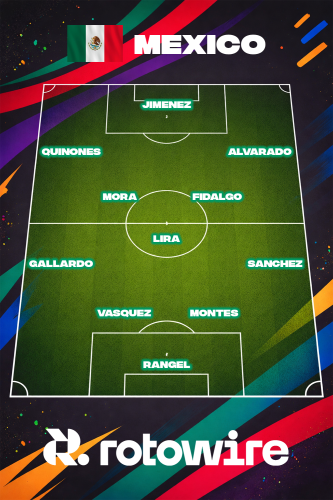
Fidalgo, Lira, Mora; Alvarado, Jimenez, Quinones.
For more updates, see the latest projected World Cup lineups on RotoWire.
Mexico Set Piece Takers for the 2026 World Cup
Corners: Brian Gutierrez, Alexis Vega, Roberto Alvarado, Gilberto Mora, Edson Alvarez, Alexis Gutierrez
Direct free kicks: Raul Jimenez
Penalties: Raul Jimenez, Orbelin Pineda
Why This Mexico Lineup Works
This is the lineup coach Aguirre has gradually assembled across two years of competitive football and high-level friendlies. Jimenez at the top, Alvarez as the shield, experience and youngsters linking play in midfield, Gallardo providing width and delivery on the left. It is a coherent, recognizable system that the players understand. At Azteca in front of a stacked crowd against South Africa on June 11, it will be one of the most electrically charged atmospheres the tournament produces. Mexico have not reached the quarterfinals since hosting in 1986. The squad, the home venues and the quality are all there.
SOUTH AFRICA | 2026 World Cup Tactical Analysis and Predicted Lineup
How South Africa Will Play at the 2026 World Cup
Manager Hugo Broos has said this will be his last job as a manager. The 74-year-old Belgian, who guided Cameroon to the 2017 AFCON title and took South Africa to fourth place at the 2023 AFCON before steering them through World Cup qualifying, closes his coaching career on the grandest possible stage. The Bafana Bafana topped their CAF qualifying group above Nigeria, finished fourth at the last continental championship and will open the entire 2026 World Cup against Mexico on June 11 at Azteca. There is no bigger opening match for a team of their ranking in the tournament's history.
The March window against Panama gave a clearer picture of where Bafana are and what coach Broos is still trying to solve. They drew 1-1, creating chances but wasting several with Lyle Foster and Bongokuhle Hlongwane both guilty of misses that would have been unforgivable at a higher level. In Cape Town, they lost 2-1 in the second game against Panama after Mbekezeli Mbokazi scored a stunning long-range goal to pull level, only to concede a headed winner from a cross that the defense dealt with poorly. The pressing is not always there for them. The clinical instinct that wins big games is not guaranteed when Foster has an off night. And the goalscoring problem, with the consistent absence of a reliable backup to Foster when he is not delivering, is the one question he goes into the tournament still trying to answer.
The system under Broos is a 4-3-2-1 in its most common form, built around Ronwen Hayden Williams between the posts, an experienced center-back partnership of Mbekezeli Mbokazi and Nkosinathi Sibisi, and the midfield engine of Teboho Mokoena as the pivot. On the wings, Oswin Appollis and Bongokuhle Hlongwane bring the energy and directness that makes South Africa's best attacking moments genuinely threatening.
South Africa's Attacking Style at the 2026 World Cup
South Africa's attacking identity is built around a clear structure of complementary roles, where individual profiles combine to maximize their effectiveness in transition and create consistent pathways to goal.
Key attacking themes include:
Lyle Foster as the target forward whose link-up play, runs in behind and aerial presence give the Bafana Bafana their clearest path to goal, even if the March window served as a reminder of what happens when he is not converting.
Oswin Appollis as the most in-form South African attacker, whose eight international goals and constant delivery on the right flank make him one of the group's underrated threats.
Relebohile Mofokeng at 21 years old as the player who most excites coach Broos and the South African public, with the directness and willingness to take men on that creates space for teammates.
Teboho Mokoena as the midfield link who connects defense and attack, with the vision and range of passing to switch the point of attack when opponents sit narrow.
South Africa's best football comes in transition, when the midfield wins the ball quickly and Appollis or Mofokeng can run at defenders before the defensive shape is set.
South Africa's Defensive Setup
Williams is the cornerstone. His penalty-saving exploits at the 2023 AFCON, four against Cape Verde in the quarterfinal, built his reputation and his 60-plus caps with the Bafana Bafana give him the experience and composure to be a difference-maker. Mbokazi at center-back has not only become a defensive anchor but also provides one of the hardest shots in world football, as his Cape Town goal against Panama demonstrated.
Aubrey Modiba and a rotating cast at left-back provide reasonable cover, though the full-back positions are not the strength of the squad. The collective defensive discipline manager Broos has built over five years has generally been solid. The Panama loss was more about individual errors than systemic failure and the question of how long they can contain Mexico in the opening match of the tournament will test every aspect of that organization.
Key Tactical Adjustments South Africa Need to Make
Find a reliable finisher alongside Foster before the tournament starts, to allow coach Broos to have different options and not force Foster to be at his absolute best.
Protect the defensive shape against Mexico's wide runners in the opening match, where the Azteca crowd and the altitude will create challenges that the Panama games did not prepare them for.
Use the South Korea and Czechia matches to press for maximum points once the Mexico game is behind them, as those are the fixtures where Bafana Bafana's counter-attacking speed and defensive discipline are most likely to yield results.
South Africa 2026 World Cup Predicted Lineup
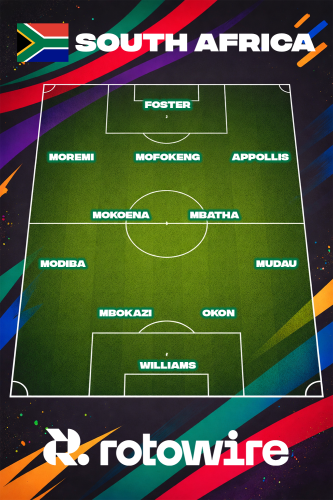
Mbatha, Mokoena; Appollis, Mofokeng, Moremi; Foster.
South Africa Set Piece Takers for the 2026 World Cup
Corners: Oswin Appollis, Teboho Mokoena, Aubrey Modiba, Sipho Percevale Mbule, Tshepang Moremi, Relebohile Mofokeng
Direct free kicks: Oswin Appollis, Teboho Mokoena
Penalties: Oswin Appollis, Lyle Foster
Why This South Africa Lineup Works
Williams in goal, a settled center-back pairing, Mokoena as the midfield anchor and Appollis and Mofokeng providing the wide energy, this is the Bafana Bafana that coach Broos has built over four years and it is a team with genuine cohesion. They will not win Group A. But a team returning to the World Cup for the first time in 16 years, organized by a coach closing out his career with a clear tactical philosophy and a genuine belief in the group, could cause problems for South Korea and Czechia in particular if the tournament-day intensity brings out the version of Bafana Bafana that finished fourth at the 2023 AFCON.
SOUTH KOREA | 2026 World Cup Tactical Analysis and Predicted Lineup
How South Korea Will Play at the 2026 World Cup
This is almost certainly Son Heung-min's final World Cup. At 34 years old, playing in MLS with LAFC after his Tottenham career ended last summer, the captain and all-time appearance record holder for South Korea arrives at the tournament with 140+ caps and a specific mission: to give a generation of players and an entire country a send-off worthy of what he has meant to Korean football. Coach Hong Myung-Bo, who captained South Korea to the semi-finals in 2002 and returned for his second stint as manager in 2023, has qualified unbeaten through the AFC third round and built a system that balances the old guard around Son with genuine young talent.
The March window was a reality check. South Korea lost 4-0 to Ivory Coast in Milton Keynes with Son and Kang-In Lee on the bench being managed for fitness, then lost 1-0 to Austria in Vienna despite manager Hong putting out his stronger lineup with Son, Lee and Lee Jae-Sung all starting. The Austria result highlighted the problem that has followed this team through the cycle. The three-back system in the 3-4-2-1 that manager Hong has favored creates attacking entries and moments of quality, but the defensive vulnerability to cutback goals and late crosses is a recurring issue that better organized opponents will exploit. Austria's winning goal arrived the moment after the defensive shape let the ball reach Marcel Sabitzer from an angle that should have been closed.
The talent is real. Son at LAFC has been extraordinary, recording four assists in a single MLS game in April. Lee at PSG is a Champions League regular, although injuries forced him to get less playing time in 2025/26. Kim Min-Jae at Bayern Munich is one of the premier center-backs in Europe. Hwang Hee-Chan at Wolverhampton provides the pressing energy and goalscoring that makes the attack dangerous from multiple angles.
South Korea's Attacking Style at the 2026 World Cup
South Korea's attacking identity is built around a blend of elite individual quality and complementary profiles across the front line, giving them multiple pathways to create and finish chances depending on the game state.
Key attacking themes include:
Son Heung-Min as the captain, who at his best is a forward capable of producing a decisive moment against any opposition. His reading of the game, his finishing in tight spaces and his capacity to drag teammates with him in big moments are irreplaceable.
Kang-In Lee as the most technically gifted player in the squad, with the close control and directness in the final third that makes him one of the more exciting wide attacking players in the group stage field.
Hwang Hee-Chan as the direct, press-triggering forward whose work rate and goalscoring sense from wide left provide South Korea with a different kind of threat to Son.
South Korea's best football comes when the midfield wins the second ball quickly, the transition is rapid and Son is in space with defenders retreating. It is a counter-attacking threat that can dismantle any team in the group.
South Korea's Defensive Setup
Kim Min-Jae is the anchor and the most important player in the squad behind Son. The Bayern Munich center-back organizes the back line with the authority and technical quality to play out from defense, and his aerial dominance makes South Korea difficult to beat from set pieces at both ends. The three-back experiment creates more defensive coverage in theory but has in practice left Korea exposed on transitions when the wing-backs are caught high. The two-match March window produced zero goals from open play in 180 minutes against opponents of similar or lower caliber, the Ivory Coast and Austria results suggest that if Son is not creating or finishing, South Korea's route to goal becomes narrow very quickly.
Kim Seung-Gyu in goal brings 80-plus caps and World Cup experience, although Jo Hyeon-Woo is a strong alternative, a K-League goalkeeper who could compete for the starting spot. The full-back positions are staffed by reliable domestic-based players whose quality is sufficient for Asian qualifying but will be tested by the pace of Group A opponents.
Key Tactical Adjustments South Korea Need to Make
Resolve the three-back debate before June, the Austria result showed the defensive shape failing at the moment it was needed most, and the alternative of a more compact four-back system may offer better protection while sacrificing some of the attacking width.
Get Kang-In Lee and Son Heung-Min into a rhythm together in the same attacking line, as the management of their minutes across the March window meant they had limited time on the pitch simultaneously.
Win the Czechia opener on June 11, a positive result against the other team in the group's second tier would put South Korea in complete control of their qualification path.
South Korea 2026 World Cup Predicted Lineup
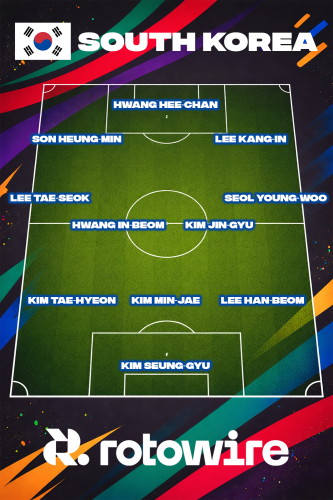
Seol Young-Woo, Kim Jin-Gyu, Hwang In-Beom, Lee Tae-Seok; Lee Kang-In, Hwang Hee-Chan, Son Heung-Min.
South Korea Set Piece Takers for the 2026 World Cup
Corners: Son Heung-Min, Kang-In Lee, Hwang In-Beom, Tae-Seok Lee, Min-Hyeok Yang, Jin-Gyu Kim
Direct free kicks: Son Heung-Min, Kang-In Lee
Penalties: Son Heung-Min, Hwang Hee-Chan
Why This South Korea Lineup Works
When Son, Lee, Kim and Hwang are all fit and in rhythm, this is a team capable of beating anyone in Group A. The depth and individual quality across the squad is the best South Korea has brought to a World Cup since 2002. The problem coach Hong must solve is the defensive structure, because the talent in attack is only useful if the team can stay in games long enough to let it express itself. If they do, this is a group stage that South Korea should navigate comfortably.
CZECHIA | 2026 World Cup Tactical Analysis and Predicted Lineup
How Czechia Will Play at the 2026 World Cup
No team at the 2026 World Cup got here through a more dramatic route. Czechia finished second in their qualifying group behind Croatia, then survived two consecutive penalty shootouts in five days under a new coach who had been in charge for a combined 210 minutes of competitive football when the second final kicked off. Coach Miroslav Koubek, 74 years old, replaced the sacked Ivan Hasek in December and his first act as national team coach was to trail Ireland 2-0 at home after 23 minutes, come back to 2-2 through Ladislav Krejci's 86th minute header, then win the shootout 4-3 with goalkeeper Matej Kovar saving two. Five days later, against Denmark, the same pattern occurred, Pavel Sulc scored after three minutes, Denmark equalized, Krejci scored in extra time in the 100th minute to go 2-1, Denmark equalized again through a Kasper Hogh header in the 111th minute, and Kovar saved one Denmark penalty in the shootout while Rasmus Hojlund hit the bar and Mathias Jensen blazed over. Michal Sadilek converted the winner to give Czechia the ticket for the World Cup.
The key data point from those two matches, noted in the Opta analysis, is that Czechia scored more set-piece goals than any other European nation in the entire 2026 qualifying cycle. Eight. In both the Ireland and Denmark matches, Krejci's equalizing headers came from exactly that source. Patrik Schick converted from the penalty spot against Ireland. Coufal nearly had a corner goal against Ireland. This is a team that wins through set pieces, defensive organization and the individual quality of Patrik Schick, and coach Koubek's tactical clarity around those principles was evident from his very first match.
The formation is either a 4-2-3-1 or a 3-4-2-1 depending on the opponent, with Tomas Soucek as the midfield engine and Patrik Schick as the focal point of everything in the final third. Matej Kovar, now at PSV Eindhoven, was the hero of qualification and projects as one of the better goalkeepers in the group stage. Vladimir Coufal and Robin Hranac both play Bundesliga football at Hoffenheim. Ladislav Krejci at Wolves has been outstanding this season and captains the side. This is a team with genuine technical quality across multiple positions, playing for a coach who knows exactly what he wants.
Czechia's Attacking Style at the 2026 World Cup
Czechia's attacking identity is built on a blend of physical presence, set-piece dominance and timely individual quality, with several players offering distinct but complementary threats in the final third.
Key attacking themes include:
Patrik Schick as the complete target forward who combines physicality, movement and composure in front of goal. His 25 international goals and seven in his last 11 starts for the national team confirm his status as the most dangerous finisher in Group A outside of Son Heung-Min.
Tomas Soucek as the late-arriving midfielder whose power, aerial threat and range of shooting makes him a set-piece danger from every dead-ball situation. His goal in the Ireland shootout, slotted calmly into the corner under pressure, is the kind of nerves-of-steel delivery that matters in big matches.
Pavel Sulc as the creative spark who scored the opening goal against Denmark within three minutes, providing the quick feet and penetrating runs that give Czechia a direct attacking option wider than Schick.
Ladislav Krejci as the captain who scored in both playoff games from set pieces, proving that the center-back is not just a defensive asset but a genuine attacking threat from dead-ball situations.
Czechia's set-piece threat, eight qualifying goals from dead balls, will give every opposing coach in Group A a genuine tactical problem at every corner, free kick and throw-in.
Czechia's Defensive Setup
Kovar in goal is the anchor. His two shootout saves against Ireland and the clean performance throughout both playoff matches proved that the Czechia have a goalkeeper capable of winning matches at this level by himself when needed. Hranac and Krejci as the center-back pairing are well-organized and comfortable on the ball, both playing regularly in high-pressure European club environments.
Coufal provides the overlapping threat on the right that can stretch defensive blocks, while David Jurasek on the left adds pace and delivery. The general defensive structure under coach Koubek is compact and organized without being overly conservative. Czechia conceded twice in both the Ireland and Denmark matches, but controlled the defensive blocks well outside of specific moments of transition.
Key Tactical Adjustments Czechia Need to Make
Manage the set-piece threat proactively rather than reactively. In both playoff matches Czechia came from behind because opponents worked out their defensive vulnerabilities early before the set-piece quality took over.
Find a way to hurt opponents from open play beyond Schick, as when he is contained or isolated the creative options become limited and the team relies heavily on dead-ball moments.
Arrive at the tournament with clarity in the new system, coach Koubek has had only two competitive matches in charge and the June opener against South Korea is only his third game.
Czechia 2026 World Cup Predicted Lineup

Provod, Schick, Sulc.
Czechia Set Piece Takers for the 2026 World Cup
Corners: Vladimir Coufal, David Jurasek, Lukas Provod, Adam Karabec, Vasil Kusej, Vaclav Cerny
Direct free kicks: Tomas Soucek
Penalties: Tomas Soucek, Tomas Chory, Patrik Schick
Why This Czechia Lineup Works
Kovar in goal, a settled and experienced back line, Soucek anchoring midfield, and Schick leading the line, this is the core that qualified and it is a core that manager Koubek has inherited rather than built. The advantage is cohesion and clarity. The risk is that Koubek has had almost no time to implement his own ideas on a squad that may be more familiar with a previous tactical system. What the two playoff matches showed is that this group has the character and the individual quality to win matches when it matters. At a World Cup, that is worth more than almost anything else.
2026 World Cup Group A Odds
Mexico are priced as favorites across all books, implying roughly a 50 percent chance to win the group. That pricing reflects squad depth but also the fact they will play at home.
Czechia and South Korea are consistently positioned close to each other, closely behind Mexico in the group odds with roughly a 20 percent implied probability to win the group.
South Africa are priced as clear outsiders with less than five percent implied probability.
For full tournament winner odds across all 48 teams, see our 2026 World Cup winner odds page.
Visit RotoWire for exclusive sports betting picks and our daily World Cup recaps. Remember that betting apps vary in terms of odds, so we have an easy-to-use odds page that allows you to shop for the best lines at DraftKings, FanDuel, BetMGM and PointsBet. Claim over a thousand dollars in bonuses by signing up at the best sports betting sites using the best sportsbook promos.
World Cup Group A Predictions: Who Advances?
Mexico win this group. The home advantage, Azteca in the opener against South Africa, Akron in Guadalajara against South Korea, and Azteca again for the Czechia finale, gives them an edge that no sportsbook can fully quantify. Jimenez in the best form of his career, Alvarez as the midfield anchor, Quinones or Alvarado as wide threats and a collective that coach Aguirre has spent two years shaping into something with genuine character are all pointing in the same direction.
Second place is where the group gets genuinely interesting. Czechia and South Korea are both priced around the same odds and both have legitimate cases. Czechia have the more reliable defensive foundation and a set-piece threat that will trouble opponents who have not specifically prepared for it. South Korea have the higher individual ceiling with Son, Lee and Kim at their collective best. They are better players than anything Czechia can match at those positions, but the defensive questions from the March window cannot be dismissed.
The South Korea-Czechia opener on June 11 is the match that determines who finishes second in the group. If South Korea win it, they control their own destiny and Czechia need maximum points from South Africa and Mexico to stay alive. If Czechia win it, South Korea face a significantly harder path. That match is the fulcrum of the group.
South Africa will give Mexico a proper game for 30 minutes in the Azteca before the altitude, the crowd and the quality begin to tell. Their realistic best-case scenario is a point from one of the three matches, most likely South Korea or Czechia, and an AFCON-level defensive display that keeps them competitive into the second half of every game. They return to the World Cup for the first time in 16 years and manager Broos, closing out his coaching career, will give them every tactical tool available to make it count.
For the latest group-winner odds across all 12 groups, visit our World Cup group preview hub.
Group A Summary
| Mexico | South Africa | South Korea | Czechia | |
|---|---|---|---|---|
| Predicted formation | 4-3-3 | 4-3-2-1 | 3-4-2-1 | 3-4-2-1 / 4-2-3-1 |
| Playing style | Defensive discipline, rapid transitions, set-piece quality, home crowd intensity | Compact defensive block, aerial duels, direct counter-attack, set-piece threat | High press, counter-attack, pace-based wide play centered on Son | Physical mid-block, aerial dominance, Schick as primary goal threat, dead-ball efficiency |
| Corners/FK takers | Gutierrez, Vega, Alvarado, Mora, Lozano, Alvarez, Gutierrez | Appollis, Mokoena, Modiba, Mbule, Moremi, Mofokeng | Son, Lee, Hwang, Lee, Yang, Kim | Coufal, Soucek, Jurasek, Provod, Karabec, Kusej, Cerny |
| Penalty takers | Jimenez, Pineda | Appollis, Foster | Son, Lee | Soucek |
2026 World Cup Group Previews Menu
Click each group for full tactical breakdowns, predicted lineups, betting odds and predictions.
Group A: Mexico, South Africa, South Korea, Czechia
Group B: Canada, Bosnia and Herzegovina, Qatar, Switzerland
Group C: Brazil, Morocco, Haiti, Scotland
Group D: United States, Paraguay, Australia, Turkiye
Group E: Germany, Curacao, Ivory Coast, Ecuador
Group F: Netherlands, Japan, Sweden, Tunisia
Group G: Belgium, Egypt, Iran, New Zealand
Group H: Spain, Cape Verde, Saudi Arabia, Uruguay
Group I: France, Senegal, Iraq, Norway
Group J: Argentina, Algeria, Austria, Jordan
Group K: Portugal, Colombia, DR Congo, Uzbekistan
Group L: England, Croatia, Ghana, Panama