In the world of fantasy golf, it's fair to say that DFS is king, the predominant way to play.
In fantasy football, while DFS certainly is popular, season-long leagues with friends and family dominate in a way not seen in any other segment of the fantasy industry. Heck, you're probably right in the thick of your playoff run right now.
So what if that season-long competition and camaraderie could be recreated in fantasy golf? Much like a fellow by the name of H.B. Reese once combined chocolate and peanut butter to make one heckuva of candy, you can do it.
We know, because at RotoWire, we do it.
The RotoWire Staff League for fantasy golf has been going on for more than a quarter-century. For many of them – some of the top names in the fantasy industry (them, not me) – it's their self-stated best league of the year in any sport. The friends, the relationships, the camaraderie are elements largely impossible to duplicate in DFS play.
So let's talk about how to have the same level of enjoyment in a season-long fantasy golf league that you do in your home leagues for fantasy football.
This article, part of our fantasy golf draft kit, will serve as a guide if you're just starting out or, if you already have a golf league, how to better compete and win.
THE BASICS
Like in fantasy football, there are two draft options: snake draft and salary cap draft, otherwise known
In the world of fantasy golf, it's fair to say that DFS is king, the predominant way to play.
In fantasy football, while DFS certainly is popular, season-long leagues with friends and family dominate in a way not seen in any other segment of the fantasy industry. Heck, you're probably right in the thick of your playoff run right now.
So what if that season-long competition and camaraderie could be recreated in fantasy golf? Much like a fellow by the name of H.B. Reese once combined chocolate and peanut butter to make one heckuva of candy, you can do it.
We know, because at RotoWire, we do it.
The RotoWire Staff League for fantasy golf has been going on for more than a quarter-century. For many of them – some of the top names in the fantasy industry (them, not me) – it's their self-stated best league of the year in any sport. The friends, the relationships, the camaraderie are elements largely impossible to duplicate in DFS play.
So let's talk about how to have the same level of enjoyment in a season-long fantasy golf league that you do in your home leagues for fantasy football.
This article, part of our fantasy golf draft kit, will serve as a guide if you're just starting out or, if you already have a golf league, how to better compete and win.
THE BASICS
Like in fantasy football, there are two draft options: snake draft and salary cap draft, otherwise known as an auction. With RotoWire, we've always done the auction. But lately I've been in industry leagues that use a snake draft. Both are awesome.
A lot of what we'll discuss here applies to both formats. It's not like in fantasy football where you need to fill different positions. That's not to say there aren't differences between the golfers and what you should be looking for in the draft. More on that as we progress here.
In the RotoWire league, we have 14 teams that draft nine golfers each (126 deep). That is quite a lot and, in all honesty, maybe too many. There are more than 126 golfers on the PGA Tour. But there are not 126 good ones.
We have a budget of $100. You need at least $1 to draft each guy. Just like in fantasy football, we have starters and a bench. We start a maximum of five golfers every week from the Sony Open in January through the Tour Championship in August and just count up the golfers' earnings when they were active in our lineups. Simple. There are a couple of wrinkles. We have bonuses for winning a major. And we divide the 14 teams in half into a season-long team bet (hmmm, we had teams before LIV had teams). The losing team pays the winning team's entry fee for the next season.
We are allowed 10 free-agent moves during the season, at a slight cost. Trades are allowed, but they're hard to pull off, just as in all fantasy leagues. There's not a lot of money changing hands, but that's never been the focus or detracted from the enjoyment.
Of course, leagues are completely customizable to your wants and needs, beginning with the number of teams, the number of golfers on each team, when you start your season and how much money is at stake. Twelve owners and 120 players? Frankly, that sounds better than what we do in the RotoWire league.
As a bonus, an auction format could help you prepare for a football auction (we have one of those too in RotoWire). While the snake draft understandably is the staple of draft formats, many fantasy football industry types say they like to make at least one of their leagues an auction.
Here's one important component of the RotoWire league: We do not have weekly head-to-head team matchups and we do not have playoffs. It's all aggregate money and everyone plays through the TOUR Championship.
I'm in another industry league in which there are weekly head-to-head matchups leading to a three-week playoffs. In that league, we use the Fantrax website as our commissioner platform to conduct the snake draft and score all season long. Fantrax mirrors DFS a little more closely in that scoring is based not on earnings but on birdies, eagles, pars, bogeys, etc.
Really, the strategy for both formats is quite similar: Pick the best golfers. Duh. Really, this isn't rocket science. A lot of it is basic stuff.
Overall, there are two rules to follow when playing fantasy golf.
Rule No. 1: Do your homework.
Rule No. 2: Your homework is never done.
CHEATERS ALWAYS PROSPER
As in, use fantasy golf cheat sheets. For all your fantasy sports, however you play, you have to know all the potential options, who all the players are, know what the rules of your league are. Like with running backs in football, there aren't enough top golfers to go around. In a snake draft, you clearly will take one of the top golfers when it's your turn in the first round. But in a salary cap draft, you don't necessarily need one of the very best. We've seen guys win the RotoWire league with a top-10 guy to anchor their lineup; we've also seen guys win the league with maybe three more cost-effective top-25 guys.
ROSTER CONSTRUCTION
With the PGA Tour now having so many signature events with their $20 million purses, plus the majors, plus THE PLAYERS Championship, plus maybe the playoffs, the top golfers play more events than they had in years. But they also now tend to play the same events together more than they used to. We still need to fill lineups for all the John Deeres and Byron Nelsons of the schedule. You'll need to strike a balance.
In a snake draft, you draft the best golfers you can as early and as often as you can. Depending on how many teams are in your league, you might be able to get two predicted top-10 or top-12 guys. After the superstars come other guys who will be in the signature events. At some point you will be left with lesser guys, at which point you have to consider a variety of characteristics, which we'll detail shortly.
It's more nuanced in an auction format. I've always wanted a big name to anchor my team, especially in the RotoWire league with our majors bonuses.
I normally would like to spend about half my budget, about $50, on my anchor. That's not enough to get a current-day Scottie Scheffler or Rory McIlroy. But the way Scheffler has played the last two years – eight wins in 2024, six wins in 2025 – it's time to rethink my strategy.
Last year, the owner who randomly was picked to throw out the first bid in the auction went with Scheffler. And, since he said his opening bid was $92, which is the maximum bid, Scheffler was his. His other eight golfers went for $1 each. None of them really excelled, though Sami Valimaki did in the fall season long after our league was over. This owner finished fourth out of the 14 teams.
Xander Schauffele, coming off a two-major 2024, went for $61. He didn't pay off. McIlroy, at $53, surely did, winning the Masters and THE PLAYERS, plus the Pebble Beach signature event.
Just like in fantasy football, past success, even superstar success, does not portend future success.
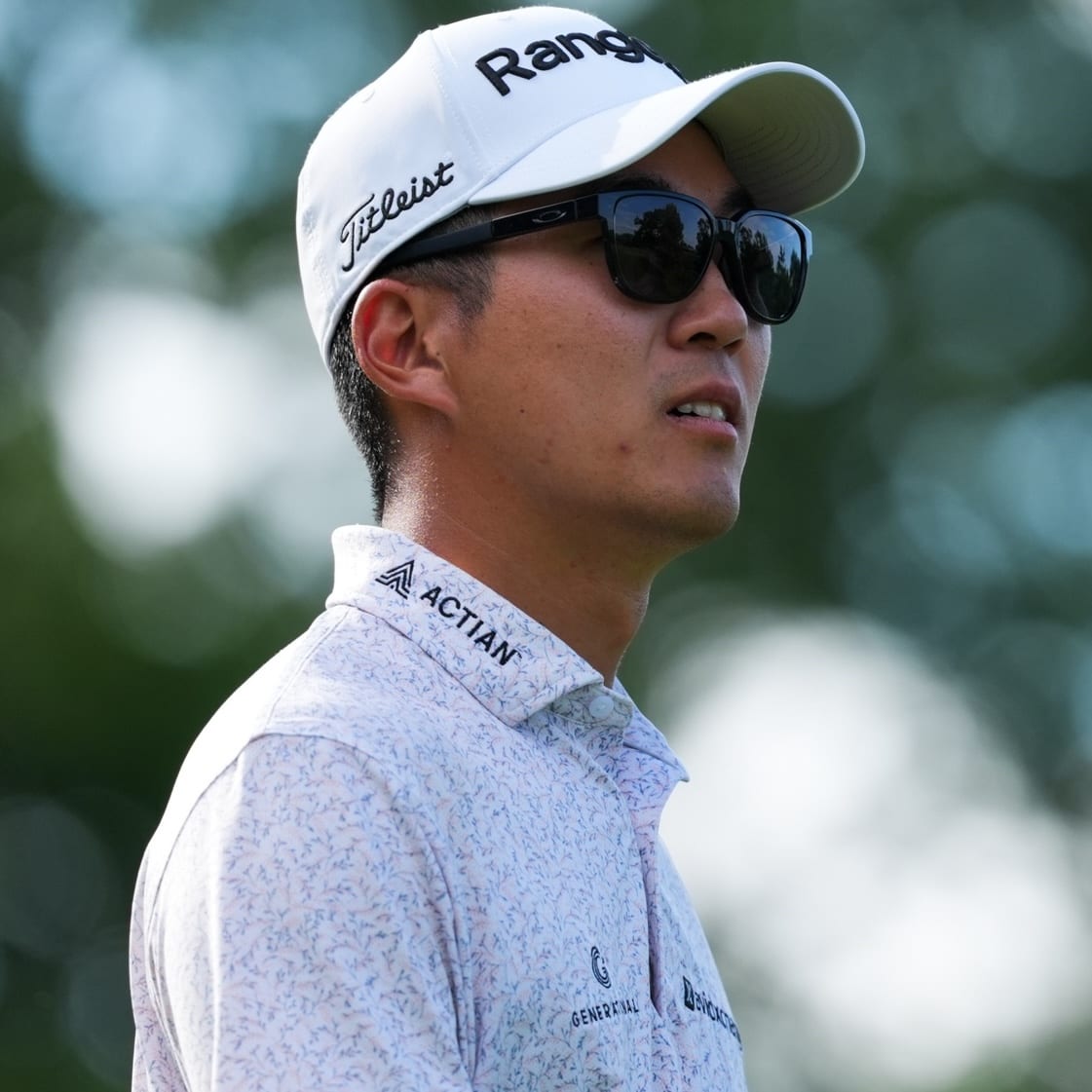
My top guy at $46 was Hideki Matsuyama, and he was a bust. But I also got Michael Kim for $2 and, even better, eventual U.S. Open winner J.J. Spaun for $1. I finished fifth out of the 14 teams.
It's possible to pay up for two big names, but not the biggest names. In theory, you could spend up to $93 on two guys, leaving $7 for the remaining seven guys on your team. That's an extreme scenario.
Even though Scheffler went from eight wins two years ago to six wins last year, there's a good chance he goes again for $92.
Two years ago, the team that had Scheffler won handily. That didn't happen last year. This hadn't been a concern since Tiger Woods' heyday.
CREAM OF THE CROP
So who are the big guys? You should start with RotoWire's Projected 2026 Earnings. Just about everybody's top three will be Scheffler, McIlroy and probably still Schauffele. Lather, rinse, repeat.
A couple of years ago, Viktor Hovland looked like a top-3 guy, as did Ludvig Aberg. Collin Morikawa was a top-three guy. All three had terrible years in 2025.
Now, Tommy Fleetwood – he finally won on the PGA Tour! – looks like a top-5 guy. Can Spaun keep it up? Same for Ben Griffin? What about Russell Henley? But who will be this year's Spaun and Griffin? Sorry, we can't help you there.
KEY CHARACTERISTICS
As you make your way through the draft, here's what to look for as things get deeper after the studs are gone: guys who will play a lot, top-10 and top-25 finishes from the past year, who will make a lot of cuts, who will get into the bigger tournaments like the majors and Signature Events. And of course, check out RotoWire's Sleepers & Busts for 2026.
The top guys are all playing more now than ever before. Why? Becau$e.
We'll still need/want to start five guys in the weeks where most of the top guys won't be playing. Here's what to look for with lesser guys, either in an auction or a snake draft:
Of course, the first thing to consider is a golfer's results. But if you focus on golfers with strong tee-to-green play — ball striking, Strokes Gained: Approach, Strokes Gained: Tee-to-Green, greens in regulation — they tend to do well over the long haul. You know how much easier it is when you find the fairway in your weekend game? Same thing for the pros (only 100ish yards farther down the fairway than for us). There tends to be more variance in putting.
Good tee-to-green and approach guys have a higher floor; top putters with weakness elsewhere likely have a higher ceiling.
At the bottom, look for cuts made and guys who play a lot.
See where a guy sits on the PGA Tour's priority rankings list. The higher up he is, the less chance of getting squeezed out of fields that aren't the maxed-out 156. The golfers who play the most are generally the worst golfers (except for the really bad guys who simply can't get into tournaments).
San Antonio or Detroit, for example, may not have the best fields, but if your lesser golfers are playing, they have a puncher's chance to claim a high finish. Every season on the PGA Tour, a bunch of punches connect. Just ask Thomas Detry, Joe Highsmith, Aldrich Potgieter, Kurt Kitayama, Brian Campbell and Ryan Fox. Because they won tournaments last year. In fact, you can ask Campbell and Fox twice, because that's how many times they won.
FAST START OR SIT TIGHT?
In the RotoWire auction, some owners can't wait to start bidding and owning golfers, making a dent early in the draft. Others like to sit back and see what develops. There's no right or wrong. Just be aware how the draft is unfolding. It can switch gears pretty quickly. Which brings to our next point …
ADJUST ON THE FLY
If it's a snake draft, golfers go in order of how good they are. In a salary cap draft, good or even great players can go long after the start of the draft. If you've done one for fantasy football, you know exactly what this is. A golfer's value will change at various points in the draft, depending on who's been taken, how much money everyone has left to spend and whom you've already drafted.
Don't just look at how much money you have, look at all your opponents' balances, too. You need to be able to adjust your thinking. A golfer's value on the course won't change, but his value during the draft will. Pay attention to that, it's very important. One thing we see year after year, if you sit back too long, that last big-name guy up for grabs can end up costing the most, just because he's the last one.
If you have 14 teams as in the RotoWire league, not everyone can get a top-10 golfer (math!). And when everyone realizes there's only one left, the price gets jacked.
RECENT HISTORY
You have to look at history, how a guy has done not only last year, but probably the last two. A golfer could have an off year. He could've been hurt for one year. His price surely would go down, but chances are you shouldn't dismiss him entirely based on one year. If a golfer has two bad years in a row, well, then that could be a red flag.
NEW PLAYERS
The Korn Ferry Tour is GOOD – probably the second best tour in the world now. Really. The top players are VERY GOOD. There will be 20 KFT grads on the PGA Tour this season. Some are former PGA Tour players who lost their cards. They are largely meh. Focus on the younger guys just making the jump. Will Zalatoris, Cameron Young and Sahith Theegala, to name a few, all emerged in the past few years. Last year, Campbell was a KFT grad. So were William Mouw, Ryan Gerard, Karl Vilips and Steven Fisk, all of whom won tournaments last year.
This year, the top KFT grad coming up to the big tour is Johnny Keefer, who is already ranked in the top 50 in the world.
Also, college guys. The college season ends in the spring and the top guys come out ready to compete immediately, like we saw with Morikawa and Hovland a few years back. Luke Clanton and Michael Thorbjornsen are more recent college arrivals. You can pick them up as free agents in May or June.
LIVE AND LET LIV
The LIV Golf guys aren't a big part of the season, but for four weeks, they can be. And a guy like Bryson DeChambeau can win a major. Or two. Same for Jon Rahm. It doesn't seem like any other LIV guys can elevate to major champion right now, but that doesn't mean a Patrick Reed or a Brook Koepka can't provide value. Many of the top LIV guys are picked in the RotoWire league. I grabbed DeChambeau last year for $6, for four tournaments. He tied for second, for fifth, for 10th and missed a cut. I'd say that was money well spent.
NOT A POPULARITY CONTEST
Try to keep emotions out of it. You love a certain guy because you went to the same college, sure. Who doesn't root for Jordan Spieth? Don't simply green-light a guy who did wonderful things for you last year. I have learned to hate just about every guy on Tour – hate is the wrong word, but you get the idea. In fact, if a guy did well for me last year, I think there's no way he can do it again. (Hmmm, if you don't like the guys who didn't do well for you and you don't like the guys who did do well for you, well, maybe counseling is right for you). The broader point is, don't pick a guy because you like him, just as you shouldn't avoid a guy because you don't like him. If the price is right, or the round is right, pounce.
TAKE DEEP BREATHS
Lastly, keep your wits about you during the draft. Stop. Focus. Breathe. It's easy to get caught up in the fast pace. It's easy to get mad if a guy you wanted went one pick before you or went for more than you could pay. It's like real golf: You can only play one shot at a time. You can only play the next shot. Make sure it's right down the middle.
For up-to-the-minute updates on injuries, tournament participation and overall golfer performance, head to RotoWire's latest golf news or follow @RotoWireGolf on X.