This article identifies five players often falsely referred to as fantasy football sleepers for 2026 NFL best ball strategy,
True fantasy football sleepers require the talent or at least the playing time opportunity to scale up to useful fantasy point totals. These players likely lack one or both of those conditions.
The players are listed in descending order of ADP. The ADPs cited are from Underdog and NFFC Best Ball Championship (June onward).
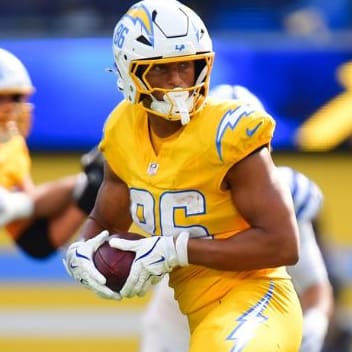
Keaton Mitchell, RB, LAC (137.3 UD, 139.56 NFFC)
Perhaps you've heard how new offensive coordinator Mike McDaniel raved about Mitchell prior to free agency, reportedly going so far as to print a Wanted poster with Mitchell (and fullback Alec Ingold) for GM Joe Hortiz.
Between that and his two-year, $9.25 million contract with the Chargers, Mitchell has understandably generated some amount of sleeper hype in what should be an exciting McDaniel offense.
Joe Hortiz said much of free agency was about building the offense in Mike McDaniel's vision.
Hortiz said McDaniel hung wanted posters in the team facility of RB Keaton Mitchell and FB Alec Ingold.
" When you change offensive scheme, philosophy, you find players that fit what…
— Kris Rhim (@krisrhim1) April 16, 2026
Mitchell's talent is not the problem. In 2025 the former East Carolina burner appeared nearly or fully recovered from the devastating ACL tear he suffered late in his 2023 rookie season, and if he's fully recovered Mitchell is a clearly useful runner in the NFL with rare speed.
The problem is that Mitchell's game does not reliably scale up from scrimmage due to volume and passing-down limitations. Mitchell has a definite, specific application in the Chargers offense: an off-the-bench firecracker who keeps the pressure on the opposing defense when Omarion Hampton takes a breather. In this capacity Mitchell should prove effective if not excellent -- a defense tenderized by Hampton really doesn't want to deal with speed like Mitchell's when their run defense is on the ropes.


If Hampton were to miss time, though, Mitchell's workload likely wouldn't change much. At around 5-foot-8, 190 pounds and with the brutal knee injury in his recent history, Mitchell isn't built for volume in general and he does not project as well on passing downs as he does as a pure runner.
Some of the fantasy hype for Mitchell specifically theorizes him as McDaniel's new De'Von Achane, which just isn't a fair expectation. Mitchell really might be pretty close to Achane as a pure runner, but Achane is a plus pass catcher and Mitchell is not. A well-timed screen design here and there should make Mitchell explosive with whatever target volume he sees, but that target volume will likely be low, especially outside of schemed targets.
Mitchell is worth drafting in best ball formats, as long as the price and expectations are reasonable. In this case a reasonable expectation would be a handful of flex-viable weeks when Mitchell rips off a long touchdown run. What's less reasonable are some of the hyper-optimistic takes on Mitchell -- the Achane comparisons and whatnot -- and in redraft formats Mitchell could prove impractical due to low weekly floors.
It would be particularly silly to suggest Mitchell might take work from Hampton. The Chargers will run a lot and they want explosive depth to consistently apply that pressure on the defense. Mitchell's role is to provide that high-octane relief and not much more.
Indeed, if Hampton were to miss time then you'd likely see Kimani Vidal take most of the difference. Vidal can withstand volume and is more reliable on passing downs than Mitchell, whose hands and blitz pickup are among his clear weaknesses.
If you're looking for a running back with starting fantasy upside then Mitchell is not your guy. If you're content with the flickering flex upside then the match checks out much better.
Superior alternatives: Tyrone Tracy, Chris Rodriguez, Jonah Coleman, Tyler Allgeier, Brian Robinson, Dylan Sampson, Sean Tucker, Alvin Kamara, Ray Davis, Nicholas Singleton
Omar Cooper, WR, NYJ (140.6 UD, 161.56 NFFC)
The Jets obviously value Cooper to select him in the first round and he was one of the best players on Indiana's National Championship team in 2025, so he should have some eventual productive stretch with the Jets. There's not much reason to believe that will be in 2026.
Cooper did not become a clear starter for Indiana until his fourth season, splitting reps with a variety of fringe- or non-prospects with the Hoosiers up to that point. Nearly 1/4 of his collegiate production occurred in just three games against small-school pushovers Indiana State (two times) and Western Illinois. Players who break out late in college don't usually start fast in the NFL.
Adonai Mitchell is the clear WR2 for the Jets on the boundary, meaning Cooper will need to earn the vast majority of his reps in the slot. If so, it shapes up for a playing time crunch between Cooper and fellow first-round pick Kenyon Sadiq at tight end.
The Jets face a simple choice: they can run more two-TE formations in 2026, thus calling for fewer slot receiver reps, or they can leave Sadiq on the bench most of the time. Second-year tight end Mason Taylor isn't just going to go to the bench. More likely, Taylor will remain mostly unmoved at the inline rep while Sadiq and Cooper grapple in a zero-sum game for the second TE or/and slot rep.
Even if Geno Smith turns out a major improvement at quarterback, the benefits of that won't necessarily fall far enough for Cooper to capitalize. He more likely needs one of Mitchell, Sadiq or Garrett Wilson to miss time to have a clear route to playing time and usage.
Superior alternatives: Jalen Nailor, Jerry Jeudy, Adonai Mitchell, Tre' Harris, Ryan Flournoy, Brandon Aiyuk
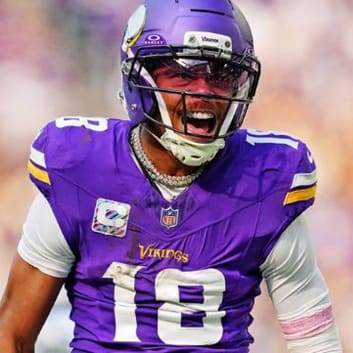
Jauan Jennings, WR, MIN (148.6 UD, 162.31 NFFC)
Jennings' ruggedness at the point of attack should make him a good real-life player for the Vikings in 2026. His odds of producing sufficiently for fantasy investors are not nearly as good.
Jennings' production the last two years was likely at least slightly informed by the benefits of the Kyle Shanahan offense, which was forced to lean heavily on Johnson the last two years while players like Ricky Pearsall, Deebo Samuel and Brandon Aiyuk were in and out of the picture. Jennings won't see the same advantageous setups in Minnesota, and there isn't nearly as much slack in the target rotation either.
Rather than a target hog, expect Jennings to be more of a structural contributor who makes timely but irregular contributions around the much heavier workloads of Justin Jefferson and Jordan Addison. Jennings' per-snap target rate in San Francisco was much lower before the previously mentioned absences/departures of Pearsall, Samuel and Aiyuk.
Even if the Vikings throw often and successfully with Kyler Murray in 2026, the target rates of Jefferson and Addison dictate a totally different application for Jennings than what he showed in San Francisco the last two years, where he was often a big fish in a small pond.
Imminent decline is another concern for Jennings as he heads into his age-29 season. Jennings ran a 4.72-second 40 in 2020, and when he starts brushing up against a 4.80 the cliff will be right there.
Superior alternatives: Jalen Nailor, Adonai Mitchell, Ryan Flournoy, Tre' Harris, Jerry Jeudy
Braelon Allen, RB, NYJ (203.9 UD, 219.75 NFFC)
Not only is Allen fully recovered from last year's season-ending MCL tear, he reported he added upwards of 15 pounds of muscle to newly weigh in around 6-foot-1, 250 pounds.
Braelon Allen says he's 100%, adding that he's bigger, stronger and faster than ever. He's 250 pounds, up from 238-240 last year, but adds that his body fat percentage is at an all-time low. Underwent knee surgery last season. #Jets pic.twitter.com/z5TaHhpa74
— Rich Cimini (@RichCimini) June 10, 2026
Allen has long captivated fantasy observers with his hulkish build and brute strength, both of which are at new all-time highs. Those who were ever sold on Allen as a prospect likely keep the faith despite the disappointing two-year start to his NFL career.
I'm going to be brief with this one because the lines have been said so many times already: Allen is not a serious NFL running back prospect because he is too slow to qualify as such. This was the case when Allen weighed 235 pounds, and adding 15 pounds of muscle is unlikely to make him any faster. It's likely to make him slower.
I'm going to somewhat rudely suggest that most Allen fans are not familiar with Florida State Greg Jones, who was already a significantly better version of whatever premise Allen offers.
Jones was a fullback in the NFL, even though he was significantly faster than Allen. If Jones was too slow to play running back at length, then so is Allen. Allen wisely if suspiciously refused to run a 40-yard dash, but if you look at plays where he breaks into straight-line sprints you can see him lose ground to players who logged 40-yard dashes in the 4.8-second range.
The pro-Allen contingent will often cling to his youth as evidence of upside though it's no such thing. It's impressive that Allen was so productive at Wisconsin, including as a 17-year-old true freshman, but age adjustment doesn't apply to running back production. Jamaal Williams was a 17-year-old standout at BYU -- does anyone care?
The myth of Allen and his incredible muscles will probably persist some amount of time longer, but Isaiah Davis is clearly the better player and novelty is the only thing carrying Allen at this point.
Superior alternatives: George Holani, Jaydon Blue, , MarShawn Lloyd, Jordan James, Kaelon Black, Emanuel Wilson, James Conner, Kimani Vidal, Emari Demercado, Tahj Brooks, Phil Mafah, Isaiah Davis
Tank Dell, WR, HOU (192.7 UD, 231.25 NFFC)
Not many NFL receivers have the innate route-running ability that Dell does. Fewer yet are as ill-suited for volume.
Dell's suddenness comes at a cost -- his 5-foot-8, 165-pound frame is uniquely fragile, and you lose something in the ground game when he's on the field. Between his volume limitations and hyper-specialization toward pass catching, Dell was never a conventional candidate to start in the NFL.
That he's returning from a catastrophic knee injury makes both of these dynamics trend for the worse. Dell missed the 2025 season after suffering multiple ligament tears and a dislocated knee in Week 16 of the 2024 season. He'll be ready for training camp, but an injury this serious can take something from a player and Dell's margins were already pressed by his perilously small frame.
Tank Dell has a helmet on but is not participating yet. The fact that he's this far is a good sign he's closer, though. pic.twitter.com/6P3gVooZNz
— Jonathan M Alexander (@jonmalexander) June 10, 2026
If Dell has to be brought along slowly in his initial return from the injury and if his application has to almost exclusively occur in three-wide, passing-down situations then his week to week floor and ceiling both will face serious constraints.
Nico Collins and Jayden Higgins will be all but immovable on the boundary, where Dell has surprisingly played most of his NFL career to this point despite possessing a build more commonly associated with the slot. Perhaps Dell can thrive in the slot, but second-year man Jaylin Noel looks like a tough prospect in his own right.
The best-case 2026 for Dell is likely one where he posts strong per-snap numbers but plays something like 350 snaps in the regular season. Even if he perfectly maintains his per-snap target rate from before the injury, I don't see how Dell gets to 60 targets in 2026.
Superior alternatives: Brandon Aiyuk, Elijah Sarratt, Pat Bryant, Kayshon Boutte, Jaylin Noel, Rashod Bateman