In this article, we will explore the key differences of best ball fantasy football and redraft leagues and the best way to approach a best ball draft, namely focusing on stacking.
How is Best Ball Different from Season-Long Formats?
Best ball is all about the draft. There's no in-season management. Once your draft is over, that's it. The platform hosting your draft will automatically generate your best possible lineup every week of the season. There are no waivers, no trades. Just the team you drafted. And then it's up to the fantasy gods from there.
The draft runs deeper (18-20 rounds) to account for the lack of roster management, but you're still going to need some good breaks to get your team over the top.
Best ball draft strategy is therefore different than what you'd deploy in redraft leagues. Instead of hunting for week-to-week consistency and being OK with having an end of the bench that you're fine with churning over each waiver period, you're drafting with two stages of the season in mind: the regular season (Weeks 1-14) and the playoffs (Weeks 15-17). Is there a rookie on the board that might be stuck on the bench to start the year but could see a role down the stretch? That's a player worth targeting in best ball you might cut without thinking twice in redraft.
Consistency is, of course, still valuable in best ball, but the scoring format also makes it more palatable to take on more volatile assets. For instance, a player who churns out 12 points a week in a three-week sample is a nice sure thing to have on your redraft roster but that might also be a player who never cracks your lineup in best ball. In best ball, it's arguably more helpful to have a player who gives you one 24-point week in that same three-week stretch, and then combines for 12 points in the other two.
That's because the "dud" weeks in best ball don't hurt you since they won't be in your lineup for that period anyway. However, a 24-point week from a player will almost certainly rank among the best performances at his position.
Stacking also comes into play more in best ball than in redraft. In redraft, a stack is an aggressive commitment to a given team doing well every single week. In best ball, it hurts much less if your stack doesn't pop in a single week.


For up-to-the-minute updates on injuries, news and everything going on around the NFL, head to RotoWire's NFL Fantasy Football News Today or follow @RotoWireNFL on X.
What is Stacking in Best Ball?
Stacking is, in its simplest form, drafting multiple players from the same team or game on your best ball roster. Usually, stacking will consist of a quarterback and 1-2 pass catchers from his team. The idea behind stacking is that if a given offense has a good week and you've rostered several pieces from that team, you've increased your likelihood of cashing in on that production.
For instance, imagine a week where the Rams offense goes off. A best ball team with a Rams stack consisting of Matthew Stafford and Puka Nacua is likely to have performed extremely well, especially if there's the added detail that Stafford had a big day through the air since Nacua has such a large share of the targets in L.A.
That correlation is key because it strips away other variables that need to break in your favor. You can have equally quality players on your team with similar ADPs to Stafford and Nacua, but when they're unstacked, that's one more thing that might work against you in a given week.
Put another way, if Stafford has a good week, Nacua likely does too. But if instead you have Jaxon Smith-Njigba and Jared Goff, you need two offenses to pop for things to be optimized. Goff having a good week will have no bearing on JSN's output, and vice versa. A Stafford-Nacua stack does not have that same problem.
Stay on top of these values as draft season heats up with updated fantasy news and RotoWire's NFL depth charts.
Different Kinds of Stacks
QB-WR or QB-TE
This is the simplest and most common type of stack. You draft a quarterback and a wide receiver from the same team. The ADP can either make this attainable or difficult. Some stacks will be draft slot dependent, i.e., if you don't have a pick in the top 5, you're unlikely to have the ability to build a stack featuring Ja'Marr Chase, Puka Nacua or Jaxon Smith-Njigba.
Other times, a quarterback and one of his better receivers will be going in the same round, making it difficult to draft both without either overreaching for one or expecting the draft room to wildly deviate from ADP.
This year, pairings like Jalen Hurts (71.7) and Makai Lemon (72.8), Quentin Johnston (77.2) and Justin Herbert (82.3), or Brock Purdy (95.7) and Ricky Pearsall (100.7) can be tricky to attain because of how close they are in the ADP.
QB-WR-WR
Adding two receivers from the same team as your quarterback is called double stacking. It is a bigger investment in a given passing game that comes with additional risk and reward. In one sense, having two receivers from the same team is inviting negative correlation because every target that goes to one of your players is inherently not going to the other. The other downside is running into cold weeks where your drafted stack runs into a tough defense or doesn't play well. The struggles from the quarterback make it unlikely for your receivers to have a strong week.
However, healthy passing attacks with good volume can support two wide receivers' fantasy volume pretty safely. And therein lies the upside case. If there's a high-scoring back-and-forth game, there's a strong likelihood that your double stack will reap the benefits.
Now, there are different levels of investment in a double stack. Some are extremely expensive when it comes to draft capital, and others are nice ways of adding a correlating piece to your quarterback in the later rounds.
Expensive double stacks would include Ja'Marr Chase (1st round) and Tee Higgins (3rd round) or CeeDee Lamb (1st round) and George Pickens (2nd/3rd round). These types of double stacks require some draft slot luck — you might not have a high enough pick in the first round to get either Chase or Lamb, or you might not be able to get Pickens coming back around. Additionally, your draft room will likely have a few vigilant drafters who see what you're up to, and end up taking either Burrow or Prescott before you're able to.
This is where "back stacking" comes into play. The idea is to add the second receiver of a stack later in the draft after you already have a receiver and quarterback from the same offense. This way, there's less draft capital investment, and there's a higher chance of you being able to pull it off. Additionally, "reaching" past ADP by half a round late in the draft is less problematic than in the early stages.
For example, teams like Tampa Bay or Houston stand out as good back stack candidates. You can grab a primo asset like Nico Collins (22.3) or Emeka Egbuka (38.2) where they go, and then take the corresponding quarterback later in the draft and then round it out with a depth piece of the receiving corps.
With a Tampa Bay back stack, you'd take Egbuka in the fourth, Baker Mayfield in the 10th, and then Jalen McMillan in the 13th without too much friction. With Houston, it'd be Collins at the 2/3 turn, and then either Jaden Higgins in the 11th and C.J. Stroud in the 12th, or wait and get Stroud and then take either Tank Dell or Jaylin Noel near the end. Tight ends Cade Otton (186.5) or Dalton Schultz (169.7) would also work in this type of setup.
"Bring Back" Stacks
A bring-back stack is when you append one or more skill position players from a team that is playing against the team you have already stacked. This comes into play more so in the playoffs. Fortunately, we have a handy best ball playoff schedule cheat sheet. The idea is to have the most players playing in the same game with a high point total in the playoffs, thereby giving your team several access points to the fantasy production that matchup.
Look at Sam Sherman's Best Ball Mania-winning lineup from Week 17 last year:
The team that took down Best Ball Mania VI with a Week 17 score of 187.92 👑
Drafted on June 1st 👀 https://t.co/8Zq65xe0Tc pic.twitter.com/rQoLOBS658
— Underdog Drafts (@UnderdogDrafts) December 30, 2025
It had Brock Purdy as part of a 49ers stack and Luther Burden on the other in what turned out to be one of the highest-scoring games of the season. Although George Kittle, the original stacking partner with Purdy, didn't crack that lineup due to an injury, having Kittle helped Sherman advance to the finals in the first place.
You can formulate bring-back stacks from a couple of vantage points. You can either go into a draft with a couple of games during the fantasy playoffs circled and draft accordingly, or you can let the draft progress, see where you're at, and find the spots where you can add a useful bring-back stack.
Right now, the games with the highest implied totals for Week 17 are:
- Ravens at Bengals: 51.5
- Lions at Bears: 49.5
- Rams at Buccaneers: 48.5
- Commanders at Jaguars: 48.5
- Bills at Dolphins: 47.5
I'm also intrigued by the Cardinals-Raiders game since it has so many players who go high in drafts. It's not hard to pull off an Ashton Jeanty/Trey McBride start or a Brock Bowers/Jeremiyah Love stack early in your draft. It's a lot of eggs in those (potentially low-scoring) baskets, but the market still deems these specific players to be high value.
We have a whole article dedicated to game stacking in the best ball playoffs here at RotoWire, which includes a tool to easily identify the best stacks for your roster.
QB-RB Stacks
These may not seem as intuitive because a rushing touchdown is going to do nothing for your quarterback in this setup, but these stacks are still viable. There are few scenarios where I feel good about a QB/RB stack.
- Pass-catching Running Back: The obvious example of this would be Christian McCaffrey and Brock Purdy. A running back that is a big piece of the passing game can help pad your quarterback's production while also having multiple avenues for production.
- Great Offense: This is where it's helpful to zoom out and look at teams with the most expected points per game. If you get the quarterback and running back from one of the most prolific offenses in the game, you have increased your marketshare of that fountain of points.
- Price is Right: Think of it as value-based drafting. If you already have the QB or RB from an offense, grabbing the other piece of this stack when it otherwise fits your roster is a good play. This is especially true if the running back is more of a pass-catching specialist. There tends to be a positive correlation between a quarterback and the RB2 on a given team since that RB is often the one picking up the passing down work.
Stacking Math
Stacking is something that inherently goes for ceiling. We use it in DFS all the time as a core part of our lineup builds, and the same principle applies here.
If one lineup/team has a quarterback posting one of the highest-scoring weeks at his position, there's a greater likelihood that the receiver you stacked with him will also have had a good week.
A Joe Burrow deep touchdown pass would likely have a strong expected fantasy points projection for Ja'Marr Chase or Tee Higgins since those two players have an established high share of Burrow's yards and touchdowns.
Stacking cuts both ways because a down week from one part of the stack may mean a lower output from the stack overall.
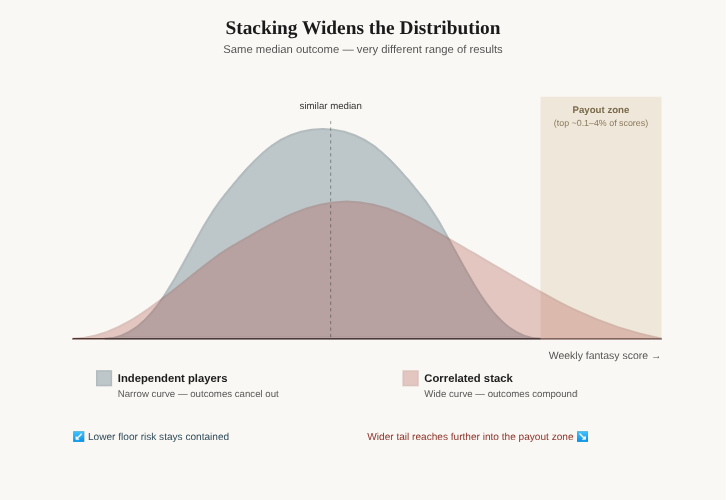
As you can see in the chart above, unstacked players may have a greater chance at giving you consistent week-over-week production that is solid but unspectacular. You don't want to avoid these players entirely, and it's unlikely that you'll have a full 18- or 20-player roster with all correlated pieces. Getting your primary stack right will give you access to the top-scoring quartile, even if there's the tradeoff of bigger floor risk.
When Stacking Goes Wrong
Sometimes overdoing it on theory ends up not working out in practice. You can have the nice roster construction that you flex on Twitter.
You can overdo it on stacks. Once you go beyond three total players (QB + 3 Pass Catchers), you're almost guaranteeing some wasted space on your roster every week.
Forcing stacks is another way to get yourself into trouble. We've established that having a stack is good, but the edge gained by having one is dulled if you've reached way past ADP to make it happen. As a general rule, you should avoid reaching well above ADP, particularly in the earlier rounds in the draft. The market tends to be sharper the earlier we are in the draft, and you're unlikely to be smarter than the market time and time again.
And sometimes, a stack just ends up being a dud. Injuries, underperformance, and an unforeseen player emerging can crater your plans for how to spend the top prize.
Favorite Stacks
Stacks come in all shapes and sizes. There are expensive ones, like the Ja'Marr Chase/Tee Higgins/Joe Burrow stack, there are ones you can backfill your roster (Texans, Panthers or Jets); and there are stacks to be had in between.
Looking at the best ball ADP, here are some of the best stacks to pull off this summer.
Easiest to Acquire
These stacks align particularly well with certain draft slots, so you can get them without straying too far from ADP.
New England Patriots: A.J. Brown (2nd Round), Drake Maye (6th), Hunter Henry (13th)
- Ideal Draft Slot: 7
Green Bay Packers: Christian Watson (5th Round), Tucker Kraft (7th), Jordan Love (10th)
- Ideal Draft Slot: 9/10
Minnesota Vikings: Justin Jefferson (1st Round), Jordan Addison (8th), Kyler Murray (10th)
- Ideal Draft Slot: 9/10
Most Expensive Stacks
These stacks will get you the best pieces of the best offenses, but you'll have to pay up for the privilege.
Cincinnati Bengals: Ja'Marr Chase (1st Round), Chase Brown (2nd), Tee Higgins (3rd), Joe Burrow (6th)
- Ideal Draft Slot: 3
Baltimore Ravens: Derrick Henry (2nd Round), Zay Flowers (3rd), Lamar Jackson (5th)
- Ideal Draft Slot: 7
Buffalo Bills: James Cook (1/2 Turn), Josh Allen (3rd), DJ Moore (6th)
- Ideal Draft Slot: 11
Bargain Bin Stacks
Stacks that are there for the taking ... for a reason.
Tennessee Titans: Tony Pollard (7th Round), Wan'Dale Robinson (10th), Cam Ward (12th), Calvin Ridley or Gunner Helm (15th)
- Ideal Draft Slot: 6
Houston Texans: Nico Collins (2nd), Jayden Higgins (11th), C.J. Stroud (12th), Dalton Schultz (14th), Jaylin Noel (18th)
- Ideal Draft Slot: 3
New York Jets: Breece Hall (3rd) or Garrett Wilson (4th), Omar Cooper (12th), Geno Smith (16th)
- Ideal Draft Slot: N/A. Can pretty much justify this from any spot on the board. As much as one can justify stacking the Jets, at least.
.
Dominate your fantasy football league this season with our 2026 RotoWire fantasy football draft kit. Packed with expert insights, rankings and strategy tips, the kit features our interactive mock draft simulator to prepare you for every scenario. Streamline your draft-day decisions using our printable cheat sheet and stay ahead of the competition with our up-to-date rankings for all formats.