2026 World Cup Group K Preview: Portugal, Colombia, DR Congo and Uzbekistan Lineups, Odds, Predictions and Tactics
Group K is defined by Cristiano Ronaldo's likely farewell, and it is easy for that storyline to consume everything around it. At 41 years old, Ronaldo missed the March window entirely with a hamstring strain suffered playing for Al Nassr in late February. In his absence, Portugal went to the Azteca and drew 0-0 with Mexico, then traveled to Atlanta and dismantled the United States 2-0 without him. That says something important about how this squad has been built under coach Roberto Martinez. They do not need Ronaldo to win matches. They do not even need him to win this group. But if he is fit, he will start, and the attention that follows him will shape how the entire tournament covers Group K.
Behind the Portugal story, the rest of the group has genuine substance. Colombia arrive off a difficult March window, consecutive defeats to Croatia and France raising real questions about manager Nestor Lorenzo's squad depth and tactical cohesion heading into June, but their individual quality, with Luis Diaz now at Bayern Munich and James Rodriguez finding playing time at Minnesota United in the MLS ahead of the tournament, is good enough to push Portugal the entire group stage.
DR Congo return to the World Cup for the first time since 1974, when they were called Zaire. Their qualification sealed by Axel Tuanzebe's 100th minute header from a corner against Jamaica on March 31, the last spot in the entire 48-team field to be filled.
And Uzbekistan, making their first World Cup appearance in their history as an independent nation, arrive under manager and Italian legend Fabio Cannavaro with Abdukodir Khusanov at Manchester City as the squad's headline European-based name.
For odds and predictions across every group, check out our 2026 World Cup group preview hub.
World Cup Group K Schedule
PORTUGAL | 2026 World Cup Tactical Analysis and Predicted Lineup
How Portugal Will Play at the 2026 World Cup
Manager Roberto Martinez has been building toward this tournament since his appointment in 2023, and the Nations League title Portugal won in the summer of 2025, beating Spain in the final, was the competitive proof of concept his squad needed. Under his management, Portugal have averaged more than 70 percent of possession, won four of six qualifying matches and scored 20 goals in that span, with an impressive 9-1 victory against Armenia in their final qualifier, a match that included hat-tricks from Bruno Fernandes and Joao Neves. The qualification campaign was not entirely smooth: a defeat to Ireland, a Ronaldo red card, and tactical experiments that exposed vulnerabilities in the midfield's ball-winning capacity. But the underlying picture is of a team that has found both a system and a depth chart, and the March window confirmed that the depth is real.
Against Mexico on March 28, Portugal drew 0-0, controlling possession, hitting the post through Goncalo Ramos, and leaving with a goalless draw that reflected their dominance without the finishing product. Three days later in Atlanta, Francisco Trincao opened the scoring in the 37th minute with a backheel from Bruno Fernandes for the assist before Joao Felix, coming off the bench, struck a sumptuous half-volley from the corner of the 18-yard box in the 59th minute to seal a clean 2-0 victory over the United States. Manager Martinez used 11 substitutions across both halves and still controlled both matches. The squad genuinely is two deep at almost every position.
The preferred formation is a 4-2-3-1 or 4-3-3 depending on the opponent. Diogo Costa in goal, Ruben Dias and Goncalo Inacio in central defense, Nuno Mendes on the left, Joao Cancelo or Diogo Dalot on the right, with a midfield of Vitinha, Joao Neves and Bruno Fernandes feeding Ronaldo or Ramos up front and Rafael Leao and Bernardo Silva wide. The attacking depth is arguably the best in the tournament, Felix, Pedro Neto, Trincao and Francisco Conceicao all competing for the wide and support roles, none of whom would be considered fringe options at any other national team.
Portugal's Attacking Style at the 2026 World Cup
Portugal's attacking structure is built on a blend of elite creativity, vertical pace and interchangeable profiles that allow them to destabilize defenses in multiple ways.
Key attacking themes include:
Bruno Fernandes as the creative conductor, with his backheel assists, movement in the half-spaces and goals contribution making him Portugal's most important attacking player regardless of what Ronaldo does. Against the United States, he set up both goals, controlled the first half tempo and showed again why his club form at Manchester United has made him the most dynamic attacking midfielder in Portugal's history.
Rafael Leao as the left-sided speed and directness threat, with the ability to beat any full-back at this tournament in a straight line and the finishing range to score from outside the box. At AC Milan he has developed into a consistent match-winner, and at a World Cup where space opens in transition, he is the player most capable of winning a game in 15 minutes of explosive football.
Bernardo Silva from Manchester City as the experience midfielder, with the technical quality that makes Portugal almost impossible to defend on both flanks simultaneously.
Goncalo Ramos as the starting striker option when Ronaldo is managed off or rested, with the movement, pressing intelligence and finishing ability that earned him the Portugal call-up in the first place and which the Atlanta win against the USA confirmed is entirely tournament-ready.
Portugal's attacking rotations give manager Martinez options that few coaches in this tournament possess. He can bring on Ramos for Ronaldo, Neto for Silva, Trincao or Felix for Leao, which could make a difference in this group.
Several Portuguese players are among the frontrunners in the 2026 World Cup Golden Boot odds.
Portugal's Defensive Setup
Dias remains the cornerstone of everything behind the ball. At 28 years old, he is at the peak of his powers at Manchester City despite a difficult season due to injuries but his reading of the game, aerial authority and ability to organize those around him gives Portugal a defensive leader who belongs in the conversation for the best center-back at this tournament. Inacio alongside him has developed into a composed, technically excellent partner who can play out under pressure.
Mendes at left-back provides the attack-minded width and defensive intensity that coach Martinez values, while Cancelo or Dalot on the right gives the team Premier League experience and positional reliability. Costa at Porto is the goalkeeper, a player Martinez has consistently praised for his composure and decision-making. The defensive concern heading into the tournament is the same one that cost Portugal in Euro 2024 and in Qatar 2022: when the midfield's pressing structure breaks down, Portugal can be exposed through the space behind the advanced full-backs.
Key Tactical Adjustments Portugal Need to Make
Manage Ronaldo carefully, not sentimentally, but tactically. If coach Martinez starts him in all three group matches regardless of form or fitness, the squad management problem could expose Portugal in the knockout rounds to opponents who have fresher attacking options.
Resolve the midfield ball-winning question that surfaced in the qualifying campaign, as the creative midfield of Fernandes, Neves and Vitinha is technically brilliant but can be overrun by high-intensity pressing opponents.
Use the group matches against DR Congo and Uzbekistan as opportunities to get the players to their sharpest possible rhythm before the Colombia match on June 27, which is the group's defining fixture.
Portugal 2026 World Cup Predicted Lineup
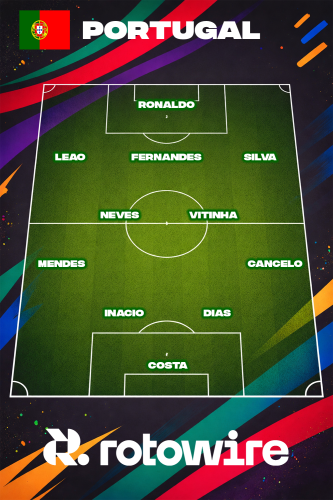
For more updates, see the latest projected World Cup lineups on RotoWire.
Portugal Set Piece Takers for the 2026 World Cup
Corners: Bruno Fernandes, Bernardo Silva, Nuno Mendes, Pedro Neto, Francisco Conceicao
Direct free kicks: Bruno Fernandes, Cristiano Ronaldo
Penalties: Bruno Fernandes, Cristiano Ronaldo
Why This Portugal Lineup Works
This is coach Martinez's settled first-choice XI when everyone is available, with the defensive foundation of Costa, Dias and Inacio, the creative engine of Fernandes and Neves in midfield, and the attacking threat of Leao and Silva wide. Ronaldo leads the line with the leadership and experience of a player who has scored 143 international goals and who still carries enough physical menace to demand full-time defensive attention. If this squad executes at its ceiling, Portugal are one of the three or four most dangerous teams at this tournament.
COLOMBIA | 2026 World Cup Tactical Analysis and Predicted Lineup
How Colombia Will Play at the 2026 World Cup
The March window was the kind that makes coaching staff lose sleep. Colombia lost 2-1 to Croatia on March 26 and three days later against a rotated France second string in Maryland, Colombia lost 3-1 as Desire Doue scored twice and Marcus Thuram added a header, with Jaminton Campaz's consolation doing nothing to mask the defensive vulnerabilities that both opponents had exploited. Manager Nestor Lorenzo was clear afterward, these were worrying results at exactly the wrong moment in the preparation cycle.
And yet the talent is undeniable. Luis Diaz, who moved to Bayern Munich last summer, is one of the best wide forwards in world football. James Rodriguez, now 34 years old and playing at Minnesota United in MLS specifically to get regular minutes before the World Cup, remains Colombia's most gifted creative player when he is physically available and mentally engaged and his record as Golden Boot winner at the 2014 World Cup gives him tournament credibility that no amount of club-level inconsistency erases. Richard Rios at Benfica has developed into one of the most complete midfielders in the Portuguese league. Jhon Arias at Palmeiras provides the direct running and creativity from wide positions that gives Colombia a second attacking dimension beyond Diaz. And the emerging Yaser Asprilla at Galatasaray, adds the unpredictability of a player whose ceiling nobody has found yet.
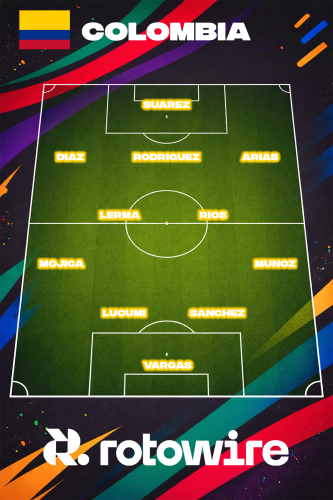
The tactical system under Lorenzo is a 4-2-3-1 with a double pivot of Rios and Jefferson Lerma behind Rodriguez, Diaz on the left, Arias on the right and Luis Suarez leading the line. Colombia's best football, the 28-match unbeaten run that defined the 2024 Copa America campaign, the wins over Germany, Brazil and Spain that marked coach Lorenzo's early tenure, comes when Rodriguez is sharp, Diaz is flying and the midfield pivot is winning second balls quickly enough to feed the attack in transition. Their worst football, which the March window showed, comes when the defensive organization collapses at set pieces and individual errors at the back compound each other.
Colombia's Attacking Style at the 2026 World Cup
Colombia's attacking structure is built around a blend of individual brilliance and complementary roles that give them both creativity and direct threat across multiple channels.
Key attacking themes include:
Luis Diaz as the primary match-winner, with the pace, technical quality and finishing range that makes him the most dangerous player in the group after Ronaldo. At Bayern Munich he has stepped up his club performance level and arrives at the World Cup in the best form of his career.
James Rodriguez as the creative hub and emotional leader, whose tournament experience, vision and long-range shooting ability give Colombia's attack a dimension that only a few players at this tournament can replicate. If he is fit and sharp, he makes this team a different proposition.
Jhon Arias from Palmeiras as the direct right-sided threat, with the energy, creativity and goal-scoring instinct that gives Colombia two genuine wide threats rather than just Diaz on the left.
Luis Suarez from Sporting CP as the physical striker option, with the pressing intensity and movement that creates space for the creative players behind him.
Colombia's best attacking football involves Rodriguez finding Diaz in behind the defensive line with a first-time pass, or the full-backs pushing high to stretch the block and create pockets for Arias and Rodriguez to operate in. Against Uzbekistan in the opener, that attacking system should generate enough chances to win comfortably. Against Portugal on June 27, it is the tactical showdown that will define the group.
Colombia's Defensive Setup
Davinson Sanchez and Juan Lucumi as the center-back pairing give Colombia physical authority and aerial coverage at the back. Daniel Munoz at right-back, whose crossing ability and attacking instinct from Crystal Palace have made him a reliable source of chance creation, provides the attacking width from right-back that the system demands.
Camilo Vargas should be the starter in goal and will get the experience of David Ospina as the backup to keep the net empty during the competition. The double pivot of Rios and Lerma gives the defensive structure its work rate and coverage, but when Colombia go through the phases of high pressing and the shape gets stretched, they can be vulnerable to quick transitions, precisely what France and Croatia both exploited in March.
Key Tactical Adjustments Colombia Need to Make
Fix the set-piece defending, specifically the goalkeeper's command of the area, as both Croatia goals and multiple France chances came from situations that well-organized defences manage routinely.
Get James Rodriguez fit, sharp and confident in the weeks between now and June, as the gap between Colombia with him on form and Colombia without him is the largest single variable in how far they go in this tournament.
Treat the Uzbekistan opener on June 17 as a six-pointer to win convincingly, because starting the group with three points and a clean sheet resets the narrative around the March results.
Colombia 2026 World Cup Predicted Lineup
Colombia Set Piece Takers for the 2026 World Cup
Corners: James Rodriguez, Jhon Arias, Jaminton Campaz, Juan Quintero, Yaser Asprilla
Direct free kicks: James Rodriguez, Luis Diaz
Penalties: James Rodriguez, Luis Diaz, Miguel Borja
Why This Colombia Lineup Works
This is the lineup that nearly beat Argentina in the Copa America final and went 28 matches unbeaten. When everyone is fit and the defensive structure is organized, Colombia can compete with any team in this tournament. Vargas in goal has the experience of big games. Sanchez and Lucumi provide the aerial presence that Uzbekistan and DR Congo will struggle with. Rodriguez, when sharp, makes this team a genuinely dangerous dark-horse contender. And Diaz, at his current level at Bayern Munich, is the kind of player who can win a World Cup game on his own. The March results need to be forgotten. The question is whether they can be.
DR CONGO | 2026 World Cup Tactical Analysis and Predicted Lineup
How DR Congo Will Play at the 2026 World Cup
The number is 52. That is how many years had passed between DR Congo's only previous World Cup appearance, as Zaire in 1974 in West Germany, and the moment Axel Tuanzebe tapped in from a corner in the 100th-minute against Jamaica on March 31 to send the Leopards back to the tournament. The celebrations that erupted across Kinshasa, lightning over the capital, people running through the rain-soaked streets, were not just about football. The Democratic Republic of Congo has endured decades of conflict, political instability and humanitarian crisis. When captain Chancel Mbemba stepped up to score the decisive penalty against Nigeria in the African playoff to send them to Mexico, and when Tuanzebe put his tap-in away against Jamaica two months later, those goals meant something that goes considerably beyond sport.
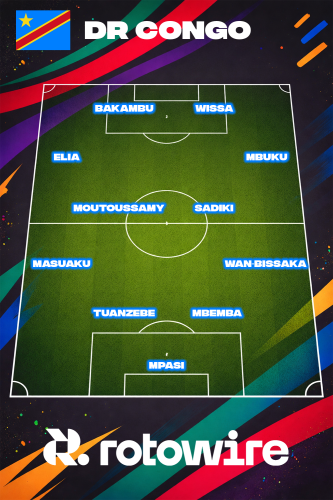
Sebastien Desabre, the French coach who has worked in eight African countries and took over in 2022, has built this squad with a combination of experienced continental players and dual-nationals who bring European tactical exposure. The recruitment operation has been active: Tuanzebe, born in the DR Congo but raised in Manchester and a former Manchester United academy product, switched his international allegiance from England to Congo in 2024. Aaron Wan-Bissaka, the former Manchester United and Crystal Palace right-back, made nine appearances for the Leopards before the tournament. Yoane Wissa from Newcastle brings explosive pace and finishing ability as a returning forward who missed AFCON with injury. Cedric Bakambu at Real Betis is the experienced striker who came closest twice against Jamaica before Tuanzebe's decisive intervention, and who remains the team's primary attacking reference.
Manager Desabre's tactical approach prioritizes organization, defensive compactness and quick transitions. The system is typically a 4-5-1 or 4-4-2 in defensive phases that compresses centrally and makes the opposing midfield work for every inch. In attack, the transitions through Wissa's pace and Nathanael Mbuku's directness give the Leopards two wide outlets capable of punishing any defensive line that commits too high.
DR Congo's Attacking Style at the 2026 World Cup
DR Congo's attacking structure is built around a small core of players whose individual profiles define how the team progresses the ball and creates chances in transition.
Key attacking themes include:
Yoane Wissa as the primary attacking threat, with the pace, directness and finishing ability that has made him one of the more reliable wide forwards in the Premier League for Newcastle. His return from injury for the tournament is the single most important piece of positive news for DR Congo heading into June.
Cedric Bakambu as the experienced central striker, with 21 international goals, La Liga experience at Real Betis and the veteran composure to lead an attacking line without the ball supply that top European forwards receive.
Nathanael Mbuku from Montpellier as the right-sided attacking outlet, with the pace and one vs one ability that gives DR Congo's counter-attacking system a different dimension from the right channel.
Noah Sadiki from Sunderland as the energetic central midfielder capable of driving forward with the ball from deep and arriving in dangerous positions when the team transitions from defence to attack.
DR Congo are at their best when the defensive block holds compact and the wide players receive early balls in transition behind a stretched opposition back line. Against Portugal, that scenario requires holding a clean sheet for long enough that the defensive shape can absorb pressure without breaking, a significant ask, but not an impossible one.
DR Congo's Defensive Setup
Mbemba at Lille is the captain and cornerstone. At 30 years old, with 100+ international caps and the experience of Porto, Newcastle and Marseille behind him, his aerial authority and leadership gives the Congolese back four its organizing principle. Lionel Mpasi, the backup goalkeeper of Le Havre, remains the preferred option and brings the composure of an experienced operator in high-pressure moments. The defensive structure against Jamaica was tight and resolute for 90 minutes and that resilience is the foundation DR Congo need to build on across three group matches.
Masuaku, Wan-Bissaka and Tuanzebe complete the back line and bring Premier League experience and security to the Leopards since the back four is almost certain, though depth in those positions is limited unless further dual-nationals come on board before June.
Key Tactical Adjustments DR Congo Need to Make
Approach the Portugal opener on June 17 as the opportunity to produce one of the tournament's great giant-killing moments, the players who were born in the DR Congo but developed in Europe have the technical quality to cause problems in the spaces behind Portugal's advanced full-backs.
Keep Wissa's fitness protected throughout the camp, as the Newcastle forward's pace is irreplaceable in the counter-attacking system and losing him would fundamentally alter what DR Congo can threaten.
Use the Colombia match on June 23 as a genuine six-pointer for knockout round qualification, it is the game that could decide third place in the group, and DR Congo have the personnel to compete in it.
DR Congo 2026 World Cup Predicted Lineup
DR Congo Set Piece Takers for the 2026 World Cup
Corners: Arthur Masuaku, Theo Bongonda, Nathanael Mbuku, Yoane Wissa, Brian Cipenga
Direct free kicks: Arthur Masuaku, Gael Kakuta, Nathanael Mbuku
Penalties: Yoane Wissa, Cedric Bakambu, Gael Kakuta
Why This DR Congo Lineup Works
Mbemba organizes everything from the back. Wissa and Mbuku give the transitions pace on counters. Bakambu leads the line with the experience of over 65 international appearances. And Tuanzebe, the man who scored the goal that qualified them, gives the defensive unit the English-league athleticism and physicality that gives DR Congo's defensive block an extra physical dimension. This is a team returning after 52 years to a stage they were told for decades they did not belong on. They earned this with their feet, and they will not spend their three group matches just grateful to be there.
UZBEKISTAN | 2026 World Cup Tactical Analysis and Predicted Lineup
How Uzbekistan Will Play at the 2026 World Cup
This is history. Uzbekistan have never played at a World Cup as an independent nation. The country existed as a Soviet republic through all the great eras of the tournament, and since gaining independence in 1991 and joining FIFA, they came close multiple times, losing on away goals to Bahrain before the 2006 tournament, agonizingly near in 2014, before finally finishing second in their AFC qualifying group in 2025 behind Iran, with six wins across 10 matches. Abbosbek Fayzullaev scored the two goals that gave them the early momentum in that campaign before the team produced five unbeaten matches to seal the place. The qualification celebration in Tashkent was the country's biggest sporting moment.
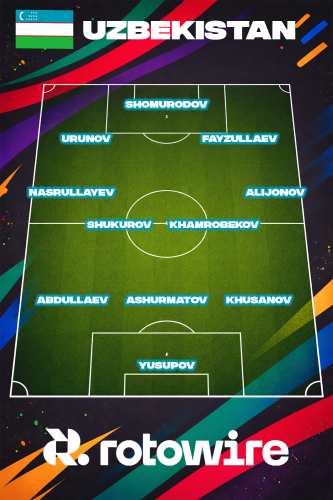
The coaching history is worth understanding. Manager Srecko Katanec, the Slovenian who did the qualifying work, resigned in January 2025. An interim period under coach Timur Kapadze kept things stable before legend Fabio Cannavaro was appointed in October 2025, the 2006 Ballon d'Or winner, the man who captained Italy to the World Cup title in Germany, taking over a nation making their first-ever appearance and describing his role as giving this team the experience of competing against the best. Cannavaro has had eight matches in charge, winning six, drawing one and losing one to coach Marcelo Bielsa's Uruguay in October 2025. His preferred approach is a 3-4-2-1 that focuses on defensive organization and quick releases to the front players, much closer to the pragmatic Italian tradition of catenaccio-influenced block defending than the high-press systems that dominate European coaching philosophy. He has said publicly that he does not believe in pressing for 90 minutes and that Uzbekistan's identity will come from discipline, organization and taking their chances.
Abdukodir Khusanov at Manchester City is the squad's most recognizable European-based player, a center-back who moved from Lens in January 2025 and has become a regular starter at one of the Premier League's elite clubs. His experience of Champions League football gives Uzbekistan's defensive structure a credibility that previous generations of the national team lacked. Eldor Shomurodov, the captain with 44 goals in 90 caps and stints at Genoa, Roma and now Istanbul Basaksehir on loan, leads the attacking line.
Uzbekistan's Attacking Style at the 2026 World Cup
Uzbekistan's attacking identity is built around a clearly defined spine of leadership, creativity, and direct width, supported by structured set-piece execution and a pragmatic transition-based approach.
Key attacking themes include:
Eldor Shomurodov as the primary striker and captain, with the Serie A experience, goal-scoring record and pressing intensity that gives Uzbekistan an attacking focal point capable of leading the line against European and South American opposition. His five qualifying goals and his ability to perform under pressure make him central to everything Uzbekistan can create.
Abbosbek Fayzullaev as the main creative attacking midfielder in the absence of Jaloliddin Masharipov (ACL), with the goal-scoring ability, including those early qualifying strikes that gave the campaign its momentum, and the technical quality to operate between the lines and find spaces in compact defensive structures.
Sherzod Nasrullayev and Khojiakbar Alijonov as the wide options, with the directness and energy that provides Uzbekistan's attack with a different dimension when they need to stretch opposing defenses.
Disciplined set-piece organization, with Khusanov's aerial dominance giving Uzbekistan a genuine threat from corners and free kicks that can produce goals against any opponent willing to defend loosely at dead balls.
Uzbekistan's most realistic attacking scenario is a team that sits deep, absorbs pressure for extended periods and attacks in sharp, fast bursts through Shomurodov and Fayzullaev. Against Colombia in the group opener on June 17, that approach will be tested immediately.
Uzbekistan's Defensive Setup
Khusanov alongside his club or national-team partners gives Uzbekistan a center-back combination anchored by Premier League quality. The captain of the defensive unit is experienced beyond his years, with the physical presence and reading of the game that coach Cannavaro, himself one of the greatest center-backs in history, will have spent months refining in his own image. Utkir Yusupov in goal, who made six crucial saves against UAE in the final qualifying match to preserve the draw that confirmed their place, gives the team a reliable shot-stopper who has performed in the most high-pressure domestic moments.
The defensive discipline manager Katanec instilled through the qualifying campaign, one loss in ten matches, seven goals conceded, is the foundation new head coach Cannavaro has built on. The concern is what happens when elite-quality attackers like Ronaldo, Diaz or Wissa have space in behind, as Uzbekistan's full-backs have limited experience of that standard of opposition.
Key Tactical Adjustments Uzbekistan Need to Make
Use the DR Congo match on June 27 as the genuine target, if Uzbekistan can take maximum points from that game, anything that happens against Colombia and Portugal becomes a bonus rather than a defeat.
Protect Khusanov's fitness across all three matches, as the Manchester City center-back is the player who most determines whether Uzbekistan's defensive structure can withstand the attacking quality of Portugal and Colombia.
Find a way to get Shomurodov in behind the opposition defense at least twice per match, as isolated chances for a striker of his quality are often enough to produce goals against any defensive structure.
Uzbekistan 2026 World Cup Predicted Lineup
Uzbekistan Set Piece Takers for the 2026 World Cup
Corners: Abbosbek Fayzullaev, Jamshid Iskanderov, Aziz Ganiyev, Otabek Shukurov
Direct free kicks: Abbosbek Fayzullaev, Eldor Shomurodov
Penalties: Eldor Shomurodov, Otabek Shukurov
Why This Uzbekistan Lineup Works
Manager Cannavaro has built this XI around Khusanov's defensive authority, Shomurodov's attacking intelligence and Fayzullaev's creative connection between the two. The compact 3-4-2-1 gives the defensive block its shape, the two-pivot protects the back three, and the wide players provide the width that allows Shomurodov to operate in the box rather than constantly dropping deep for the ball. For a nation playing in their first ever World Cup match, this lineup represents the best available version of what Uzbekistan football has produced, and that is worth considerably more than a ranking number suggests.
2026 World Cup Group K Odds
This preview is part of our full tactical breakdown of all 12 World Cup groups.
Portugal are priced as the clear favorites across all books, implying roughly a 65 percent chance to win the group. That reflects their consistency across recent tournaments and the depth of the team.
Colombia project as the clear second favorites with around a 25 percent chance of winning the group.
DR Congo and Uzbekistan are priced as clear outsiders with seven percent and one percent implied probability, respectively.
Early value in this group is limited unless Colombia drift beyond current pricing, while Portugal's odds reflect a low-risk group winner profile.
Visit RotoWire for exclusive sports betting picks and our daily World Cup recaps. Remember that betting apps vary in terms of odds, so we have an easy-to-use odds page that allows you to shop for the best lines at DraftKings, FanDuel, BetMGM and PointsBet. Claim over a thousand dollars in bonuses by signing up at the best sports betting sites using the best sportsbook promos.
World Cup Group K Predictions: Who Advances?
Portugal are the clear favorites to win Group K based on squad depth, attacking quality and recent tournament form. Colombia project as the strongest challenger, while DR Congo and Uzbekistan are competing for third place and a possible qualification path.
Portugal win this group. The depth coach Martinez has built, the Nations League title they hold, and the combination of Ronaldo's experience and the extraordinary attacking quality surrounding him makes this a group Portugal should navigate without genuine difficulty. The DR Congo opener on June 17 will be the one where the world watches to see whether the Leopards can produce a Saudi Arabia 2022 moment. It is possible, and worth treating as a genuine risk rather than a formality, but the qualifying matches of Portugal and a squad built around Champions League-level talent makes Portugal the overwhelming favorite.
Second place is one of the most compelling second-place battles in the tournament. Colombia and Portugal meet on June 27, the last group game for both, the fixture that could decide the group winner and simultaneously confirm second place. If Colombia beat Uzbekistan on June 17 and then get a result against DR Congo on June 23, they arrive at the Portugal match already through. If they drop points early, the Miami fixture becomes existential. The March defeats to Croatia and France are genuinely concerning for a team of Colombia's quality, but both opponents found the same defensive weakness, set-piece vulnerability and defensive disorganization in transition, and coach Lorenzo has identified the problem. Whether two months is enough time to fix it is the question Group K will answer.
DR Congo face Portugal in the opener, which is the toughest possible opening fixture for a team returning after 52 years. If they can hold Portugal to a single goal, take their chances against Colombia and beat Uzbekistan, the mathematics of a third-place advance become real. For manager Desabre's team, realistic expectations are one result that shocks the group and the knowledge that 52 years of waiting ended with Tuanzebe's tap-in in the rain in Guadalajara.
Uzbekistan want three points from DR Congo on June 27. That is their primary objective. Everything before it, the Colombia opener and the Portugal match, is preparation for the game they have the best chance of winning. Head coach Cannavaro understands this, and the squad selection he makes across all three matches will reflect it.
For predicted lineups and tactical breakdowns across every group, check our 2026 World Cup preview hub.
Group K Summary
| Portugal | DR Congo | Uzbekistan | Colombia | |
|---|---|---|---|---|
| Predicted formation | 4-2-3-1 | 4-4-2 | 3-4-2-1 | 4-2-3-1 |
| Playing style | High possession, technical overloads wide, Ronaldo as focal point, depth-driven rotation | Compact defensive block, direct counter-attack, pace through Wissa and Mbuku, set-piece threat | Defensive organization, disciplined mid-block, quick transitions through Shomurodov, coach Cannavaro structure | Technical possession, Diaz-led attacking transitions, Rodriguez as creative hub, full-back width |
| Corners/FK takers | Fernandes, Silva, Mendes, Neto, Conceicao, Ronaldo | Masuaku, Bongonda, Mbuku, Wissa, Cipenga, Kakuta | Fayzullyaev, Iskandarov, Ganiyev, Shukurov | Rodriguez, Diaz, Arias, Campaz, Quintero, Asprilla |
| Penalty takers | Fernandes, Ronaldo | Wissa, Bakambu, Kakuta | Shomurodov, Shukurov | Rodriguez, Diaz, Borja |
2026 World Cup Group Previews Menu
Click each group for full tactical breakdowns, predicted lineups, betting odds and predictions.
Group A: Mexico, South Africa, South Korea, Czechia
Group B: Canada, Bosnia and Herzegovina, Qatar, Switzerland
Group C: Brazil, Morocco, Haiti, Scotland
Group D: United States, Paraguay, Australia, Turkiye
Group E: Germany, Curacao, Ivory Coast, Ecuador
Group F: Netherlands, Japan, Sweden, Tunisia
Group G: Belgium, Egypt, Iran, New Zealand
Group H: Spain, Cape Verde, Saudi Arabia, Uruguay
Group I: France, Senegal, Iraq, Norway
Group J: Argentina, Algeria, Austria, Jordan
Group K: Portugal, Colombia, DR Congo, Uzbekistan
Group L: England, Croatia, Ghana, Panama