

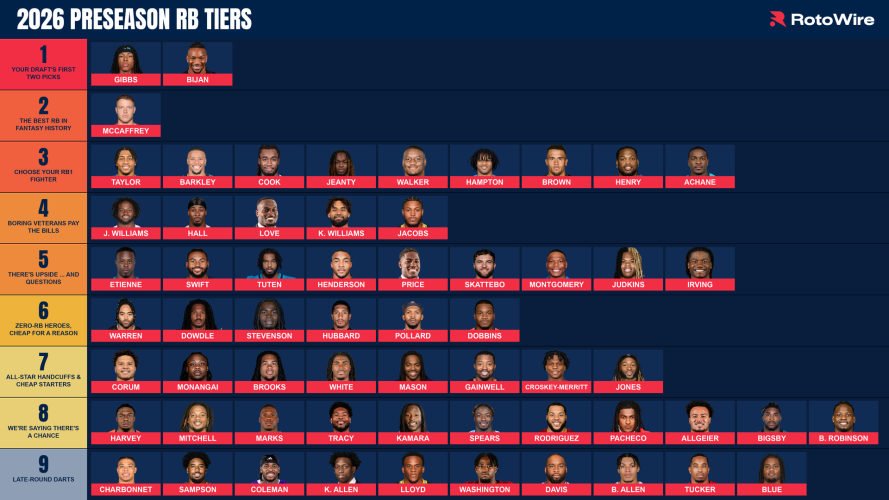
Rankings are cool and all, but as any fellow fantasy nerd knows: Tier-based drafting is really where it's at. This is because — get this — sometimes us alleged fantasy experts can be wrong, so it's best to embrace this horrifying reality by grouping similarly ranked players into tiers instead of pretending like we're going to get every single individual ranking correct.
Cool? Cool: What follows are my preseason RB tiers along with some quick fun facts as well as one bigger picture question for each individual tier.
As always: It's a great day to be great.
Reminder: You can check out all of Ian's rankings and content with a premium RotoWire subscription. Use code "Ian20" for 20% off.
Tier 1: Your Fantasy Draft's First Two Picks
- RB1 Jahmyr Gibbs: Career average of 5.4 yards per carry ranks fifth … ever … and the explosive 24-year-old is also lethal as a pass-catcher (only Bijan Robinson and Christian McCaffrey have more receptions the last three seasons).
- RB2 Bijan Robinson: Quite possibly planet Earth's RB1 if the aliens invaded the planet and forced us to play a football game to save humanity. Only CMC racked up more PPR points from receiving than Robinson last season, but no RB averaged more yards per route run (1.88).
Key question: Who deserves the nod as Mr. 1.01?
Here's the four-pronged case for Gibbs:
1. We are potentially looking at the world's best real-life running back. I wouldn't blame anyone
Rankings are cool and all, but as any fellow fantasy nerd knows: Tier-based drafting is really where it's at. This is because — get this — sometimes us alleged fantasy experts can be wrong, so it's best to embrace this horrifying reality by grouping similarly ranked players into tiers instead of pretending like we're going to get every single individual ranking correct.
Cool? Cool: What follows are my preseason RB tiers along with some quick fun facts as well as one bigger picture question for each individual tier.
As always: It's a great day to be great.
Reminder: You can check out all of Ian's rankings and content with a premium RotoWire subscription. Use code "Ian20" for 20% off.
Tier 1: Your Fantasy Draft's First Two Picks
- RB1 Jahmyr Gibbs: Career average of 5.4 yards per carry ranks fifth … ever … and the explosive 24-year-old is also lethal as a pass-catcher (only Bijan Robinson and Christian McCaffrey have more receptions the last three seasons).
- RB2 Bijan Robinson: Quite possibly planet Earth's RB1 if the aliens invaded the planet and forced us to play a football game to save humanity. Only CMC racked up more PPR points from receiving than Robinson last season, but no RB averaged more yards per route run (1.88).
Key question: Who deserves the nod as Mr. 1.01?
Here's the four-pronged case for Gibbs:
1. We are potentially looking at the world's best real-life running back. I wouldn't blame anyone for rolling with Bijan or someone like Saquon Barkley or Jonathan Taylor; just realize Gibbs' career average of 5.4 yards per carry ranks fifth … ever … and he's also lethal as a pass-catcher
2. This is one of the league's more fantasy-friendly offensive environments for an RB. Nobody has scored more points than the Lions the last three seasons. Goff's immobility results in a ton of checkdowns (Lions RBs collectively rank seventh in targets since 2023). The scheme and offensive line have provided the third-most rushing yards *before* contact per carry since drafting Gibbs (and they were still 4th in a down 2025). Bringing in offensive coordinator Drew Petzing could even further help matters, considering he managed to produce the league's sixth-most efficient rushing offense in terms of EPA per designed rush while leading the Cardinals.
3. A true workhorse role is finally here. This was usually the one concern when debating Gibbs vs. Bijan or CMC in past years: The presence of David Montgomery capped the projectable touch ceiling. Not anymore! RotoWire Projections only have Bijan (375) topping Gibbs (344) when it comes to total touches this season. Gibbs has averaged an absurd 24.4 PPR points per game in 14 career contests with Montgomery playing less than a third of the offense's snaps.
4. Gibbs remains smack dab in the middle of his prime. The 24-year-old talent is directly in the age range that has produced the most elite fantasy seasons at the position. Additionally, availability is the best ability, and Gibbs has played in 49 of a possible 51 regular-season games since entering the league.
Yes, Bijan is also an ultra-talented, three-down workhorse in the middle of his best years, but the difference in overall offensive firepower is what has me leaning Gibbs at the top of drafts. Preseason Vegas implied team totals have the Lions sitting pretty as the league's No. 1 ranked scoring offense while the Falcons are … tied for 24th.
Tier 2: The Best RB in Fantasy Football History
- RB3 Christian McCaffrey: CMC is the RB1 in career PPR points per game. He had more PPR points from just receiving (236.4) than Saquon Barkley had overall (232.3) last season!
Key question: Should we be concerned about CMC following such a high-volume season?
To try to get a better feel for whether RBs do indeed tend to crash out following a high-usage season, I looked at the 30 instances of an RB getting 350-plus touches in a single season from 2015-2024 and what they managed to achieve in their following campaign.
The results (you can see a full chart here):
- Average games played the next season AFTER having 350-plus touches: 13.3. The median was 16 (including playoffs).
- However, things have been better in recent years, as 12 of the last 13 qualifiers (sorry CMC) played at least 13 games the next season.
- Average PPR points per game the next season dropped to 16.6 (-3.9).
- Not ideal, though this still produced pretty solid average (RB14.7) and median (RB12) position ranks.
- Average yards per carry went from 4.7 to 4.1 (-0.6).
- Again, not great, but natural regression from a great season is probably more so the culprit as opposed to an arbitrary touch number.
Ultimately, I believe big workload numbers to probably be something we should address on a case-by-case basis as opposed to trying to find a definitive rule of thumb. Does David Johnson dislocating his wrist in Week 1, 2017 really mean we shouldn't draft Christian McCaffrey in 2026?
It's also worth noting that so much of CMC's dominance comes from his receiving ability. The aforementioned dropoff in yards per carry isn't something to be as worried about when looking at someone who easily led the position in PPR points per game from purely receiving production. You shouldn't need more than one hand to count the number of overall players you're drafting over McCaffrey in 2026.
Tier 3: Choose Your Baller RB1 Fighter
- RB4 Jonathan Taylor: Averaged 27 PPR points per game (RB1) in Weeks 1-10 … and 12.6 (RB23) in Weeks 12-18 once Daniel Jones was injured.
- RB5 Saquon Barkley: One year removed from looking like the best RB alive, Eagles RBs averaged 1.45 (7th) yards *before* contact per carry in 2025 compared to 2.25 (1st) in 2024.
- RB6 James Cook: Yes, his booms have been somewhat reliant on big-play touchdowns inside a high-scoring offense. Also yes, what's the ceiling here if the Bills stay good *and* ask Cook to handle more pass-catching work?
- RB7 Ashton Jeanty: RB1 and RB3 in tackles avoided and yards after contact per carry *when* given the benefit of gaining just one yard before contact. What if Klint Kubiak makes that luxury a more consistent reality in 2026?
- RB8 Kenneth Walker: Ranks second and 11th in tackles avoided per carry (27%) and explosive rush rate (8.9%) since entering the NFL in 2022. Chiefs RBs during that same timeline rank last in both metrics.
- RB9 Omarion Hampton: The expected bell-cow of the potentially high-flying Herbert-McDaniel offense absolutely dominated in Weeks 1-5 compared to after returning from his fractured ankle in terms of yards per carry (4.8 vs. 4.0), yards after contact per carry (3.8 vs. 2.9) and tackles avoided per rush (33.3% vs. 17.2%).
- RB10 Chase Brown: The RB11 in PPR points per game the last two seasons should clear 300 touches with good health inside what sure looks like could be one of the league's highest-scoring offenses.
- RB11 Derrick Henry: There have only been four instances of an RB scoring 15-plus PPR points per game in a season the last decade … and two were by King Henry in 2024 and 2025.
- RB12 De'Von Achane: The all-time RB leader in yards per carry in the Super Bowl era also ranks second in PPR points per game from receiving at the position since 2024. Achane might be at the top of this tier if it wasn't for, you know, him playing in arguably the worst offensive environment in the NFL.
Key question: Can running backs in BAD offenses still put up good fantasy numbers?
This is important when discerning whether Ashton Jeanty and De'Von Achane should be prioritized inside this long tier when the Raiders (28th in Vegas preseason scoring ranks) and Dolphins (29th) are widely expected to be two of the lower-scoring offenses in the league this season.
To get a better idea of this, I looked at the relationship between every position's top-12 performers during the past decade of action *with* their offense's eventual scoring rank. Verdict: It's certainly possible — 14 RBs (11.7%) have posted top-12 fantasy numbers on a per-game basis while operating inside a bottom-10 scoring offense — but not exactly ideal. In fact, only top-performing QBs (+0.43) have a higher r-correlation coefficient than RBs (+0.29) the last decade; top fantasy WRs (+0.11) and TEs (+0.13) have been far less dependent on working in a high-scoring ecosystem.
However, a look at the specific running backs who managed to buck this trend reveals a bunch of players who offered a LOT of upside in the pass game.
Overall, this group of backs averaged 52 receptions (median 50) during these productive seasons on bad offenses. Derrick Henry is the only qualifier with less than 40 since 2018!
This should give at least a little bit of relief to Ashton Jeanty and De'Von Achane believers, though the latter does have to grapple with the reality that Malik Willis ranks first in scramble rate (14.5%) the last two seasons. Tua Tagovailoa (2.1%) comes in at 56th among 62 qualified QBs. I've had a hard time taking Achane before the mid-to-back half of Round 2 because of these concerns.
Tier 4: Sometimes Boring Vets Pay the Bills (& Jeremiyah Love)
- RB13 Javonte Williams: The reigning RB12 in PPR points per game got paid and (again) finds himself as the only show in town as THE running back, y'all, in an offense that could lead the league in scoring and it wouldn't surprise anyone.
- RB14 Breece Hall: We love explosive, pass-catching archetypes at the RB position, and Hall does have an RB6 finish to his name in 2023. And yet, how high can expectations really be inside the league's reigning 31st-ranked scoring offense?
- RB15 Jeremiyah Love: Ultra-talented No. 3 overall pick with the skill-set to one day vie for overall RB1 status in fantasy land … unfortunately operating in what figures to be a VERY bad offense that also has several notable veteran backs to compete for snaps.
- RB16 Kyren Williams: Saw fewer touches in 2025 (17.4) than in 2023 (21.7) or 2024 (21.9), but still returned RB11 production as the lead back of the league's No. 1 scoring offense — two realities that are still firmly on the table ahead of 2026.
- RB17 Josh Jacobs: Ongoing off-the-field issues are preventing Jacobs from topping this tier. After all, the Packers' bell-cow back has scored 30 touchdowns in 32 regular-season games since taking his talents to Lambeau, posting back-to-back top-10 fantasy finishes along the way.
Key question: What does Vegas say about the upside of these scoring offenses?
We already established that high-end fantasy running backs are a bit more dependent on living in high-scoring offenses than other positions. With this in mind, the chart below indicates the top-36 RBs in preseason ADP with their team's Vegas implied scoring rank.
The good news for Hall and Love is both possess the sort of aforementioned pass-catching upside to perhaps be exceptions to this rule, and the offenses *could* border on average as long as Geno Smith and Jacoby Brissett remain under center. That said: Both could be looking at midseason QB changes if these teams are anywhere near as bad as Vegas expects them to be — this makes it VERY intriguing to take an elite QB or TE in Round 3, especially if you already came away with a sweet RB or two in Rounds 1-2.
Tier 5: There's Upside … and Questions
- RB18 Travis Etienne: The Saints have 48 million reasons to feed ETN the football, though the lingering presence of Alvin Kamara does add potential to a dreaded "dead zone" profile here considering the likely limited pass-game work in an offense not exactly expected to light up the scoreboard on a weekly basis.
- RB19 D'Andre Swift: Has never finished worse than RB24 in PPR points per game since entering the league. Still, snaps (56% vs. 43%) and rush attempts (52% vs. 41%) were fairly split between Swift and Kyle Monangai during the Bears' final 11 games of 2026.
- RB20 Bhayshul Tuten: Will Liam Coen feature old Kentucky friend Chris Rodriguez? Or is C-Rob's presence essentially Tuten's version of Zack Moss/Samaje Perine, and he's poised to turn into a low-end RB1 like Chase Brown? I lean toward the latter scenario.
- RB21 TreVeyon Henderson: Failed to live up to the hype in Year 1 and was badly out-touched by Rhamondre Stevenson in the playoffs. And yet, Henderson demonstrated his upside with 17.6 PPR points per game (RB7) during the second half of last season. It's legal for professional football players to improve from one year to another.
- RB22 Jadarian Price: Did more cool stuff at Notre Dame than any draft-eligible RB in college football last season (literally). The first-rounder should lead the backfield for the Super Bowl champs for however long Zach Charbonnet (ACL) is sidelined (could be until the second half of the season). Probably shouldn't overthink this one.
- RB23 Cam Skattebo: The history of players returning from a fibula fracture is NOT good, though Skattebo is tentatively expected to be ready for Week 1. *IF* he bucks the trend, there's big-time upside at this price — the Arizona State mad man was fantasy's RB9 on a per-game basis despite not even starting until Week 4.
- RB24 David Montgomery: There's no shame in getting your job snatched from Jahmyr Gibbs, and we are looking at someone who posted rock-solid fantasy numbers in 2020 (RB6), 2021 (RB15), 2023 (RB15) and 2024 (RB16) alike. Still, there are at least some dead zone vibes, considering we're mostly just banking on volume overcoming another potentially bad offensive line/scoring environment in Houston.
- RB25 Quinshon Judkins: Like Skattebo, Week 1 availability doesn't seem to be too big of a question; the bigger issue is whether Judkins is the same coming off his brutal season-ending injury. It's also pretty damn tough to be overly optimistic about a Browns offense that has ranked 32nd and 31st in scoring the last two seasons.
- RB26 Bucky Irving: Was electric on his way to racking up 1,514 total yards and eight touchdowns as a rookie, though his previously elite efficiency numbers crashed and burned while playing through various injuries in 2026. There's potential for a rough "between-the-20s" role should Kenneth Gainwell command most of the work on passing downs while Sean Tucker works as the goal-line back.
Key question: Which running backs have the best and worst early-season schedules?
I'm wary of putting too much stock into positional strength of schedule analysis. After all, defensive personnel and play-calling changes can and will result in all sorts of shuffling among the league's best and worst units; we shouldn't pretend like 2025 numbers will overly help us predict 2026 matchups.
Still, extreme outliers could at least point us in the right direction of guys who could surprise — or disappoint — early based on their schedule.

My big three takeaways from this group:
- D'Andre Swift: Starts the year with the Panthers, Vikings, Eagles and Jets. While the former two defenses made it a point to add some resources to their front seven, Swift still feels undervalued as the clear lead back of an ascending Ben Johnson-led offense that we largely love.
- TreVeyon Henderson: Starts with reigning top-10 defenses against RBs in the Seahawks, Steelers and Jaguars before relief comes against the Bills. The Patriots' high-flying offense should still present plenty of scoring opportunities, but early season fireworks could be tough to come by.
- David Montgomery: I've had my doubts about Monty due to the potential for this Texans' scoring offense to be more meh than good, but the schedule gods certainly did him some favors to start the season: He gets three matchups against reigning bottom-eight defenses against the Bills, Bengals, Colts and Cowboys.
Tier 6: Zero-RB Heroes Who are Cheap for a Good Reason
- RB27 Jaylen Warren: Borderline erotic advanced efficiency metrics, but has never been fully trusted with a true workhorse role — something that we shouldn't assume will be on the table after new coach Mike McCarthy brought in old friend Rico Dowdle.
- RB28 Rico Dowdle: Has scored just five fewer PPR points from receiving than Jaylen Warren in the same number of games the last two seasons. It's surprising to see Warren so regularly go two-plus rounds earlier than Dowdle in drafts.
- RB29 Rhamondre Stevenson: Dominated snaps over TreVeyon Henderson in the playoffs (71% vs. 31%!), but the touch split was much more even in 14 regular-season games together (162 to 158). Credit to Mondre for making the most out of his opportunities, but it's tough to see TOO big of upside here without an injury to his backfield mate.
- RB30 Chuba Hubbard: Just one year removed from an RB13 finish, and his down 2025 can at least partially be explained by playing through a calf injury. And yet, we saw coach Dave Canales willing to turn over the backfield to someone else already, and 2024 second-rounder Jonathon Brooks *should* be fully healthy going into Week 1.
- RB31 Tony Pollard: Joins Derrick Henry as the league's only RBs with 1,000p-plus rushing yards in each of the last four seasons, though the last two iterations only produced RB22 and RB30 finishes in fantasy land. 29-year-old RBs *usually* don't boom in fantasy land.
- RB32 J.K. Dobbins: Racked up 164 touches compared to just 75 for RJ Harvey during the first 10 weeks of last season and was considerably more efficient as a rusher (5 vs. 3.7 YPC) along the way. Still, Dobbins was just the RB27 during this stretch — a mark that's been consistent for Sean Payton's RBs since leaving New Orleans.
Key question: What do RotoWire Projections have to say about these closely contested backfields?
The Steelers, Patriots, Panthers, Titans and Broncos are five of the more peculiar backfields for fantasy managers to try to get a feel for ahead of 2026. Luckily, RotoWire projections can help lead us in the right direction when trying to figure out an early leader.
- Steelers: Warren (204 carries, 46 receptions) is projected to lead the way — but not by much. Dowdle (181, 43) is also expected to be very involved, even as a receiver.
- Patriots: This one is really neck-and-neck: Mondre (186 carries, 30 receptions) has the slight edge in rush attempts, but TreVeyon (182, 35) is expected to lead the way in the passing game.
- Panthers: The fantasy world is going crazy trying to make sleeper Jonathon Brooks happen, but RotoWire projections have Chuba (218 carries, 33 receptions) with a comfortable lead over Brooks (117, 21) in both the run and pass game.
- Titans: Pollard has generally been viewed as the clear workhorse here, though he's not exactly seeing huge projected volume (180 carries, 28 receptions due to the presence of Tyjae Spears (89, 37) and even rookie Nicholas Singleton (48, 10).
- Broncos: What a mess. J.K. Dobbins (143 carries, 24 receptions) is projected to lead the way on early downs, but RJ Harvey (133, 41) and Jonah Coleman (67, 10) are also expected to be very involved.
Tier 7: All-star handcuffs and the position's cheapest starters
- RB33 Blake Corum: Posted top-5 numbers in yards per carry and rush success rate in 2025 — and he looked good doing it! There's weekly standalone value here should the Williams-Corum split err even more toward a true 50/50 split (as has been speculated), but at a minimum Corum has a good case as fantasy football's most valuable handcuff.
- RB34 Kyle Monangai: Turned 29 touches into 198 total yards in his only game without D'Andre Swift. This helped him average 13.7 opportunities per game across da Bears' final 10 contests. Like Corum, Monangai profiles as a rock-solid "FLEX with benefits" option.
- RB35 Jonathon Brooks: Still somehow just 22 years old, learned doctors are optimistic that Brooks should be back to something close to 100 percent this season. If so: A 1A/1B timeshare with Chuba Hubbard makes sense, and given Rico Dowdle's ascension up the depth chart last season, we shouldn't rule out Brooks eventually taking over.
- RB36 Rachaad White: Your favorite fantasy nerd's favorite late-round running back, White turned in RB10 and RB23 seasons as recently as 2023 and 2024. The man has caught 205 passes in his four-year career — more than anyone other than CMC and Alvin Kamara since 2022. Whoever wins the Commanders RB1 job will surely shoot up the ranks.
- RB37 Jordan Mason: Vikings insider Matthew Coller believes Mason, not Jones, will lead the way this season. There's upside here should Kyler Murray improve the team's run game as expected and increase the number of goal-line opportunities allotted to the RBs. Minnesota tied for the fifth-fewest rush attempts (12) inside the 5-yard line last season!
- RB38 Kenneth Gainwell: The reigning Steelers team MVP caught 73 passes last year and BOOMED (19-99-1 rushing, 6-35-0 receiving) in his only game without Jaylen Warren. This might not be a clean week-to-week projection as long as Bucky Irving and Sean Tucker are healthy, but Gainwell possesses explosive three-down ability. That's a start!
- RB40 Jacory Croskey-Merritt: Credit to the artist known as Bill for averaging the NFL's 12th-most rushing yards over expected per carry as a rookie (Next-Gen Stats) and for ranking eighth in rushing success rate. Croskey-Merritt profiles as the most-explosive option in this muddled backfield, but another annoying three-RB committee could certainly be on the way.
- RB41 Aaron Jones: Worked as the RB34 in PPR points per game last season and continues to profile as the best pass-game option in Minnesota. Still, it's tough to see too high of a ceiling here with Jordan Mason expected to soak up most of the early down work and rookie Demond Claiborne perhaps factoring in on pass downs.
Key question: Who are fantasy's "S" tier handcuffs?
When looking for the very BEST handcuffs we ideally want players with enough standalone value to offer FLEX appeal during any given week, and also the sort of three-down ability to completely take things over should their team's starter miss time as well. A high-scoring offense doesn't hurt matters either.
It's no surprise that this tier is full of some of fantasy's best handcuffs — these are the next-best options after most of the league's low-end starters are off the board. Not including TreVeyon Henderson or Rico Dowdle …
- Blake Corum: Doesn't exactly present takeover potential, but even a 40/60 split with massive handcuff upside is more than enough to warrant mid-tier RB3 treatment inside the league's reigning No. 1 ranked scoring offense.
- Kyle Monangai: There might be a little bit more potential here for Monangai to even things up with Swift, but either way: It's hard to complain about working as Ben Johnson's 1B. Just ask Jamaal Williams and David Montgomery.
- Jonathon Brooks: Probably the most takeover potential, but at the same time the most mystery surrounding weekly usage as long as Chuba is healthy. Brooks is a great later-round sleeper; just realize the hype train is already moving — I saw him straight up get picked ahead of Chuba himself in a high-stakes FFPC draft last week!
Tier 8: Clearly Team's RB2, but We're Saying There's a Chance
- RB41 RJ Harvey: Returned RB8 production following the team's Week 12 bye with J.K. Dobbins out of the picture, but now must compete with rookie Jonah Coleman for whatever scraps are left behind Dobbins. Coach Sean Payton's Broncos offenses haven't exactly led to boatloads of production for his running backs.
- RB42 Keaton Mitchell: The pint-sized speedster ranks second in the Super Bowl era in career yards per carry if you move the minimum rush attempt threshold low enough. Mike McDaniel allegedly put up "Wanted" posters for Mitchell outside of GM Joe Hortiz's office. A high-volume role seems unlikely, but 10-12 opportunities per game could still go a long way considering the speed and coordinator at hand.
- RB43 Woody Marks: Rookie-year Marks was painfully inefficient as a rusher, but still handled at least 15 touches in all but two of his final 10 games. There's potential for him to handle most of the pass-game work alongside David Montgomery, and if not, there's still a decent pure handcuff ceiling worth spending a late-round pick on.
- RB44 Tyrone Tracy: Averaged 18.1 opportunities per game following Cam Skattebo's season-ending ankle injury. While Skattebo is expected to be good for Week 1, perhaps early season inefficiency and/or a new coaching staff could lead to a bigger weekly role for the rising third-year back.
- RB45 Alvin Kamara: My most drafted RB in best ball land this offseason (what could go wrong?), Kamara is just one year removed from posting top-5 PPR numbers. The returns weren't great in 2025 obviously, though this also wasn't exactly the world's most RB-friendly environment. FLEX-with-benefits upside is here, and Kamara would almost certainly rise up the ranks should he be traded at any point.
- RB46 Tyjae Spears: Nobody has avoided more tackles per touch (33.4%) the last three seasons among 48 running backs with at least 300 touches. The new coaching staff might not view Spears as starter material due to size concerns (5-foot-9, 201), but you could imagine what it'd be like if they did.
- RB47 Chris Rodriguez: Posted a 225-1,379-9 rushing line with coach Liam Coen directing the Kentucky Wildcats offense in 2021. C-Rod is great in short yardage (4th in success rate last season) and flashed some nice vision and agility at different points of last season, though his utter lack of a pass-game ceiling makes it tough to be too excited.
- RB48 Isiah Pacheco: It's possible the man who runs like the ground stole his lunch money is more involved than expected in short-yardage and/or goal-line situations. Flex-worthy standalone value is unlikely either way; just realize the only competition at hand are NPC's Sione Vaki and Jacob Saylors. Pacheco would be on the cover of every waiver-wire article in the industry if Gibbs were forced to miss time.
- RB49 Tyler Allgeier: The NFL's all-time leader for most career touches without a fumble (737) also earned PFF's second-highest pass-blocking grade among RBs in 2025. The problem: It's tough to expect ANY standalone value as long as Jeremiyah Love is healthy, and even if the rookie misses time, it's not like this offense possesses sky-high scoring upside.
- RB50 Tank Bigsby: Bigsby averaged a whopping 5.9 yards per carry behind the same offensive line that held Saquon to 4.1 — and he looked good doing it! Bigsby isn't going to overtake Barkley anytime soon; just realize the ex-Jaguars has some borderline erotic advanced metrics the last two seasons and offers strong contingent upside.
- RB51 Brian Robinson: The NFL's reigning leader in percentage of carries to gain at least three yards after contact, B-Rob is an early down grinder in every sense of the word and projects as the next-man-up behind the other B Robinson. Of course, like Allgeier, we probably shouldn't get carried away with the best-case handcuff upside considering the likelihood that this offense kinda sucks.
Key question: Who are this year's best late-round RB darts?
Well, this tier does consist of my two most-drafted running backs of the offseason in best ball land:
- Tank Bigsby: The Saquon handcuff is just 24 and has done nothing other than post elite rushing efficiency numbers the last two seasons. Bigsby doesn't have a ton of pass-game upside, but he actually profiles as sort of a poor man's Saquon due to his size and big-play ability.
- Alvin Kamara: Is one of eight running backs to average 18+ PPR points per game in one of the last two seasons … and the other seven are going in fantasy's top-12 picks. Obviously the newfound presence of Travis Etienne makes too big of a boom unlikely, but there's still "flex with benefits" potential as the 1B of an ascending offense.
Tier 9: LATE-Round Darts
- RB52 Zach Charbonnet: January torn ACL leaves his status for the start of the season VERY iffy. Some doctors believe a late-November return is most likely. Exposure to the professional vulture should mostly be limited to re-draft leagues with IR spots.
- RB53 Dylan Sampson: Some of his per-route efficiency numbers are up there with the league's best pass-down backs. You can argue Sampson is a cheaper Tyjae Spears … or a more expensive Justice Hill.
- RB54 Jonah Coleman: Did all of "The Little Things" right at Washington and could be a thorn in the side of J.K. Dobbins and RJ Harvey alike due to his combination of size (5-8, 220) and pass-down ability (87 career catches).
- RB55 Kaytron Allen: Snatched Nicholas Singleton's chain down the stretch of their time together at Penn State and theoretically has a chance to win the early down job inside this wide-open Commanders backfield competition.
- RB56 MarShawn Lloyd: The injury history sucks, though it's not like the rising third-year talent has experienced any MAJOR long-term setbacks in recent years. Maybe I just need to talk to my psychiatrist more, but Lloyd's explosive pass-down ability in a good offense headlined by an RB currently dealing with some off-the-field issues sure seems to make him a solid LATE-round dart.
- RB57 Mike Washington: The FREAK athlete is the next man up behind Ashton Jeanty. That alone is worth a late-round dart in deeper leagues.
- RB58 Ray Davis: Commanded 23 of 27 (85%) backfield carries and targets in his *one* career game with James Cook sidelined. It's possible Ty Johnson evens things out in a larger sample, but for now Davis should be considered the primary handcuff in Buffalo.
- RB59 Braelon Allen: The 250-pound rhinoceros is still somehow just 22. Don't expect any standalone value alongside Breece Hall, but Allen profiles as the better handcuff bet over Isaiah Davis.
- RB60 Sean Tucker: Commanded nine carries inside the 5-yard line compared to zero for Bucky Irving in 2025. Tucker would probably be the lead early down back if Irving missed time, but Kenneth Gainwell should remain pretty involved either way.
- RB61 Jaydon Blue: Worked behind Malik Davis in this Javonte Williams-led backfield during the second half of last season. Blue's theoretical explosive pass-catching ability gives him the nod as the preferred LATE-round handcuff dart, but it's tough to be overly optimistic.
Key question: Is it time to give up on MarShawn Lloyd?
Over my freaking corpse!
Sorry, that was a little intense. ANYWAY: What if the Injury Gods don't strike down upon Lloyd with great vengeance and furious anger this year?
Reminder: Lloyd, a former Round 3 pick from the 2024 draft, possesses the sort of size (5-9, 220) and explosive pass-catching skill-set that we look for in backup RBs. IF healthy, there could be some level of 1A/1B potential based on Matt LaFleur's pre-Josh Jacobs committee history.

Maybe Chris Brooks complicates things, but it sure sounds like the Packers want Lloyd to fulfill his prophecy as LaFleur's No. 2 RB.
Ultimately, Lloyd projects as the second RB in an offense we like behind a running back currently dealing with some not-great legal problems. The former reality already makes Lloyd a perfectly fine click in the final round or two of fantasy drafts, while the potential of the latter situation becoming a problem really makes Lloyd appealing due to the reality that he would SHOOT up the ranks if Jacobs was at risk of suspension or landing on the exempt list.
.
Dominate your fantasy football league this season by exploring our draft kit. Use code "Ian20" for 20% off. Packed with expert insights, rankings and strategy tips, the draft kit features our interactive mock draft simulator to prepare you for every scenario. Streamline your draft-day decisions using our printable cheat sheet and stay ahead of the competition with our up-to-date rankings for all formats.