So far this season, this column has focused on using themes to narrow down the player pool to be considered for inclusion. I began the research for this week's article by sorting pitchers by the biggest change in their wOBA from 2025 to this season, and it is still loosely based on that parameter. However, it also incorporates some recent news, particularly in the "Risers" category. Let's jump in.
Risers

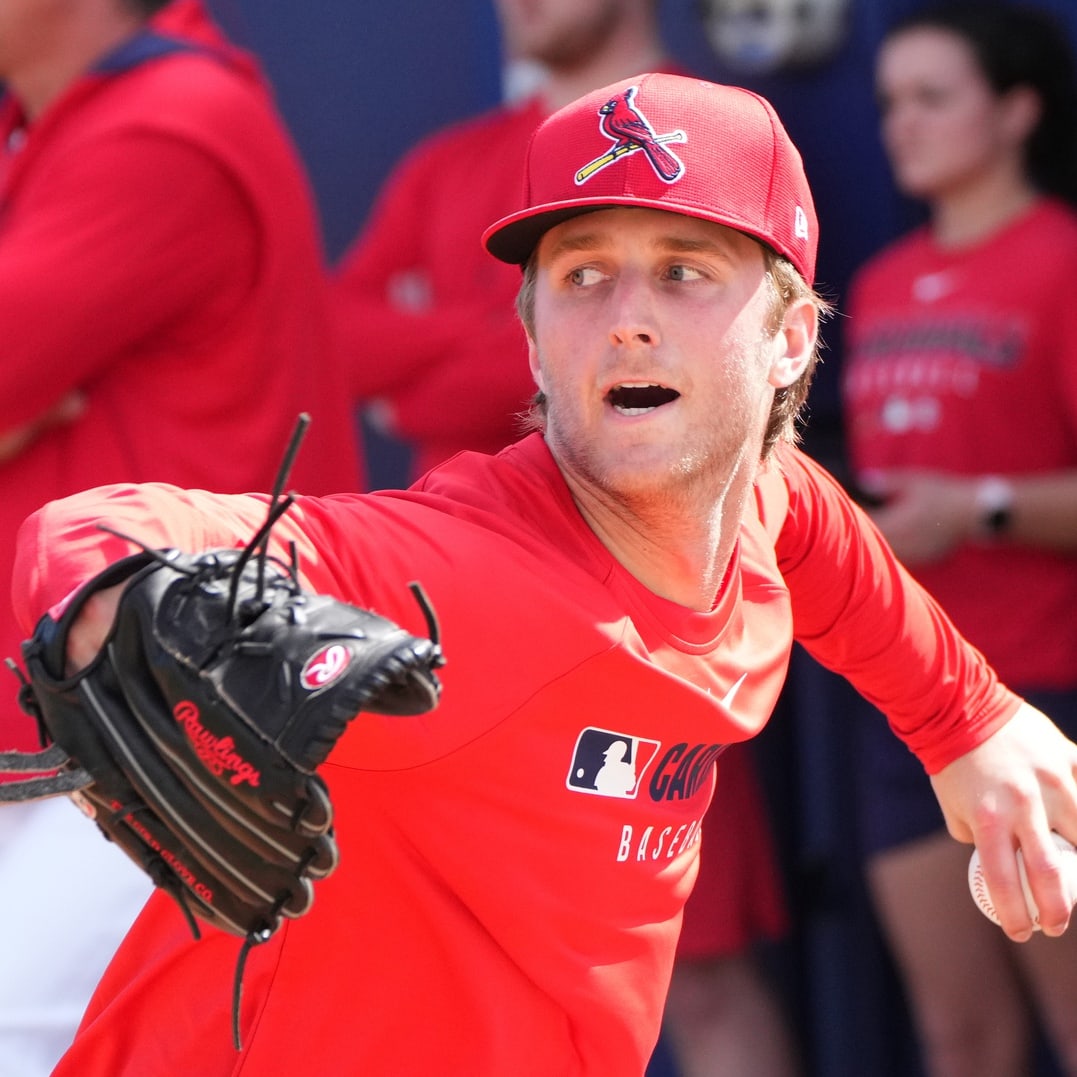
Roupp has taken steps forward in nearly every aspect of his skills profile so far in 2026. There are some that are quite apparent, including a six-point increase in his strikeout rate. That has been aided by increased velocity on his sinker and the continued excellence of his slider. Roupp has also continued his successful transition from a swing man to true rotation arm. Even with decent surface results in 2025, using Roupp in fantasy lineups was a difficult task because his workload was unpredictable. Of his 22 starts, he completed at least six innings on eight occasions. In his 10 starts in 2026, he's already completed at least six innings five times.
Less obvious has been Roupp's ability to limit hard contact to an extreme degree. Roupp has always been a sinker-forward pitcher, which has led to a high groundball rate. That has become even more extreme in 2026. An impressive 38.3 percent of the contact against him has been "topped" — almost always resulting in a weak ground ball — six percentage points higher than the
So far this season, this column has focused on using themes to narrow down the player pool to be considered for inclusion. I began the research for this week's article by sorting pitchers by the biggest change in their wOBA from 2025 to this season, and it is still loosely based on that parameter. However, it also incorporates some recent news, particularly in the "Risers" category. Let's jump in.
Risers
Roupp has taken steps forward in nearly every aspect of his skills profile so far in 2026. There are some that are quite apparent, including a six-point increase in his strikeout rate. That has been aided by increased velocity on his sinker and the continued excellence of his slider. Roupp has also continued his successful transition from a swing man to true rotation arm. Even with decent surface results in 2025, using Roupp in fantasy lineups was a difficult task because his workload was unpredictable. Of his 22 starts, he completed at least six innings on eight occasions. In his 10 starts in 2026, he's already completed at least six innings five times.
Less obvious has been Roupp's ability to limit hard contact to an extreme degree. Roupp has always been a sinker-forward pitcher, which has led to a high groundball rate. That has become even more extreme in 2026. An impressive 38.3 percent of the contact against him has been "topped" — almost always resulting in a weak ground ball — six percentage points higher than the league average. Furthermore, he's allowed only a 1.7 percent barrel rate, a 26.7 percent hard-hit rate and a .272 xSLG, with the latter two marks ranking in the 93rd and 95h percentile among qualified pitchers, respectively.
Relying solely on soft contact can be dangerous, but Roupp has improved in all nearly every area of his game. He's pitching deeper into starts, striking out more batters, and generating extremely weak contact. Not all of those things may be sustainable, but Roupp seems to have raised his baseline skill level enough to be an intriguing fantasy starter in most formats even if regression occurs.

Meyer's improvement is pretty straightforward. He has consistently relied upon his breaking pitches to have success, with his slider serving as his primary pitch. His slider remains his most thrown pitch as well as his most effective — by most measures — but Meyer has also increased his sweeper usage so far this season. In 2025, he threw his sweeper only 11.5 percent of the time. So far in 2026, he's thrown it 24.6 percent of the time, the second-highest mark among his five-pitch mix.
Importantly, the pitch has also been effective, giving Meyer a pitch to get whiffs to complement his slider. The results have followed as expected. His swinging strike rate is at a career-high 14.3 percent, up from his career average of 12.1 percent, while Meyer's overall strikeout rate has jumped to 26.7 percent. This would be notable for all pitchers, but it's particularly so for Meyer due to other flaws in his profile. In particular, he's maintained bloated walk and home run rates to this point in his career, and a higher strikeout rate could help neutralize those things if they pop up again.

We'll close out with a few small-sample successes, with Miller being a pretty obvious choice. He's made two starts since returning from elbow and oblique injuries, and he has shown a surprising increase in velocity. All of his pitches have increased a few miles per hour, with his fastball averaging 97.1 mph — almost exactly two ticks higher than his career-best mark. So far, that hasn't translated to an increased strikeout rate, but it does indicate he's feeling healthy.
There was also some question about Miller's role due to the emergence of Emerson Hancock, but he's made two traditional starts and worked 5.1 and 5.2 innings. Two questions remain. The first is Miller's general health. He was diagnosed with a bone spur in his pitching elbow late last season and did not have surgery to resolve it. Miller may be able to pitch through it for a time, but that's not likely to last forever. The second is whether his increased velocity can be maintained. That's harder to project, but Miller did add 12 pounds of muscle this offseason, perhaps helping him add and ultimately hold that velocity.
 /
/Matthews and Brown have both had their issues as starters in past seasons, but both have looked good in a handful of starts in 2026. Matthews has particularly struggled to get outs against left-handed hitters, and he appears to have shifted his arsenal in an effort to curtail that issue. Specifically, he has increased his changeup usage to 23 percent when facing opposite-handed hitters. In a very small sample, he's surrendered only a .119 wOBA against lefties while generating a 42.9 percent strikeout rate. It's obvious those numbers won't stick, but it's positive that Matthews has introduced a new approach that is working for the time being.
A lot of improvement across the league this season seems to be spurred by either introducing or increasing sinker usage, and that pitch has been a key addition to Brown's arsenal as both a reliever and starter. His two-pitch mixed seemed to eliminate the possibility of him becoming a true rotation arm in past seasons, but he's posted an excellent 16:4 K:BB in 13 innings as a starter and completed 5.0 innings for the first time on Tuesday night. With Cade Horton out for the year and Justin Steele slowed in his return, Brown looks to have a clear path to holding a rotation spot for the foreseeable future.
Fallers
In some ways, Munoz's struggles early this season are irrelevant because he isn't at risk of losing his closer role and has already banked eight saves. However, given his preseason ADP and his placement among the elite closers in the league, any blemish in his profile becomes notable. As is often the case for relievers, his ERA is currently bloated by one particularly poor outing, his five earned run appearance on April 15. The problems run deeper however, as he's given up at least an earned run in four of his 20 appearances. For reference, in 2025, he gave up an earned run in eight of 64 appearances.
The cause of these issues is the long ball. Munoz has served up three home runs across 18.2 innings, a mark that already surpasses the number of homers he allowed in 2025 (in 62.1 innings) and 2023 (in 49.0 innings). Munoz offered his own explanation for his relative struggles after his April 15 appearance, citing the grip on his slider being off. Since then, he's allowed three earned runs across 12 innings with a 22:2 K:BB, so perhaps the issues have already been resolved and this was simply a slow start to the season. The level of concern a fantasy manager may have is likely to come down to how they analyze Munoz. His season-long numbers paint at least a relatively concentering profile, but his short-term results suggest that the underlying cause of those issues have been resolved.
Perez hasn't located his pitches effectively early on this season, and that's manifested itself in a few important ways. The most obvious is his elevated walk rate of 12.2 percent and an inflated 1.41 WHIP. However, the subtle problems his lack of command has caused may be even more troubling. A quick glance at his heat maps shows that his three most-used pitches — his fastball, slider and sweeper — each have lived in the middle of the zone this season. The barrel rate against him is 11.9 percent, and he is inducing soft contact at a lower than league average across the board. Put another way, he's allowed 10 home runs across 52.1 innings early this season, after serving up 12 across 95.1 frames in 2025.
The tricky part about assessing Perez's outlook is that it's unclear why his command has been so far off. He attributed some of his struggles to hitters being able to foul off pitches, while another theory is that his mechanics are off due to his lanky build. Perez has the talent to turn things around, so there shouldn't be a rush to move away from him, even in redraft formats. That doesn't change the fact that the hoped-for breakout in 2026 also doesn't look to be imminent.
Ray has walked a very thin line between fantasy usefulness and disaster throughout his career. So far, he's been more on the side of the former, maintaining a 3.04 ERA and 1.17 WHIP in his 50.1 innings of work. However, his xERA (4.58) and SIERA (4.21) suggest trouble could be on the way, and that's also present in his underlying skills and batted ball profile.
One particular red flag is Ray's flyball rate. He has allowed more flyballs than groundballs for long stretches of his career, but Ray's flyball to groundball rate has been more extreme than usual this season, with a 53.0 percent flyball rate and only a 27.3 percent groundball rate. His home park is beneficial, but that isn't likely to be enough to overcome the combination of his high flyball rate and 11.3 percent barrel rate. As has typically been the case, Ray's control has also been suspect (9.9 percent walk rate), creating even more of a significant risk of disastrous outings.
Given Gilbert's track record, it was easy to shake off his slow start to the season, particularly because the underlying skills were still present. Through his first five starts of the season, despite posting a 4.03 ERA, he posted a 32:5 K:BB across 29 innings. In his last five starts, including Sunday's outing against the Padres, Gilbert has only 25 strikeouts across 27.2 innings and his ERA has inflated to 4.88. Drilling down a bit further, he has more than five strikeouts in only one of those appearances.
The cause looks to be fairly straightforward. Gilbert's velocity is down across the board, with the exception of his fastball, and the result is that he's given up both more contact and a higher quality of contact. The pitch-level analysis is a bit more complicated, but the bottom line is that Gilbert's fastball and slider — his two most commonly used pitches — have surrendered a .646 and .604 slugging percentage, respectively.
There's a good chance that Gilbert will figure things out if you take his past skills and results into account, but his start to the year has been concerning.