

Last week, we covered the fantasy all-stars based on RotoWire's Earned Auction Value tool. At the helpful suggestion of a subscriber, we'll turn to the negative this week by examining some of the biggest busts. This isn't quite as straightforward as picking out the best players, because the bottom earners are often players who aren't fantasy relevant and likely aren't even roster considerations in the deepest of leagues. With that in mind, I set up some parameters for the selection. The player had to be selected inside (roughly) the top 200 ADP in Main Event Leagues, and the reason for their low earnings cannot be primarily due to injury. Like last week, we'll break from the traditional risers and fallers and instead break the players into groups with small write-ups for each in an effort to provide analysis for most players on this list.
Freddy Peralta, Edward Cabrera and Christian Yelich have recently appeared in an edition of the Barometer, so they will not be covered again in this week's edition.
| AL Hitters | Team | POS | Earned Value | ADP | BA | HR | RBI | R | SB |
| Cal Raleigh | SEA | C | ($10) | 19 | 0.169 | 9 | 29 | 23 | 2 |
| Vinnie Pasquantino | KC | 1B | ($5) | 85 | 0.222 | 6 | 32 | 28 | 3 |
| Jose Altuve | HOU | 2B | $0 | 112 | 0.235 | 11 | 27 | 45 | 2 |
| Jacob Wilson | ATH | SS | ($5) | 175 | 0.281 | 4 | 26 | 24 | 2 |
| Maikel Garcia | KC | 3B | ($2) | 70 | 0.261 | 3 | 30 | 32 | 5 |
| Steven Kwan | CLE | OF | ($9) | 162 | 0.225 | 1 | 16 | 37 |
Last week, we covered the fantasy all-stars based on RotoWire's Earned Auction Value tool. At the helpful suggestion of a subscriber, we'll turn to the negative this week by examining some of the biggest busts. This isn't quite as straightforward as picking out the best players, because the bottom earners are often players who aren't fantasy relevant and likely aren't even roster considerations in the deepest of leagues. With that in mind, I set up some parameters for the selection. The player had to be selected inside (roughly) the top 200 ADP in Main Event Leagues, and the reason for their low earnings cannot be primarily due to injury. Like last week, we'll break from the traditional risers and fallers and instead break the players into groups with small write-ups for each in an effort to provide analysis for most players on this list.
Freddy Peralta, Edward Cabrera and Christian Yelich have recently appeared in an edition of the Barometer, so they will not be covered again in this week's edition.
| AL Hitters | Team | POS | Earned Value | ADP | BA | HR | RBI | R | SB |
| Cal Raleigh | SEA | C | ($10) | 19 | 0.169 | 9 | 29 | 23 | 2 |
| Vinnie Pasquantino | KC | 1B | ($5) | 85 | 0.222 | 6 | 32 | 28 | 3 |
| Jose Altuve | HOU | 2B | $0 | 112 | 0.235 | 11 | 27 | 45 | 2 |
| Jacob Wilson | ATH | SS | ($5) | 175 | 0.281 | 4 | 26 | 24 | 2 |
| Maikel Garcia | KC | 3B | ($2) | 70 | 0.261 | 3 | 30 | 32 | 5 |
| Steven Kwan | CLE | OF | ($9) | 162 | 0.225 | 1 | 16 | 37 | 1 |
| Lawrence Butler | ATH | OF | ($8) | 151 | 0.196 | 5 | 22 | 31 | 6 |
| George Springer | TOR | OF | ($4) | 96 | 0.218 | 9 | 22 | 31 | 6 |
| Salvador Perez | KC | DH/C | ($4) | 90 | 0.209 | 11 | 37 | 31 | 0 |
| AL Pitchers | Team | POS | Earned Value | ADP | W | K | ERA | WHIP | SV |
| MacKenzie Gore | TEX | SP | ($3) | 186 | 5 | 115 | 4.63 | 1.29 | 0 |
| Tatsuya Imai | HOU | SP | ($13) | 173 | 5 | 63 | 6.06 | 1.5 | 0 |
| Luis Castillo | SEA | SP | ($12) | 170 | 3 | 81 | 4.93 | 1.369 | 0 |
| Jack Flaherty | DET | SP | ($8) | 221 | 3 | 98 | 4.48 | 1.44 | 0 |
| Shane Baz | BAL | SP | ($6) | 199 | 4 | 99 | 4.19 | 1.39 | 0 |
| Framber Valdez | DET | SP | ($3) | 90 | 5 | 87 | 4.1 | 1.32 | 0 |
| Kenley Jansen | DET | RP | ($3) | 146 | 1 | 25 | 4.56 | 1.23 | 11 |
| Andres Munoz | SEA | RP | $8 | 46 | 3 | 51 | 4.19 | 1.28 | 16 |
| NL Hitters | Team | POS | Earned Value | ADP | BA | HR | RBI | R | SB |
| Agustin Ramirez | MIA | C | ($14) | 82 | 0.23 | 2 | 14 | 14 | 3 |
| Michael Busch | CHC | 1B | $6 | 106 | 0.239 | 11 | 49 | 40 | 2 |
| Matt McLain | CIN | 2B | ($3) | 126 | 0.19 | 8 | 25 | 32 | 11 |
| Ezequiel Tovar | COL | SS | ($5) | 197 | 0.2 | 8 | 32 | 32 | 5 |
| Eugenio Suarez | CIN | 3B | ($5) | 100 | 0.208 | 11 | 35 | 23 | 0 |
| Sal Frelick | MIL | OF | ($2) | 204 | 0.236 | 4 | 34 | 33 | 6 |
| Teoscar Hernandez | LAD | OF | $1 | 125 | 0.243 | 8 | 36 | 36 | 2 |
| Heliot Ramos | SFG | OF | ($2) | 210 | 0.275 | 8 | 28 | 31 | 0 |
| Christian Yelich | MIL | DH/OF | $1 | 123 | 0.243 | 6 | 31 | 42 | 6 |
| NL Pitchers | Team | POS | Earned Value | ADP | W | K | ERA | WHIP | SV |
| Aaron Nola | PHI | SP | ($16) | 212 | 3 | 102 | 5.75 | 1.43 | 0 |
| Bubba Chandler | PIT | SP | ($13) | 163 | 3 | 85 | 4.77 | 1.45 | 0 |
| Edward Cabrera | CHI | SP | ($11) | 193 | 5 | 65 | 5.1 | 1.4 | 0 |
| Freddy Peralta | NYM | SP | ($8) | 63 | 5 | 104 | 4.66 | 1.44 | 0 |
| Andrew Abbott | CIN | SP | ($7) | 225 | 5 | 84 | 4.11 | 1.42 | 0 |
| Emmet Sheehan | LAD | SP | ($5) | 134 | 4 | 93 | 4.81 | 1.24 | 0 |
| Dennis Santana | PIT | RP | ($15) | 169 | 2 | 37 | 5.8 | 1.46 | 2 |
| Devin Williams | NYM | RP | $1 | 72 | 3 | 45 | 4.68 | 1.65 | 14 |
Injury Has Played a Role, but There are Bigger Problems

It was unrealistic to expect a full repeat of 2025 from Raleigh, but a second-round pick earning $10 more than halfway through the season is a disaster. Injury has undoubtedly had something to do with that number, as Raleigh missed a month of action between May and June due to an oblique injury. The problem is that he hasn't picked up his performance since his return, as he's hit just .172 with a 32.7 K percentage to go along with two home runs, 11 RBI and seven runs scored in 26 games since being activated. All of Raleigh's quality of contact metrics have also fallen to at or near career lows, and his rolling xwOBA for his last 100 plate appearances remains well below league average. Given all that, things don't look likely to get better, with the only reason for optimism being Raleigh's track record.

Pasquantino is a bit trickier to analyze. Like Raleigh, most of his quality of contact metrics have fallen significantly. The most noteworthy is his bat speed, as he has a fast-swing rate of just 8.9 percent and an average swing speed of 70.2 mph. Both are well below his career norms. That's important because Pasquantino recently returned from a broken hamate, so perhaps the injury was bothering him for all or most of the season. He's played in only four games since being activated from the injured list, so his outlook is a bit more uncertain.
Garcia is the only player currently sidelined on this list, but he had 283 plate appearances prior to his injury, and he hadn't met preseason expectations in that sample. Even if his power breakout of 2025 wasn't to be believed, he has always been a consistent source of stolen bases. So far this season, he has gone only 5-for-8 on the basepaths, and his power has mostly shifted back to pre-2025 form. His hand injury further muddies his post-All-Star break outlook, but this was already shaping up to be a disappointing year for Garcia.
Check out where all the players on your fantasy baseball team fit into RotoWire's MLB Cheat Sheet!
It May Be Over

Suarez was supposed to be landing in the ideal spot by signing back with Cincinnati this offseason, but things haven't gone according to plan. He is still able to get to some power (.190 ISO), but his strikeout rate has spiked and his quality of contact metrics have fallen. Suarez has bounced back after slow starts in each of the last few seasons, but that slow start has turned into half of the year, and there isn't anything in his skills profile to suggest things will drastically improve.

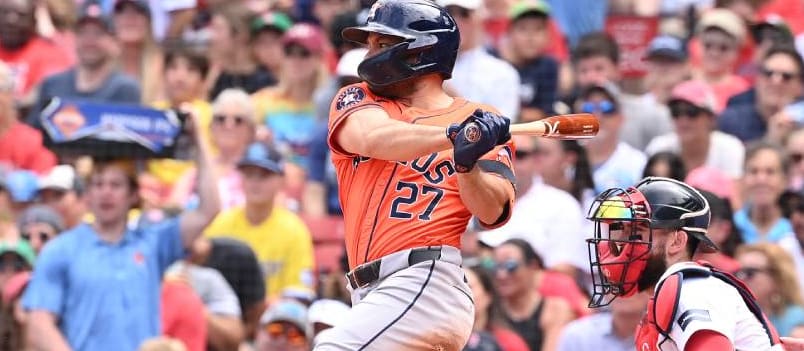
Altuve clearly hasn't operated at his prime level for the past few seasons, but he was still able to remake and maximize what was remaining of his skill set to retain fantasy value. Mostly, he was able to get on-base at an above-average, and at times elite, level and rack up a ton of runs scored as a fixture in the top third of the Astros' lineup. This season, his strikeout rate has ballooned to above 20 percent for the first time, hurting his ability to get on base while also pushing him to the bottom half of the order when the entire Houston lineup is healthy. Perhaps that will help him trade in runs for RBI, but he's primarily a two-category contributor (at best) at this point.

There really isn't much analysis needed for Nola. His xERA and SIERA continue to say he's getting unlucky, but he keeps giving up home runs at an alarming rate. After serving up another three home runs Thursday night, there doesn't seem to be an end in sight.

Springer turned around the trajectory of his career last season, when he turned around a two-year slide. His quality of contact metrics have fallen back to the levels of his 2023 and 2024 seasons in many regards, but he's also maintained a strong strikeout rate under 20.0 percent and optimizes his fly balls with a high pull-air rate.
The biggest problem from a fantasy perspective is that Springer isn't running anymore, and his sprint speed has fallen by 25 percentile points from last season. It wouldn't be a shock to see Springer put up some power numbers in the second half, but there are too many warning signs to be overly optimistic.

Hernandez's counting stats and average are in line with expectations (at least on a per plate-appearance basis), so this one is all about power. Hernandez's .142 ISO is the lowest of his career, and both his max exit velocity and barrel percentage are at their lowest rates of his career in any significant sample. Unlike Springer, Hernandez doesn't optimize his power output with his fast swing rate or pulled fly balls. It looks likely that he'll be particularly reliant on team context to bounce back in the second half.

Kwan doesn't fit the mold of most of the rest of these hitters because he's only 28 years old. However, he had a very narrow path to fantasy value that was reliant on an elite contact rate, something he still has, and an ability to make solid contact. The latter has completely disappeared this season, as his already weak hard contact and barrel rates have sunk further this season. Kwan has reached the point where even his high rate of contact can't overcome his lack of any hard contact.

The 2025 season was disappointing for Butler, but 2026 has been a complete disaster. Power was always projected to be his calling card, but he's struggled to even so much as lift the ball this season (25.1 FB percentage). That doesn't get into other issues in his profile, which also include a lack of pulled fly balls (8.7 percent).
Butler also announced himself as potentially the next elite power-speed contributor when he stole 18 bases in 2024 and 22 in 2025, but his sprint speed has plummeted, with his stolen base attempts following suit. His hopes for the 2026 season seem minimal at this point, but there is still reason to have belief in Butler in the long term.
Butler had a few different knee injuries to close the 2025 season and was eased into spring training. His batted ball profile, lack of stolen bases and loss of defensive range all suggest he's still playing through injury. Of course, that argument can cut both ways. If Butler can get healthy, there is reason to believe he'll return to the previous heights he's shown. On the other hand, one of the issues was termed chronic, so it's not clear he'll remain at full strength for long periods of the remainder of his career.
Hitters Who Will Bounce Back

The outlook on Busch will be defined by expectation. Those who expected a repeat of 2025 will be disappointed. On the other hand, he's better than he looked to start the season. Since May 1, he has maintained a .195 ISO and a .377 wOBA. The latter is very impressive but doesn't translate particularly well to category leagues. Busch's barrel rate also sits at 10.8 percent in that time, an above-average mark, but nowhere near his 17.1 percent barrel rate from 2025.
Busch's projections for the second half range from anywhere between nine and 11 home runs, and I'd be comfortable landing on the high end of that projection.
The fantasy community has been waiting on Perez's decline for the last handful of years, primarily because of the very heavy workload he's taken on as a catcher throughout his career. There are mixed signals in his profile. In what has become a theme of this article, his quality of contact has suffered this season. However, his bat speed – a key signal of potential aging and loss of quality of contact – has remained league average. Similarly, he's been able pull his fly balls at nearly his typical rate and well above the league average.
Projection systems are also still giving him the benefit of the doubt, with around 20 home runs and 70 RBI this season being his most common outlook for the rest of the year. Overall, Perez is no longer a fantasy star, but he should be serviceable in two-catcher leagues and a potential streamer as needed in shallower formats.
Closers Who will Bounce Back

Jansen is an easy player to make assumptions about given his age and the recent trajectory of his career, but there are actually quite a few positives to his profile. He has earned 11 saves to lead the Tigers, despite both Will Vest and Keider Montero mixing in at times. Jansen also seems to have some additional job security with Vest sidelined until at least early August. From a skills perspective, Jansen has also retained his velocity and even boosted his strikeout rate. That's a decent starting point in a mid-round closer.
The negatives are that Jansen has developed a home run and walk problem. The latter looks to be a real issue, but the former looks to be bad luck. Jansen has been shockingly good at limiting hard contact, as he would rank very highly in xBA against, hard-hit percentage and average exit velocity. Based on his skills, Jansen should be in for a good second half.
The danger is that the Tigers tear things down and opt to trade Jansen to a situation where he doesn't close. Despite the disappointing season, Detroit sits only 4.5 games out of a wild-card spot through Sunday, so these next few weeks will be key for his status on the team.

Similarly to Jansen, for as bad as things have been for Williams, he still has a lot of factors in his favor. He still has strong strikeout stuff with a 29.6 K percentage, and he has 14 saves with no realistic competition behind him in the Mets' bullpen.
The start to July has been rocky for Williams, but he also showed signs of returning to his peak form in June, delivering a 22.1 K-BB percentage and 0.96 ERA. Williams may not deliver on his ADP, but a 25- to 30-save season with improved ratios down the stretch isn't a disaster.
Munoz has shown signs of turning things around since his shaky start, posting a 1.15 WHIP in June and having yet to surrender a run in July. His peripheral skills have moved the opposite direction, as he had a 19.4 K-BB percentage in June, a solid mark, but one still well below Munoz's career norms.
Munoz deserves the benefit of the doubt based on his track record. Despite his inconsistency, he also hasn't blown a save since June 7, a span of 12 appearances. Like Williams, you may not get exactly what you paid for during draft season, but there doesn't look to be a reason to panic.
It's Been Frustrating, but Have Patience

Imai and Chandler are appropriate to group together because they were selected in the same range of ADP with very little to sample in the majors. Bad control has been the primary downfall of each, with Imai also suffering from a home run problem while also generating more strikeouts.
Imai looks to be the better bet to get more consistent due to his ability to get strikeouts, which is also reflected by his 4.39 SIERA. There is still reason to believe in Chandler, however, as he struggled with his control for most of 2025 before sharply turning things around and earning a promotion.
I'd try to start each of these pitchers sparingly in the short term, but they could turn into key fantasy assets down the stretch.
Sheehan has a quality of contact problem, as he has a lot of the same metrics we'd look for in prolific power hitters. Most specifically, opposing hitters have a pulled fly ball rate of 27.4 percent. That, combined with a 9.7 percent barrel rate, go a long way to explaining Sheehan's 1.64 HR/9.
There are two positives. The first is that Sheehan has gained one mile per hour on his fastball since the concern over his velocity was a major storyline early in the season. He also has a very strong 19.1 K-BB percentage. If he can solve some of the problems when hitters do make contact, he'll become a very strong fantasy option.

Gore is known for his inconsistency, so the ups and downs of his season shouldn't be a surprise at this point. His ERA is the primary driver of poor earned auction value, but most of his skills are in line with or slightly better than last season. Most notable is Gore's WHIP, which sits below 1.30 for the first time in his career.
Flaherty has been excellent for the last two months, and has had K-BB percentage marks above 22 in both May and June. Since the start of May, Flaherty has a 4.11 ERA and 1.26 WHIP. Since the start of June, those numbers have been 2.12 and 1.04. His career has largely been marked by wild swings, so things could turn badly as quickly as they have turned good, but he's worth adding in pretty much all formats at this point.