

SAN DIEGO - Mick Mulvaney has occupied a lot of rooms most people never get near — the House floor, the Consumer Financial Protection Bureau's corner office, the chief of staff's spot a few feet from Donald Trump's desk in the Oval Office. These days he's found a new spot: at the head of the "Gambling Is Not Investing Coalition," a group built specifically to stop prediction markets from becoming, in his view, "unregulated backdoor into sports betting nationwide."
Mulvaney's case starts with a simple bit of framing: Strip away the "contract" language and the Commodity Futures Trading Commission's regulatory branding, he argues, and what's left is indistinguishable from a wager — if San Diego wins tonight, you pay me $20, and if Arizona wins, I pay you $30. That, he says, is a bet: not an investment, not price discovery, just a bet wearing a different suit.
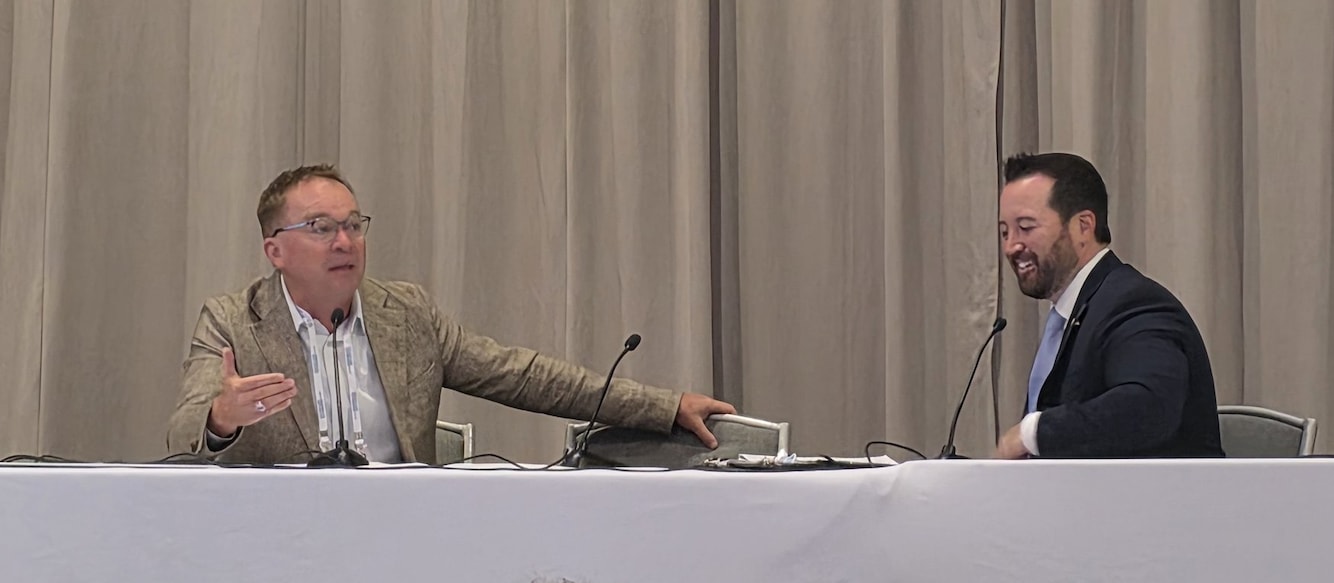
Mulvaney spoke to the National Council of Legislators from Gaming States summer meeting. Day One included a full-frontal assault on prediction markets, focused primarily but not exclusively on their foray into sports betting.
NCLGS President and West Virginia legislator Shawn Fluharty summed up the dilemma thusly: "How does the CFTC go from crops to props?"
Mulvaney is careful to note he isn't moralizing about gambling itself — he's played professional poker and helped roll back South Carolina laws that once criminalized home poker games — his objection is narrower and more structural: call the thing what it is, and regulate it accordingly.
Gambling Traditionally A State-By-State Issue
That distinction matters because of who has historically done the regulating. Mulvaney's central argument is that gambling has always been the states' turf, both by tradition and constitutional design, which is why Nevada held a monopoly on legal casino betting for decades. He casts platforms like Kalshi as trying to route around that arrangement entirely — asking a federal commodities regulator, rather than 50 state governments, for permission to offer sports-adjacent betting everywhere at once. In his telling, it's less an innovation story than a jurisdictional end-run, dressed up in fintech language.
"There's a couple of things that traditionally, both by practice and by constitution, that the states have had exclusive jurisdiction over alcohol and gambling, which is why forever and ever you could only gamble in Las Vegas," he told RotoWire in an interview after his presenation.
"Kalshi is the mob going to Washington DC in 1952 and saying, 'We'd really like to have gambling in all 50 states. We know that only Vegas lets us do it now, but we think we should be able to do it. Could you let the CFTC please legalize casino gambling every place so we can do it everywhere?'" - Mick Mulvaney
Mulvaney described how prediction market language was quietly inserted into the North Carolina state budget. The state placed a 6% tax rate on net revenues from prediction market operators against a 23% tax on the money made by regulated sportsbooks. The potential lost gaming revenue could "blow a $100 million hole" the state's budget.
States need to know that "there's a huge effort with a huge amount of money to do exactly what they just did in North Carolina in every single one of the states. My understanding was the prediction market language that they got a sympathetic lawmaker or group of lawmakers to slip this into the budget," Mulvaney told RotoWire. "But this was a pure lobbying effort done on fairly short notice without the ordinary committee process, review process, or vote process."
His warning to other statehouses: the same playbook is coming, state by state, backed by serious money.
Speaking of North Carolina, Mulvaney offered this simple question concerning prediction markets:
"What can you do on a prediction market in the sporting realm that isn't already being served by legal gambling sites I don't know the answer to that question," he said. "Go back to Kalshi. In North Carolina where sports betting is legal and they have an NHL team, why can't I do that on FanDuel?"
CFTC Not Ready For Prime Time With Sports Betting
His skepticism of the CFTC as a consumer-protection body runs deep, colored by his own tenure running the CFPB. Asking the commodities regulator to police sports-related contracts is "like putting a baseball umpire in charge of officiating a soccer match."
He sees the agency's posture as one that follows the path set by President Trump: "move-fast-and-figure-out-the-fallout-later." The CFTC has appetite for weighing the downstream effects on state budgets, consumer protections, or problem-gambling safeguards that regulated sportsbooks already have to build in.
Congress, in Mulvaney's assessment, isn't going to ride in and settle any of this. He describes it as too gridlocked to clarify statutory intent or rein in the CFTC's reach, more focused on avoiding new self-inflicted messes than resolving a complicated regulatory turf war. That leaves two arenas where he thinks the fight actually gets decided: rulemaking and the courts.
He's urging state lawmakers and regulators to flood CFTC proceedings with substantive comments — not just to influence the rule itself, but to build a record that plaintiffs can point to later. He expects the endgame to run through litigation, with state attorneys general and amicus briefs doing the heavy lifting, and says he's ready to help file them given his own history arguing before the Supreme Court.
Strategically, Mulvaney is blunt that the general public isn't the audience that matters here — most people have never heard of a prediction market. The real targets are state legislatures, tribal gaming interests, youth-advocacy groups, and congressional staff, the people with the bandwidth and mandate to actually engage with a niche regulatory fight. He frames the broader stakes in federalism terms: if gambling policy — one of the oldest, clearest examples of state authority — can be preempted through a federal commodities loophole, it chips away at the argument for robust state government generally.
Best Way To Get Through To Trump . . . Via TV
There's also a media angle Mulvaney knows intimately. Asked how to get an argument in front of Trump himself, he described the former president as one of the heaviest news consumers he's ever encountered — four print papers cover to cover daily (the Times, the Post, the New York Post, and the Journal), plus a "quad box" television setup toggling between Fox, Fox Business, CNN and MSNBC, running constantly. If Mulvaney's coalition wants to plant an idea in the Oval Office, he suggested, that's the actual delivery route — not press releases, but those specific print and cable outlets Trump reads and watches obsessively.
Taken together, it's less a moral crusade than a jurisdictional one: Mulvaney isn't arguing that people shouldn't bet on sports. He's arguing that if they are betting on sports, the states — not a commodities regulator built for grain futures — should be the ones deciding how, how much, and under what rules.