2026 World Cup Group I Preview: France, Senegal, Iraq and Norway Lineups, Odds, Predictions and Tactics
Group I jumps off the page as one of the tournament's must-watch sections. France come in as one of the clear favorites to win it all, loaded with depth and coming off a pair of statement wins in March. Senegal arrive as reigning AFCON champions with the talent to go deep, but also carrying the fallout from one of the most controversial moments African football has seen in years. Iraq, who punched their ticket with a 2-1 win over Bolivia in Mexico in early April, return for the first time since 1986, bringing with them the emotion of a nation that waited four decades for this moment. And Norway are back on the World Cup stage for the first time in 28 years, powered by the most lethal striker in the game and a qualifying run that turned heads across Europe.
This is the full tactical guide to Group I, including playing style, attacking and defensive structure, key adjustments, projected starting lineups, set-piece takers and the latest odds for France, Senegal, Iraq and Norway.
See how France's group compares across the tournament in our 2026 World Cup group previews.
World Cup Group I Schedule
FRANCE | 2026 World Cup Tactical Analysis and Predicted Lineup
How France Will Play at the 2026 World Cup
Coach Didier Deschamps has already confirmed this will be his final tournament in charge, which adds real weight to this run. He is not coaching under pressure, he is chasing legacy, looking to add a second World Cup as manager to the one he won in 2018. On paper, this is the deepest squad in the field, and the March window on American soil made that clear.
France beat Brazil 2-1 at Gillette Stadium on March 26, the same venue where they will face Norway on June 26. Kylian Mbappe opened the scoring after Aurelien Tchouameni won the ball high and Ousmane Dembele slipped a perfect through ball, before Hugo Ekitike doubled the lead in the second half. Even down a man, France held on. Three days later, a fully rotated lineup handled Colombia 3-1, with Desire Doue scoring twice and Marcus Thuram adding a header while Mbappe came on late. The takeaway was simple: France are not just deep, they are stacked.
The base shape is a 4-2-3-1 with Tchouameni and Adrien Rabiot anchoring midfield, Dembele and Michael Olise rotating between the right wing and central roles, and Mbappe operating as a free striker drifting left. The only real concern is Mbappe's knee, which sidelined him several weeks at club level, but he looked sharp again in March and is closing in on Olivier Giroud's all-time scoring record.
France's Attacking Style at the 2026 World Cup
France attack with elite profiles everywhere and the freedom to rotate constantly in the final third.
Key attacking themes include:
Kylian Mbappe as the centerpiece, free to roam, isolate defenders and explode into space. At full speed, nobody in this group can deal with him.
Ousmane Dembele bringing directness and end product from the right after his Champions League-winning season with PSG, where he established himself as one of the best wide players in the world.
Michael Olise adding creativity, pace and shooting from advanced areas, capable of taking over matches when he finds rhythm.
Hugo Ekitike was emerging as a real option up front after a strong season, though that final attacking spot will now remain open due to the serious Achilles injury he suffered against Paris Saint-Germain in the Champions League quarterfinal second leg which rules him out for the competition. Desire Doue, Rayan Cherki and Bradley Barcola will be all pushing for the starting role.
France can hurt teams in waves. The starting front line is elite, and the second unit can still control games against strong opposition.
Several France players are among the frontrunners in the 2026 World Cup Golden Boot odds.
France's Defensive Setup
The only real questions sit at center-back. William Saliba, Dayot Upamecano and Ibrahima Konate are all competing for two spots, with Saliba missing March through injury and Maxence Lacroix stepping in well. Jules Kounde should start at right-back with Malo Gusto behind him, while Theo Hernandez provides width on the left with Lucas Digne as depth.
Mike Maignan is locked in as the number one between the posts. In midfield, Tchouameni and Rabiot lead the race, with N'Golo Kante and Eduardo Camavinga as strong alternatives. The vulnerability comes in transition when the full-backs push high, but Group I opponents are unlikely to punish that consistently.
Key Tactical Adjustments France Need to Make
Manage Mbappe's workload carefully across three group matches, given his recent injury history, to ensure he arrives at the knockout rounds at maximum intensity.
Settle the central defense partnership before the squad is finalized and avoid further red cards that unsettle the back four.
Find the right balance between the first-choice XI and the rotation options, as burning players early against weaker group opponents is a real risk given the quality available.
France 2026 World Cup Predicted Lineup
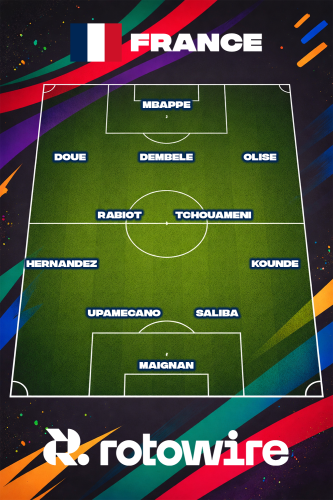
Tchouameni, Rabiot; Olise, Dembele, Doue; Mbappe.
For more updates, see the latest projected World Cup lineups on RotoWire.
France Set Piece Takers for the 2026 World Cup
Corners: Michael Olise, Ousmane Dembele, Rayan Cherki
Direct free kicks: Michael Olise, Kylian Mbappe, Ousmane Dembele
Penalties: Kylian Mbappe
Why This France Lineup Works
This is as close to a settled XI as coach Deschamps has shown across the March window, with the defensive structure of Tchouameni and Rabiot in the double pivot giving the wide attackers and Mbappe the freedom to press high and create in the spaces that France's press generates. Maignan is authoritative in goal, the full-backs provide width and delivery, and the attacking quality is the best in Group I by a considerable distance. France win this group and expect a deep run in the knockout phase.
SENEGAL | 2026 World Cup Tactical Analysis and Predicted Lineup
How Senegal Will Play at the 2026 World Cup
The AFCON 2025 story is impossible to separate from how Senegal arrive at this World Cup. They beat Morocco 1-0 in extra time in the final in Rabat in January, but the match was overshadowed by coach Pape Thiaw ordering his players off the pitch in protest after a late penalty was awarded to Morocco following a VAR review that disallowed a Senegalese goal. Sadio Mane refused to leave, persuaded teammates to return from the dressing room, and Edouard Mendy saved the subsequent Brahim Diaz panenka. Pape Gueye scored in extra time and Senegal celebrated until CAF stripped the title on appeal and awarded it to Morocco on the basis that Senegal's walkoff constituted a forfeit under competition rules. The case has gone to the Court of Arbitration for Sport, where it remains unresolved.
Coach Thiaw received a five-match suspension from CAF, but since the ban applies only to CAF competitions, he is fully available to coach Senegal at the World Cup. The suspension expires quietly during later qualifying windows. Senegal arrived at the Stade de France for the March friendly against Peru on March 28 carrying the AFCON trophy onto the pitch in a show of defiance. They won 2-0 with a squad that included Sadio Mane, Kalidou Koulibaly and the rest of the core group.
The tactical identity under manager Thiaw is a 4-3-3 that presses high and uses Mane's ability to drop into midfield and recycle possession as the pivot between defense and attack. Koulibaly organizes the defense with the authority of a player who has captained this generation through multiple AFCON campaigns. Senegal have one of the deepest midfields in the competition with experience from the Premier League.
Senegal's Attacking Style at the 2026 World Cup
Built around a core of experience, pace and attacking variety, Senegal enter the tournament with a well-defined offensive structure capable of hurting opponents in multiple ways.
Key attacking themes include:
Sadio Mane as captain and emotional leader, almost certainly playing in his last major tournament. His Player of the Tournament display at AFCON showed he retains the ability to control decisive moments, and his influence on the group extends far beyond his output on the pitch.
Nicolas Jackson as the central striker, with the physicality, movement and pressing intensity that made him a Premier League regular for Chelsea. He scored twice against Botswana at the AFCON and has developed into a reliable source of goals.
Iliman Ndiaye providing the creativity and directness from wide areas, with the quick feet and the ability to cut inside and shoot that makes him one of the more difficult wide players to defend in Africa.
Ismaila Sarr offering the explosive pace and direct running as another solution, with the experience of multiple major tournaments.
Senegal are at their best when Mane is pulling the strings in the pockets behind Jackson and the wide players are running at fullbacks in transition. They have the personnel to match Norway physically and the tactical discipline to make life difficult for anyone in the group.
Senegal's Defensive Setup
Koulibaly at 35 years old remains the cornerstone of the defense, with Moussa Niakhate from Lyon alongside him. Edouard Mendy in goal brings Champions League-winning experience from his Chelsea years and the AFCON final heroics against Brahim Diaz.
The defensive concern heading into the tournament is the AFCON final fallout, but coach Thiaw's handling of the trophy presentation at the Stade de France suggests the group has found a way to channel the controversy rather than be consumed by it.
Key Tactical Adjustments Senegal Need to Make
Put the AFCON controversy firmly behind them before June, the CAS outcome could arrive before the tournament starts, which in either direction will create a new cycle of noise around the squad.
Protect Mane from physical wear across three group matches, managing his minutes carefully against Iraq to ensure he arrives at the Norway and France fixtures at full capacity.
Find the right balance between defensive organization and attacking ambition against Norway, as that is the match that will realistically decide second place in the group.
Senegal 2026 World Cup Predicted Lineup

Diarra, I.Gueye, P.Gueye; Ndiaye, Jackson, Mane.
Senegal Set Piece Takers for the 2026 World Cup
Corners: Krepin Diatta, El Hadji Malick Diouf, Ismail Jakobs, Lamine Camara
Direct free kicks: Sadio Mane
Penalties: Sadio Mane, Nicolas Jackson, Ismaila Sarr
Why This Senegal Lineup Works
This is manager Thiaw's settled first-choice lineup with the players who won AFCON matches against Egypt, Mali and Morocco. Koulibaly and Niakhate anchor the defense with the experience the team needs. The midfield three of two Gueyes and Diarra provides the defensive intensity and physical presence to compete with any midfield in the group. And up front, Mane, Ndiaye and Jackson have the quality, movement and pace to trouble France, trouble Norway, and certainly overwhelm Iraq. Senegal deserve to be at this tournament and they have every reason to believe they belong in the knockout rounds.
IRAQ | 2026 World Cup Tactical Analysis and Predicted Lineup
How Iraq Will Play at the 2026 World Cup
The story of how Iraq got here is the kind that football occasionally produces and then struggles to believe it did. A Middle East conflict shut down airspace across the region. Players were stranded in Jordan, Dubai and the UAE. Embassies closed, preventing visas from being processed. Head coach Graham Arnold imposed a social media ban and focused his squad entirely on the football. They traveled to Mexico as the last team to secure a World Cup place, beat Bolivia 2-1 on April 1st with Ali Al Hamadi scoring the opener in the 10th minute and Aymen Hussein sealing it with a thunderous top-corner strike in the 53rd minute, and the entire country declared two national holidays. Streets were renamed in honor of the Lions of Mesopotamia. It is not hyperbole to say that qualifying for this World Cup is the most significant single sporting moment in Iraqi history.
Manager Arnold, who took Australia to the 2022 Round of 16, built the team on the same foundations that define his coaching career: defensive organization, collective unity and an us-against-the-world mentality. Iraq play in a compact 4-5-1 or 4-4-2 that prioritizes keeping the defensive block narrow and difficult to penetrate, then transitions quickly through Al Hamadi or Hussein when the opportunity arises.
Much of the squad plays in the Iraqi domestic league or the Gulf region, with European-based players providing the quality differential: Al Hamadi at Luton Town in the Championship, and Zidane Aamar Iqbal, the Manchester United academy product now at Utrecht, as the creative midfield threat. Iqbal's vision and passing range give Iraq something different in possession, and his availability heading into June is one of the more interesting tactical variables in the group.
Iraq's Attacking Style at the 2026 World Cup
Iraq's attacking structure for this tournament is built on a clear set of functional, high-impact principles that maximize their most dangerous personnel.
Key attacking themes include:
Ali Al Hamadi as the primary attacking reference point, with the movement, technical quality and finishing ability that has carried the team through the playoff campaign. His goal against Bolivia was as composed a World Cup qualifier as you will see.
Aymen Hussein as the physical striker option, with 90-plus caps and the aerial presence and work rate that forces defenders to commit. His thunderous strike to seal qualification against Bolivia was not a fluke.
Zidane Aamar Iqbal as the creative midfielder capable of delivering the kind of key pass that creates chances from nothing, with the quality to make things happen against a high-defensive block.
Direct counter-attacking transitions, using the pace and determination of the forwards to exploit the space behind advancing fullbacks.
Iraq's realistic ceiling is a single result that shocks the group, most likely against Norway in the opener. If they can stay organized, absorb pressure and release Al Hamadi into space on the counter, there is a scenario where the Lions of Mesopotamia produce the kind of moment that Iraq has not created on a World Cup stage since 1986.
Iraq's Defensive Setup
The defensive structure is manager Arnold's primary concern and his primary work since taking the job. Iraq kept disciplined defensive records against UAE and Saudi Arabia in qualifying, and while the squad is not dotted with elite European defenders, the combination of experience, with many players carrying 70-plus caps, and the collective organization Arnold has instilled gives the back four a resilience that is difficult to manufacture quickly.
The goalkeeper situation has changed often in recent months, but Jalal Hassan is expected to be first choice by June.
Key Tactical Adjustments Iraq Need to Make
Approach the Norway match as the one genuine opportunity to take points, defending compactly for 90 minutes without Haaland forcing an individual error.
Protect Iqbal through the group, as his technical quality is the most difficult to replace and the squad needs him sharp for all three matches.
Use the context of the occasion, the first World Cup in 40 years, as a motivational tool without letting the emotion of the moment affect tactical discipline in the early minutes of each game.
Iraq 2026 World Cup Predicted Lineup
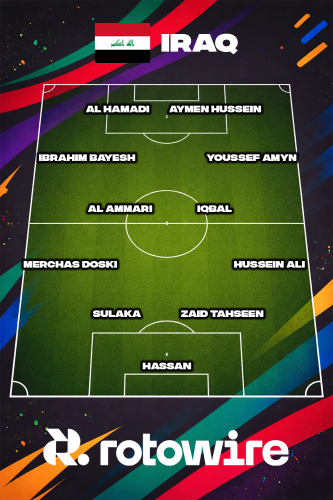
Youssef Amyn, Iqbal, Al Ammari, Ibrahim Bayesh; Aymen Hussein, Al Hamadi.
Iraq Set Piece Takers for the 2026 World Cup
Corners: Amir Al-Ammari, Ali Jasim
Direct free kicks: Amir Al-Ammari, Aymen Hussein
Penalties: Amir Al-Ammari, Aymen Hussein
Why This Iraq Lineup Works
This lineup reflects coach Arnold's established first-choice team from the playoff campaign: a disciplined defensive block, Iqbal as the creative pivot, and Al Hamadi and Hussein providing the attacking threat. It is not a lineup that will win possession or dominate games against France or Senegal. It is a lineup built to defend for 90 minutes, stay in the match and take the one or two chances that a disciplined team always creates. For a nation returning to the World Cup after 40 years, that kind of tactical clarity and collective purpose is worth more than individual quality gaps would suggest.
NORWAY | 2026 World Cup Tactical Analysis and Predicted Lineup
How Norway Will Play at the 2026 World Cup
Twenty-eight years. That is how long Norway waited to return to the World Cup, and when Erling Haaland scored his 16th qualifying goal in a 4-1 win over Italy at San Siro in November 2025, the wait ended in the most emphatic manner possible. The qualifying campaign was a statement with eight wins from eight games, 37 goals scored, five conceded. Under coach Stale Solbakken, Norway found the tactical frame to use Haaland most effectively, a 4-3-3 that can evolve into a 4-2-2-2 with Martin Odegaard as the No. 10 and the wide players stretching the defensive block that allows Haaland to receive service in dangerous positions.
The March window, however, introduced some genuine concern. Haaland was rested for the Netherlands friendly in Amsterdam, Odegaard missed it with a knee issue, and a Norway side missing both key players lost 2-1 despite opening the scoring. The broader Norwegian squad went through its worst spell since the summer, with multiple players carrying injuries or out of form at club level.
The sterner test of Norway's tournament readiness will come in the group matches themselves. What they showed in qualifying, the ruthlessness, the goals, the collective belief, is a real foundation. But the question of whether the system can sustain that level when the opposition is France, Senegal and Iraq, rather than Italy and Estonia, is what Group I will answer.
Norway's Attacking Style at the 2026 World Cup
Norway's attacking structure is built around a clear hierarchy of roles, combining elite physical presence, creative distribution and vertical pace to consistently destabilize defensive lines.
Key attacking themes include:
Erling Haaland as the primary goal threat, with the combination of size, pace and finishing ability that forces every opposing defensive coach to dedicate significant tactical preparation to limiting his supply. Even below his peak form, he is the most physically imposing striker at the tournament.
Martin Odegaard as the creative conductor, providing the vision and passing range to find Haaland in the spaces between defensive lines. His knee injury recovery ahead of June is the biggest fitness story in the group.
Antonio Nusa as the explosive wide option from RB Leipzig, with the pace and one-on-one ability to stretch defenses and create the space Haaland needs at the far post.
Alexander Sorloth as the physical backup striker or secondary forward from Atletico Madrid, with 26 international goals and the aerial presence to win set-piece battles.
Norway's best attacking football comes when Haaland pulls defenders deep with wide players stretching the defensive block to allow him to receive service. The qualifying goals against Italy were built on exactly that pattern.
Norway's Defensive Setup
The back four has been an area of fluctuation, with Torbjorn Heggem at center-back carrying injury concerns after multiple setbacks since January. Kristoffer Ajer provides the more settled defensive option alongside him, with Leo Ostigard as a real option to start as well. Orjan Nyland in goal has been reliable despite uncertainty at his club Sevilla.
Sander Berge covers the defensive midfield alongside Patrick Berg, providing the protection for the back four that allows Odegaard his creative freedom. The vulnerability Norway showed against the Netherlands, conceding twice after taking the lead without their two best players, is a concern, but the reality is that this group asks whether Norway can beat Senegal and Iraq rather than whether they can contain the Netherlands.
Key Tactical Adjustments Norway Need to Make
Get Haaland back to his clinical best after a below-par run of open-play goals at club level. If he rediscovers his sharp form by June, Norway have a genuine chance to push France for first place.
Ensure Odegaard's knee recovers fully, as the difference in Norway's creative output with and without him is stark.
Take maximum points against Iraq in the opener on June 16, then approach the Senegal match with the belief that second place in this group is accessible.
Norway 2026 World Cup Predicted Lineup
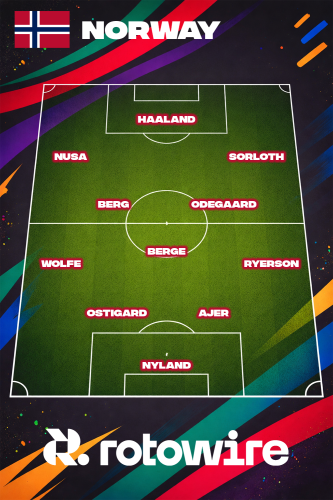
Odegaard, Berge, Berg; Sorloth, Haaland, Nusa.
Norway Set Piece Takers for the 2026 World Cup
Corners: Martin Odegaard, Julian Ryerson, Kristian Thorstvedt, Oscar Bobb
Direct free kicks: Martin Odegaard
Penalties: Erling Haaland
Why This Norway Lineup Works
This is manager Solbakken's established best available lineup when both Haaland and Odegaard are fit, and it reflects the attacking identity that carried Norway through qualifying. Haaland, Sorloth and Nusa as the front three, gives Norway multiple ways to create danger. The double pivot of Berge and Berg protects the back four, and when Odegaard is operating in the pockets between the lines, the entire structure clicks into a fluid attacking machine. Norway's first World Cup in 28 years deserves the best version of this team.
2026 World Cup Group I Odds
France are priced as clear favorites across all books, implying roughly a 70 percent chance to win the group. That pricing reflects squad depth but also their two consecutive finals in the last two World Cups.
Norway are consistently positioned as the second favorite to qualify from Group I with roughly a 20-percent implied probability to win the group.
Senegal and Iraq are priced as clear outsiders, with Senegal holding roughly an eight percent implied probability.
For full tournament winner odds across all 48 teams, see our 2026 World Cup winner odds page.
Visit RotoWire for exclusive sports betting picks and our daily World Cup recaps. Remember that betting apps vary in terms of odds, so we have an easy-to-use odds page that allows you to shop for the best lines at DraftKings, FanDuel, BetMGM and PointsBet. Claim over a thousand dollars in bonuses by signing up at the best sports betting sites using the best sportsbook promos.
This is part of RotoWire's 12-group World Cup preview series with tactical breakdowns and betting odds.
Who Will Qualify from World Cup Group I?
France win this group. Two victories over South American opponents on US soil in March, with a fully rotated second string routing Colombia and a 10-man first choice beating Brazil, made their argument for tournament favorites all over again. The only genuine uncertainty is Mbappe's fitness timeline, but coach Deschamps will manage that carefully and by the Norway match on June 26 at the very stadium where France beat Brazil in March, he should be at full capacity.
Second place is where the genuine drama lives. Norway have the individual quality to finish second. Haaland at full power, Odegaard pulling the strings and Sorloth as the aerial threat is a front line that Senegal's defense will find very difficult to contain. But the March window raised real concerns about whether that version of Norway was actually available, and manager Solbakken has work to do before June to get his key players back to peak condition.
Senegal's path to the knockout rounds runs through the Norway game. Win that, and they are through regardless of what happens in the France match. Draw it, and they need maximum points against Iraq and a favor elsewhere. Lose it, and a third-place finish becomes the realistic outcome. The AFCON controversy and the ongoing CAS case add a layer of uncertainty that genuine World Cup contenders would prefer to avoid heading into their opening fixtures.
Iraq face Norway on June 16. The match is coach Arnold's tactical masterpiece waiting to be delivered or the reminder that Group I was always going to be a learning experience. Either way, the Lions of Mesopotamia are back on the world stage for the first time since 1986, and the qualification story alone is worth the price of admission.
Group I Summary
| France | Senegal | Iraq | Norway | |
|---|---|---|---|---|
| Predicted formation | 4-2-3-1 | 4-3-3 | 4-4-2 | 4-3-3 |
| Playing style | High press, possession control, devastating attacking depth, clinical in transition | Physical pressing, Mane-led creation, rapid transitions, set-piece threat | Compact defensive block, direct counter-attack, Iqbal as creative pivot | Direct high press, Haaland-centric attack, explosive wide runners |
| Corners/FK takers | Olise, Dembele, Cherki, Mbappe | Diatta, Diouf, Jakobs, Camara, Sane | Al-Ammari, Ali Jasim, Abdulkareem, Hussein | Odegaard, Ryerson, Thorstvedt, Bobb |
| Penalty takers | Mbappe | Mane, Jackson, Sarr | Al-Ammari, Hussein | Haaland |
2026 World Cup Group Previews Menu
Click each group for full tactical breakdowns, predicted lineups, betting odds and predictions.
Group A: Mexico, South Africa, South Korea, Czechia
Group B: Canada, Bosnia and Herzegovina, Qatar, Switzerland
Group C: Brazil, Morocco, Haiti, Scotland
Group D: United States, Paraguay, Australia, Turkiye
Group E: Germany, Curacao, Ivory Coast, Ecuador
Group F: Netherlands, Japan, Sweden, Tunisia
Group G: Belgium, Egypt, Iran, New Zealand
Group H: Spain, Cape Verde, Saudi Arabia, Uruguay
Group I: France, Senegal, Iraq, Norway
Group J: Argentina, Algeria, Austria, Jordan
Group K: Portugal, Colombia, DR Congo, Uzbekistan
Group L: England, Croatia, Ghana, Panama