2026 World Cup Group D Preview: United States, Paraguay, Australia and Turkiye Lineups, Odds, Predictions and Tactics
Group D may be the most talked-about group in the tournament before a ball is even kicked. The United States, co-hosts of the biggest World Cup in history, playing at home in front of crowds unlike anything most of these players have experienced, are the favorites. But Turkiye's qualification brings real attacking quality to a group that suddenly looks far more competitive than it did on first read. Paraguay are the most disciplined defensive unit from CONMEBOL you will see in these previews. And Australia, for all their attacking limitations, reached the Round of 16 at the last World Cup and have no interest in simply making up the numbers.
This is the full tactical guide to Group D, including playing style, attacking and defensive structure, key adjustments, projected starting lineups, set-piece takers and the latest odds for United States, Paraguay, Australia and Turkiye.
This preview is part of our complete 2026 World Cup group preview coverage with odds and predictions for every group.
World Cup Group D Schedule
UNITED STATES | 2026 World Cup Tactical Analysis and Predicted Lineup
How the United States Will Play at the 2026 World Cup
The final two matches before coach Mauricio Pochettino names his World Cup squad on May 26 did not go to plan. The United States lost 5-2 to Belgium on March 28 at Mercedes-Benz Stadium in Atlanta after a promising first half, then completely unraveled in a disastrous second half in which Belgium scored four unanswered goals. Three days later, a reshuffled USA side lost 2-0 to Portugal, even without Cristiano Ronaldo or Bernardo Silva. Pochettino called the Belgium result a "reality check" and insisted it was better to learn those lessons now than in June. He has two more warmup matches before the tournament, against Senegal on May 31 and Germany on June 6.
The tactical identity under Pochettino is still taking shape. He used a 3-4-3 heavily during the fall 2025 window, then shifted back to a 4-2-3-1 against Belgium and a 4-3-3 against Portugal in March, which suggests the staff are still settling on the final structure. What does seem clear is that the spine of the team is largely in place: Matt Freese in goal after emerging as the clear first choice ahead of Matt Turner, Chris Richards to lead the back line, with Ream's age likely forcing a different combination with Auston Trusty and Mark McKenzie as possible choices, Antonee Robinson on the left, Weston McKennie and Tyler Adams anchoring midfield, and Christian Pulisic as the creative focal point in attack. The biggest concern from the March window is Pulisic's form. He has now gone eight straight appearances for the USMNT without scoring, and his extended drought for AC Milan since late December only adds to the concern.
The United States' Attacking Style at the 2026 World Cup
The USMNT can build around a clear group of difference-makers whose club roles and individual skill sets give this side more balance, creativity and cutting edge than it has had in recent cycles.
Key attacking themes include:
Folarin Balogun as the starting striker at Monaco, bringing the steady goal return and off-ball movement the position has lacked in recent USMNT cycles. The striker was in incredible form in the second half of the Ligue 1 campaign and will hope to bring that to the national team.
Christian Pulisic as the main creative threat, whether through the middle or from the wings, with the expectation that the kind of form rebound that has followed previous slumps arrives in time.
Malik Tillman at Bayer Leverkusen delivering goal contributions from midfield and providing the progressive carrying that opens space for others.
Timothy Weah providing width and directness from the right, with Weston McKennie's versatility allowing him to step into a more advanced role when the system calls for it.
Home advantage is a real tactical factor for the USMNT in Group D. Two of their three group matches are in Los Angeles, and the Seattle match against Australia will be the Socceroos' first there since 2016. The crowd noise, the familiarity and the emotional lift of playing at home in a World Cup the country has waited decades for will create an environment that can freeze some opponents. Paraguay, who grind matches down rather than open them up, could be particularly uncomfortable in that setting.
Can some USMNT players score higher than their places in the 2026 World Cup Golden Boot odds?
The United States' Defensive Setup
The main defensive question heading into the tournament is the partnership between Richards and Ream. Richards has been one of the better stories in this USMNT cycle, developing into a reliable Premier League center-back at Crystal Palace. Ream, at 37 years old, still brings experience and leadership, but he showed his age badly against Belgium in March. With Richards missing that match through injury, Mark McKenzie stepped in alongside Ream and was also poor on the opening goal.
Coach Pochettino will be hoping Richards is back to full fitness in time, because that center-back pairing matters enormously in a system that relies on a high line. Matt Freese has been reliable in goal, having started every competitive match in this cycle. His shot-stopping has been solid. The only question is how he handles sustained pressure in a World Cup environment.
Key Tactical Adjustments the United States Need to Make
Resolve the Pulisic form issue or find a structure that is less dependent on him producing at his 2023-24 level. The team cannot carry a captain who is not delivering in front of goal into a tournament.
Fix the defensive structure exposed against Belgium, where the second-half collapse was not just about individual mistakes but a collective loss of shape.
Settle the formation before June, because the switching between 3-4-3 and 4-2-3-1 has created confusion more than versatility.
The United States 2026 World Cup Predicted Lineup
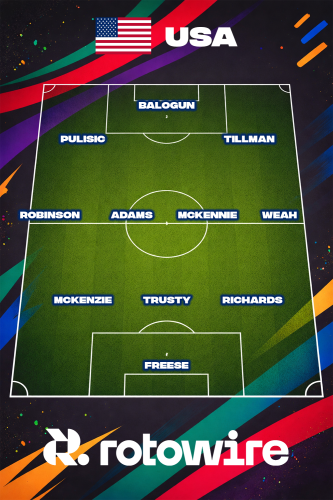
Weah, McKennie, Adams, A. Robinson; Tillman, Balogun, Pulisic.
For more updates, see the latest projected World Cup lineups on RotoWire.
The United States Set Piece Takers for the 2026 World Cup
Corners: Christian Pulisic, Sebastian Berhalter, Malik Tillman, Antonee Robinson
Direct free kicks: Christian Pulisic, Sebastian Berhalter
Penalties: Christian Pulisic, Folarin Balogun
Why This United States Lineup Works
This lineup puts the strongest available combination on the field based on current form and manager Pochettino's established preferences. The double pivot gives the USMNT the defensive cover and midfield progression that make everything else work. Balogun has shown the most consistent goal return of any forward in this cycle, and Tillman and Pulisic behind him offer the creativity and press resistance needed against organized defensive sides like Paraguay and Australia.
PARAGUAY | 2026 World Cup Tactical Analysis and Predicted Lineup
How Paraguay Will Play at the 2026 World Cup
Paraguay are back at the World Cup for the first time since 2010, and the story of how they got here is almost entirely the story of coach Gustavo Alfaro. The Argentine took over after a disastrous 2024 Copa America in which Paraguay lost all three group matches under previous manager Daniel Garnero. Within months of his arrival, Alfaro had guided Paraguay to wins over Brazil, Argentina and Uruguay during an eight-match unbeaten run. His team was built on the same principles that have always defined his work: defensive organization first, attacking intelligence second, individual brilliance as a bonus rather than a requirement. Paraguay have alternated between a 4-2-3-1 and, more recently, a 4-4-2.
Their qualifying numbers tell the story cleanly. Paraguay scored just 14 goals in 18 matches, the lowest total of any automatic qualifier from South America. They also conceded only 10 times, comfortably one of the top three defensive records in CONMEBOL. They were not trying to outscore anyone. They were trying to make it almost impossible for anyone to outscore them. That approach, carried into a World Cup group with the United States, Australia and Turkiye, gives them a very real path to the Round of 32 through two manageable results rather than three.
In March 2026, Paraguay beat Greece 1-0, then lost 2-1 to Morocco in Lens on March 31. Those results showed both the structure that makes them difficult to deal with and the attacking limitations that remain against stronger opposition.
Paraguay's Attacking Style at the 2026 World Cup
Paraguay's attack is built on verticality, physicality and quick-release runners who can punish teams the moment possession changes hands.
Key attacking themes include:
Miguel Almiron as the main attacking outlet. The former Newcastle winger brings relentless pressing intensity, technical quality and the ability to drive at defenders from deep positions.
Julio Enciso as the wildcard creative threat, the young Strasbourg forward whose long-range shooting and direct running can produce a moment capable of flipping a match.
Antonio Sanabria as the physical reference point up front, holding the ball, bringing midfield runners into play and winning aerial duels that allow Almiron and the wide players to operate.
Diego Gomez of Brighton providing box-to-box quality in midfield, recovering possession and connecting the press to the attack.
Paraguay's transition game is their most dangerous attacking weapon. When they win the ball high in coach Alfaro's press, they can release Almiron into space before defenses have time to reset, and that pattern has produced goals against opponents stronger than Paraguay on paper.
Paraguay's Defensive Setup
The backbone of Paraguay's defensive solidity is the center-back pairing of Gustavo Gomez and Omar Alderete. Gomez is the captain and leader of this team, and his aerial dominance, paired with Alderete's cleaner reading of the game, gives manager Alfaro a reliable foundation. The midfield press led by Andres Cubas and Diego Gomez protects those center-backs well, limiting the space opponents can find in front of the back four.
Paraguay's defensive record in qualifying, among the most conservative in CONMEBOL, reflects a system that values collective organization over individual flair. They have conceded against every team in this group in recent friendlies, but being hard to beat in a tournament is very different from being hard to beat in low-stakes friendlies. Ramon Sosa and Miguel Almiron are expected to handle the wide roles, while Antonio Sanabria and Julio Enciso lead the line as a striker pairing.
Key Tactical Adjustments Paraguay Need to Make
Find a way to generate more threat in the final third, because 14 qualifying goals will not be enough if they need a win against Turkiye or a positive result against the USA.
Manage Almiron carefully across the three group matches, given his age and the fact that Paraguay's entire transition game runs through him.
Produce a result against Australia on June 25, which looks like their clearest route to the next round.
Paraguay 2026 World Cup Predicted Lineup
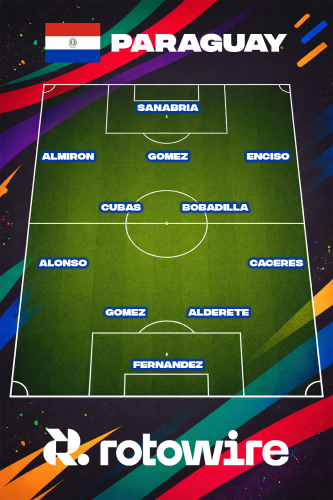
Bobadilla, Cubas; Enciso, Gomez, Almiron; Sanabria.
Paraguay Set Piece Takers for the 2026 World Cup
Corners: Diego Gomez, Julio Enciso, Miguel Almiron
Direct free kicks: Julio Enciso, Miguel Almiron
Penalties: Miguel Almiron, Antonio Sanabria
Why This Paraguay Lineup Works
This lineup reflects the core that got Paraguay here: Gomez and Alderete at center-back, Cubas and Diego Gomez screening midfield, Almiron and Enciso creating from wide areas, and Sanabria as the physical reference point up front. The system is not built for the beautiful game but to get results. Against Australia in particular, it gives Paraguay the organized structure and transition threat that could deliver the points that matter most.
AUSTRALIA | 2026 World Cup Tactical Analysis and Predicted Lineup
How Australia Will Play at the 2026 World Cup
Coach Tony Popovic replaced Graham Arnold in September 2024 after a qualifying wobble briefly threatened Australia's run of consecutive World Cup appearances. In a relatively short time, he has built a team with a clear shape, a clear pressing identity and a group of players who understand exactly what is being asked of them. The Socceroos qualified directly from the AFC third round, finishing second behind Japan, and their campaign included a 1-0 win over Japan, a 5-1 thrashing of Indonesia and the composure to win the matches they had to win when it mattered.
The preferred setup is a 3-4-2-1 with wing-backs central to everything. Jordan Bos of Feyenoord emerged as maybe the most important player of the March window, scoring the winner against Cameroon in the 85th minute and combining brilliantly with Nestory Irankunda in the 5-1 rout of Curacao. Irankunda, now at Watford, scored twice in that Curacao match and is the squad's most exciting individual talent, the player most likely to create something out of nothing.
The Cameroon match in Sydney was probably a more honest reflection of where Australia are than the Curacao result. They controlled the game without really dominating it, missed a penalty through substitute Ajdin Hrustic and needed a defensive mistake to gift Bos the winner in the 85th minute. Manager Popovic was candid afterward, the first half was anxious, while the second improved, and the result still mattered even if the performance was not fully convincing. The goalkeeper question also looks settled, with Mathew Ryan starting against Cameroon and making several important saves, which strengthened his grip on the number one role heading into the tournament.
Australia's Attacking Style at the 2026 World Cup
Australia have enough individual weapons to hurt teams in Group D, but their ceiling will depend on how well those pieces connect inside a fast and aggressive structure.
Key attacking themes include:
Nestory Irankunda as the side's most dangerous attacking outlet, with the pace, directness and finishing ability to unsettle any Group D defense on the right day.
Jordan Bos as the left wing-back who pushes high and combines well with the front line, with a scorer's instinct for arriving late in dangerous areas. The Bos-Irankunda combination on Australia's left is as potentially dangerous a wide partnership as the Socceroos have had in close to two decades.
Mohamed Toure leading the line, bringing pace, intelligent movement and a real understanding with Irankunda built as much on personal chemistry as tactical fit. That connection is a genuine weapon. Toure missed the March window with a groin injury.
Australia's best football comes when the wing-backs are active, the press is coordinated across the front line and the transition from defense to attack is direct and quick.
Australia's Defensive Setup
The back three of Harry Souttar, Cameron Burgess and Alessandro Circati is one of the most settled and reassuring parts of head coach Popovic's setup. Souttar was outstanding for Sheffield United and Australia before his Achilles injury, and his 2022 World Cup in Qatar was genuinely elite. His return to fitness by June is central to Australia's defensive hopes. Burgess has been steady throughout, while Circati has developed into a national team captain and a standout for Parma in Serie A. The depth behind them, Milos Degenek, Jason Geria and Kye Rowles, is decent, while young Lucas Herrington was brilliant during the March break, but the gap to the starting three is still significant.
At right wing-back, Lewis Miller's Achilles injury ruling him out of the World Cup is a real blow. Jacob Italiano has been the solution during the March window and handled himself well, with Fran Karacic also in the mix. On the left, Bos has made the job his own and is arguably the best Australian currently at club level. In goal, Mathew Ryan, with 103 caps and the experience of three World Cups, organizes the back line with the authority this format demands.
Key Tactical Adjustments Australia Need to Make
Manage Irankunda's minutes carefully across three matches. He is still a teenager, and the energy of a World Cup will be unlike anything he has faced at club level.
Find a Riley McGree replacement, because nobody else in the squad offers the same mix of creativity and defensive work rate in that advanced midfield role.
Find consistency at right wing-back in Miller's absence, because Italiano and Karacic will both need time to settle into the role at tournament level.
Australia 2026 World Cup Predicted Lineup
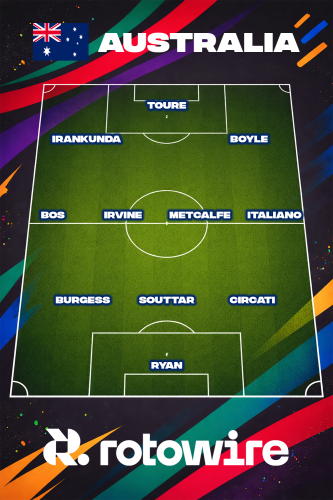
Italiano, Metcalfe, Irvine, Bos; Boyle, Toure, Irankunda.
Australia Set Piece Takers for the 2026 World Cup
Corners: Martin Boyle, Nestory Irankunda, Ajdin Hrustic, Riley McGree
Direct free kicks: Riley McGree, Ajdin Hrustic
Penalties: Martin Boyle, Ajdin Hrustic, Nestory Irankunda
Why This Australia Lineup Works
Ryan in goal brings the experience of three World Cups. Souttar, Burgess and Circati form the most settled Australian center-back unit in years, with the aerial authority and composure on the ball that a 3-4-2-1 demands. Irvine's experience and leadership anchor the midfield alongside teammate Metcalfe and Boyle's directness. And out wide, the Bos-Irankunda combination gives Australia a level of unpredictability that Paraguay and Turkiye will genuinely struggle to contain. For a team entering its sixth straight World Cup, this is the most complete and tactically coherent Australian squad in some time.
TURKIYE | 2026 World Cup Tactical Analysis and Predicted Lineup
How Turkiye Will Play at the 2026 World Cup
Turkiye are back at the World Cup for the first time since 2002, when they finished third in Korea and Japan. The wait has lasted 24 years, and the scenes in Pristina after Kerem Akturkoglu's 53rd minute goal against Kosovo on March 31 secured their place in Group D captured exactly what that absence has meant for Turkish football. Players mobbed coach Vincenzo Montella, who was drenched during his post-match press conference and then announced he felt like a Turk and would gladly accept the citizenship federation president Ibrahim Haciosmanoglu had promised if qualification was achieved.
Under the Italian coach, who took over before Euro 2024, Turkiye finished second in their UEFA qualifying group behind Spain and came through a tight playoff path, beating Romania 1-0 in the semifinal and Kosovo 1-0 in the final, to reach North America. The system is a 4-2-3-1 that fits the personnel well: Hakan Calhanoglu as the deep-lying playmaker and defensive anchor from Inter Milan, Arda Guler in the number 10 role with the freedom to drift and create, and Kenan Yildiz on the left bringing the pace, directness and goal threat of a top-level Juventus forward entering his peak years. Kerem Akturkoglu, the match-winner in Pristina, leads the line, while Orkun Kokcu or Ismail Yuksek provide progressive carrying from the second midfield spot.
Turkiye's Attacking Style at the 2026 World Cup
Turkiye's attack is built on a clear blend of creativity, control and relentless pressure across the front line.
Key attacking themes include:
Arda Guler as the creative spark. The Real Madrid number 10, at 21 years old, can make the ball disappear for defenders and produce quality from angles that do not look real. He is the main reason Turkiye are more dangerous than their draw position suggests.
Kenan Yildiz on the left providing the directness and goal threat that put extra pressure on any defense that is not fully set.
Hakan Calhanoglu as the midfield organizer who controls tempo, delivers the set pieces and brings the same qualities from Inter Milan that made him one of Serie A's best midfielders last season.
Kerem Akturkoglu as the pressing striker who scored the qualification goal and provides the defensive work rate that allows the more gifted creators behind him to take risks.
Turkiye are at their best when Guler and Yildiz have space to work, which means unsettling the opponent's shape early and establishing a tempo that forces quick defensive decisions. Against Australia and Paraguay, both of whom prefer to defend from organized structures, Turkiye's attacking profile will ask questions neither side sees often.
Turkiye's Defensive Setup
The back four features Ferdi Kadioglu as the most dynamic left-back in the squad, with Zeki Celik or Mert Muldur on the right. The center-back pairing of Merih Demiral and Abdulkerim Bardakci, with Ozan Kabak as depth, provides solidity and aerial quality, though neither starter has been tested consistently at World Cup level.
Ugurcan Cakir was exceptional against Kosovo. His save from Fisnik Asllani's curling effort in the 87th minute kept Turkiye alive and earned him player-of-the-match honors in the final even as his side escaped. Manager Montella's system can look vulnerable when opponents press the double pivot, which is the main concern against the United States and possibly Paraguay if Alfaro chooses to be aggressive.
Key Tactical Adjustments Turkiye Need to Make
Give Guler the freedom to be unpredictable, because over-structuring his role would take away exactly what makes him so difficult to defend.
Find the defensive balance that allows Calhanoglu to step higher without exposing the back four to the transition play both the United States and Paraguay can generate.
Manage the emotional weight of a historic World Cup return. Experienced coaches know debutant or returning nations can lose focus early when the occasion overwhelms the preparation.
Turkiye 2026 World Cup Predicted Lineup
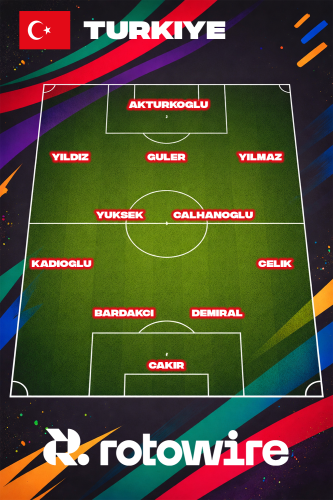
Calhanoglu, Yuksek; Yilmaz, Guler, Yildiz; Akturkoglu.
Turkiye Set Piece Takers for the 2026 World Cup
Corners: Hakan Calhanoglu, Arda Guler, Orkun Kokcu
Direct free kicks: Hakan Calhanoglu, Arda Guler
Penalties: Hakan Calhanoglu, Kerem Akturkoglu
Why This Turkiye Lineup Works
This is head coach Montella's strongest available XI, the same core that beat Romania and Kosovo to qualify. Calhanoglu controls, Guler creates, Yildiz scores. The pressing from Akturkoglu and the structure from Yuksek in the double pivot give the more talented players the platform to express themselves. In Group D, this lineup has enough individual quality to beat any of the other three teams on its day.
2026 World Cup Group D Odds
The United States are priced as slight favorites across all books, implying roughly a 40 percent chance to win the group. That pricing reflects squad depth but also the home atmosphere that should help the players.
Turkiye are consistently positioned as the second favorite to qualify from Group D right behind the United States by a few percentage points.
Paraguay and Australia are priced as clear outsiders, with Paraguay holding roughly twice the implied probability of Australia to win the group.
For full tournament winner odds across all 48 teams, see our 2026 World Cup winner odds page.
Visit RotoWire for exclusive sports betting picks and our daily World Cup recaps. Remember that betting apps vary in terms of odds, so we have an easy-to-use odds page that allows you to shop for the best lines at DraftKings, FanDuel, BetMGM and PointsBet. Claim over a thousand dollars in bonuses by signing up at the best sports betting sites using the best sportsbook promos.
Who Will Qualify from World Cup Group D?
The United States should win this group, but the word "should" comes with more caution than the market seems to price in. The 5-2 loss to Belgium and 2-0 defeat to Portugal in March were not just bad results. They were performances that showed a team still searching for its defensive structure and leaning heavily on a captain who is not currently producing at the level the system needs from him. Home advantage will close some of that gap. The crowd for the Paraguay opener will be the most intense environment the USMNT have played in since the country was confirmed as a 2026 host, and that matters.
The second-place race is wide open. Turkiye arrive with Guler, Yildiz and Calhanoglu plus the momentum of ending a 24-year World Cup absence through two straight 1-0 playoff wins, which makes them a real threat to any team in the group. Paraguay's defensive structure and Almiron's transition quality give them the tools to grind out a result if the game is managed on their terms, and their 2010 quarterfinal run remains a reminder that coach Alfaro's cautious approach can carry a side a long way in a short tournament.
Australia are the longshots, but manager Popovic's squad has more depth than the early odds suggest. The six goals they scored in the March window, even against modest opposition, showed an attacking energy that was not there under previous coach Arnold. If Irankunda is fit and in rhythm, one moment of individual quality could be the difference between a group-stage exit and a real run.
See all 12 group breakdowns in our World Cup tactical preview hub.
Group D Summary
| United States | Paraguay | Australia | Turkiye | |
|---|---|---|---|---|
| Predicted formation | 3-5-2 / 4-2-3-1 | 4-2-3-1 / 4-4-2 | 3-4-2-1 | 3-4-3 / 4-5-1 |
| Playing style | High press, vertical transitions, attacking fullbacks, home advantage | Defensive organization, low block, direct counter-attack through Almirón | Wing-back driven 3-4-2-1, high press, direct attack via Irankunda and Bos | Midfield control through Calhanoglu, creative freedom for Guler and Yildiz |
| Corners/FK takers | Pulisic, Berhalter, Tillman, Robinson | Gomez, Enciso, Almiron | Boyle, Irankunda, Hrustic | Calhanoglu, Guler, Kokcu |
| Penalty takers | Pulisic, Balogun | Almiron, Sanabria | Boyle, Hrustic, Irankunda | Calhanoglu, Akturkoglu |
2026 World Cup Group Previews Menu
Click each group for full tactical breakdowns, predicted lineups, betting odds and predictions.
Group A: Mexico, South Africa, South Korea, Czechia
Group B: Canada, Bosnia and Herzegovina, Qatar, Switzerland
Group C: Brazil, Morocco, Haiti, Scotland
Group D: United States, Paraguay, Australia, Turkiye
Group E: Germany, Curacao, Ivory Coast, Ecuador
Group F: Netherlands, Japan, Sweden, Tunisia
Group G: Belgium, Egypt, Iran, New Zealand
Group H: Spain, Cape Verde, Saudi Arabia, Uruguay
Group I: France, Senegal, Iraq, Norway
Group J: Argentina, Algeria, Austria, Jordan
Group K: Portugal, Colombia, DR Congo, Uzbekistan
Group L: England, Croatia, Ghana, Panama