

The goal with Lineup Lowdown is simple: we're looking for trends which could help identify players that might be undervalued or overvalued. Who is playing more/less? Who is moving up/down? This week, we will be focusing on players from the National League.
Trending Up
Ildemaro Vargas, 1B/2B,  Arizona Diamondbacks
"Trending up" doesn't feel like strong enough of a phrase to describe a guy who has gone from 34-year-old journeyman utility infielder to reigning NL Player of the Month for April.
After re-upping with the Diamondbacks on a minor-league contract over the winter, Vargas won an Opening Day roster spot as a reserve and started two of the team's first 10 games of the season. Since then, he's been in the lineup for all but one contest, and over the last eight tilts he has not hit lower than fifth, regardless of the handedness of the opposing pitcher.
Vargas has always been an elite contact hitter, and in 2026 his strikeout rate ranks in the 97th percentile. The switch hitter's hard-hit rate, average exit velocity and barrel rate are all below average, but his squared-up rate ranks in the 97th percentile, and his pull-air rate has gone from 11.8 percent to 22.7 percent year-over-year. It's possible he's still useful moving forward, but I'm having a difficult time buying into the validity of Vargas' big start. There's simply not enough there in terms of quality of contact, and obviously the track record points to regression.
Moises Ballesteros, DH,  Chicago Cubs
The goal with Lineup Lowdown is simple: we're looking for trends which could help identify players that might be undervalued or overvalued. Who is playing more/less? Who is moving up/down? This week, we will be focusing on players from the National League.
Trending Up
Ildemaro Vargas, 1B/2B, Arizona Diamondbacks
"Trending up" doesn't feel like strong enough of a phrase to describe a guy who has gone from 34-year-old journeyman utility infielder to reigning NL Player of the Month for April.
After re-upping with the Diamondbacks on a minor-league contract over the winter, Vargas won an Opening Day roster spot as a reserve and started two of the team's first 10 games of the season. Since then, he's been in the lineup for all but one contest, and over the last eight tilts he has not hit lower than fifth, regardless of the handedness of the opposing pitcher.
Vargas has always been an elite contact hitter, and in 2026 his strikeout rate ranks in the 97th percentile. The switch hitter's hard-hit rate, average exit velocity and barrel rate are all below average, but his squared-up rate ranks in the 97th percentile, and his pull-air rate has gone from 11.8 percent to 22.7 percent year-over-year. It's possible he's still useful moving forward, but I'm having a difficult time buying into the validity of Vargas' big start. There's simply not enough there in terms of quality of contact, and obviously the track record points to regression.
Moises Ballesteros, DH, Chicago Cubs
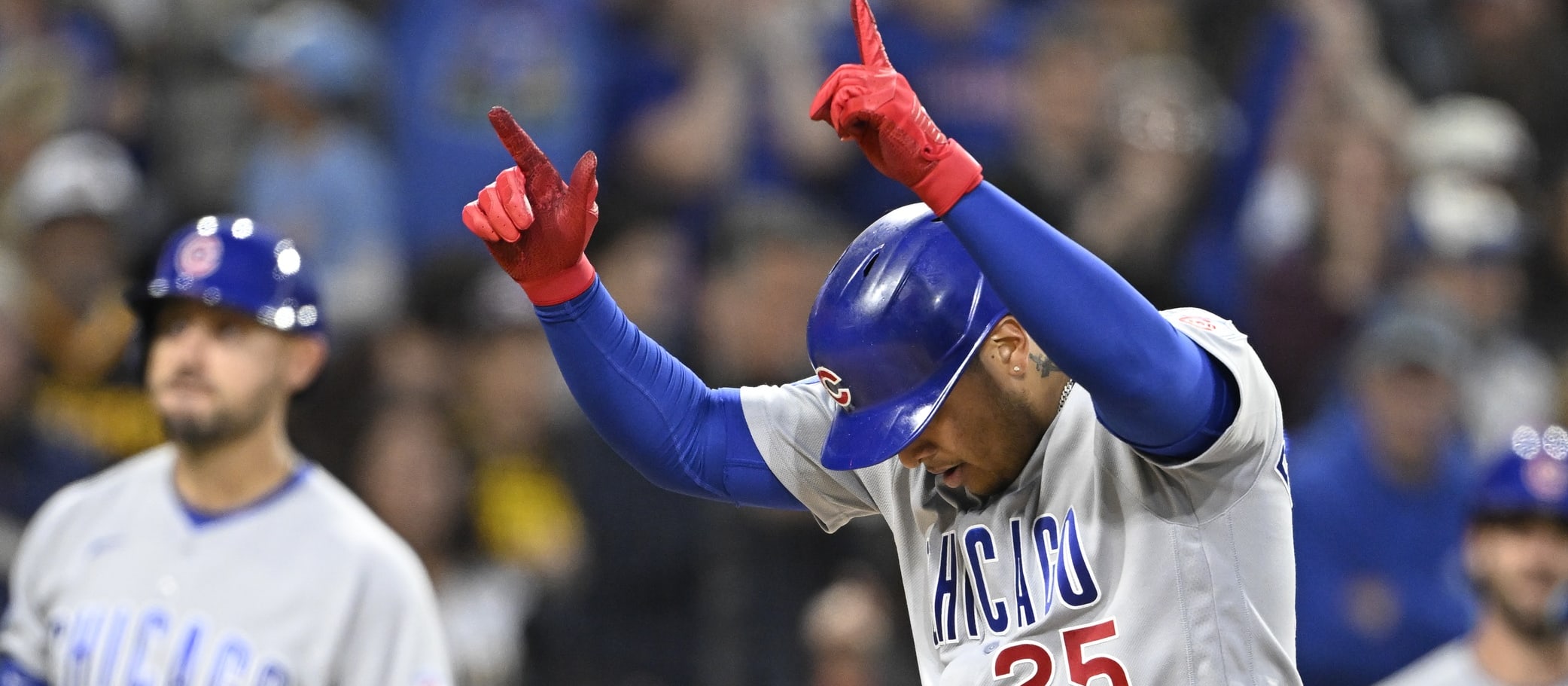
Ballesteros was a monster for the Cubs in his first 25 contests this season, slashing a ridiculous .387/.435/.710 with five home runs. He mostly batted sixth or seventh over that span, but since then the Cubs have elevated the 22-year-old to the two hole in their lineup for each of the past six tilts when they've gone up against a righty.
Unfortunately, Ballesteros has immediately fallen into a mini slump since the move, going just 2-for-24 at the dish, though one of those hits was a home run and he also has a 4:3 BB:K during that stretch. Ballesteros' quality of contact has been excellent, as he boasts a 48.6 percent hard-hit rate (81st percentile), 12.5 percent barrel rate (77th percentile) and 90.4 mph average exit velocity (67th percentile). The youngster is impacting the ball harder without it affecting his plate discipline, too, as he's put up a 15.5 percent strikeout rate and 10.3 percent walk rate. Ballesteros might eventually gain catcher eligibility, too, as he's logged a couple appearances there, including his first start last week.
MJ Melendez, OF,  New York Mets
The Mets have been searching for anyone to help ignite a dormant offense, and lately Melendez has been playing an integral role.
Melendez did not make the Opening Day roster and batted eighth on April 15 in his first start. Of late, though, the left-handed hitter has batted third in each of the Mets' last five contests versus right-handed pitching. The 27-year-old is slashing .297/.366/.541 with a couple long balls in his first 15 games with New York.
When Melendez was a highly thought of prospect with the Royals, it was how hard he impacted the ball that made him intriguing. He's taken it to another level in his small sample size with the Mets, sporting a 60.9 percent hard-hit rate, 13 percent barrel rate and 96.4 mph average exit velocity. Melendez was never able to break through in Kansas City in large part because of swing-and-miss issues. Those haven't gone away, as he's sitting on a 35.7 percent strikeout rate in 2026. Between the strikeouts and pull-heavy, flyball approach, Melendez represents a huge batting average risk. It's a profile that's certainly capable of going on a power binge but also one that could send Melendez back to the minors when the inevitable cold spell arrives. Melendez might also get pushed aside when Luis Robert (back) and/or Jorge Polanco (wrist) return.
JJ Bleday, OF,  Cincinnati Reds
Bleday came up short for an Opening Day roster spot despite a strong spring training, but he didn't pout, earning a call-up in late April after collecting a 1.121 OPS with six home runs in his first 24 tilts with Triple-A Louisville. He responded with a home run in his first game with the Reds and has since added three more long balls.
The left-handed-hitting Bleday has taken over as the regular left fielder against right-handed pitching, making eight consecutive starts in such situations. After batting seventh in the first four of those starts, he has occupied the No. 2 spot in the Reds' batting order for the last four contests versus righties.
The No. 4 overall pick in the 2019 First-Year Player Draft, Bleday experienced a mini-breakout in 2024 with the Athletics when he clubbed 20 home runs with a .762 OPS, but he cratered to a .698 OPS in 2025 and was non-tendered over the winter. He's stinging the ball in the early going in Cincinnati with a 57.9 percent hard-hit rate, 21.1 percent barrel rate and 94.8 mph average exit velocity. Bleday is also striking out at just a 17.2 percent clip while walking at the same 17.2 percent rate. He's not going to play against lefties, and the Reds have other options in the outfield should Bleday begin to stumble. However, he's still just 28, is in a great home park and is currently occupying a very favorable lineup spot. You could definitely talk yourself into a mid-career bounce-back.
Trending Down
Michael Busch, 1B, Chicago Cubs
Busch was the Cubs' regular leadoff man against right-handed pitching in the second half of last season and he started out in the same slot this year. However, between a slow start for Busch and a red-hot start for new leadoff man Nico Hoerner, the former has been finding himself lower in the batting order.
The left-handed-swinging Busch has batted sixth in three of the last four games versus right-handed pitching and has hit either fifth or sixth in five of the past six tilts against righties (he did return to the leadoff spot in the other game on a day Hoerner was banged up. Busch's hard-hit rate (47.3 percent to 35.4 percent), barrel rate (17.1 percent to 8.3 percent) and average exit velocity (92.2 mph to 86.4 mph) are all way down year-over-year. However, he has managed to right the ship lately from a bottom-line production perspective, sporting a 1.066 OPS with all three of his home runs and 14 RBI over his last 13 games. With Busch heating up and the aforementioned Moises Ballesteros slowing down a bit, it wouldn't be a surprise if those two swap spots.
Busch is playing a lot more against lefties this season, starting 10 of 11 contests. That's just one fewer start than he had all of last season versus southpaws. The production has been a bit better, with Busch slashing .225/.385/.325 against lefties. Tyler Austin had been set to serve as the short-side platoon partner with Busch but required knee surgery in February and it's unclear when he might be back. Other than Busch, the only Cubs that have made starts at first base this season are Matt Shaw and Carson Kelly, and they've started there just once apiece.
Matt McLain, 2B, Cincinnati Reds
I found myself targeting McLain in drafts this spring after he had an offseason to focus on training rather than rehabbing injury. He added muscle over the winter, had a massive Cactus League showing and manager Terry Francona committed to McLain as his No. 2 hitter. The post-hype sleeper appeal was real.
Unfortunately, McLain has not held up his end of the bargain. The 26-year-old is slashing only .189/.299/.283 through his first 36 games this season, adding a couple home runs and five stolen bases. He has posted a 12.2 percent walk rate, but his strikeout rate remains a bit elevated at 25.2 percent and his hard-hit rate has dipped all the way to 30 percent.
McLain batted second in 29 of his first 30 starts this season and hit leadoff in the other game. However, in his last two starts he batted ninth once and eighth once. He was also absent from the lineup in two of the past four tilts. The Reds have used Sal Stewart at second base in those two contests McLain didn't start, and while it might be unlikely that Stewart becomes an everyday second baseman, it would not be a surprise if he plays more and more at the position while McLain is scuffling. A reset in the minors for McLain is possible, though his quality defensive work at the keystone could prevent a demotion.
Ezequiel Tovar, SS,  Colorado Rockies
Tovar was in the cleanup spot for the Rockies in each of the first eight games this season. In each of Colorado's last eight contests, he's batted eighth.
With a .192/.244/.280 batting line, just one home run, a 28.1 percent strikeout rate and a 5.2 percent walk rate, Tovar has been one of the worst everyday players in baseball from an offensive standpoint. The 24-year-old's batted-ball data has been remarkably similar every season since he became a regular in 2023, and that includes this season. There's no doubt he's been unlucky, as Tovar sports a .264 BABIP in 2026 after he collected a .333 BABIP from 2023-2025. He's also somehow slashing just .140/.200/.200 at Coors Field, where he hit .290/.324/.466 across the previous three seasons.
Tovar is almost surely due for some better luck moving forward, particularly when the weather warms up in Colorado. It's a naturally volatile profile, however, so I would be cautious in buying a rebound too aggressively.
Willy Adames, SS,  San Francisco Giants
The Giants' offense as a whole has really struggled. Rafael Devers is probably the poster boy for those struggles, but Adames is right there with him in terms of early-season futility.
Through 35 contests this season, Adames is sitting on a lowly .199/.236/.340 batting line. He's always been a high-strikeout guy, but a 31.1 percent strikeout rate in 2026 is high even for him, and he is not drawing free passes like he normally does to help make up for it with just a 4.1 percent walk rate. Adames' 83.2 percent zone contact rate would be a career high, but his 30.5 percent chase rate is easily his highest in three years. He's also sporting a 59.5 percent meatball swing rate, which is more than 20 percentage points lower than his career average. It points to a hitter that's in between right now and searching for his swing.
Adames began the season as the Giants' cleanup hitter and then was their everyday leadoff man for nearly a month. Since then, however, he batted sixth in seven straight games and was down in the No. 7 spot Tuesday, which is the lowest spot in the lineup that he's occupied since signing with San Francisco. Adames is a notoriously slow starter and is bound to eventually heat up. He slashed .210/.297/.339 for the first three months last season before hitting .242/.341/.512 the rest of the way.