2026 World Cup Group B Preview: Canada, Bosnia and Herzegovina, Qatar and Switzerland Lineups, Odds, Predictions and Tactics
Group B is one of the tournament's most compelling stories on the opening day alone. Canada open their home World Cup on June 12 at BMO Field in Toronto against Bosnia and Herzegovina, and the fact that it is Bosnia and not Italy in that fixture is itself a story, the four-time world champions were eliminated in a penalty shootout on March 31, and Canadians on team buses watched it unfold on their phones as they headed to their own friendly against Tunisia that same evening.
Switzerland arrive as the group's most technically complete team, with six straight World Cup appearances, a flawless qualifying campaign and the quiet confidence of a squad that has knocked out France, Italy and Spain in recent knockout rounds.
Qatar are back at the World Cup for the first time having earned it through competition rather than as hosts, operating under Julen Lopetegui and carrying a genuine attacking weapon in Akram Afif, but their March preparation was wiped out entirely by regional conflict, leaving them the worst-prepared team in the field by some distance.
And Canada, co-hosts for the first time in their history, carry a country's expectations on a squad that showed real character in the March window even while navigating a significant injury crisis.
This is the full tactical guide to Group B, including playing style, attacking and defensive structure, key adjustments, projected starting lineups, set-piece takers and the latest odds for Canada, Bosnia and Herzegovina, Qatar and Switzerland.
See how Group B stacks up against the rest in our complete World Cup group previews.
World Cup Group B Schedule
CANADA | 2026 World Cup Tactical Analysis and Predicted Lineup
How Canada Will Play at the 2026 World Cup
Head coach Jesse Marsch was hired for one purpose: get Canada out of the group stage at a home World Cup and give a country that qualified for the tournament for the first time since 1986 a run worth remembering. The American coach, who built his reputation across RB Salzburg, RB Leipzig and Leeds United before taking the Canada role in May 2024, brings a pressing identity that fits this squad almost perfectly. Canada have athletes throughout the starting XI. They have genuine pace in Alphonso Davies and Tajon Buchanan. They have a world-class striker in Jonathan David. And they have the collective intensity, the willingness to run and press and commit, that manager Marsch has spent his entire coaching career manufacturing. The formation is a 4-4-2 or 4-2-3-1 depending on the opponent, but the true identity is about verticality, the press, winning the ball high up the pitch and attacking before the opposition can reset.
The March window was defined by absence. Davies, the Bayern Munich left-back and the single most important player in this squad, missed both friendlies with a hamstring strain after returning from a torn ACL. Alistair Johnston missed with hamstring surgery. Moise Bombito was unavailable with a fractured tibia. Stephen Eustaquio was out with a hematoma. Canada played Iceland on March 28 without their first-choice back line, went 2-0 down in the first half after individual errors, and needed two Jonathan David penalties to salvage a 2-2 draw before Buchanan was sent off for an elbow in the 81st minute, the fourth red card in their last eight matches, a disciplinary pattern that Marsch acknowledged has to change. Against Tunisia on March 31, still without some key players, Canada drew 0-0 in a match where Marcelo Flores, the Tigres winger, was the brightest player on the pitch and effectively secured his World Cup spot. David's two penalties against Iceland took him to 39 international goals and cemented him as the squad's primary scoring threat.
The fitness situation will resolve. Davies, Bombito and Johnston are all expected to be available by June. When healthy, the first-choice XI is the best Canadian side in a generation, Davies at left-back doubling as a left wing-back in transition, Johnston pushing from the right, Bombito and Cornelius at centre-back, David and his strike partner up top, and a midfield built on Eustaquio's passing range and Ismael Kone's intensity. If they all arrive fit, Canada are a genuine top-two team in this group.
Canada's Attacking Style at the 2026 World Cup
Canada's attacking structure is built around pace, verticality and early-game intensity, with several high-level European-based players shaping a forward line capable of overwhelming opponents before they can settle defensively.
Key attacking themes include:
Jonathan David as the primary goal threat, now at Juventus after his five-year Lille career produced numbers that few strikers in world football could match. His composure under pressure, demonstrated in both penalty situations against Iceland, reflects a striker who does not shrink from the moment.
Alphonso Davies as the left-sided attacking force, with the acceleration, crossing ability and direct running that turns Canada's left side into one of the most dangerous attacking channels in the group. His health by June is the single most important question in this squad.
Tajon Buchanan at Villarreal as the wide attacking option with the directness and physicality to unsettle defenders. His red card against Iceland was the third in a run of four red cards across eight games, and managing that disciplinary edge is something coach Marsch must address.
Cyle Larin at Southampton as the second striker option, providing physicality, aerial presence and a goal-scoring record across multiple European leagues that makes him a credible alternative or partner to David.
Canada's best attacking football comes in the first 20 minutes, when the press is at its highest intensity, the opposition has not settled and the space behind the defensive line is available for Davies and Buchanan to exploit.
Can some Canadian players score higher than their places in the 2026 World Cup Golden Boot odds?
Canada's Defensive Setup
When fully fit, Bombito and Cornelius as the centre-back pairing gives Canada something they have rarely had in their international history, two defenders who look genuinely comfortable in possession and are physically equipped to handle top-level forwards. Bombito at Nice has been one of Ligue 1's better centre-backs when fit, and his fractured tibia recovery timeline heading into June is one of the more important injury stories in the group.
Dayne St. Clair as the starting goalkeeper, the 2025 MLS Goalkeeper of the Year, gives Canada a shot-stopper with genuine club-level credentials, while the experienced Maxime Crepeau provides a reliable alternative who showed against Tunisia that he still commands the area well. The left side of the defense, with Davies pushing high, means the shape essentially becomes a back three in defensive phases, which places significant demands on Cornelius or whoever fills the right centre-back role to cover the space.
Key Tactical Adjustments Canada Need to Make
Eliminate the careless red cards, four in eight games is not a coincidence, and at a World Cup, a man disadvantage against Bosnia or Switzerland could be the difference between advancing and going home.
Trust the press but know when to retreat into the mid-block, as Canada's biggest vulnerability is the space behind the first press wave, which technically proficient opponents like Switzerland will exploit without hesitation.
Get a fully healthy squad by June since many of the predicted starters have been dealing with issues in recent months.
Canada 2026 World Cup Predicted Lineup
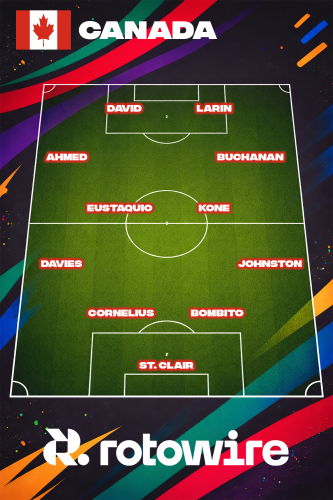
Buchanan, Kone, Eustaquio, Ahmed; Larin, David.
For more updates, see the latest projected World Cup lineups on RotoWire.
Canada Set Piece Takers for the 2026 World Cup
Corners: Mathieu Choiniere, Jonathan Osorio, Stephen Eustaquio, Ali Ahmed, Marcelo Flores, David Junior Hoilett, Jacob Shaffelburg
Direct free kicks: Stephen Eustaquio, Mathieu Choiniere
Penalties: Jonathan David
Why This Canada Lineup Works
When fit, this is a lineup with the tools to compete with anyone in Group B. Davies and Johnston provide the width and energy from full-back that manager Marsch's system demands. Eustaquio and Kone give the midfield both the creative range and the defensive intensity to function against Bosnia's athleticism and Switzerland's technical control. David gives Canada a striker capable of putting any chance away. And the home crowd at BMO Field on June 12, the tournament's second day, will provide an energy that Canada simply does not experience in other settings. This is a group they have the quality to advance from. The only question is fitness and discipline.
BOSNIA AND HERZEGOVINA | 2026 World Cup Tactical Analysis and Predicted Lineup
How Bosnia and Herzegovina Will Play at the 2026 World Cup
The story of how Bosnia and Herzegovina got to this World Cup is worth sitting with for a moment. They beat Wales on penalties in Cardiff on March 26. Five days later, they hosted Italy at the Stadion Bilino Polje in Zenica, a ground that holds around 15,000 people, which Gennaro Gattuso had publicly acknowledged was going to be hostile. Italy went ahead. Alessandro Bastoni was sent off right before halftime, reducing Italy to ten men. Haris Tabakovic pounced on an Edin Dzeko rebound for the equalizer to push the game into a penalty shootout. And Bosnia held their nerve to eliminate the four-time world champions for the second consecutive World Cup cycle, this time knocking them out entirely. Sergej Barbarez, the former Hamburger SV and Borussia Dortmund attacker who captained Bosnia in the 2000s and had zero senior management experience when he took the job in April 2024, allowed himself to say afterward "We're two years ahead of schedule. Now, I've told [the players] that we have to go to a tournament every two years."
This is Bosnia's second World Cup appearance, and what makes them genuinely interesting in Group B is not just the Dzeko story, though the 40-year-old's form in the 2. Bundesliga at Schalke, where he became the oldest goalscorer in the league's history earlier this season, is genuinely remarkable, but the generation emerging around him. Esmir Bajraktarevic from PSV Eindhoven has been one of the most direct and dangerous wide players in the Eredivisie this season. Ermedin Demirovic from Stuttgart has been the ideal foil for Dzeko, doing the pressing and the space-creation that lets the veteran captain drift into scoring positions. Benjamin Tahirovic from Brondby IF adds technical quality in midfield that earlier Bosnian generations rarely possessed.
The style under coach Barbarez is physical and direct, with quick transitions and an explicit willingness to defend deep and hit on the counter. He told the Italian media before the playoff final that Bosnia would "park the bus" if they scored, which manager Gattuso publicly called a bluff. It was not a bluff. This is a team that knows exactly what it is and has the individual quality to make the approach work. The formation is a 4-4-2 or 4-2-3-1 depending on the opponent.
Bosnia and Herzegovina's Attacking Style at the 2026 World Cup
Bosnia's attacking structure is built around clear focal points up front supported by dynamic runners and direct wide threats, creating a system that blends experience, physicality and transition-based efficiency.
Key attacking themes include:
Edin Dzeko as the attacking reference point, carrying 148 caps and 73 international goals into what will certainly be his last major tournament. Even at his age, his hold-up play, movement in the box and ability to score when others might not still makes him a threat that centre-backs must plan for specifically.
Ermedin Demirovic from Stuttgart as the mobile forward partner, whose energy and pressing intensity creates the space Dzeko exploits and who has developed into one of the Bundesliga's more efficient attackers in his own right.
Esmir Bajraktarevic on the right wing, with the acceleration and directness that was evident throughout the playoff campaign and that makes Bosnia's counter-attacking transitions genuinely dangerous.
Haris Tabakovic from Borussia Monchengladbach as the goal-scoring alternative, whose Zenica equalizer against Italy showed the instinct and composure of a striker who rises to the occasion.
Bosnia are most dangerous in the first 15 minutes of each half, when their pressing intensity is at its peak and opponents are still adjusting to the physicality and directness of the approach.
Bosnia and Herzegovina's Defensive Setup
The 4-4-2 or 4-2-3-1 defensive structure that manager Barbarez prefers is built around collective discipline rather than individual brilliance. Nikola Vasilj in goal at St. Pauli has been excellent in the Bundesliga this season and provides the kind of shot-stopping reliability that gives the compact defensive block genuine security.
The centre-back pairing is experienced and physical, and the midfield screen, composed of Tahirovic and Ivan Sunjic in the engine room, gives the back four protection that allows Bosnia to sit deep and make life difficult for technically superior opponents. The defensive reality is that Bosnia are most exposed when the midfield line is bypassed quickly, particularly against teams with the technical quality and pace to exploit the channels. Canada and Switzerland both have those tools.
Key Tactical Adjustments Bosnia and Herzegovina Need to Make
Manage Dzeko's minutes carefully across three group matches, he is 40 years old, the group stages are compressed and wearing him down against Canada to the point where he cannot function against Switzerland would be a tactical error.
Find a way to score against Canada in the first game rather than simply defending, because a point against Canada at BMO Field is worth considerably less than a win given how the group dynamics work out.
Be ready to adapt the press-and-counter approach against Switzerland, who are the group's most technically proficient team and whose midfield control will test Bosnia's defensive discipline throughout the clash.
Bosnia and Herzegovina 2026 World Cup Predicted Lineup
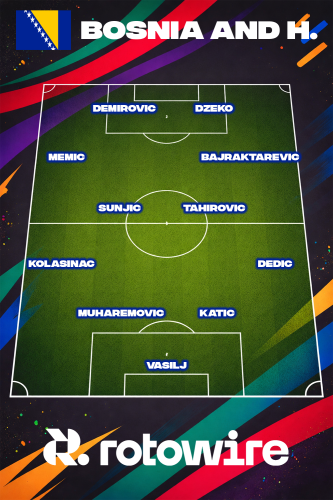
Bajraktarevic, Tahirovic, Sunjic, Memic; Dzeko, Demirovic.
Bosnia and Herzegovina Set Piece Takers for the 2026 World Cup
Corners: Kerim-Sam Alajbegovic, Esmir Bajraktarevic, Ivan Basic, Amar Dedic
Direct free kicks: Edin Dzeko, Esmir Bajraktarevic
Penalties: Edin Dzeko, Kerim-Sam Alajbegovic, Amir Hadziahmetovic
Why This Bosnia and Herzegovina Lineup Works
This is the core group that beat Wales and Italy on consecutive penalties. Vasilj in goal, the physical centre-back pairing, Tahirovic protecting the defensive structure and Dzeko leading the line, every element reflects what coach Barbarez has built. There is not as much individual quality depth here as in the top two teams in the group, but there is collective belief, the scars of big games won against the odds, and a captain in Dzeko who knows how to get the best out of a locker room for what will be his final tournament. Knocking out Italy to reach this World Cup was not a fluke. It was a statement that this group is ready.
QATAR | 2026 World Cup Tactical Analysis and Predicted Lineup
How Qatar Will Play at the 2026 World Cup
Everything about Qatar's preparation for this tournament has been complicated. The planned March friendlies against Serbia and Argentina, which would have been two of the highest-profile tests available to any team outside Europe at this stage, were cancelled due to the regional conflict affecting scheduled events in Qatar. Coach Julen Lopetegui, who took the job in May 2025, ran a training camp instead. Qatar arrive at the 2026 World Cup having not played a competitive match since December 2025, which is far from ideal for a team that ranked 55th in the world and is stepping into a Group B alongside Canada, Switzerland and Bosnia and Herzegovina. Their last competitive action in the Arab Cup was disastrous, as they were knocked out in the group stage at home, losing to Palestine and Tunisia and drawing with Syria.
And yet the individual quality at the top of this squad is real. Akram Afif, who plays for Al-Sadd and spent time on loan at Villarreal as the first Qatari player ever signed by a La Liga club, is a genuinely world-class attacking player. He sits among the best players for the Qatar Stars League this season with 14 goals and 12 assists in 21 league appearances by mid-April heading into the World Cup preparation period. The difference between Afif on his best day and the structural limitations of a squad that is almost entirely based in the Qatar Stars League is significant, but on his best day that gap can be bridged with one moment of individual quality.
Manager Lopetegui's preferred system is a 4-2-3-1 or 4-3-3 built around compact defensive blocks, quick transitions and getting clean ball into Afif in the half-spaces where he is most effective. The former Spain, Real Madrid and Sevilla coach won the Europa League in 2020, went unbeaten in 20 games as Spain manager before being sacked on the eve of the 2018 World Cup in circumstances that defined his subsequent career, and brings a tactical intelligence to this job that Qatar have not previously had. The question is whether two months of preparation, including a scheduled friendly against Ireland in Dublin in late May, is enough to compensate for the disruption of the cancelled March fixtures and the December competitive dormancy.
Qatar's Attacking Style at the 2026 World Cup
Qatar's attacking structure is built around a small core of players whose roles are clearly defined and tightly interconnected, shaping both their identity and their most dangerous patterns of play.
Key attacking themes include:
Akram Afif as the primary attacking weapon and the player around whom the entire Qatari system is designed. He drifts from the left or right into central half-spaces, creates chances for others, scores himself and is the kind of player who can produce a moment of quality that changes a match regardless of what is happening around him.
Almoez Ali as the central striker, with 55 international goals and the unique distinction of having scored at an Asian Cup, a Copa America and a CONCACAF Gold Cup. His relationship with Afif is the essence of Qatar's attacking identity.
Assim Madibo as the midfield engine who gives Afif the freedom to roam, covering the ground and breaking up opposition possession that allows the creative players space to function.
Hassan Al-Haydos, the captain who returned to the national team after a brief retirement in 2025, providing the experience and leadership in big moments that a squad primarily composed of Qatar Stars League players needs.
Qatar's best attacking sequence is a quick transition from a defensive block, with the ball fed quickly to Afif before the opposition defensive line has reorganized, and a direct run or through ball toward Almoez Ali. When it flows, it is genuinely dangerous.
Qatar's Defensive Setup
The defensive structure under coach Lopetegui is built around a compact block that prioritizes not conceding from open play, with Meshaal Barsham in goal as the most experienced goalkeeper in the squad and one of the better shot-stoppers in Asian football. Boualem Khoukhi and Lucas Michel Mendes as the centre-back pairing give the back line the physical presence and positional discipline to hold a mid-block shape for extended periods.
The full-back positions, with Pedro Miguel and Ayoub Mohamed Al Ouwi, are workmanlike rather than exceptional, the clearest individual limitation of a squad that draws almost entirely from domestic football is in those wide defensive positions. The March preparation void is the real concern, without two high-level friendly matches against Argentina and Serbia, manager Lopetegui has not been able to test his defensive shape against genuinely elite opposition for months.
Key Tactical Adjustments Qatar Need to Make
Use the May 28 friendly against Ireland in Dublin as a genuine competitive test to sharpen the defensive block and find the right balance between sitting deep and engaging higher up the pitch.
Accept that the group will likely require getting a result against Bosnia in the final group match, and prepare tactically and emotionally for a must-win scenario.
Ensure Afif is protected through the Switzerland game, because losing him to injury or suspension against the group's most physically demanding team would effectively end Qatar's tournament.
Qatar 2026 World Cup Predicted Lineup
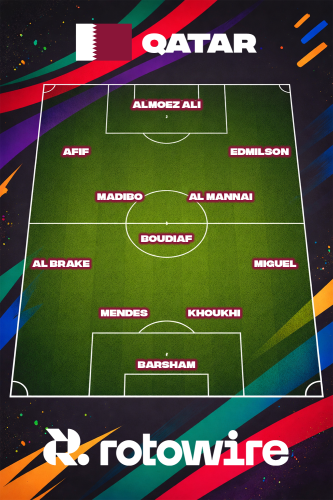
Al Mannai, Boudiaf, Madibo; Edmilson, Almoez Ali, Afif.
Qatar Set Piece Takers for the 2026 World Cup
Corners: Akram Afif, Edmilson Junior Paulo da Silva, Homam Al-Amin, Mohammed Waad
Direct free kicks: Akram Afif, Almoez Ali
Penalties: Akram Afif, Almoez Ali
Why This Qatar Lineup Works
This is the first-choice lineup that head coach Lopetegui has settled on through qualifying and the Arab Cup, and it reflects the best available combination of defensive organization, midfield control and attacking quality around Afif and Ali. Barsham in goal is reliable. The midfield pivot of Madibo and Karim Boudiaf gives the creative players protection. And when Afif and Ali are both on form and finding each other, Qatar can score against anyone. The preparation deficit is real, and it is significant. But on the day, with Afif at his best and the compact structure doing its job, this team is capable of getting the result against Bosnia that would scramble the final standings entirely.
SWITZERLAND | 2026 World Cup Tactical Analysis and Predicted Lineup
How Switzerland Will Play at the 2026 World Cup
Switzerland are not exciting. They have never been exciting. But they are extraordinarily consistent, and consistency at a World Cup is worth more than excitement in every single group stage game that has ever been played. Coach Murat Yakin's team qualified for this tournament by finishing first of their group with zero losses and only two goals conceded in six games. They have not missed a World Cup since 2002. No one who has watched this team in recent tournaments treats them as a soft draw anymore, and the odds for Group B reflect that reality.
The March window showed the team in comfortable form before the shock of the Germany result. Switzerland hosted Germany in Basel on March 27 in one of the most entertaining friendlies of the window, Dan Ndoye opened the scoring in the 17th minute, Breel Embolo made it 2-1 before halftime, Switzerland led 3-2 into the final stretch before Florian Wirtz scored twice in the closing stages, including an 86th minute winner, to give Germany a 4-3 victory. The scoreline was not what Switzerland wanted, but the performance, leading at halftime against one of the tournament's genuine contenders, was not a disaster. Three days later in Oslo, they drew 0-0 with Norway in a game where both sides had chances but neither could convert.
Manager Yakin's system is a 4-2-3-1 built around Granit Xhaka as the controlling midfielder who sets the tempo, covers the ground between the lines and pulls the strings from deep. Xhaka, now at Sunderland after his transformative years at Bayer Leverkusen, is Switzerland's most important player and the player who most determines how the team's tactical identity manifests on any given day. When he is sharp, Switzerland are fluid and difficult to play through. The defensive spine of Manuel Akanji at centre-back and Nico Elvedi since Fabian Schar won't be fit for the tournament, gives them elite individual quality at the back. Gregor Kobel has the starting role in goal after Yann Sommer's retirement from the Nati.
Switzerland's Attacking Style at the 2026 World Cup
Switzerland's attacking structure is built around pace on the flanks, physicality through the middle, and a midfield link that ties transitions together into consistently dangerous forward movements.
Key attacking themes include:
Dan Ndoye at Nottingham Forest as the primary wide attacking threat, with the pace, directness and finishing ability on the right side that consistently creates chances in transition and from crosses into the box.
Breel Embolo at Rennes as the central striker, physically imposing, direct and capable of holding the ball up and bringing others into play. His goal against Germany was a reminder of the finishing quality he brings even when his overall form fluctuates.
Noah Okafor at Leeds United as the versatile attacking alternative, with the pace and pressing intensity that coach Yakin can deploy from the bench or in the starting XI depending on the opponent's defensive structure.
Remo Freuler and Fabian Rieder providing the creative link between midfield and attack, with the ability to arrive in dangerous positions late and the passing range to find Ndoye and Embolo in their best positions.
Switzerland's most dangerous attacking moments come in transition from defensive phases, when Xhaka finds Ndoye early and the right side has space to run into. Embolo's runs in behind are the second outlet, and his aerial presence from set pieces gives Switzerland a dead-ball threat that Canada and Bosnia both need to account for.
Switzerland's Defensive Setup
Akanji and Elvedi as the centre-back pairing gives Switzerland one of the better defensive units in the group, Akanji's composure in possession is elite, his reading of the game has been refined across Champions League football at Inter Milan, and Elvedi's physical presence and aerial dominance at right centre-back give the partnership balance.
Ricardo Rodriguez at left-back brings the experience of a decade of international football, while Silvan Widmer on the right provides the attacking width that Switzerland need to stretch opponents. Kobel in goal arrives in good form from Dortmund this season and gives Switzerland a shot-stopper capable of keeping clean sheets against any attack in the group.
Key Tactical Adjustments Switzerland Need to Make
Find the right balance between pressing Canada's defensive vulnerability and not leaving space for Alphonso Davies and Tajon Buchanan to exploit on the counter, as Switzerland's defensive structure can be stretched by genuine pace.
Get Embolo in form and match sharpness by June, as the striker's output at Rennes has been inconsistent this season and Switzerland need him at his clinical best in the group's most difficult tests.
Assess Fabian Schar before the competition as his long-term injuries this season forced him to miss about four months and his leadership and experience can be game changers for the Nati.
Switzerland 2026 World Cup Predicted Lineup
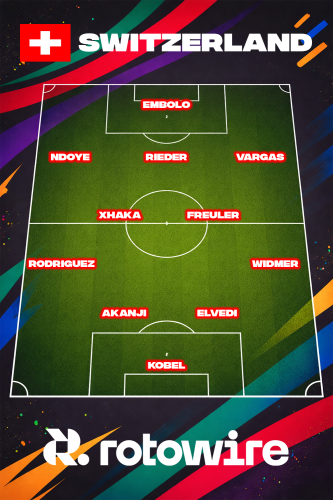
Freuler, Xhaka; Vargas, Rieder, Ndoye; Embolo.
Switzerland Set Piece Takers for the 2026 World Cup
Corners: Ruben Vargas, Fabian Rieder, Michel Aebischer, Djibril Sow, Alvyn Sanches
Direct free kicks: Granit Xhaka, Ricardo Rodriguez
Penalties: Granit Xhaka, Breel Embolo, Zeki Amdouni
Why This Switzerland Lineup Works
This is head coach Yakin's settled first-choice XI that has carried the team through a perfect qualifying campaign and two recent tournament knockout runs. Kobel anchors the back line with experience that no other goalkeeper in this group can match. Akanji, Schar and Elvedi provide the defensive solidity that has made Switzerland one of the hardest teams to score against in Europe across this entire cycle. Xhaka controls the tempo and gives the wide players and Embolo the clean possession they need to create. And when the team is organized, compact and defending well, their transition speed through Ndoye and Okafor gives them a counter-attacking threat that can hurt anyone. Switzerland are the team in Group B who will be least surprised by the moment, and at a first World Cup in 20 years for Bosnia, a first earned World Cup for Qatar, and a first home World Cup for Canada, that composure has real value.
2026 World Cup Group B Odds
Switzerland are priced as favorites across all books, implying roughly a 55 percent chance to win the group. That reflects their consistency across recent tournaments.
Canada and Bosnia and Herzegovina are consistently positioned close to each other, with Canada around 25 percent and Bosnia around 20 percent.
Qatar are priced as clear outsiders with less than five percent implied probability.
For full tournament winner odds across all 48 teams, see our 2026 World Cup winner odds page.
Visit RotoWire for exclusive sports betting picks and our daily World Cup recaps. Remember that betting apps vary in terms of odds, so we have an easy-to-use odds page that allows you to shop for the best lines at DraftKings, FanDuel, BetMGM and PointsBet. Claim over a thousand dollars in bonuses by signing up at the best sports betting sites using the best sportsbook promos.
World Cup Group B Predictions: Who Advances?
Switzerland win this group. Consecutive knockout-round appearances at major tournaments, a squad built around genuinely elite European talent in Akanji, Xhaka, Kobel and Ndoye, and a coach who has managed this team through enough difficult nights to understand how to get results that matter. The Germany loss in March was their only blemish in a solid window and should not overshadow what they have built across two full qualifying cycles.
Second place is genuinely open between Canada and Bosnia, with Qatar's path to the knockout rounds running through being the most organized and disciplined version of themselves across all three matches and hoping for a result against Bosnia in the final game. Canada are the more talented team on paper, and with Davies, Bombito and Johnston all returning from injury, they will be a different proposition than the depleted squad that struggled against Iceland in March. But Bosnia are the team who have just knocked out two nations in consecutive penalty shootouts, one of which was Italy, and they arrive in Toronto for the opener with absolutely nothing to lose and a clear set-piece threat in Dzeko that Canadian centre-backs will have to account for throughout the match.
The decisive game is Switzerland versus Bosnia. Win that, and Bosnia are serious candidates for second. Lose it, and Canada's path to the knockout round opens up considerably. Whatever happens, Group B deserves to be watched closely from the first match at BMO Field to the final games on June 24.
For predicted lineups and tactical breakdowns across every group, check our 2026 World Cup preview hub.
Group B Summary
| Canada | Bosnia and Her. | Qatar | Switzerland | |
|---|---|---|---|---|
| Predicted formation | 4-4-2 | 4-4-2 | 4-3-3 | 4-2-3-1 |
| Playing style | High press, vertical transitions, pace-based attack, home crowd energy | Physical and direct, compact defensive block, quick counter-attack, Dzeko-led set pieces | Possession control, compact mid-block, rapid transition through Afif, clinical in dead-ball situations | Defensive solidity, controlled possession through Xhaka, direct attacking transitions, consistent structure |
| Corners/FK takers | Choiniere, Osorio, Eustaquio, Ahmed, Flores, Hoilett, Shaffelburg | Alajbegovic, Bajraktarevic, Basic, Dedic, Dzeko | Afif, Edmilson, Al-Amin, Waad, Ali | Vargas, Rieder, Aebischer, Sow, Sanches, Rodriguez |
| Penalty takers | David | Dzeko, Alajbegovic, Hadziahmetovic | Afif, Ali | Xhaka, Embolo, Amdouni |
2026 World Cup Group Previews Menu
Click each group for full tactical breakdowns, predicted lineups, betting odds and predictions.
Group A: Mexico, South Africa, South Korea, Czechia
Group B: Canada, Bosnia and Herzegovina, Qatar, Switzerland
Group C: Brazil, Morocco, Haiti, Scotland
Group D: United States, Paraguay, Australia, Turkiye
Group E: Germany, Curacao, Ivory Coast, Ecuador
Group F: Netherlands, Japan, Sweden, Tunisia
Group G: Belgium, Egypt, Iran, New Zealand
Group H: Spain, Cape Verde, Saudi Arabia, Uruguay
Group I: France, Senegal, Iraq, Norway
Group J: Argentina, Algeria, Austria, Jordan
Group K: Portugal, Colombia, DR Congo, Uzbekistan
Group L: England, Croatia, Ghana, Panama